Axewelledge, a leading exporter from India, specializes in high-quality Bentonite. With a commitment to excellence, we supply premium Bentonite to the Middle East and Southeast Asia markets.


North Angle Complex, 304,
150 Feet Ring Rd, Opposite Ambedkar Nagar BRTS Stop,
Madhav Park, Punit Nagar,
Mavdi, Rajkot, Gujarat 360004
© Axewelledge 2026, All Rights Reserved.
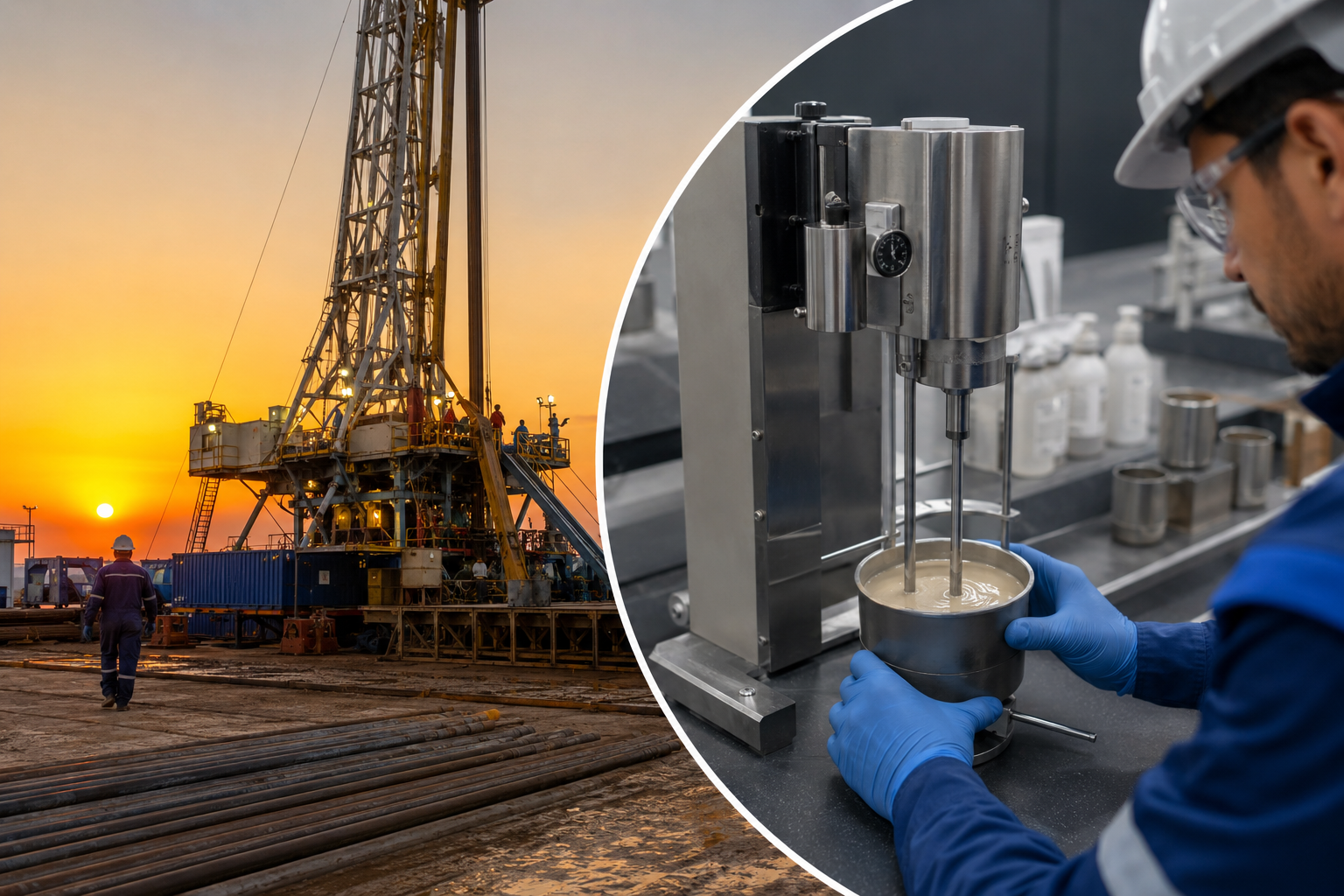
Deep-water wells, high-angle laterals, and extended-reach reservoirs push modern drilling fluids far beyond basic cooling and lubrication. When a bottomhole assembly sits thousands of feet down, the integrity of your entire mud program often hinges on a single, foundational mineral: high-purity, API-grade sodium bentonite.
At its core, premium API-grade bentonite serves as the primary viscosifier and fluid-loss control agent in water-based drilling fluids. By swelling up to 15 to 18 times its dry volume in fresh water, it transforms raw water into a thixotropic gel capable of suspending dense weighting agents like barite, transporting heavy drill cuttings to the surface, and plastering formation walls with a thin, impermeable filter cake. Without it, operators face rapid fluid loss, differential sticking, pipe drag, and catastrophic hole collapse.
This guide breaks down the rheological physics, specification standards, operational trade-offs, and field performance metrics you need to evaluate premium API-grade bentonite for modern oil and gas operations.
Not all montmorillonite clay is created equal. Raw industrial bentonite mined for civil engineering or foundry casting rarely meets the strict physical and chemical parameters required downhole. The American Petroleum Institute sets the global benchmark under API Specification 13A (ISO 13500).
API 13A defines specific requirements for physical quality, hydration kinetics, and rheological performance. Within the standard, drilling clay generally falls under two key sections:
To pass Section 9 certification, a raw or naturally processed sodium bentonite must meet rigorous lab testing using standardized Fann 35 viscometer protocols:
+-----------------------------------------------------------------------+
| API 13A SECTION 9 CRITERIA | +-----------------------------------+-----------------------------------+
| Test Parameter | Target Specification | +-----------------------------------+-----------------------------------+
| Viscometer Reading (600 rpm) | 30 Minimum |
| Yield Point / PV Ratio | 3.0 Maximum |
| API Filtrate Loss (30 min) | 12.5 mL Maximum |
| Wet Screen Residue (>75 microns) | 2.5% Maximum |
| Moisture Content | 10.0% - 13.0% Maximum | +-----------------------------------+-----------------------------------+
When a mud engineer mixes 22.5 grams of API Section 9 bentonite into 350 mL of deionized water (equivalent to a 22.5 lb/bbl suspension), it must deliver these exact flow properties. Failing any single metric results in rejected shipments and unpredictable downhole hydraulics.
Understanding why API bentonite performs so effectively requires a close look at clay mineralogy. Bentonite consists predominantly of smectite group montmorillonite, a 2:1 expandable sheet silicate. Each micro-platelet features an aluminum octahedral sheet sandwiched between two silicon tetrahedral sheets.
Isomorphous substitution—where magnesium (Mg²?) replaces aluminum (Al³?) in the octahedral layer—gives the platelet a net negative surface charge. Counter-ions sit within the interlayer space between these sheets to balance the charge.
[Silica Tetrahedral Sheet] ---> (Si??) Negative surface charge
[Alumina Octahedral Sheet] ---> (Mg²? substitution creates charge deficiency)
[Silica Tetrahedral Sheet] ---> (Si??) =========================== INTERLAYER SPACE ---> Sodium ions (Na?) + Water molecules (H?O) =========================== [Silica Tetrahedral Sheet]
The identity of that primary interlayer ion dictates whether the clay is suitable for drilling:
Sodium ions have a large hydrated ionic radius and a low valence state (+1). When exposed to fresh water, water molecules readily penetrate the interlayer space, forcing the platelets up to 20 Angstroms apart. This crystalline swelling leads to complete osmotic dispersion into individual, nanometer-thin sheets.
These dispersed sheets form a hydrated house-of-cards structure through electrostatic attraction between negative face charges and positive edge charges. The result is high plastic viscosity, high yield point, excellent gel strength, and a tight filter cake.
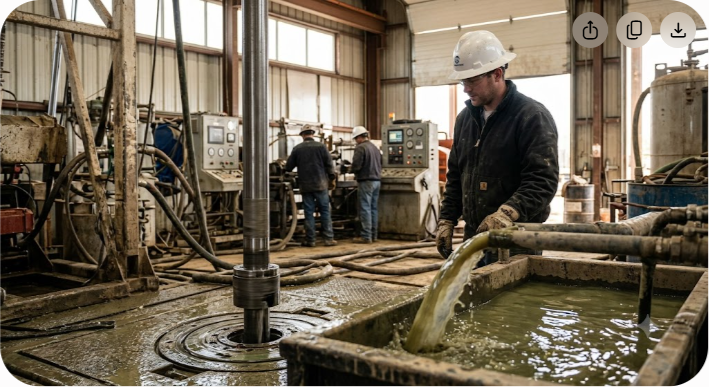
Calcium ions carry a double positive charge (Ca²?) and hold the montmorillonite platelets together with much tighter ionic attraction. Calcium bentonite experiences only limited crystalline swelling, absorbing water without dispersing into individual platelets.
In drilling muds, un-activated calcium bentonite produces low viscosity, poor cuttings suspension, and high fluid loss. While calcium bentonite can undergo chemical activation using soda ash (sodium carbonate) to swap calcium for sodium, natural high-grade sodium bentonite from premium deposits yields superior thermal stability and longer-lasting rheology downhole.
Every barrel of water-based drilling fluid serves multiple physical and chemical purposes simultaneously. Premium API-grade bentonite provides the base mechanics for four critical mud functions.
+--------------------------------+
| API-GRADE SODIUM BENTONITE | +---------------+----------------+ | +-------------------+--------------+--------------+-------------------+
| | | | v v v v +--------------+ +---------------+ +---------------+ +---------------+
| Viscosity & | | Cuttings | | Filter Cake & | | Lubrication & |
| Gel Strength | | Transportation| | Fluid Loss | | Bit Cooling | +--------------+ +---------------+ +---------------+ +---------------+
Without viscosifiers, water flows like plain water. It cannot move heavy rock bits' cuttings out of a 10,000-foot well. Adding 15 to 25 pounds of API sodium bentonite per barrel of fluid creates a non-Newtonian, shear-thinning fluid.
When circulation stops to make a pipe connection or log a zone, gravity pulls suspended drill cuttings back toward the bottom of the hole. Unchecked cuttings settlement leads to stuck pipe, packed-off annulus, and expensive fishing jobs.
API bentonite generates dynamic gel strength. When mud velocity drops to zero, the electrostatic attraction between clay platelet edges (positive charge) and faces (negative charge) rebuilds the structural lattice in seconds. This gel suspends heavy drill cuttings and barite indefinitely. As soon as the mud pumps restart, the gel breaks cleanly without demanding excessive pump pressures.
Permeable formations—such as porous sandstones and depleted sands—act like sponges. If untreated water enters these formations, it destabilizes shale walls, damages hydrocarbon-producing zones, and causes differential sticking of the drill string.
As drilling fluid pushes against a permeable zone, high-grade bentonite platelets stack flat across the pore throats. Over minutes, this creates a flexible, micro-thin, low-permeability filter cake (often under 2/32 inch thick). A quality cake acts as an impermeable barrier that:
The hydrated clay suspension surrounds the drill string and bit, carrying frictional heat away from cutter heads and dispersing it across surface pits. Furthermore, the colloidal film created by dispersed montmorillonite lowers the coefficient of friction along the borehole wall, easing rotational torque in directional drilling.
Drilling engineers choose between various viscosifiers based on hole depth, salinity, formation temperature, and budget. Here is how premium API-grade sodium bentonite compares against common alternatives.
| Operational Property | Premium API Sodium Bentonite (Section 9) | High-Yield Extended Bentonite (Section 10) | OCMA Grade Bentonite | Xanthan Gum (XC Polymer) | Organophilic Clay (Oil-Based Mud) |
|---|---|---|---|---|---|
| Primary Base Chemistry | Natural Na-Montmorillonite | Na-Bentonite + Polymer Extender | Lower-Purity Smectite Clay | Polysaccharide Polymer | Amine-Treated Bentonite |
| Yield (Barrels of 15 cP mud/ton) | 91 - 100 bbl/ton | 150 - 200+ bbl/ton | 45 - 60 bbl/ton | N/A (Additive) | N/A (Oil Phase) |
| Salt Tolerance (NaCl) | Moderate (Slight hydration drop > 10,000 ppm) | Poor (Polymers shear/coil in salt) | Low | Excellent (High salinity stable) | Excellent (Invert emulsion) |
| Temperature Limit | 400°F (204°C)+ | 250°F - 300°F (121°C - 148°C) | 350°F (176°C) | 250°F (121°C) | 350°F - 400°F |
| Filtrate Control Quality | Superior (Thin, tough cake) | Good to Moderate | Fair to Poor | Poor (Requires fluid loss additive) | N/A (Oil filtrate) |
| Cost per Yield Barrel | Low - Medium | Very Low | Low (Higher volumetric need) | High | High |
Managing bentonite in the pit goes beyond simply dumping bags into a hopper. Mud engineers rely on regular tests with a rotational viscometer to balance three core parameters: Plastic Viscosity (PV), Yield Point (YP), and Gel Strength.
[ Speed Knob ] | +---------------+ | 600 RPM | ===> R600 | 300 RPM | ===> R300 +---------------+ |
| | v v Plastic Viscosity (PV) Yield Point (YP) PV = R600 - R300 YP = R300 - PV (Measures mechanical friction) (Measures electrochemical attraction)
Plastic Viscosity represents the mechanical resistance to fluid flow caused by physical friction. Factors include:
Goal: Keep PV as low as possible. High PV increases circulating pressures, slows rate of penetration (ROP), and generates excess heat. Excessive low-grade drill solids increase PV rapidly. Pre-hydrating high-grade API bentonite allows you to reach target yield without adding unneeded solid volume.
Yield Point measures the attractive electrochemical forces between clay particles under dynamic flow conditions. It represents the stress required to start fluid movement.
Goal: Maintain a stable YP (typically 12 - 25 lb/100 ft² depending on hole geometry). A healthy YP ensures efficient cuttings removal in the annulus. If YP drops too low, cuttings fall out of suspension, leading to fill on bottom after connections.
Gel strength reflects the static electrochemical network built when the fluid sits still.
Ideal Profile (Flat Gels): A quality bentonite mud displays a quick initial gel (e.g., 6–8 lb/100 ft²) that rises moderately after 10 minutes (e.g., 10–14 lb/100 ft²).
Problem Profile (Progressive Gels): If 10-minute gels climb sharply (e.g., 35+ lb/100 ft²), the mud is building progressives. Restarting pumps can break fragile formations, causing lost circulation. This issue usually stems from fine solids contamination or excess calcium ions, which can be corrected by treating with thinners (lignosulfonates) or soda ash.
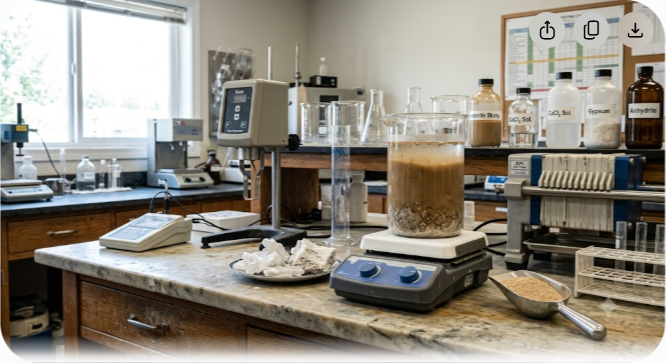
When drilling through complex strata, clean water-bentonite systems encounter contaminants that disrupt hydration, collapse the double-layer electrical charge, or cause extreme flocculation. Here is how to diagnose and correct common downhole issues.
DOWNHOLE CONTAMINATION | +---------------------------------+---------------------------------+
| | | v v v +--------------+ +---------------+ +---------------+
| Calcium | | Anhydrite / | | Sodium |
| (Cement Cut) | | Gypsum | | Chloride | +--------------+ +---------------+ +---------------+
| | | v v v Phenolphthalein test High SO?²? ions EC / Titration pH jumps > 11.0 Viscosity spikes Hydration drops
| | | v v v Treat with Sodium Treat with Soda Ash Pre-hydrate in fresh Acid Pyrophosphate or Barium Carbonate water or use polymers
Drilling out cement shoes introduces high levels of calcium hydroxide Ca(OH) 2 ?
. Calcium ions replace sodium on the montmorillonite exchange sites, stripping the clay of its hydration shell. The clay particles aggregate into tight clumps, causing fluid loss to skyrocket and yield point to drop.
3 ?
). Bicarbonate precipitates calcium as insoluble calcium carbonate (CaCO 3 ?
), lowering pH back to safe ranges (8.5 to 9.5).
$$ ext{Ca(OH)}_2 + ext{NaHCO}_3 ightarrow ext{CaCO}_3downarrow + ext{H}_2 ext{O} + ext{NaOH}
Drilling through anhydrite ($ ext{CaSO}_4$) or gypsum ($ ext{CaSO}_4cdot2 ext{H}_2 ext{O}$) releases calcium ions without altering pH as drastically as green cement.
ext{CaSO}_4 + ext{Na}_2 ext{CO}_3 ightarrow ext{CaCO}_3downarrow + ext{Na}_2 ext{SO}_4$$
When drilling through salt domes or entering high-salinity formation water, high concentrations of Na + or Cl ? compress the electrical double layer surrounding clay platelets. Without electrostatic repulsion, the clay collapses out of suspension.
Getting full performance out of every sack of API bentonite requires proper surface mixing techniques. Improper addition creates unhydrated clumps—commonly called fish-eyes—that waste raw material and blind shale shaker screens.
Before adding bentonite, test makeup water in the mixing tank. High hardness or extreme pH prevents full hydration.
2+ , Mg 2+ ): Should be below 200 mg/L (ppm).
Never dump bentonite directly into open mud pits. Add dry powdered bentonite through a high-shear Venturi hopper at a controlled rate of 15 to 20 minutes per 100 lb bag.
VENTURI MIXING HOPPER
[ Dry Bentonite ] | v Makeup Water In ================> ( Venturi ) ================> Pre-Hydration Pit (pH 8.5 - 9.5) Constriction (High Shear Rotor) [ High Vacuum Zone ]
The high fluid velocity inside the Venturi jet creates a vacuum that draws dry powder directly into the turbulent stream, wetting individual particles before they can clump together.
Full hydration does not happen instantaneously. While initial yield occurs within 30 minutes, full swelling requires 4 to 6 hours of active circulation or mechanical agitation in a pre-hydration tank.
Field Tip: Whenever possible, pre-hydrate bentonite in fresh water at double concentration (30 to 40 lb/bbl) overnight before transferring it into the active circulating system. This maximizes yield and reduces total bag consumption by up to 20%.
Protect hydrated bentonite systems by setting shale shaker screens correctly. API bentonite particles exist as sub-micron colloids that comfortably pass through 140 to 200 mesh shaker screens.
However, un-hydrated bentonite clumps or drill cuttings will get caught on fine screens. Ensure degassers, desanders, and desilters function correctly to strip out coarse drill solids (>15 microns) without discarding useful colloidal bentonite.
Drilling contractors and supply companies source thousands of metric tons of API bentonite annually. Sourcing high-quality raw mineral reserves requires strict supply chain auditing.
API BENTONITE QUALITY ASSURANCE PIPELINE
[ Geological Mining ] [ Processing & Drying ] [ Lab Certification ] Natural Na-bentonite ===> Controlled rotary ===> Fann 35 testing selective extraction drying (<105°C) API 13A Section 9 | v [ Global Logistics ] [ On-Site Quality Control ] [ Moisture Packaging ] Docks / Bulk Vessel <=== Pre-shipment analysis <=== Moisture-proof bags port staging lot tracking pallet wrapping
Global suppliers like Axewelledge combine extensive mine reserves with dedicated API testing laboratories and international export infrastructure. This integration gives operators reliable access to API-grade bentonite that meets Section 9 specifications batch after batch.
Natural sodium bentonite is one of the most environmentally friendly additives used in oilfield operations.













Have questions about our products? We're here to help!