Axewelledge, a leading exporter from India, specializes in high-quality Bentonite. With a commitment to excellence, we supply premium Bentonite to the Middle East and Southeast Asia markets.


North Angle Complex, 304,
150 Feet Ring Rd, Opposite Ambedkar Nagar BRTS Stop,
Madhav Park, Punit Nagar,
Mavdi, Rajkot, Gujarat 360004
© Axewelledge 2026, All Rights Reserved.
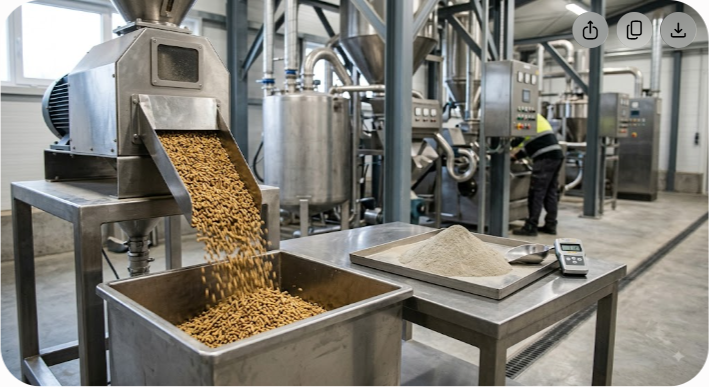
Yes. Feed-grade bentonite can be used as an animal feed binder, but the right grade, inclusion level, and regulatory status matter. In feed manufacturing, bentonite is primarily used as a technological additive to improve pellet quality, reduce dust and fines, support feed flow, and, for suitable clay products, adsorb certain mycotoxins such as aflatoxin B1.
The important qualification is that bentonite isn't a universal nutritional supplement or a cure for contaminated feed. Its performance depends on mineral composition, montmorillonite content, particle size, moisture, processing conditions, and the specific authorization for the intended animal species and market.
For most feed applications, manufacturers should select a documented feed-grade product, establish an appropriate inclusion rate with their nutritionist or formulation team, and verify the material through a current Certificate of Analysis (COA). Industrial bentonite intended for drilling, foundry, construction, or other technical applications should not be substituted for feed-grade material.
This guide explains how bentonite works as a feed binder, where it fits into poultry, swine, ruminant, and aquaculture feeds, how to incorporate it during manufacturing, what quality parameters to check, and which common claims deserve more caution.
Bentonite is a naturally occurring clay material composed largely of smectite minerals, especially montmorillonite. Its properties vary considerably from one deposit to another. The type and proportion of exchangeable cations, mineral impurities, particle size, and processing history all affect how a bentonite behaves when it comes into contact with water.
That variation matters in feed manufacturing. Two products sold as bentonite may have very different swelling, water-absorption, binding, and adsorption characteristics.
In animal feed, bentonite can serve several technological roles. Depending on the approved product and application, these include:
These functions shouldn't be treated as interchangeable. A bentonite that performs well as a pellet binder isn't automatically the best product for mycotoxin control, and a clay selected for toxin adsorption shouldn't be assumed to provide the same pelleting performance.
Montmorillonite is the main smectite mineral associated with the characteristic swelling and adsorption behavior of many bentonites. Its layered structure provides a large reactive surface and allows water and certain ions to interact with the clay.
However, a higher stated montmorillonite percentage doesn't by itself prove that a product is better for every feed application. Mineralogy, exchange capacity, particle size, purity, processing, and test method all matter.
Feed manufacturers should therefore evaluate a bentonite against the performance specification required for the finished feed rather than buying solely on a single headline number.
The terms sodium bentonite and calcium bentonite describe broad mineral behaviors associated with the dominant exchangeable cation. They are useful starting points, but they don't tell the whole story about a commercial feed-grade product.
Sodium-dominant bentonite generally has higher swelling capacity and stronger water absorption than calcium-dominant bentonite. Those characteristics can make it useful where moisture management and binding are important.
When hydrated, the clay can form a viscous suspension or gel-like structure. During feed conditioning and pelleting, this behavior can help fine particles adhere and may contribute to stronger pellets.
Still, the actual binding performance depends on the formulation and processing conditions. It isn't accurate to assume that every sodium bentonite will automatically improve pellet durability by the same amount.
Calcium-dominant bentonite generally swells less than sodium-dominant bentonite. It can nevertheless have useful adsorption properties and may be selected for particular feed applications.
For mycotoxin management, the key question isn't simply whether a clay is called calcium bentonite. The product should have documented evidence for adsorption of the target toxin under relevant conditions, along with regulatory approval or authorization for the intended use.
The answer depends on the job the clay needs to perform. If pellet binding and moisture management are the primary goals, a suitable high-performing bentonite with the required feed authorization may be appropriate. If the primary objective is mycotoxin adsorption, the manufacturer should focus on demonstrated adsorption capacity and the applicable regulatory requirements.
A supplier's technical data sheet and COA are more useful than the mineral name alone.
Bentonite can influence feed at two different stages: during manufacturing and after the feed is consumed. The mechanisms shouldn't be confused.
Commercial pelleting involves grinding, mixing, conditioning, compression through a die, and cooling. Steam adds heat and moisture during conditioning, which helps soften feed ingredients and improve their ability to bind.
Hydrated bentonite can interact with fine feed particles and water, contributing to cohesion within the pellet. The result can be a more durable pellet that generates fewer fines during conveying, transportation, and feeding.
The effect varies with formulation. A diet that already contains ingredients with strong natural binding properties may show a smaller response than a formulation that is difficult to pellet.
Bentonite can absorb water and change the physical behavior of powdered materials. In appropriate formulations, that can support flowability and reduce caking.
However, more absorption isn't always better. Excessive moisture can create handling problems, while excessive clay can change the physical characteristics of the finished feed. The target is a stable formulation, not maximum clay addition.
Fines are the small particles generated when pellets break during production and handling. High fines levels can lead to segregation, inconsistent intake, dust, and feed wastage.
A binder can help maintain pellet structure, but pellet durability is influenced by much more than binder selection. Grinding, conditioning temperature, steam quality, moisture, die specifications, compression ratio, cooling, and ingredient composition all play a role.
That is why a feed mill should evaluate bentonite using its own pellet durability and fines measurements rather than relying on a generic performance claim.
Some bentonite products can adsorb aflatoxins because of their mineral surface and physicochemical properties. This is particularly relevant to aflatoxin B1, a mycotoxin produced by certain Aspergillus species.
The mechanism is better described as adsorption than simply chemical destruction. The toxin interacts with available sites on the clay surface and may become less available for absorption in the gastrointestinal tract.
The distinction matters because clay-based toxin binders aren't equally effective against every mycotoxin. A product that performs well against aflatoxin shouldn't automatically be marketed as an effective binder for trichothecenes, zearalenone, fumonisins, or other toxins without supporting evidence.
Feed manufacturers should also address the underlying contamination problem. Good storage, moisture control, raw-material testing, and proper feed management remain essential.
The strongest case for bentonite is usually practical rather than dramatic. A well-selected product can help a feed mill solve a specific processing or feed-quality problem without requiring a major reformulation.
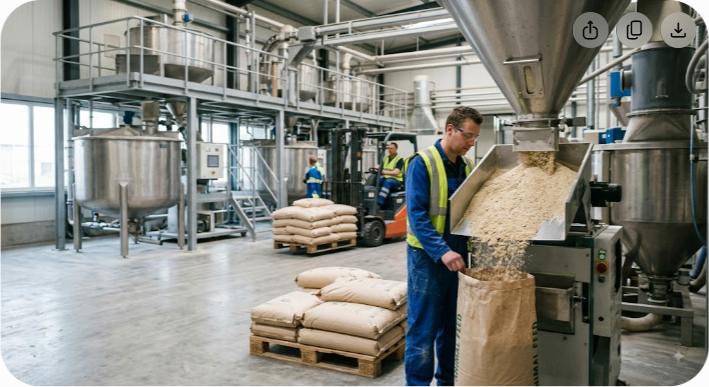
A suitable bentonite can contribute to stronger pellets and lower fines, particularly in formulations where binding is a limiting factor. Better pellet integrity can reduce product loss during conveying, loading, transport, and feeding.
The Pellet Durability Index (PDI) is commonly used to assess pellet resistance to breakage. A higher PDI generally indicates a more durable pellet, although the appropriate target depends on the feed type and production system.
There is no universal PDI improvement that can be guaranteed by adding a fixed percentage of bentonite. Claims such as a specific five- or ten-point increase should be treated as formulation-specific results, not general rules.
Improved pellet durability can reduce the amount of loose material created during handling. This can make feed cleaner to transport and distribute.
Dust control also depends on grinding, ingredient selection, pellet cooling, conveying equipment, and storage. Bentonite is one part of the process, not a replacement for good mill design.
Some bentonite products can help control moisture and improve the handling characteristics of dry feed. This can be useful in powders, premixes, and other products where caking creates a practical problem.
The correct dosage is important because too much clay can have the opposite effect and alter the physical properties of the mixture.
A suitable, authorized bentonite-based additive can provide an additional tool for managing aflatoxin exposure. This can be valuable when raw materials are vulnerable to fungal contamination.
It shouldn't be presented as permission to use visibly spoiled or heavily contaminated grain. Testing and prevention come first.
Depending on the formulation and equipment, a binder may affect pellet throughput, die behavior, energy demand, and pellet quality. These effects are highly dependent on the complete feed formula and operating conditions.
A feed mill should confirm the economics through controlled production trials rather than assuming that a binder will automatically reduce energy consumption or extend die life.
There is no single inclusion rate that works for every animal species or every bentonite product. The appropriate level depends on the product's authorization, intended function, feed formula, processing conditions, and local regulations.
As a starting point for technical discussions, feed manufacturers may encounter bentonite inclusion levels in the range of roughly 0.5% to 2% in some applications. Certain specialized products and applications may use different rates, including levels above 2%, but those rates should only be used when supported by the product specification and applicable authorization.
| Animal Category | Common Discussion Range | Typical Purpose | Important Consideration |
|---|---|---|---|
| Poultry | 0.5% to 1.5% | Pellet quality, feed flow, selected toxin-control applications | Confirm species-specific authorization and formulation compatibility |
| Swine | 0.5% to 2.0% | Pellet binding, flow, selected toxin-control applications | Evaluate effects on nutrient density and diet formulation |
| Dairy Cattle | Product-specific | Feed processing or selected clay additive applications | Follow the approved use and consult the nutritionist |
| Beef Cattle | Product-specific | Pellet or supplement processing and selected additive uses | Ration type and regulatory status determine the appropriate level |
| Aquaculture | Product-specific | Pellet cohesion and water stability | Confirm authorization for the target species and feed type |
These figures are not universal prescriptions. A commercial feed formulation should never be changed solely on the basis of a generic internet table.
Bentonite has little or no nutritional energy value, so excessive inclusion can dilute the nutrient density of a ration. Depending on the clay and diet, high levels may also affect the availability of certain nutrients or additives.
The right approach is to identify the required function first, then establish the lowest effective inclusion rate through formulation work and production testing.
Bentonite is used differently across animal feed categories. The processing objective, diet composition, and regulatory requirements change with the species.
Poultry feeds are often manufactured as mash, crumble, or pellets. Pellet integrity matters because excessive fines can create handling and intake problems.
Bentonite may be incorporated as a technological additive to support pellet quality or, where authorized, as an aflatoxin-binding additive. The response depends on the diet's ingredients and manufacturing conditions.
Claims that bentonite automatically improves feed conversion, egg production, litter quality, or bird health should be supported by product-specific or independent evidence. Better pellet quality can influence feed handling, but it doesn't guarantee a biological performance improvement.
Pig diets can be manufactured in meal, pellet, or crumble form. In pelleted feeds, a binder may help maintain pellet structure and reduce fines.
Clay additives may also be considered as part of a broader mycotoxin-management strategy. The target toxin matters. Aflatoxin adsorption is not equivalent to broad-spectrum protection against every fungal toxin.
For nursery pigs in particular, formulation changes should be evaluated carefully because young animals can respond differently to changes in mineral content, nutrient density, and feed texture.
Ruminant diets contain a complex mixture of forage, grain, protein sources, minerals, and additives. Bentonite may be used in selected feed products for technological purposes or as part of a specific additive strategy.
It's important not to overstate claims about rumen buffering. Bentonite should not be treated as a direct substitute for established ration-management practices used to control subacute ruminal acidosis. Effective fiber levels, physically effective forage, starch management, feeding frequency, and overall ration formulation remain central.
Similarly, claims that bentonite reliably controls rumen ammonia or improves milk-fat percentage should be treated as formulation-specific rather than universal effects.
Aquaculture pellets must remain intact long enough for fish or shrimp to consume them. Water stability is therefore an important manufacturing characteristic.
Bentonite can contribute to pellet structure in some formulations, but it is only one of several possible binders. Starches, alginates, proteins, and other ingredients may also influence water stability.
Because aquaculture diets are formulated for specific species and life stages, the additive must be evaluated for the target feed rather than copied from a terrestrial livestock formula.
Bentonite is one option among several binder technologies. The best choice depends on cost, formulation, processing requirements, regulatory status, and the desired function.
| Binder Category | Examples | Main Strength | Toxin Adsorption | Typical Consideration |
|---|---|---|---|---|
| Bentonite and Other Clays | Sodium bentonite, selected smectite clays | Mineral binding and moisture management | Strongest evidence for selected aflatoxins in suitable products | Performance varies significantly by mineralogy |
| Lignosulfonates | Calcium or sodium lignosulfonate | Strong pellet binding | Not a primary function | Can be effective at relatively low inclusion levels |
| Starch-Based Binders | Wheat, tapioca, modified starches | Pellet binding and cohesion | No | Also contributes carbohydrate to the diet |
| Cellulose Derivatives | Carboxymethylcellulose and related materials | Binding and texture modification | No | Cost and regulatory use vary by market |
| Protein-Based Binders | Selected protein ingredients | Cohesion and nutritional contribution | No | Function depends on the protein source and formulation |
Bentonite can be attractive when a manufacturer wants a mineral-based additive that provides both physical processing value and a potential role in aflatoxin adsorption. It isn't automatically superior to every alternative.
The practical comparison should be based on cost per tonne of finished feed, pellet durability, fines generation, process performance, nutrient impact, and regulatory compliance.
Uniform distribution is essential. A concentrated pocket of clay in one part of a batch doesn't provide the same result as even dispersion throughout the feed.
Before production, verify that the bentonite is approved or authorized for the intended feed application and animal species. Check the product specification, recommended inclusion rate, storage conditions, particle size, and current COA.
Use calibrated dosing equipment. Small inclusion rates can be difficult to distribute consistently when the material is added manually.
If the feed mill has a micro-ingredient system, bentonite can be introduced according to the plant's validated batching procedure.
Bentonite should generally be dispersed with dry ingredients before the batch is exposed to large quantities of liquid. The precise sequence should follow the feed mill's formulation and equipment design.
A controlled dry pre-mix helps prevent localized concentrations and improves batch uniformity.
During steam conditioning, water and heat change the physical properties of the mash. The correct temperature, moisture level, retention time, and steam quality depend on the feed formula and equipment.
Don't assume that a single conditioning temperature is suitable for every feed mill. Excessive heat can damage sensitive nutrients, while inadequate conditioning can reduce pellet quality.
After pelleting, the feed should be cooled and dried to the target specification. Evaluate pellet durability, fines, moisture, bulk density, and other relevant quality parameters.
A useful trial compares the control feed with the bentonite-containing formulation under otherwise similar production conditions.
When a manufacturer wants to evaluate a new bentonite supplier, a small controlled production trial is usually more informative than a supplier brochure.
This approach gives the feed manufacturer evidence that applies to its own equipment and formulation.
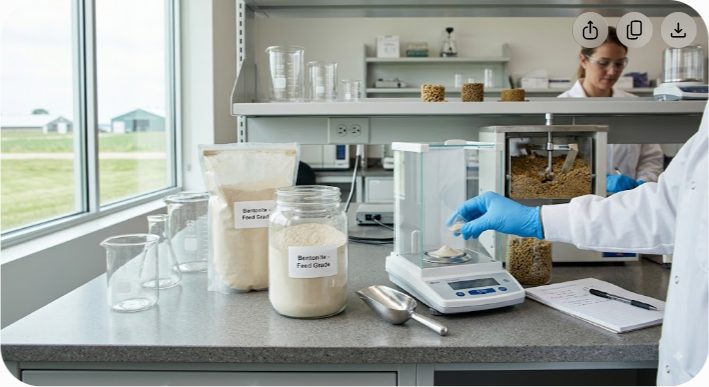
The phrase feed-grade is important. Bentonite used in animal feed should be manufactured, tested, and documented for the intended application.
A current COA should provide relevant test results for the supplied batch. Depending on the product and regulatory market, this may include:
The exact analytical requirements vary by jurisdiction and product category.
Heavy metal limits shouldn't be copied from a generic supplier sheet and treated as universal standards. Permitted concentrations can vary by jurisdiction, animal species, additive category, and regulatory framework.
A responsible purchasing specification should identify the applicable legal limits for the destination market and require laboratory testing against those limits.
Mineral composition is particularly important because bentonite deposits can contain associated minerals such as quartz, feldspar, calcite, or other phases.
A high-quality feed product should have a clearly defined specification and consistent performance. Montmorillonite content is useful information, but it shouldn't be used as the sole indicator of suitability.
Particle size affects dispersion, handling, dust generation, and the interaction of the clay with water. The ideal specification depends on how the bentonite is dosed and what role it is expected to perform.
The feed mill should match the product's particle-size profile to its own batching and mixing system.
Feed-grade bentonite should be treated as a regulated feed ingredient or additive according to the rules of the market where the finished feed is sold.
In the United States, the regulatory status of a bentonite product depends on its composition, intended use, animal species, and applicable FDA rules or recognized feed-ingredient framework. Manufacturers should verify the current requirements rather than relying on a general statement that all bentonite is GRAS or approved for every feed use.
Where a product is used as a technological additive or mycotoxin-control agent, the manufacturer should confirm the applicable authorization, labeling, and conditions of use.
In the European Union, feed additives are subject to authorization under the applicable EU feed-additive framework. Bentonite and related clay products may fall into defined functional categories and may have specific conditions of use.
The authorization must be checked for the exact additive and intended function. A generic reference to bentonite does not establish that every bentonite product is authorized for every animal species or purpose.
Requirements in India, the Middle East, Southeast Asia, and other export destinations can differ. Exporters should provide documentation that supports the destination market's requirements rather than assuming that approval in one jurisdiction automatically transfers to another.
For international feed production, regulatory documentation should be part of supplier qualification from the beginning.
Drilling-grade or construction-grade bentonite is not a substitute for feed-grade bentonite. Industrial products can have different mineral compositions, processing histories, contaminants, and additives.
Always verify the intended feed application before purchasing.
Swelling behavior, mineralogy, adsorption capacity, particle size, and purity can vary widely. Comparing products only by the word bentonite on the label isn't enough.
Ask for a technical specification and batch-specific documentation.
A 1% addition may perform well in one feed formula and poorly in another. The effect depends on ingredient composition and pelleting conditions.
Use controlled trials to establish the practical inclusion rate.
This is one of the most important misconceptions to avoid. Clay adsorption can be highly selective. Bentonite is particularly associated with aflatoxin adsorption, while other mycotoxins may respond differently.
If a supplier claims broad-spectrum toxin control, ask for evidence for each target toxin and the conditions under which the test was conducted.
Bentonite doesn't provide the same energy or protein contribution as conventional feed ingredients. Increasing its inclusion rate can therefore dilute the nutrient density of the finished ration.
The additive should be incorporated into the formulation, not simply added on top of it without adjustment.
Laboratory test data can be useful, but feed mills operate under specific conditions. A product that performs well in one plant may behave differently elsewhere.
Run a controlled trial and measure the results.
A toxin binder does not replace good agricultural and storage practices. Raw materials should be tested, stored under appropriate conditions, and protected from moisture and fungal growth.
Mycotoxin management works best as a system rather than a single additive strategy.
Supplier qualification should go beyond price per tonne. The lowest quoted price can become expensive if the mineral quality changes from shipment to shipment or if the product isn't suitable for the intended market.
The document should clearly identify the product, its intended application, physical properties, mineral composition where relevant, recommended use, storage requirements, and applicable regulatory information.
A COA should correspond to the material actually shipped. Look for lot identification and test methods where appropriate.
Feed mills need repeatable raw materials. Ask the supplier how it controls mining, processing, blending, drying, grinding, and packaging.
Bentonite is moisture-sensitive. Packaging should protect the material during transportation and storage. The supplier should also provide clear storage recommendations.
A sample and controlled production trial can reveal differences in swelling, dispersion, dust, pellet binding, and finished-feed performance.
For export purchases, also verify documentation, shipment specifications, and regulatory requirements in the destination country.
Before adding bentonite to a formulation, answer five questions.
This framework prevents a common purchasing mistake: choosing a clay first and deciding what to do with it later.
A successful bentonite program should be measurable. Depending on the application, useful indicators include:
Biological outcomes should be evaluated separately from processing outcomes. A stronger pellet is a manufacturing result; improved animal performance requires appropriate controlled nutritional evidence.
This distinction makes supplier comparisons more credible and prevents marketing claims from being mistaken for established nutritional effects.
Bentonite can be a useful animal feed binder when the product is genuinely feed-grade, appropriately authorized, and matched to the job the feed mill needs it to perform.
Its clearest practical applications are pellet binding, feed-flow and moisture management, and, for suitable products, adsorption of certain mycotoxins such as aflatoxin B1. The benefits are not automatic. Mineral composition, inclusion rate, feed formulation, conditioning, pelleting, and storage all influence the final result.
For that reason, the best approach is straightforward: define the target function, select a product with reliable technical and regulatory documentation, run a controlled trial, and measure the finished-feed results.
For manufacturers sourcing bentonite internationally, supplier consistency matters just as much as the initial specification. Axewelledge supplies bentonite from India and can support feed manufacturers evaluating mineral specifications, documentation, and supply requirements for their intended application. Buyers should still verify that any specific product meets the regulatory and technical requirements of their destination market before use.













Have questions about our products? We're here to help!