Axewelledge, a leading exporter from India, specializes in high-quality Bentonite. With a commitment to excellence, we supply premium Bentonite to the Middle East and Southeast Asia markets.


North Angle Complex, 304,
150 Feet Ring Rd, Opposite Ambedkar Nagar BRTS Stop,
Madhav Park, Punit Nagar,
Mavdi, Rajkot, Gujarat 360004
© Axewelledge 2026, All Rights Reserved.
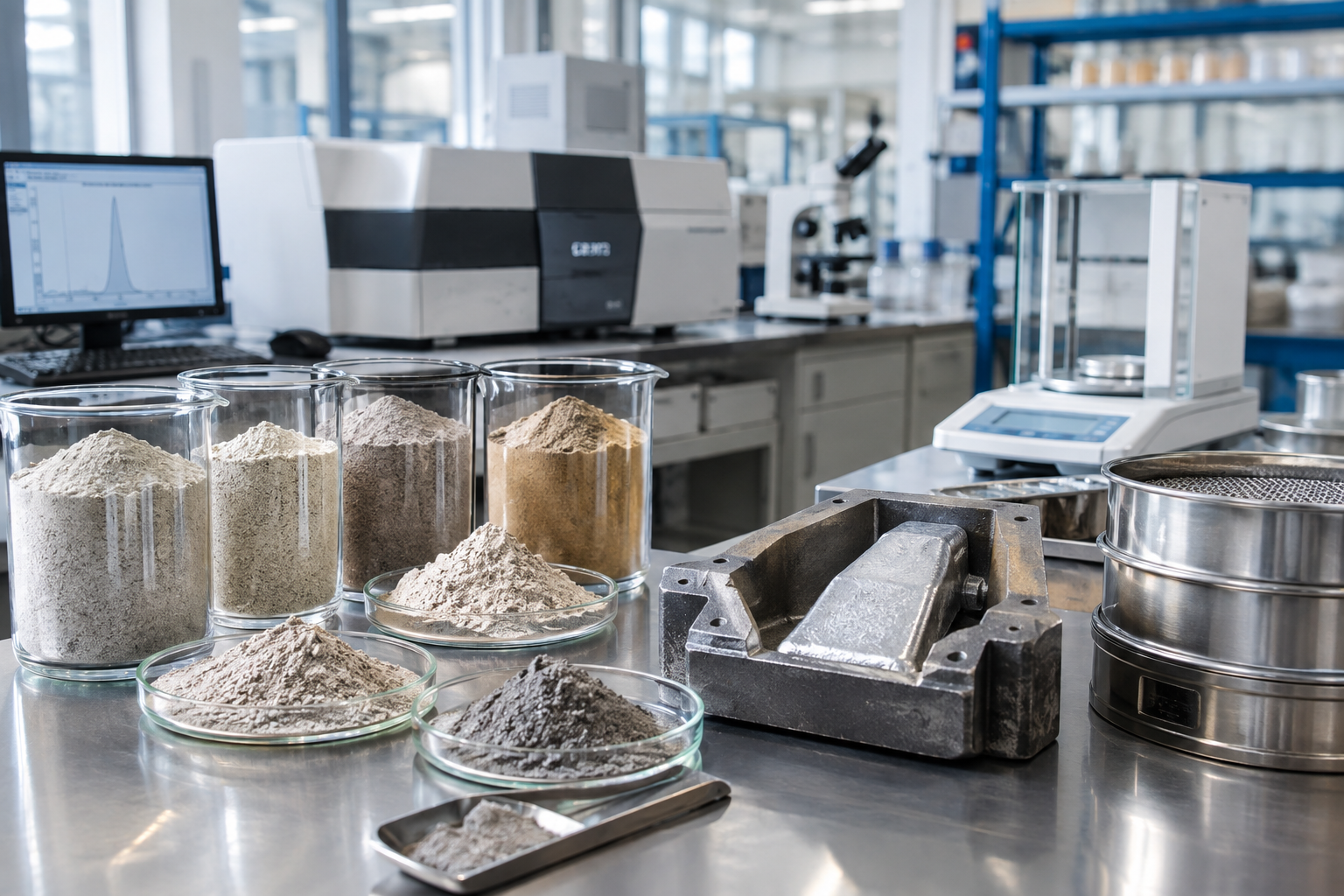
Bentonite is used in manufacturing because its performance changes dramatically when it interacts with water, heat, ions, and other materials. Depending on its mineral composition and treatment, it can act as a binder, suspending agent, rheology modifier, sealant, adsorbent, or process additive.
The main mineral in most commercial bentonites is montmorillonite, a smectite clay with a layered structure and a high capacity for ion exchange. Sodium-dominant bentonite generally develops greater swelling and gel strength, while calcium-dominant bentonite tends to offer lower swelling with useful adsorption and absorption properties. Processed or activated grades can be further tailored for specific applications.
The seven major bentonite applications covered here are green sand foundry casting, iron ore pelletizing, civil engineering and sealing, ceramics, industrial wastewater treatment, drilling fluids, and paper manufacturing. The correct grade depends on the job. A bentonite that performs well in a drilling fluid may be poorly suited to a ceramic glaze, and a foundry-grade material cannot automatically be substituted for a paper microparticle product.
The practical question is therefore not simply whether bentonite works. It is which bentonite, at what dosage, under what processing conditions, and against which performance specification?
Bentonite is a naturally occurring clay formed mainly through the alteration of volcanic ash and other volcanic materials. Commercial deposits vary considerably in mineralogy, exchangeable ions, moisture, particle size, and the amount of non-clay material they contain. Processing can include drying, grinding, screening, beneficiation, sodium activation, or other treatment depending on the intended application.
Sodium bentonite has sodium as a major exchangeable cation associated with the smectite structure. When hydrated, it can separate into very fine clay platelets and develop substantial swelling and viscosity. This makes sodium bentonite particularly useful where water retention, gel strength, filtration control, or binding is important.
Typical applications include:
The actual performance still depends on smectite content, chemistry, particle size, hydration conditions, and the specification required by the end user.
Calcium bentonite contains calcium as a major exchangeable cation. Compared with sodium bentonite, it generally develops less free swelling in fresh water, but it can provide useful adsorption, absorption, plasticity, and surface-area characteristics.
Calcium bentonite and calcium-rich clays are used in applications such as absorbents, selected ceramic formulations, and processed products such as activated bleaching earth. Acid activation can substantially change the surface and pore characteristics of a clay, so an acid-activated product should not be treated as interchangeable with untreated calcium bentonite.
| Property | Sodium-Dominant Bentonite | Calcium-Dominant Bentonite |
|---|---|---|
| Main exchangeable cation | Sodium | Calcium |
| Fresh-water swelling | Generally high | Generally lower |
| Gel development | Generally strong | Generally weaker |
| Water retention | High in suitable grades | Moderate to high, depending on grade |
| Common industrial role | Binder, slurry, sealant, rheology modifier | Adsorbent, absorbent, selected process additive |
| Typical applications | Foundry, drilling, civil engineering, sealing | Absorbents, ceramics, activated clay products |
These categories are useful starting points, but they aren't complete specifications. Two products both described as sodium bentonite can behave very differently in the same process.
One of the most established industrial uses of bentonite is as a binder in green sand casting. Foundries use prepared molding sand to create molds for iron, steel, aluminum, and other metal castings. Bentonite helps the sand hold its shape before and during pouring while also contributing to the mechanical properties required during mold handling and casting.
A typical green sand system contains silica sand, active clay, water, and selected carbonaceous or other additives. The exact formulation varies with the metal, molding equipment, sand system, casting geometry, and reclamation practice.
When water is added during mixing, bentonite hydrates and coats the sand grains. Properly conditioned clay creates a cohesive network between particles. The result is sufficient green strength for molding and handling, along with suitable dry and hot properties during metal pouring.
The process can be summarized in four practical stages:
Bentonite in a circulating foundry sand system is repeatedly exposed to heat. Some of the clay becomes thermally degraded and no longer contributes the same binding performance. This material is often described as dead clay or thermally inactive clay.
Foundries therefore monitor the active clay content rather than relying only on the total clay percentage. Methylene blue testing and other foundry control methods can help assess the active clay condition, while moisture, compactability, permeability, and strength tests provide additional information about the working sand system.
Sodium-dominant bentonite is commonly selected where high swelling, strong bonding, and durability in repeated sand cycles are required. Calcium bentonite generally develops less swelling and is not a universal substitute for sodium bentonite in green sand systems.
Foundry performance also depends on the complete formulation. Simply increasing bentonite does not necessarily improve casting quality. Excessive clay can alter permeability and increase the amount of material that must be removed during reclamation.
Using total clay as a substitute for active clay: Reclaimed sand can contain thermally altered clay that still appears in a chemical or ignition-based measurement but contributes less to bonding.
Adding water without checking compactability: Too little water can leave the clay inadequately hydrated. Too much can reduce permeability and create gas-related casting defects.
Ignoring mulling quality: Even a good bentonite grade performs poorly when the mixing process does not distribute it uniformly across the sand grains.
Choosing solely by price per tonne: A lower-cost clay can require a higher addition rate or produce less consistent molding properties, changing the real cost of the formulation.
Iron ore beneficiation produces fine concentrates that need to be agglomerated before many downstream ironmaking processes. Bentonite is one of the binders used in iron ore pelletizing, where it helps fine mineral particles form durable green pellets that can withstand handling before and during induration.
Fine iron ore concentrate is mixed with water and a small quantity of binder. The moist feed enters a balling disc or drum, where particles collide, roll, and gradually form spherical pellets.
Bentonite contributes to this process by improving the cohesion of the wet pellet and helping maintain pellet integrity during handling. The green pellets then undergo drying, preheating, and firing in an induration process that develops the required strength.
Typical bentonite addition rates are low and are often around 0.5% to 1% by weight, although the actual target depends on ore chemistry, mineralogy, pelletizing equipment, binder quality, and the required pellet properties.
A pelletizing operation must balance several properties rather than maximize binder addition. Important measurements can include:
Bentonite itself contains mineral components other than iron-bearing material. Excessive addition can therefore increase gangue input and affect pellet chemistry. This is one reason pelletizing plants optimize binder dosage carefully.

The objective is not to add as much bentonite as possible. It is to use enough to achieve the required pellet integrity while minimizing its effect on final pellet chemistry and downstream performance.
A consistent binder with controlled moisture and particle size can make dosage control easier. However, the optimum value must be established through plant trials because iron ore concentrates differ substantially from one source to another.
The swelling and filtration properties of sodium bentonite make it particularly useful in geotechnical and civil engineering applications. It is used in drilling and excavation slurries, diaphragm-wall construction, cutoff systems, and engineered containment products.
When a trench is excavated below the water table or in unstable ground, the exposed soil can collapse or allow groundwater to enter the excavation. A properly prepared bentonite slurry can provide temporary support while the permanent structure is constructed.
The slurry works through several related mechanisms:
The exact slurry concentration isn't universal. It is selected according to soil conditions, groundwater chemistry, excavation method, required viscosity, filtration behavior, and project specifications.
In diaphragm-wall construction, bentonite slurry can support a deep trench until reinforcement and concrete are placed. The slurry must be maintained within a controlled range of density, viscosity, sand content, and filtration properties.
Poorly controlled slurry can create problems. Excessive sand content may affect concrete placement, while unsuitable viscosity can interfere with excavation or cleaning. Water chemistry also matters because calcium and other dissolved ions can reduce the swelling and gel performance of sodium bentonite.
Geosynthetic clay liners, commonly called GCLs, use bentonite as a low-permeability barrier within a manufactured composite. The bentonite layer is generally held between geotextiles and designed to hydrate when exposed to water.
Once hydrated under appropriate confinement and chemical conditions, the bentonite can form a low-permeability layer. GCL performance depends on the bentonite grade, loading conditions, hydration environment, liner construction, and compatibility with the surrounding soil and liquids.
For landfill, mining, wastewater, and other containment projects, the correct product should therefore be selected against project-specific hydraulic and chemical requirements rather than using a generic bentonite specification.
Ceramic manufacturers use bentonite in relatively small quantities because its effect on plasticity and suspension can be significant. It can improve workability in ceramic bodies and help keep fine mineral particles suspended in glaze slurries.
Ceramic bodies typically contain combinations of clay, feldspar, silica, and other minerals. Some formulations need additional plasticity or green strength to withstand forming and handling before firing.
A carefully selected bentonite can contribute to these properties at a relatively low addition level. The actual dosage depends on the body composition and forming method. Too much bentonite can increase drying shrinkage, affect rheology, or alter firing behavior, so more is not automatically better.
Glaze slurries contain fine mineral particles suspended in water. Without adequate suspension control, heavier particles can settle during storage and create inconsistent application.
Bentonite can contribute to a weak gel structure that keeps particles suspended while still allowing the glaze to flow when stirred, pumped, or sprayed. This behavior is especially useful when a formulation needs controlled thixotropy.
The selection of a low-iron or specially processed grade may also matter where fired color and surface appearance are important. Ceramic producers should test the clay alongside the complete glaze or body because even small formulation changes can affect viscosity, drying, firing shrinkage, and final appearance.
A common mistake is treating bentonite as a generic thickener. Ceramic performance depends on interactions among clay minerals, deflocculants, soluble salts, particle size, solids loading, and firing conditions. A grade that gives excellent suspension in one glaze may create excessive viscosity in another.
Bentonite can be used in selected wastewater treatment systems because its charged clay surfaces and high specific surface area can interact with suspended particles and dissolved species. Its role is usually application-specific rather than a universal replacement for conventional coagulants, adsorbents, or treatment technologies.
Montmorillonite has a negatively charged layer structure with exchangeable cations. Depending on the clay chemistry and wastewater composition, these exchange sites can interact with dissolved metal ions and other charged species.
Bentonite can also provide a surface for interactions with suspended or colloidal material. In some treatment systems, it is combined with polymers or other reagents to improve floc formation and separation.
The actual removal efficiency depends strongly on pH, ionic strength, contaminant concentration, competing ions, contact time, bentonite dose, and the characteristics of the wastewater.
A simplified treatment sequence can look like this:
This approach is more realistic than assuming bentonite alone will remove every contaminant from industrial wastewater.
A related but distinct application involves acid-activated clay, commonly produced from calcium-rich bentonite or other suitable clay feedstocks. Acid treatment changes the mineral structure and increases accessible surface area and porosity.
Activated bleaching earth is used to remove color bodies and other impurities from oils and fats. The raw clay and the activated product should not be treated as equivalent materials because their properties and applications are different.
Bentonite is a fundamental additive in many water-based drilling fluids used for water wells, mineral exploration, oil and gas wells, and selected geothermal operations. Its value comes from its ability to develop viscosity and gel strength while also contributing to filtration control.
When adequately hydrated and dispersed, suitable sodium bentonite produces a non-Newtonian fluid with useful shear-thinning and thixotropic behavior. The fluid can circulate through the drilling system while still developing enough structure at low shear to help suspend cuttings when circulation stops.
Its main functions can include:
Dry bentonite doesn't immediately reach its final rheological performance when it touches water. Hydration depends on mixing energy, water chemistry, temperature, particle size, concentration, and time.
Fresh water with low hardness generally allows sodium bentonite to develop its properties more effectively than highly saline or calcium-rich water. In difficult water conditions, treatment and grade selection may be required.
For petroleum drilling fluids, products intended to meet API Specification 13A should be evaluated against the relevant specification and tested using the applicable procedures. For water-well and other drilling applications, the appropriate grade should be selected against the actual mud properties required by the drilling program rather than by API labeling alone.
Paper mills use selected bentonite products in microparticle retention systems and other process applications. The objective is to improve the retention of fine fibers and mineral fillers while maintaining drainage and formation at high machine speeds.
Paper furnish contains water, fibers, mineral fillers, additives, and fine particles. During sheet formation, much of the water drains through the forming fabric. Without an effective retention system, valuable fine material can leave with the white water.
A common microparticle approach combines a high-molecular-weight polymer with a fine mineral such as bentonite. The polymer initially forms larger associations within the furnish. Shear then partially breaks those structures, after which the microparticle system helps create smaller, more compact flocs.
The objective is a practical balance:
The exact bentonite dosage is machine- and furnish-specific. Excessive flocculation can harm formation even when retention improves, so the process should be optimized using actual mill measurements rather than a fixed universal dose.
Bentonite and other nanoclay materials can also be incorporated into selected polymer and coating systems. When clay platelets are well dispersed, they can create a more tortuous path for gases or liquids moving through a polymer matrix.

Food-contact applications require additional attention to the complete formulation, migration requirements, processing conditions, and applicable regulations. A bentonite product should not be assumed to be suitable for direct food-contact packaging simply because it is natural or mineral-based.
Each application uses a different property of the mineral. The comparison below is a practical starting point rather than a substitute for product qualification.
| Industrial Application | Typical Bentonite Type | Main Property Used | Key Control Factors |
|---|---|---|---|
| Foundry green sand | Sodium-dominant foundry grade | Binding, swelling, thermal performance | Active clay, moisture, compactability, permeability |
| Iron ore pelletizing | Selected sodium bentonite | Wet and dry pellet bonding | Binder dosage, ore chemistry, pellet strength |
| Civil engineering slurry | High-yield sodium bentonite | Swelling, gel strength, filtration control | Water chemistry, viscosity, fluid loss, sand content |
| Ceramic bodies and glazes | Application-specific low-iron or other grade | Plasticity and suspension | Solids loading, deflocculation, firing behavior |
| Wastewater treatment | Application-specific bentonite or activated clay | Adsorption and solids interaction | pH, ions, contaminant type, dose, contact time |
| Drilling fluids | Drilling-grade sodium bentonite | Rheology and filtration control | Hydration, salinity, hardness, fluid-loss target |
| Paper retention | Fine microparticle-grade bentonite | Flocculation and fine retention | Polymer system, shear, drainage, formation |
The table also shows why the phrase industrial bentonite clay is too broad for purchasing decisions. The application should determine the specification.
The most reliable purchasing process starts with the required performance rather than the supplier's generic product description.
First identify what the bentonite must actually do. Is the priority swelling, binding, viscosity, filtration control, adsorption, suspension, plasticity, or fine-particle retention?
A foundry may need active clay and compactability. A drilling operation may care about rheology and fluid loss. A ceramic plant may prioritize low iron and controlled rheology. These are very different specifications.
Important information can include:
The exact tests should match the intended application.
Chemical analysis alone cannot predict every processing behavior. Functional tests are often more useful for comparing suppliers.
Depending on the application, these can include:
For standards-based applications, agree in advance on the test method, sample preparation, acceptance limits, and reporting format.
A high-swelling sodium bentonite can lose performance in water containing significant concentrations of calcium, magnesium, or other electrolytes. The same issue can affect drilling fluids and construction slurries.
Always test the product using the water actually used in production when water chemistry is likely to influence performance.
Natural minerals vary by deposit and mining zone. A supplier should be able to provide a clear product specification and suitable quality documentation for commercial shipments.
For continuous manufacturing, consistency from shipment to shipment can be more valuable than an isolated laboratory result from a single sample.
There is no single test that defines industrial bentonite quality. The correct test panel depends on the application.
Free swell testing measures the volume developed by a specified mass of clay after hydration under a defined procedure. It is particularly useful for comparing swelling behavior in sodium-rich bentonites and sealing products.
However, free swell should not be treated as a universal quality indicator. A material with high free swell is not automatically the best choice for foundry, paper, ceramic, or activated-clay applications.
Methylene blue tests are commonly used to assess the reactive surface or cation-exchange characteristics of clay-containing materials. In foundry systems, methylene blue testing can be used as part of active-clay control.
The result should be interpreted according to the method and application rather than converted automatically into a precise montmorillonite percentage without appropriate calibration.
Particle size affects dispersion, hydration rate, dust generation, feeding, and process response. A finer product may disperse more quickly, but grinding finer is not automatically beneficial if the application requires a different particle distribution.
Sieve analysis, laser diffraction, or other particle-size methods can be selected according to the product and specification.
For drilling and civil engineering grades, viscosity, gel strength, filtration loss, and related rheological measurements are often more meaningful than a simple swelling number. Testing should be performed using the applicable standard or agreed laboratory method.
Even a suitable bentonite grade can underperform if the process around it is poorly controlled.
A general-purpose bentonite is rarely a reliable solution for every industrial application. Foundry, drilling, civil engineering, paper, ceramic, and activated-clay products can have very different specifications.
Better approach: Define the required functional properties first and ask the supplier to match the product to those requirements.
Hard or saline water can interfere with the hydration and dispersion of sodium bentonite. Calcium and magnesium ions can compress the electrical double layer around clay particles and reduce swelling and viscosity.
Better approach: Test the process water and, where appropriate, condition it before preparing the bentonite slurry. Soda ash may be used in some drilling-fluid systems to reduce the effect of calcium, but the treatment should be based on measured water chemistry and the drilling-fluid program.
Bentonite needs adequate dispersion and hydration time to develop its intended properties. Dumping a large quantity of powder into a poorly mixed tank can produce fish-eyes or partially hydrated lumps that take much longer to disperse.
Better approach: Use controlled powder addition, adequate agitation, and the hydration procedure recommended for the selected grade.
More bentonite isn't always the answer. Excessive addition can increase viscosity, reduce permeability, change ceramic shrinkage, increase gangue input in pelletizing, or interfere with paper formation.
Better approach: Identify the actual process variable that is out of specification before increasing dosage.
Repeated exposure to molten metal gradually changes the clay population in a circulating sand system. Adding fresh bentonite without monitoring active clay and moisture can lead to unstable molding properties.
Better approach: Control the sand system using active-clay, moisture, compactability, permeability, and strength measurements appropriate to the foundry process.
Two bentonites with similar appearance and bulk pricing can have very different functional performance. A product that requires a higher dosage or produces greater process variability may cost more in actual production.
Better approach: Compare suppliers using delivered cost per unit of required performance, not only the purchase price per tonne.
Bentonite should be protected from unintended moisture exposure during storage. Damp material can form lumps, complicate feeding, and make consistent dispersion more difficult.
Better approach: Store bags or bulk material in dry conditions, protect packaging from water ingress, and use stock rotation appropriate to the product and site conditions.
Industrial bentonite is used wherever its mineral properties solve a specific processing problem. The largest and most established applications include foundry binding, iron ore pelletizing, drilling fluids, civil engineering slurries, geosynthetic clay liners, ceramic processing, paper retention systems, absorbents, and selected wastewater or oil-treatment applications.
The reason bentonite appears across such different industries is that montmorillonite responds strongly to its surrounding environment. Water, exchangeable ions, particle size, temperature, concentration, and shear can all change how the clay behaves.
That versatility is also the reason product selection matters so much. There is no single bentonite grade that is optimal for every manufacturing process.
Bentonite delivers the most value when the mineral is treated as a process ingredient rather than an interchangeable commodity.
The best supplier is not necessarily the one offering the lowest price or the highest swelling number. A dependable supplier should be able to provide a consistent grade, relevant technical data, suitable test results, and practical support for the intended application.
For manufacturers purchasing bentonite at commercial scale, supplier qualification should therefore include mineral consistency, processing capability, quality control, packaging, logistics, documentation, and application-specific technical support. Those factors determine whether a mineral performs reliably after it leaves the laboratory and enters the production line.













Have questions about our products? We're here to help!