Axewelledge, a leading exporter from India, specializes in high-quality Bentonite. With a commitment to excellence, we supply premium Bentonite to the Middle East and Southeast Asia markets.


North Angle Complex, 304,
150 Feet Ring Rd, Opposite Ambedkar Nagar BRTS Stop,
Madhav Park, Punit Nagar,
Mavdi, Rajkot, Gujarat 360004
© Axewelledge 2026, All Rights Reserved.
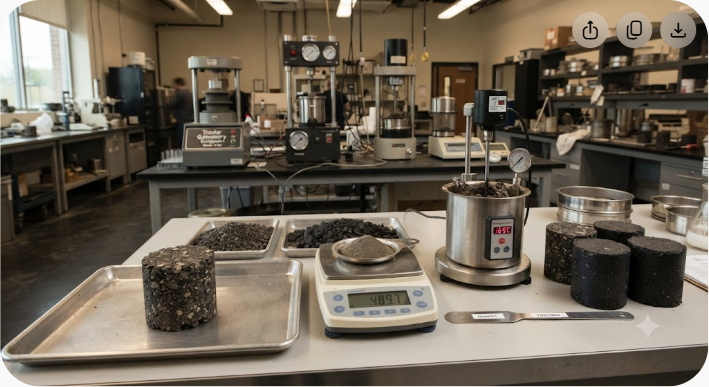
Bentonite can improve selected asphalt mixture properties, but it isn't automatically a better pavement material simply because it is a highly absorbent, swelling clay. Its most practical role is as a controlled partial replacement for conventional mineral filler, where its fine particles and surface characteristics can change the asphalt mastic and mixture structure.
Research has reported improvements in properties such as Marshall stability, density, tensile strength, and hydraulic conductivity when natural bentonite replaces part of the conventional mineral-filler fraction. One laboratory study reported its highest Marshall stability at a 15% replacement level. Other research has examined bentonite-containing filler systems in cold-patch asphalt and reported improvements in several mechanical properties. At the same time, research on bentonite-modified asphalt has also found reduced resistance to moisture damage in some formulations.
That mixed picture is important. Bentonite isn't a universal asphalt additive. Its high surface area, water affinity, swelling behavior, and interaction with the binder can help one formulation while creating problems in another.
So, if you're considering bentonite for an asphalt mixture, the useful question isn't simply, "Does bentonite work?" It is: what role should it play, at what proportion, and which performance requirement are you trying to improve?
Bentonite is a clay-rich mineral material dominated by montmorillonite. Its behavior varies with mineralogy, exchangeable cations, particle size, processing, and moisture condition. Sodium bentonite generally has greater swelling and water absorption than calcium bentonite because of differences in its exchangeable-ion chemistry.
In asphalt mixtures, bentonite is most naturally considered as a fine mineral filler or partial replacement for existing filler rather than as a conventional asphalt binder.
That distinction matters. Mineral filler occupies part of the fine fraction of an asphalt mixture and interacts with asphalt binder to form the mastic. The mastic, in turn, affects the way aggregate particles are held together and how the mixture responds to loading. The Federal Highway Administration notes that filler characteristics such as gradation, particle shape, texture, and plasticity can influence hot-mix asphalt performance.
Bentonite can therefore affect several aspects of the mixture at the same time:
Those effects don't operate independently. Increasing stiffness, for example, may improve a laboratory strength measurement but make a mixture harder to compact or more vulnerable to cracking or moisture-related damage. A useful asphalt formulation has to balance these properties rather than maximize one of them in isolation.
Yes. Under suitable formulation conditions, bentonite can improve some asphalt mixture performance characteristics, particularly when it is used as a controlled partial replacement for mineral filler. The result depends heavily on the bentonite, aggregate, binder, filler system, dosage, moisture condition, and test method.
A 2018 study published in the Journal of Materials in Civil Engineering evaluated natural bentonite clay as a partial replacement for mineral filler. The researchers examined replacement levels of 5%, 10%, 15%, and 20%, with additional stability testing at higher levels. They measured Marshall stability, flow, bulk density, hydraulic conductivity, and indirect tensile strength. In that particular study, the reported Marshall stability increased from 9.17 kN for the control mixture to 11.57 kN at 15% bentonite replacement. The researchers also reported increases in flow and indirect tensile strength and lower hydraulic conductivity.
Those figures are study results, not universal design targets. They came from one material source, aggregate system, asphalt binder, mixture design, and laboratory procedure. Changing any of those variables can change the outcome.
More recent research on cold-patch asphalt has also examined bentonite as part of a combined filler system. One 2025 study investigated bentonite and cement as partial replacements for mineral powder. Its reported laboratory optimum used a total filler dosage of 4.3%, with 50% of the mineral powder replaced and a bentonite-to-cement ratio of 0.2:1. The researchers reported improvements in forming strength, residual stability, and freeze-thaw splitting strength in the tested formulation.
Again, the value of that result is not that every cold-patch mixture should use the same proportions. It shows that bentonite can have a useful role when the entire filler system is deliberately designed around it.
The broader lesson is simple: bentonite performance comes from the complete mixture, not from the mineral alone.
Several mechanisms help explain the results seen in laboratory studies. Some can work in the same direction, while others can create trade-offs.
Bentonite contains very fine clay particles. When those particles are distributed through the filler fraction, they can change the structure, consistency, and surface area of the asphalt mastic.
The mastic isn't just asphalt binder. It is a binder-plus-fine-mineral system, and its behavior affects how the larger aggregate particles interact under traffic loads.
A suitable filler can contribute to stiffness and stability. FHWA guidance describes how very fine filler can form a mortar or mastic with asphalt cement, while somewhat coarser filler particles can contribute to aggregate contact and mixture structure.
Bentonite is different from a relatively inert mineral powder because of its very fine particle size and large specific surface area. Those characteristics can increase interaction with the binder and alter the amount of binder needed to coat the fine fraction effectively.
Water interaction is one of bentonite's defining properties, and it is also one of the main reasons asphalt formulations need careful testing.
Montmorillonite has a layered structure that interacts strongly with water. Sodium bentonite can hydrate, absorb water, and swell substantially. That behavior is highly useful in sealing and other applications, but asphalt mixtures have different performance requirements.
If bentonite isn't incorporated and conditioned properly, moisture can influence coating, dispersion, compaction, and the bond between asphalt binder and aggregate. For that reason, moisture susceptibility shouldn't be treated as a secondary check after strength testing. It belongs in the core test program.
Fine particles help occupy spaces between larger aggregate particles. Changing the characteristics or amount of filler can therefore affect bulk density, air voids, voids in mineral aggregate, voids filled with asphalt, and the overall mastic structure.
There is a limit, though. Adding more fine material can increase the surface area that the asphalt binder has to coat. If the filler system becomes too fine or too abundant for the available binder, workability and compaction can suffer, and the optimum binder content may shift.
The goal isn't to maximize filler. It is to achieve the desired mixture structure with enough binder to coat and bind the particles effectively.
Laboratory research has reported higher Marshall stability, indirect tensile strength, and resilient modulus in some bentonite-modified mixtures. Research involving direct bentonite modification of bitumen has also reported improvements in several mechanical indicators while finding lower moisture-damage resistance.
That combination is a useful warning against relying on a single strength result. A stiffer or stronger specimen under one test condition isn't automatically a more durable pavement.
Real pavements experience repeated loading, temperature changes, moisture, construction variability, and aging. Mix design should therefore balance stiffness and strength against cracking, rutting, moisture damage, and long-term durability.
These two approaches are sometimes treated as though they are interchangeable. They aren't. The dosage basis, mixing procedure, and expected mechanism are different.
In this approach, bentonite replaces part of the conventional fine mineral filler. This is the more direct route when the objective is to study bentonite's effect on asphalt mastic and mixture behavior.
The natural-bentonite filler study described earlier followed this approach. The researchers replaced portions of the mineral-filler fraction rather than simply adding bentonite to the entire asphalt mixture.
Keeping the replacement within the filler fraction also makes comparison easier. A control mixture can be tested against several defined replacement levels while the aggregate structure and other major variables remain controlled.
A different approach is to incorporate bentonite into the asphalt binder itself before the binder is combined with aggregate.
A laboratory study published in Petroleum Science and Technology investigated bentonite additions of 10% to 30% by weight of bitumen and evaluated binder and mixture properties. The researchers reported improvements in several mechanical properties but also observed reduced resistance to moisture damage.
Those dosage levels should not be transferred directly into an ordinary pavement mix design. A percentage based on binder mass is fundamentally different from a percentage used to replace mineral filler.
That distinction is easy to overlook and can lead to a serious formulation error. Always state the basis of a dosage: percent of total mixture, percent of binder, percent of total filler, or another defined basis.
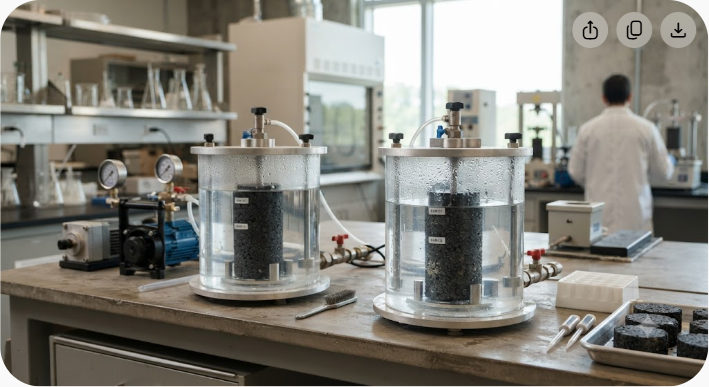
Neither type is universally better for asphalt. The right choice depends on the target mixture properties and the behavior required from the filler system.
Sodium bentonite generally has stronger swelling and water absorption than calcium bentonite. That can produce stronger interaction with water and a different mastic response, but stronger swelling isn't automatically an advantage in pavement applications.
| Property | Sodium bentonite | Calcium bentonite |
|---|---|---|
| Typical swelling tendency | Higher | Lower |
| Water interaction | Strong | Generally lower than sodium bentonite |
| Exchange chemistry | Sodium-dominant exchangeable ions | Calcium-dominant exchangeable ions are common |
| Potential asphalt role | Fine filler with strong surface interaction | Fine filler with lower swelling behavior |
| Main formulation concern | Water sensitivity, dispersion, and workability changes | Different mastic response and filler behavior |
| Selection method | Compare through laboratory asphalt testing | Compare through laboratory asphalt testing |
Don't select a bentonite grade simply because it has the highest swelling index. The properties that make bentonite valuable in a sealing application aren't necessarily the properties that produce the best asphalt mixture.
For pavement work, consider particle-size distribution, mineralogy, moisture content, swelling behavior, specific surface characteristics, compatibility with the binder, and the requirements of the finished mixture.
The answer varies by formulation, but several properties are worth examining during development.
Marshall stability measures the maximum load a compacted specimen can withstand under specified test conditions. It remains a useful laboratory measure for appropriate mix-design applications, although modern pavement design often uses a broader set of performance tests.
Natural bentonite filler has been reported to increase Marshall stability in laboratory mixtures. In the 2018 study discussed above, stability increased from 9.17 kN in the control specimen to 11.57 kN at the reported 15% bentonite replacement level.
That result should be read as evidence from a particular formulation, not as a target that every asphalt producer should attempt to reproduce.
Indirect tensile strength provides information about the tensile response of an asphalt mixture and can help assess cracking-related and moisture-related behavior.
The natural-bentonite study reported higher indirect tensile strength after partial replacement of the mineral filler.
Even so, a higher ITS result doesn't establish better long-term pavement performance by itself. Temperature susceptibility, fatigue, moisture conditioning, deformation, and other project-specific tests may still be needed.
Resilient modulus describes the recoverable response of an asphalt material under repeated loading. It provides useful information about stiffness and structural response.
Research on bentonite-modified asphalt has reported increases in resilient modulus alongside higher stability and tensile strength. The same research also reported reduced moisture-damage resistance.
That combination illustrates why asphalt evaluation should look at a group of performance indicators rather than treating one improved number as the final answer.
Water-related behavior is where bentonite requires especially careful interpretation.
One natural-bentonite filler study reported reduced hydraulic conductivity. Under the conditions of that study, this indicated a less permeable internal structure.
Another study, however, found reduced resistance to moisture damage after bentonite modification.
Those findings aren't necessarily contradictory. Hydraulic conductivity and moisture susceptibility measure different aspects of material behavior. A mixture can become less permeable while still developing an unfavorable binder-aggregate moisture interaction.
For this reason, don't use permeability or water absorption as a substitute for a direct moisture-susceptibility test.
Bentonite's useful properties come with several formulation risks. Most can be managed only by controlling the material condition and testing the finished mixture.
The first concern is moisture. Bentonite interacts strongly with water, while asphalt mixtures depend on effective aggregate-binder adhesion and controlled moisture conditions.
If bentonite increases water retention or interferes with binder coating, the mixture may become more susceptible to stripping and other forms of moisture-related damage.
The risk isn't proof that bentonite will damage every asphalt mixture. It is a reason to measure moisture performance rather than assume it from the mineral's individual properties.
Mineral filler already has a substantial influence on asphalt mastic. Adding excessive ultra-fine clay can increase the surface area that must be coated by asphalt binder.
That can increase binder demand, alter workability, and affect compaction. In a plant environment, an overly fine or moisture-laden filler can also create feeding and handling problems.
Bentonite should be distributed uniformly through the intended filler system. Lumps or poorly dispersed material won't behave like a uniformly distributed fine mineral phase.
Moisture condition matters here as well. Bentonite that has absorbed atmospheric moisture may flow and disperse differently from dry, free-flowing powder during storage, batching, and mixing.
This mistake is particularly easy to make if you're familiar with bentonite in drilling fluids, geosynthetic clay liners, or sealing compounds.
In those applications, swelling can be highly desirable. Asphalt has a different job. The mixture needs to remain stable, compactable, durable, and resistant to traffic and environmental stresses.
The best asphalt filler isn't necessarily the bentonite with the highest free swell.
There is no universal bentonite dosage for asphalt mixtures.
Published studies use different dosage definitions and different material systems. The natural-bentonite filler study examined replacement of the mineral-filler portion at 5%, 10%, 15%, and 20%, with higher replacement levels also examined in additional stability testing.
A separate cold-patch asphalt study used bentonite as part of a combined filler system and identified a laboratory optimum specific to its formulation.
Neither result should be copied directly into a commercial mix design.
A more defensible development program starts with a conventional control mixture and then examines several defined replacement levels. The laboratory should choose the actual levels based on the project specification, material properties, and expected performance risks. A screening series might include low, medium, and higher partial replacements rather than jumping immediately to one percentage.
The objective is to identify both sides of the response: where bentonite begins to provide a useful change and where additional bentonite starts creating undesirable effects.
When discussing bentonite dosage, always specify what the percentage refers to. For example, "15% bentonite" could mean 15% of the mineral-filler fraction, 15% of the total binder mass, or 15% of the entire mixture. Those are very different formulations.
A technically useful asphalt specification should therefore state the reference mass and replacement basis clearly. Ambiguous dosage language makes laboratory results difficult to reproduce and even harder to transfer to plant production.
If you're evaluating bentonite for a commercial asphalt application, treat the work as a material-development program rather than a simple additive trial.
Start with the raw material. Before changing the asphalt mixture, establish what the bentonite actually is and how consistent it is.
Useful characterization can include:
The exact test list should match the intended application and governing specification. A test that matters for drilling-grade bentonite, for example, may not be the most useful quality measure for an asphalt filler.
Prepare the conventional asphalt mixture without bentonite. Record the binder content, aggregate gradation, filler content, air voids, density, and relevant mechanical results.
This control becomes the reference point for every modified formulation. Without it, an apparent improvement may simply reflect a change in another part of the mixture.
Instead of adding an arbitrary quantity, replace a defined portion of the conventional filler and keep the other major formulation variables controlled.
Run several replacement levels rather than relying on a single trial. That approach helps identify whether performance changes progressively, reaches a plateau, or deteriorates after a certain point.

Measure the properties required by the applicable mix-design method. Depending on the mixture, this can include density, air voids, VMA, VFA, binder demand, and compaction behavior.
Pay attention to practical handling as well. A mixture that produces a strong laboratory specimen but becomes difficult to feed, mix, compact, or reproduce at the plant isn't necessarily an improvement.
Depending on the pavement type and project specification, useful tests may include:
Not every project needs every test. Select the test program around the actual failure mechanisms expected in service.
Give this step particular attention when using bentonite.
Compare unconditioned and moisture-conditioned specimens using the test method required for the project. Look for evidence of stripping, loss of tensile strength, or reduced retained strength.
Don't assume that bentonite's ability to absorb water means the finished asphalt will resist water damage. Those are different material behaviors.
Asphalt must perform across a range of temperatures. A filler modification that increases stiffness at one temperature can behave differently at lower temperatures.
Check the relevant high-temperature and low-temperature properties rather than evaluating the mixture under one laboratory condition. The appropriate tests depend on the pavement type, climate, binder, and governing specification.
If the initial results are promising, repeat the work with another representative production lot.
This matters because bentonite is a natural mineral. Deposit characteristics, mineralogy, processing, moisture, and particle-size distribution can vary between sources and lots.
A formulation that works with one laboratory sample isn't automatically a production specification. Reproducibility is part of the specification.
Laboratory performance is only one part of the decision. Before full-scale adoption, check whether the material can be stored, conveyed, metered, and blended consistently with the existing plant setup.
Watch for moisture pickup, bridging, inconsistent feed rates, dust generation, and incomplete dispersion. These issues can be as important as the laboratory performance numbers when the formulation moves into production.
For most pavement projects, the useful comparison isn't bentonite versus no filler. It is bentonite versus the conventional filler that already performs acceptably in the mixture.
| Factor | Conventional mineral filler | Bentonite filler | Practical implication |
|---|---|---|---|
| Water absorption | Often lower | Can be high | Moisture control becomes more important |
| Swelling | Generally low | Can be substantial | Useful in some formulations but requires control |
| Surface area | Varies by material | Often high | Can alter binder demand |
| Mastic behavior | Depends on mineralogy | Strongly influenced by clay properties | Requires mix-specific testing |
| Stability | Established through mix design | May increase in some formulations | Verify experimentally |
| Moisture susceptibility | Depends on aggregate and filler | May improve or worsen | Must be tested directly |
| Workability | Usually familiar to the plant | Can change with bentonite content | Trial batching is important |
| Supply consistency | Depends on source | Depends on deposit and processing | Lot testing can be valuable |
FHWA guidance emphasizes the importance of controlled filler characteristics, including gradation and plasticity, and the need to minimize undesirable clay and shale content in conventional mineral-filler applications.
Bentonite is intentionally a clay-rich material, so it shouldn't simply be judged by conventional filler criteria without considering why it is being introduced. The correct question is whether its specific characteristics produce the required behavior in the finished asphalt mixture.
Bentonite is more active than many conventional mineral fillers. Its interaction with water, fine particle structure, and surface characteristics need to be considered during mix design and handling.
Treating it as though it were simply another source of inert stone dust can hide the very properties that make it behave differently.
High swelling is valuable for sealing and several other industrial applications. It isn't automatically the best characteristic for asphalt.
Choose the bentonite according to the performance objective of the mixture. If lower water interaction produces a better-balanced formulation, a lower-swelling material may be more appropriate than the highest-swelling grade available.
A published 15% replacement level, for example, doesn't mean that every asphalt mixture should contain 15% bentonite filler.
Aggregate structure, binder grade, filler mineralogy, compaction method, replacement basis, and test conditions all influence the result. A research dosage is a starting point for investigation, not a universal specification.
A higher stability result can be useful evidence, but it doesn't answer questions about moisture damage, rutting, cracking, fatigue, temperature sensitivity, or field durability.
Use a performance test program that reflects the pavement's expected service conditions.
Bentonite can pick up moisture before it reaches the mixer. That can affect flowability, dosing, dispersion, and the condition of the material entering production.
Store it under controlled conditions and establish an incoming-material moisture check that is practical for the plant.
Because fine bentonite particles can increase the effective surface area of the filler system, binder demand may change. If binder content and bentonite content are changed simultaneously, it becomes difficult to determine which variable caused a performance change.
Keep the experimental variables controlled wherever possible. If binder content must change, record the reason and treat it as a separate formulation variable.
A lower hydraulic conductivity value may look positive, but it doesn't prove that the asphalt mixture has better resistance to moisture damage.
Permeability describes how readily fluid moves through a material. Moisture susceptibility also depends on the interaction between water, binder, aggregate, and the internal structure of the mixture. Test the property you actually want to improve.
It can be investigated for hot-mix asphalt as a partial mineral-filler replacement, but suitability has to be demonstrated through the relevant mix-design and performance tests.
The research evidence is promising in some areas. Natural bentonite has been evaluated as a partial mineral-filler replacement in asphalt mixtures, with reported improvements in stability, density, indirect tensile strength, and reduced hydraulic conductivity under the conditions tested.
Hot-mix asphalt production, however, introduces practical requirements that a small laboratory experiment may not capture. Bentonite must feed consistently, disperse properly, remain within an acceptable moisture condition, and work with the plant's existing aggregate and binder system.
Production temperature and mixing time also matter. The objective isn't simply to get bentonite into the mixture; it is to produce a uniform material with repeatable properties.
A successful laboratory specimen is the starting point, not the finish line.
Cold-patch formulations provide another area worth investigating because filler composition can influence slurry rheology, forming behavior, strength development, and resistance to environmental conditioning.
A 2025 study investigated bentonite together with cement as a partial replacement for mineral powder in cold-patch asphalt. Its reported laboratory optimum improved forming strength, residual stability, and freeze-thaw splitting strength compared with the relevant control formulation.
The researchers also observed interactions between bentonite and the cement filler system. That suggests the performance effect may come from the combined filler chemistry and structure rather than from bentonite acting independently.
For cold patch, it can therefore make sense to evaluate bentonite as part of a designed filler system rather than assuming it should replace all conventional mineral powder.
Cold-patch materials also have different handling and curing requirements from hot-mix asphalt. A formulation that performs well in a laboratory test still needs to be checked for storage stability, application behavior, early strength, and performance after environmental conditioning.
Once laboratory testing shows that bentonite has potential, the next question is whether the material can be supplied consistently.
Look for a supplier that can provide a defined product specification and representative technical data rather than relying on broad descriptions such as "high swelling" or "high quality."
Useful information can include:
For a large asphalt producer, consistency can matter as much as the headline specification. A change in fine-particle characteristics or moisture can alter how a clay-rich filler behaves during batching and mixing.
If you're evaluating a supplier, ask for representative samples from more than one production lot where practical. Compare the material against the same laboratory test program used during formulation development.
Axewelledge supplies processed bentonite for industrial applications and can be considered when a project requires a consistent mineral source supported by defined quality controls. The appropriate grade should still be selected against the asphalt formulation and verified through laboratory testing rather than chosen solely from a general product description.
Before replacing conventional asphalt filler with bentonite, work through these questions:
Yes, bentonite can improve selected asphalt mixture properties, particularly when it is used as a controlled partial replacement for mineral filler. Published research has reported improvements in stability, density, tensile strength, and other performance indicators. More recent work has also explored bentonite-containing filler systems for cold-patch asphalt.
The qualification is just as important: bentonite isn't automatically a better filler because it has high swelling or high water absorption. Its interaction with moisture can create performance risks, and research has reported reduced moisture resistance in some bentonite-modified mixtures.
The most reliable approach is to start with the pavement's actual performance requirement, characterize the bentonite, define the dosage basis clearly, replace only a controlled portion of the filler, and test the complete mixture. Strength, volumetrics, moisture susceptibility, temperature response, deformation, cracking, and plant handling should be considered according to the project's requirements.
In other words, don't choose bentonite first and then look for a benefit. Define the performance problem first, then test whether a particular bentonite grade solves it without creating a different problem.
If you're sourcing bentonite for asphalt research or industrial filler development, Axewelledge can help you evaluate a consistent mineral supply against your project's technical requirements. The final decision should be based on the tested performance and production behavior of the complete asphalt formulation, not on a single bentonite specification.













Have questions about our products? We're here to help!