Axewelledge, a leading exporter from India, specializes in high-quality Bentonite. With a commitment to excellence, we supply premium Bentonite to the Middle East and Southeast Asia markets.


North Angle Complex, 304,
150 Feet Ring Rd, Opposite Ambedkar Nagar BRTS Stop,
Madhav Park, Punit Nagar,
Mavdi, Rajkot, Gujarat 360004
© Axewelledge 2026, All Rights Reserved.
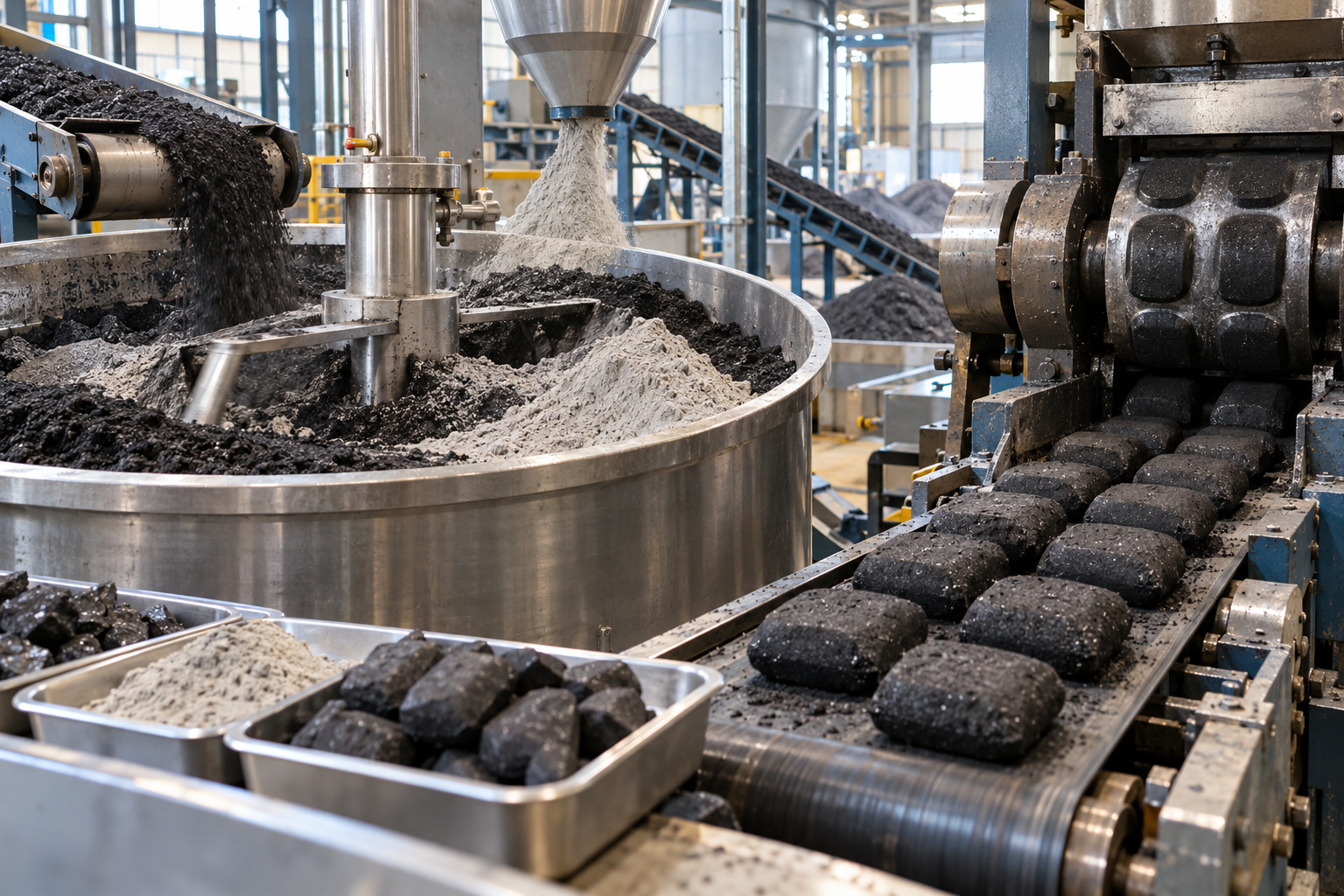
Bentonite works as a binder in coal briquettes by using water, clay cohesion, and mechanical compaction to hold fine coal particles together. When the formulation is properly controlled, hydrated bentonite spreads through the coal blend, occupies gaps between particles, and helps create a compact structure that can withstand handling.
The difficult part isn't making a briquette that holds together. It's finding the point where the briquette is strong enough for transport, storage, and feeding without adding more mineral matter than the application can tolerate. Bentonite itself isn't fuel, so excessive addition can raise ash and reduce the proportion of combustible material.
A 2022 study published in Scientific Reports tested bentonite at 2%, 4%, 6%, 8%, and 10% in briquettes made from subbituminous coal and torrefied biomass. In that particular formulation, increasing bentonite improved several mechanical properties, while higher binder levels reduced calorific value. The researchers reported 2% bentonite as the best balance for their tested mixture. That result is useful as a reference, but it isn't a universal recipe. Coal rank, particle size, bentonite grade, moisture, pressing pressure, curing conditions, and end use can all change the optimum formulation.
Bentonite acts primarily as a mineral binder. When finely divided bentonite is mixed with coal particles and the right amount of water, its clay minerals become more cohesive. During compaction, the hydrated clay can spread across particle surfaces, fill small voids, and help create a continuous binding phase.
Coal fines don't naturally behave like one solid material. Individual particles may touch at many points, but those contacts can be too weak to survive conveying, loading, storage, or repeated handling. A suitable binder strengthens those contacts and helps the compacted mixture retain its shape.
In practical terms, bentonite can help a coal briquetting process:
Bentonite is particularly relevant where an inorganic binder is acceptable. Unlike many organic binders, it doesn't depend on a carbon-based film that is consumed during combustion. Its clay mineralogy, interaction with water, and behavior under pressure are central to how it performs.
That also creates a trade-off. The clay remains part of the mineral fraction of the finished briquette, so binder selection has to consider ash and heating value as well as mechanical strength.
The binding mechanism becomes easier to understand when the process is separated into four stages: hydration, distribution, compaction, and drying or curing.
Bentonite is a clay material dominated by minerals from the smectite group, commonly including montmorillonite. Sodium-rich bentonite is known for its strong interaction with water and swelling behavior.
When suitable bentonite comes into contact with water, hydration changes the way the clay particles interact. The material becomes more dispersed and can form a plastic, cohesive phase that spreads through the coal mixture.
Water therefore does more than make the feed easier to process. It is part of the binding system.
The amount and distribution of water matter. Too little moisture may leave the bentonite insufficiently hydrated and limit its ability to distribute across coal surfaces. Too much can make the feed sticky, increase drying requirements, and interfere with efficient compaction.
The target moisture level has to be established for the actual coal, bentonite, mixer, and press rather than copied from another formulation.
Fine bentonite particles can occupy spaces between larger coal particles. During mixing, hydrated clay spreads over particle surfaces and into the voids within the blend.
A useful way to think about the mixture is that coal provides most of the combustible structure while bentonite creates a mineral binding phase around and between the particles. Uniform distribution matters because concentrated pockets of binder and poorly bonded regions can produce inconsistent briquette properties.
Particle size plays a role here. If bentonite is significantly coarser than intended, it may distribute less evenly. The result can be local variations in binder concentration and potential weak points inside the briquette.
For industrial production, the binder should therefore be treated as a controlled raw material with defined particle-size and moisture specifications rather than simply as a generic clay powder.
Briquetting pressure reduces void space and brings coal and bentonite particles into closer contact. The hydrated clay can deform around particle surfaces and occupy some of the remaining gaps and irregularities.
Mechanical interlocking also contributes to the structure. The binder isn't simply sitting between two coal particles as a separate layer. Under pressure, it can conform to their surfaces and help lock the compacted material together.
One published experimental study using subbituminous coal and torrefied biomass reported a hydraulic pressing pressure of 28 MPa. Within that specific experimental system, cold crushing strength increased as bentonite content increased across the tested range. That pressure should not be treated as a universal production setting. Die geometry, equipment design, feed characteristics, target density, and production rate can all change the required operating conditions.
Freshly pressed briquettes contain moisture. As that water is removed, the clay structure becomes less plastic and the compacted material gains stability.
The exact changes after pressing depend on the formulation and the thermal history of the briquette. The 2022 study mentioned above used room-temperature curing and, for selected tests, subsequent treatment at 300°C under inert conditions. The researchers reported evidence associated with silica-related bonding and mechanical interlocking in the resulting briquettes.
That doesn't mean every coal briquette needs thermal curing. Many commercial processes use different drying or conditioning methods, and some applications may not require the same treatment at all. The important point is that binder performance depends on the full process, including what happens after the briquette leaves the press.
Coal fines are difficult to handle because small particles have a high surface area relative to their mass. They can generate dust, separate during transport, and behave inconsistently in hoppers and feeding equipment.
Briquetting changes the physical form of those fines. Instead of moving loose powder or small particles, the operator handles larger pieces with defined dimensions and substantially different flow and handling characteristics.
Bentonite can support that transformation by increasing cohesion without requiring a large percentage of binder. This can be useful when the process needs better mechanical integrity while retaining as much of the coal's fuel value as practical.
There is a clear limitation, though: bentonite contributes mineral matter rather than combustible energy. As its proportion increases, the coal fraction of the finished briquette decreases. Depending on the grade and dosage, that can increase ash and reduce heating value.
That leads to the main formulation question:
How much binder is enough to meet the handling requirement without unnecessarily sacrificing fuel quality?
The answer has to come from testing.
There is no single bentonite percentage that works for every coal briquette.
A laboratory development program might test a range such as 1% to 10%, depending on the starting material and intended application. The useful dosage is the one that meets the required mechanical and fuel specifications, not simply the one that produces the highest strength.
The 2022 Scientific Reports study tested 2% to 10% bentonite in a mixture containing 95% subbituminous coal and 5% torrefied biomass. At 2% bentonite, the reported briquette HHV was about 24 MJ/kg, while the 10% formulation was about 17.68 MJ/kg. At the same time, higher bentonite levels improved cold crushing strength in that experimental system.
The example shows why binder optimization is a balancing exercise. Mechanical performance and fuel quality don't necessarily move in the same direction when mineral binder content changes.
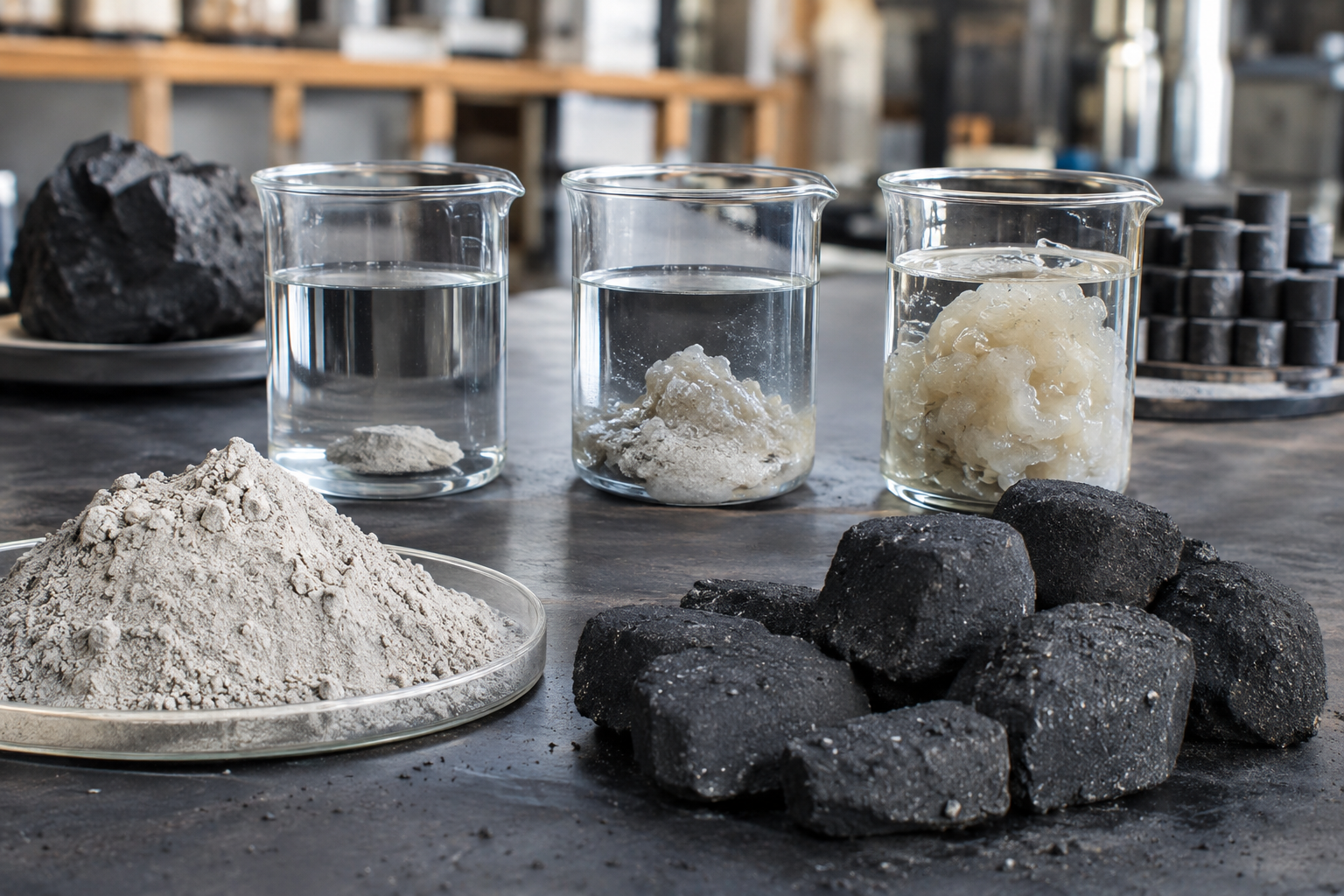
For a new formulation, a controlled trial is more useful than adopting someone else's percentage. A practical development sequence is:
The goal isn't maximum strength at any cost. It is a briquette that is durable enough for its intended handling system while retaining acceptable fuel properties.
The term "bentonite" covers materials with different mineral compositions and processing characteristics. A supplier name alone doesn't provide enough information to predict briquetting performance.
Swelling is one of the best-known characteristics of sodium bentonite. Its interaction with water affects hydration, dispersion, and cohesion within the mixture.
That doesn't mean the bentonite with the highest swelling value will automatically produce the best briquette. Briquetting performance depends on the relationship between the clay, coal, moisture level, mixing conditions, and compaction process.
A grade designed for a sealing application, for example, should not automatically be assumed to be optimal for fuel briquetting simply because it swells strongly.
Fine, consistent bentonite can distribute more evenly through a coal blend. Coarser particles may not spread as uniformly and can contribute to local variations in binder concentration.
Particle size should therefore be included in the raw-material specification and monitored when consistency matters.
Bentonite can contain silica, alumina, iron-bearing minerals, alkali and alkaline-earth elements, and other mineral components in addition to its clay fraction. The actual composition affects the ash introduced into the finished briquette.
Where ash chemistry influences furnace, kiln, or boiler operation, the chemical composition of the selected bentonite deserves particular attention.
Bentonite delivered to a plant may already contain moisture. That moisture should be included when calculating process water addition.
If incoming material moisture changes substantially from one lot to another, the same nominal water addition can produce different working conditions. A stable process therefore needs a way to account for moisture in both the coal and the binder.
Industrial briquetting depends on repeatability. The binder specification should cover the properties that influence the process, such as moisture, particle size, and relevant mineral characteristics, rather than relying only on the commercial product name.
The choice between bentonite and an organic binder depends on the finished briquette specification and the equipment that will use it.
| Factor | Bentonite | Organic binder |
|---|---|---|
| Binder type | Inorganic mineral | Carbon-based or polymeric material |
| Water interaction | Important for hydration and dispersion | Depends on binder chemistry |
| Ash contribution | Adds mineral matter and can increase ash | Often contributes less mineral ash, depending on chemistry |
| Mechanical bonding | Clay cohesion and particle interlocking | Film, matrix formation, or other binder-specific mechanisms |
| Thermal behavior | Mineral residue remains after combustion | Binder may burn, decompose, or react during heating |
| Fuel dilution | Increases with excessive dosage | Depends on binder type and dosage |
| Process sensitivity | Moisture, particle size, mixing, and pressure matter | Chemistry, moisture, temperature, and mixing may matter |
| Selection basis | Strength, ash limits, fuel quality, and process requirements | Fuel properties, emissions, thermal behavior, and process requirements |
Neither category is automatically the right choice for every application. The specification of the finished briquette should determine the selection criteria.
For example, when ash content is tightly controlled, the mineral contribution of bentonite deserves close attention. Where high-temperature structural behavior matters, an inorganic binder may be worth evaluating because it leaves a mineral residue rather than simply burning away. Where preserving the highest possible combustible fraction is the priority, the mineral content of any bentonite formulation becomes more important.
The useful comparison is therefore not simply "bentonite versus organic." It is a comparison of complete formulations under the same test conditions.
Increasing binder content can improve mechanical strength, but strength is only one part of briquette performance.
The clearest concern is dilution of the combustible fraction. As bentonite content rises, the proportion of coal in the finished product falls. Depending on the starting materials, that can increase ash and reduce calorific value.
The published coal-biomass study gives a useful example. Its measured HHV fell from approximately 24 MJ/kg at 2% bentonite to approximately 17.68 MJ/kg at 10% bentonite. Those figures describe one formulation and test program, not a universal relationship between bentonite dosage and heating value.
Higher binder levels can also change combustion behavior, total ash production, and the characteristics of the residue left after combustion. If the briquettes are destined for a furnace, kiln, boiler, or other thermal system, these effects should be evaluated against the operating requirements of that equipment.
One common mistake is to optimize only for compression strength. A briquette can perform well in a compression test and still fail its fuel specification because of excessive ash, lower heating value, or unsuitable combustion characteristics.
The opposite problem is insufficient cohesion.
When the binder level is too low, there may not be enough hydrated clay to bridge the gaps between coal particles. A briquette can look intact when it leaves the press but break apart during drying, conveying, loading, or storage.
Common signs include:
The solution isn't always to add more bentonite. First examine moisture, mixing uniformity, particle size, feed consistency, and compaction conditions. A process problem can easily look like a binder shortage.
Moisture is one of the most important variables in bentonite briquetting because water controls how the clay hydrates and behaves during mixing and compaction.
A dry blend may contain the correct percentage of bentonite and still produce inconsistent briquettes if water isn't distributed evenly. One part of the batch can contain adequately hydrated clay while another remains comparatively dry.
Too little moisture can limit hydration and reduce plasticity. Too much can create sticky feed, increase drying energy, interfere with compaction, and produce surface or dimensional defects.
The correct moisture level must be established experimentally for the specific coal, bentonite, mixer, and press.
One published experimental procedure used water at 10% of the coal and torrefied biomass weight while varying bentonite content. That figure should not be transferred directly to another production process. Water demand changes with coal rank, particle size, clay characteristics, ambient conditions, and equipment design.
For production control, monitor at least:
If those values move significantly, briquette strength and dimensional consistency can move with them.
Sodium bentonite is often considered for applications where strong water interaction, swelling, and cohesive behavior are useful. Calcium bentonite generally has different hydration and swelling characteristics.
Still, "sodium is better" is too broad a conclusion for industrial briquetting. The more useful question is whether a specific grade produces the required bonding behavior at an acceptable dosage under the actual process conditions.
For a commercial evaluation, compare candidate grades using the same coal, moisture content, mixing procedure, pressing conditions, and drying or curing method. That keeps the comparison focused on the binder rather than introducing several process variables at once.
It is also worth checking the final ash chemistry and calorific value. A binder can perform well mechanically and still be unsuitable for the end-use fuel specification.
A controlled process can be organized into seven stages. The exact equipment and operating conditions vary, but the principle is consistent: prepare the raw materials, distribute the binder and water uniformly, compact the blend, then verify the finished briquette.
Remove unwanted contaminants and establish a consistent particle-size distribution. Extremely coarse particles can make packing less uniform, while very fine material can increase surface area and change water and binder demand.
Record the incoming moisture and basic fuel properties before formulation trials begin.
Use a consistent bentonite grade with defined specifications. Check moisture and, where relevant, particle-size distribution and chemical characteristics.
If the binder arrives with variable moisture, adjust process-water calculations accordingly.
Where the process allows, distribute the bentonite through the coal before adding water. The purpose is simple: start with an even distribution of binder so that hydration doesn't create large local differences in clay concentration.
Mixing time and intensity should remain consistent during comparative trials.
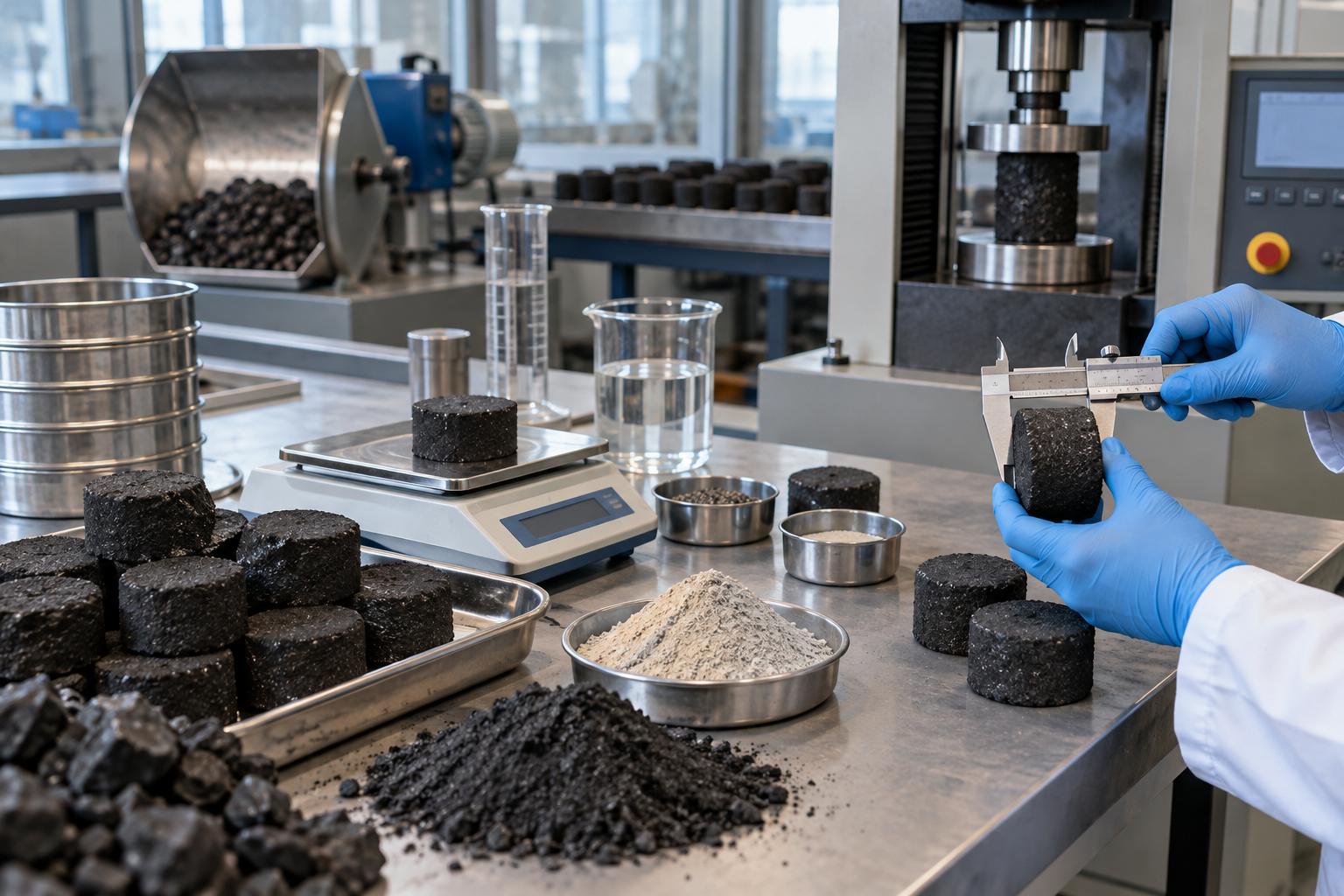
Add water in a controlled manner while mixing. Avoid treating water as a single uncontrolled addition because uneven moisture can create both dry and over-wet regions in the same batch.
The conditioned material should have a repeatable consistency before it reaches the press.
Feed the conditioned blend into the briquetting equipment. During trials, keep pressing pressure, dwell time, die geometry, and feed rate as consistent as practical.
Changes in these variables can affect briquette density and strength independently of binder dosage.
Allow the briquettes to reach the moisture condition required for storage and use. The drying profile depends on the formulation and production system.
Avoid assuming that faster drying is always better. Drying rate, temperature, and final moisture can affect the condition of the finished product.
Test the properties that matter to the customer and end-use equipment. Mechanical strength is important, but it shouldn't be the only acceptance criterion.
Useful tests may include:
No single test captures every aspect of briquette performance. A useful binder evaluation combines mechanical tests with fuel-quality measurements.
Cold crushing strength indicates how much compressive load a briquette can withstand before failure. It is useful for evaluating storage and handling durability, especially when briquettes will experience stacking or mechanical conveying.
The Scientific Reports study reported cold crushing strength values of roughly 19.7 to 40.2 MPa across its tested bentonite levels. Those figures belong to that specific formulation and test method. They should not be treated as a general specification for coal briquettes.
Drop testing shows how the briquette responds to impact. It can be particularly useful when briquettes move between conveyors, bins, trucks, railcars, or loading points.
The test should reproduce the type and height of impact expected during actual handling whenever practical.
Tumbling tests provide an indication of how much material breaks down into smaller particles during repeated mechanical movement.
This is relevant when the product will be conveyed or transferred several times before reaching the final combustion system.
If briquettes will encounter humid storage or outdoor conditions, water resistance needs attention. Bentonite's strong interaction with water is useful during formation, but the finished briquette may respond differently depending on its formulation and drying history.
Storage conditions should therefore be part of the product specification when exposure to moisture is expected.
Calorific value is essential for fuel applications. A mechanically strong briquette may still be unsuitable if its heating value falls below the requirement of the combustion process.
Testing calorific value alongside strength makes the formulation trade-off visible instead of optimizing one property in isolation.
A 2% formulation that works for one coal may fail with another. Coal rank, ash content, particle size, moisture, and surface characteristics all influence binder demand.
Use published results as starting points, not as production recipes.
Compression strength matters, but it doesn't describe fuel quality. Evaluate strength alongside calorific value, ash, moisture, and any combustion-related requirements that apply to the end use.
A nominal 5% addition doesn't represent the same dry-basis binder quantity if the incoming bentonite contains significantly different amounts of water from one lot to another.
Account for moisture when calculating the formulation.
Poor water distribution can produce wet and dry zones within the same batch. The resulting briquettes may vary significantly in density and strength.
Controlled addition and adequate mixing are more reliable than trying to correct the problem after pressing.
Swelling is useful information about bentonite behavior, but it doesn't predict the entire briquetting result. The coal, moisture, particle size, pressure, and drying conditions all influence final performance.
A binder cannot compensate indefinitely for an unsuitable coal particle-size distribution. Packing behavior affects both density and the amount of binder and water needed to form a stable briquette.
Laboratory work is valuable, but production equipment introduces variables such as throughput, residence time, die wear, feed consistency, temperature, and material handling.
A formulation that works in a small press should be validated before it is treated as a production specification.
The most reliable approach is a controlled formulation matrix. Instead of changing several variables at once, select a few binder levels and hold the main process conditions constant.
For example, an initial trial could compare 2%, 4%, 6%, and 8% bentonite. If the results show that the best balance lies between two levels, run a second set of narrower trials around that region.
For each formulation, record at least the following:
| Parameter | Why it matters |
|---|---|
| Binder percentage | Shows the effect of mineral addition on the final briquette |
| Water percentage | Controls hydration, plasticity, and processing behavior |
| Coal particle size | Influences packing, surface area, and binder demand |
| Pressing pressure | Affects density and mechanical bonding |
| Curing or drying conditions | Determines final moisture and influences structure |
| Crushing strength | Measures resistance to compressive failure |
| Drop or abrasion resistance | Measures durability during handling |
| Ash | Shows the mineral contribution to the fuel |
| Calorific value | Measures usable energy content |
| Final moisture | Affects storage, handling, and combustion behavior |
Then select the lowest binder level that consistently meets the actual product specification.
This approach gives the development team a clearer picture of the trade-offs. It also makes scale-up easier because the selected formulation is supported by measured process data rather than a single strength result.
Industrial selection should begin with the finished-briquette specification and work backward to the raw materials. Before choosing a grade, define the required mechanical strength, acceptable ash level, target calorific value, storage conditions, combustion system, and production constraints.
The supplier should be able to provide consistent information about the bentonite, including relevant moisture, particle-size, and mineral characteristics. Where the application is sensitive to ash chemistry, a chemical analysis may also be important.
A representative sample is more useful than a generic product description. Run it with the actual coal and process conditions, then compare the results with other candidate grades under the same test method.
For international procurement, consistency between shipments also matters. Packaging, moisture protection, lot identification, and quality documentation can become important once the formulation moves from laboratory work to regular production.
For industrial buyers, binder selection starts with a consistent raw material and a clear application specification. The supplier needs to understand what the material is expected to do, not simply which product name appears on the purchase order.
Axewelledge supplies bentonite from India for industrial applications and supports mineral supply for international customers. For coal briquetting, the useful discussion is about matching bentonite characteristics with the coal, process conditions, and finished-product requirements.
Before placing a larger order, discuss the intended application, particle-size requirements, moisture expectations, packaging, testing requirements, and target performance. A representative sample followed by a controlled trial can provide much more useful information than selecting a grade from a general-purpose specification alone.
Bentonite works as a coal-briquette binder because hydrated clay can spread through coal fines, occupy gaps between particles, improve cohesive contact, and support a stable structure after compaction and drying.
The important variable isn't simply the amount of bentonite. It is the interaction between binder dosage, water, coal particle size, mixing, compaction, and post-press treatment.
Too little binder can produce fragile briquettes and excessive fines. Too much can increase mineral content, ash, and fuel dilution. Moisture can be just as important as binder percentage because it controls how effectively the clay hydrates and distributes through the mixture.
The strongest briquette in a compression test isn't automatically the best fuel. A useful formulation must satisfy the mechanical requirements of handling while also maintaining the heating value, ash level, and combustion characteristics required by the end user.
For a new coal briquetting project, start with controlled trials rather than a fixed recipe. Test several binder levels, account for incoming moisture, keep process variables consistent, and measure both mechanical durability and fuel quality before scaling up. For industrial bentonite sourcing, Axewelledge can help evaluate a material specification suited to the intended application.













Have questions about our products? We're here to help!