Axewelledge, a leading exporter from India, specializes in high-quality Bentonite. With a commitment to excellence, we supply premium Bentonite to the Middle East and Southeast Asia markets.


North Angle Complex, 304,
150 Feet Ring Rd, Opposite Ambedkar Nagar BRTS Stop,
Madhav Park, Punit Nagar,
Mavdi, Rajkot, Gujarat 360004
© Axewelledge 2026, All Rights Reserved.
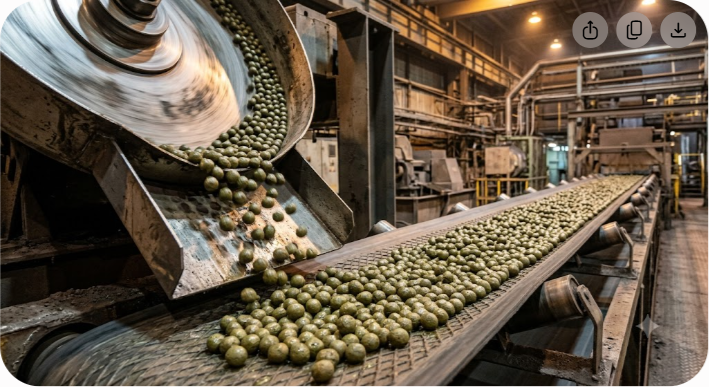
If a green pellet collapses on the conveyor belt between the balling disc and the induration machine, it never gets the chance to reach 2,500 newtons of cold crushing strength in the kiln. It simply becomes undersized fines, blinding the grate bed, choking airflow, and forcing plants to recycle up to 30% of their daily throughput.
In modern iron ore pelletizing plants, green strength—the mechanical integrity of unfired, wet pellets—is the primary bottleneck controlling production capacity. Achieving optimal green compressive strength (typically 1.0 to 1.5 kg/pellet) and a drop number above 4 to 6 impacts every downstream thermodynamic step.
This is where bentonite binder performs its heavy lifting. Added at rates between 0.5% and 1.2% by weight, high-swelling sodium bentonite acts as both a structural adhesive and a hydraulic dampener. It absorbs excess surface moisture, forms viscous liquid bridges between ultrafine iron oxide particles, and builds a flexible clay matrix that survives transport transfers, screen drops, and initial thermal drying.
Understanding the precise physical and surface chemistry mechanisms behind bentonite binders allows plant metallurgists to maximize green pellet performance while tightly controlling silica contamination and raw material costs.
Before analyzing binder physics, we must define what constitutes a structurally sound green pellet. During iron ore beneficiation, iron ore concentrates (magnetite or hematite) are ground down to a fine particle size, typically 60% to 80% passing 44 microns (325 mesh), with a specific surface area (Blaine value) between 1,500 and 2,200 cm²/g.
When water and binders are introduced in a balling drum or disc pelletizer, capillary forces draw these fine particles together into spherical agglomerates ranging from 9.0 mm to 16.0 mm in diameter. However, water alone creates capillary bridges that are fragile and highly sensitive to moisture loss.
Pellet formation follows four distinct physical stages:
A green pellet must satisfy four critical physical quality parameters before entering the induration furnace:
Not all clays are created equal. Bentonite is an absorbent aluminum phyllosilicate clay consisting primarily of montmorillonite. The layered crystal structure of montmorillonite consists of an aluminum octahedral sheet sandwiched between two silicon tetrahedral sheets (a 2:1 layer structure).
When montmorillonite comes into contact with water, water molecules penetrate the interlayer spaces between these triple-layer packages. The nature of the exchangeable cation residing within these interlayers dictates how the clay behaves in an iron ore slurry or damp filter cake.
| Property | Natural Sodium Bentonite | Calcium Bentonite (Un-activated) | Soda-Ash Activated Bentonite |
|---|
| Primary Interlayer Cation | Na + | Ca 2+ | Na + (converted from Ca 2+ ) |
| Free Swelling Capacity | 20 to 30+ mL/2g | 4 to 8 mL/2g | 15 to 22 mL/2g |
| Water Absorption (Enslin) | 500% to 800% | 100% to 200% | 350% to 500% |
| Thermal Stability | Highest (> 600°C) | Moderate | Lower (deactivates earlier) |
| Green Strength Impact | Outstanding | Poor | Moderate to High |
Natural sodium bentonite possesses monovalent Na + ions in its crystal lattice. Because sodium ions have a large hydrated ionic radius and relatively weak electrostatic attraction to the negatively charged clay sheets, water easily wedges the layers apart. This process, called macro-swelling or crystalline swelling, allows Na-bentonite to swell up to 15 to 30 times its dry volume.
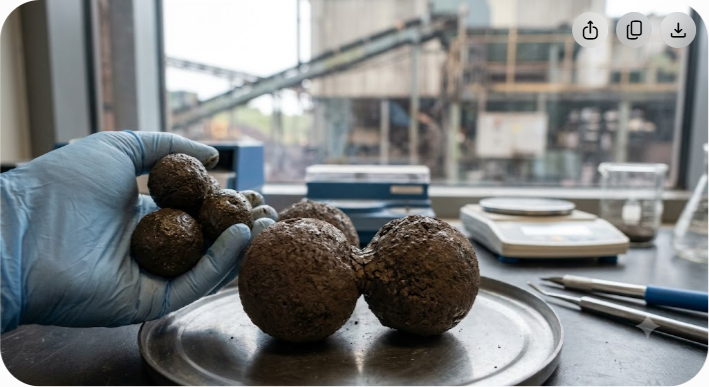
As the clay swells, it disintegrates into hundreds of millions of individual microscopic platelets (less than 1 micron in length with an aspect ratio over 100:1). These microscopic platelets disperse throughout the thin moisture film surrounding each iron oxide grain, creating a gel network with exceptionally high plastic viscosity.
Calcium bentonite contains divalent Ca 2+ ions. The double positive charge binds the adjacent montmorillonite layers tightly together, preventing water from expanding the crystal lattice beyond a few layer thicknesses. As a result, Ca-bentonite exhibits low swelling (4 to 8 mL/2g) and offers minimal green strength enhancement unless chemically activated with sodium carbonate (soda ash).
Even after activation, soda-ash treated calcium bentonites frequently underperform natural sodium bentonites because thermal drying in the induration furnace can reverse the ion exchange or break down the artificially activated gel matrix prematurely.
To visualize how bentonite functions inside a green pellet, consider the microscopic environment during the balling process. As iron ore concentrate leaves the vacuum disc filters, it carries between 8% and 10% moisture. This moisture sits on the surface of the iron particles and fills the void spaces between them.
A viscous hydrogel film coats each iron oxide particle, anchored by monolayer capillary forces and a three-dimensional clay card-house network. This micro-structure resists shear stress during transport transfers and prevents early mechanical collapse.
Here is the step-by-step physical mechanism of how sodium bentonite builds green strength:
When dry, finely ground bentonite is blended into the iron ore concentrate, it rapidly absorbs excess surface water from the iron particles. Unbound liquid water creates weak, sloppy capillary bridges that cause green pellets to deform or stick together in the drum. By absorbing free surface water into its crystal interlayer, sodium bentonite transforms liquid water into an immobile hydrogel film, optimizing the capillary tension within the pore network.
Hydrated montmorillonite platelets carry a negative charge on their flat surfaces and a slight positive charge on their edges. This electrical charge distribution creates a classic "card-house" structure in aqueous suspension. This three-dimensional clay matrix increases the plastic viscosity of the liquid phase between the iron ore grains. As the balling disc rotates, compressive forces press the iron ore particles closer together, forcing the viscous bentonite gel into the micro-voids.
Iron ore concentrates are dense, abrasive mineral particles with high specific gravity (4.8 to 5.2 g/cm³). Without a binder, these particles slide past one another easily when subjected to external shear forces. The high aspect ratio of fully exfoliated bentonite platelets imparts a high microscopic surface area that coats the rough contours of the magnetite or hematite grains. This coating dramatically increases internal friction, preventing grain-boundary sliding under mechanical stress.
Green pellets undergo constant deformation as they roll down transfer chutes and pass over vibrating roller screens. The tensile strength of the wet pellet film—often referred to as wet web strength—determines whether the pellet stretches plastically or cracks open under load. Sodium bentonite increases wet web tensile strength by establishing cohesive hydrogen bonds across the water-clay interface, allowing the pellet to absorb energy during physical impacts.
While green strength protects the pellet during wet handling, dry strength protects the pellet during the pre-heating and drying zones of the induration furnace. Once the green pellets enter the traveling grate or shaft furnace, hot process gases (150°C to 400°C) evaporate the moisture within the pellet bed.
As moisture evaporates, capillary forces vanish completely. If water were the only binder, the dried pellet would crumble back into fine dust under the weight of the burden above it. This leads to severe bed compaction, high pressure drop across the grate, and uneven gas flow.
Bentonite solves this critical transition phase through solid-state bridging:
In recent years, iron ore pelletizing operations have evaluated organic binders—such as carboxymethyl cellulose (CMC), polyacrylamides, starches, and lignosulfonates—to eliminate the silica and alumina penalties associated with bentonite.
Because bentonite contains roughly 55% to 65% SiO 2 ?
and 15% to 20% Al 2 ?
O 3 ?
, every 1.0% of bentonite added to an iron ore mix increases the silica content of the finished pellet by approximately 0.5% to 0.6%. In direct reduction (DRI) pellet specifications, where total silica must remain below 1.5% or 2.0%, this chemical addition is an operational constraint.
However, organic binders present their own technical limitations, making a direct comparison essential:
| Operational Factor | Natural Sodium Bentonite | Organic Binders (CMC / Polymers) | Composite Binders (Bentonite + Organic) |
|---|---|---|---|
| Typical Dosage Rate | 0.60% – 1.00% | 0.03% – 0.10% | 0.20% – 0.40% |
| Green Compressive Strength | High (1.2 – 1.6 kg/pellet) | Moderate (0.8 – 1.1 kg/pellet) | High (1.1 – 1.4 kg/pellet) |
| Green Drop Number | Excellent (5 – 8 drops) | Moderate to Good (3 – 5 drops) | High (5 – 7 drops) |
| Dry Compressive Strength | Exceptional (> 3.0 kg/pellet) | Very Low (< 1.5 kg/pellet) | Moderate to High (2.0 – 3.0 kg) |
| Thermal Shock Resistance | Superior (> 400°C) | Poor to Fair (220°C – 300°C) | Good (320°C – 380°C) |
| Silica (SiO 2 ?
) Addition | +0.35% to +0.60% | 0.00% | +0.10% to +0.25% |
| Moisture Sensitivity | Highly forgiving | Narrow operating window | Moderately forgiving |
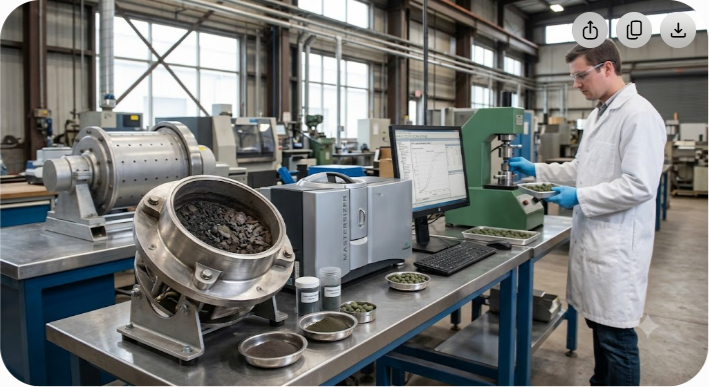
While organic binders leave no inorganic ash behind during firing, they decompose at temperatures between 200°C and 250°C—long before hematite or magnetite particles begin sintering together at temperatures above 1,000°C. This creates a dangerous "strength valley" in the pre-heating zone of the induration furnace, where pellets lose organic binding before ceramic bonds form.
Furthermore, organic binders do not absorb excess moisture in the same manner as montmorillonite clay. If the filter cake moisture surges by even 0.5%, green pellets made with organic binders become sticky, deform into oversized lumps, or adhere to conveyor transfer plates.
As a result, many world-class pellet plants utilize a hybrid binder system or rely on high-yield, low-dosage sodium bentonite grades to achieve maximum physical performance while minimizing chemical impurities.
Because every additional kilogram of bentonite introduces unwanted silica into blast furnace or DRI feeds, modern pellet plant engineers focus heavily on binder optimization. Below are four proven strategies to lower your bentonite consumption rate while maintaining target green and wet strength metrics.
Bentonite requirements spike when raw concentrate moisture fluctuates unpredictably. When moisture is too low, pellets fail to nucleate; when too high, excessive bentonite must be added simply to act as a drying agent. Implementing automated moisture control sensors on vacuum disc filters or ceramic filters ensures the concentrate enters the mixer within a narrow band (e.g., 8.8% ± 0.2% moisture), allowing binder dosage to be reduced by up to 15%.
Simply dropping dry bentonite onto a moving belt carrying damp ore results in poor dispersion, clumping, and wasted binding capacity. Utilizing high-intensity vertical or horizontal intensive mixers subjects the ore-bentonite blend to high shear forces. This mechanically exposes the montmorillonite particles directly to free moisture, forcing rapid hydration and uniform distribution across every iron ore grain. Plants converting from simple ribbon blenders to intensive mixers frequently report dropping their bentonite dosage from 0.90% to 0.60% with zero loss in drop number.
Compared to low-shear belt blending where un-hydrated bentonite clumps lead to wasted binder and lower strength, high-shear intensive mixing fully delaminates clay platelets, forming a microscopic coating that maximizes strength at lower dosages.
Not all industrial bentonites deliver equal binding efficiency. Switching from a medium-grade sodium bentonite (swelling volume of 16 mL/2g) to an ultra-premium natural sodium bentonite (swelling volume > 24 mL/2g, liquid limit > 500%) allows pelletizing plants to achieve identical green strength at significantly lower additions (e.g., reducing dosage from 0.8% down to 0.5%).
The surface area of the iron ore concentrate directly influences how green pellets pack together. Increasing the specific surface area (Blaine fineness) from 1,600 cm²/g to 1,900 cm²/g increases particle contact points, enhancing the efficacy of capillary forces and bentonite gel bridges. However, over-grinding must be avoided, as extremely fine slimes increase water demand beyond optimal levels.
To illustrate the impact of bentonite binder selection on green strength and induration performance, let us examine a representative operating scenario from a North American pelletizing facility processing a magnetite concentrate.
2 ?
) contribution from binder by 0.20% absolute, improving blast furnace hot metal yield and lowering flux consumption downstream.
When evaluating bentonite suppliers for iron ore pelletizing, procurement managers and metallurgical specialists should demand rigorous testing against international standards (such as ISO 13500 or ASTM guidelines tailored for iron ore binders).
Key technical specifications include:
| Quality Parameter | Target Industry Specification Range |
|---|---|
| Montmorillonite Content | ? 75% to 85% (determined by XRD / Methylene Blue index) |
| Free Swelling Volume | ? 20 to 30 mL / 2 grams |
| Liquid Limit (Atterberg) | ? 450% to 600%+ |
| Water Absorption (Enslin) | ? 500% in 2 hours |
| Moisture Content (As-shipped) | 8.0% to 12.0% (prevents premature degradation) |
| Particle Size (Fineness) | Minimum 85% to 95% passing 75 microns (#200 mesh) |
| Exchangeable Cation Ratio | High Na + /Ca 2+ ratio (> 2.5) |
Partnering with a vertically integrated miner and processor like Axewelledge guarantees that these mineralogical properties remain consistent from shipment to shipment. With direct control over high-grade sodium montmorillonite reserves, advanced refining technologies, and dedicated metallurgical testing, global iron ore producers can secure the precise physical binder profiles needed to maximize green pellet survival rates while protecting chemical purity.
Green strength is not merely an arbitrary quality control metric—it is the operational shield that protects your green pellets from the moment they emerge from the balling disc until they sinter inside the induration kiln.
By selecting a high-purity natural sodium bentonite binder, optimizing moisture uniformity, and introducing high-shear intensive mixing, pelletizing operations can:
Investing in binder quality pays immediate dividends in reduced bed blinding, lower recirculating fines, higher fuel efficiency, and optimal plant throughput.
Whether you are aiming to lower your silica footprint, increase green drop numbers, or optimize your balling circuit for DRI-grade pellet production, Axewelledge provides high-yield sodium bentonite solutions tailored to your mineralogy. Contact our industrial technical support team today to request samples, arrange laboratory comparative testing, or discuss bulk global supply logistics.













Have questions about our products? We're here to help!