Axewelledge, a leading exporter from India, specializes in high-quality Bentonite. With a commitment to excellence, we supply premium Bentonite to the Middle East and Southeast Asia markets.


North Angle Complex, 304,
150 Feet Ring Rd, Opposite Ambedkar Nagar BRTS Stop,
Madhav Park, Punit Nagar,
Mavdi, Rajkot, Gujarat 360004
© Axewelledge 2026, All Rights Reserved.
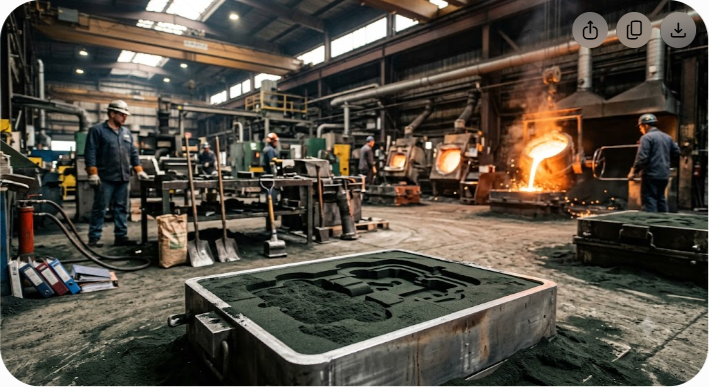
When a green sand mold yields a rough surface, internal scab defects, or an unexpected dimensional shift, foundry teams often blame pouring temperatures or gating design. More often than not, the true culprit lies beneath the surface: the quality and condition of the bentonite clay binder. In modern green sand metal casting, bentonite clay is not just an additive—it is the structural matrix holding the mold intact under extreme thermal and mechanical shock.
Premium bentonite clay acts as a microscopic hydraulic gel that coats individual silica sand grains. When mixed with water and muller energy, it creates a flexible, cohesive film capable of holding complex shapes under pressure, surviving molten metal contact up to 1,500°C (2,732°F) or higher, and collapsing cleanly during shakeout. Selecting and maintaining the correct bentonite chemistry dictates your scrap rates, surface finish, and overall sand system economics.
To control green sand performance, you must understand the mineralogy of bentonite. Bentonite is a natural clay composed primarily of montmorillonite, a 2:1 expandable hydrated aluminum silicate.
Each montmorillonite crystal consists of an octahedral sheet sandwiched between two tetrahedral silica sheets. What makes this mineral special for foundry applications is its net negative structural charge, caused by natural crystal lattice substitutions (like magnesium replacing aluminum). This negative charge attracts hydrated cations—typically sodium (Na + ) or calcium (Ca 2+ )—into the interlayer space between crystal sheets.
+-------------------------------------------------------+
| Silica Tetrahedral | +-------------------------------------------------------+
| Aluminum Octahedral | +-------------------------------------------------------+
| Silica Tetrahedral | +-------------------------------------------------------+ [ Interlayer Region: Na+ or Ca2+ & H2O ] +-------------------------------------------------------+
| Silica Tetrahedral | +-------------------------------------------------------+
When water enters this interlayer region, the clay swells and develops its signature viscosity and green strength. How much it swells, how fast it hydrates, and how well it survives heat depends heavily on which primary cation sits in that interlayer space.
Foundries around the world rely on two primary types of bentonite clay: natural or activated sodium bentonite and calcium bentonite. Understanding their unique performance profiles helps you select the right binder balance for your specific metal, section size, and production volume.
Sodium bentonite features single-valence Na + ions in its interlayer space. Because sodium ions hold water molecules loosely, water can easily enter between crystal layers, causing the clay to swell up to 15 to 20 times its original dry volume.
Calcium bentonite contains divalent Ca 2+ ions. Because the double-positive charge holds the crystal sheets tightly together, water cannot hydrate the inner layers as dramatically. Swelling is typically limited to 2 to 4 times its original volume.
| Performance Metric | Natural Sodium Bentonite | Calcium Bentonite | Soda-Ash Activated Bentonite |
|---|---|---|---|
| Swelling Capacity | 15–20x dry volume | 2–4x dry volume | 8–12x dry volume |
| Green Compression Strength | Moderate to High | Very High | High |
| Wet Tensile Strength | High (0.25–0.40 N/cm 2 ) | Low to Moderate | Moderate | | Thermal Durability | Exceptional (>600 ? C) | Low (<400 ? C) | Moderate (450–500 ? C) |
| Shakeout & Collapsibility | Moderate | Excellent | Good |
| Primary Metal Application | Medium to Heavy Iron, Steel | Aluminum, Non-Ferrous, Light Iron | General Ferrous Casting |
Many modern foundries use blended clay systems (e.g., 70% sodium / 30% calcium) to balance high thermal resistance with fast mulling speed and clean shakeout.
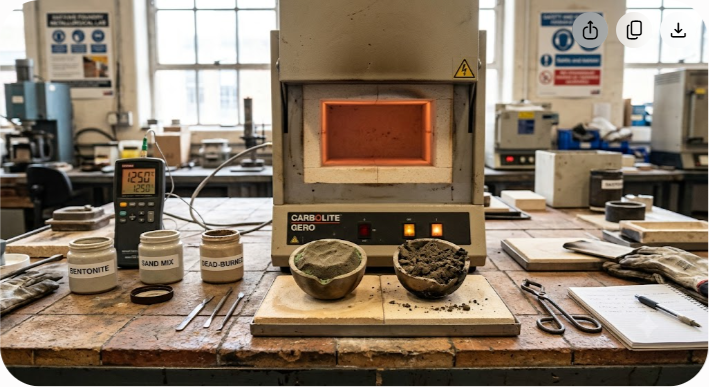
The binding process in green sand relies on three physical phenomena working simultaneously: hydration, mechanical mulling, and water-film bridges.
When water is added to dry molding sand containing 6–8% bentonite, the clay flakes absorb moisture and form a plastic paste. Physical mulling exerts shear force, smearing this sticky clay paste thinly and uniformly across the smooth surfaces of silica or chromite sand grains.
[ Sand Grain ] === ( Hydrated Bentonite Layer ) === [ Water Film Bridge ] === ( Hydrated Bentonite Layer ) === [ Sand Grain ]
To ensure consistent quality, quality control labs evaluate several key parameters when sourcing premium bentonite:
Measured in milliliters per 2 grams of dry clay. High-grade sodium bentonites score between 24 mL and 36 mL. A drop in swelling capacity indicates lower montmorillonite purity or thermal degradation.
Measures the active montmorillonite content in both fresh clay and recycled system sand. Expressed in milliequivalents per 100 grams (meq/100g) or percentage of active clay. Premium bentonites show MBV numbers above 80–90 meq/100g, ensuring maximum binding capacity per ton of material.
Every bentonite has a temperature threshold where structural water (OH ? hydroxyl groups) leaves the crystal lattice permanently. Once dehydroxylation occurs, the clay loses its swelling capacity and can no longer hold sand grains together—it becomes inert "dead clay."
Higher thermal durability directly lowers clay consumption rates per metric ton of melted iron or steel.
Determines how much water the clay requires to reach its optimal plastic state. Clay with a high liquid limit provides a wider operating window for compactability, helping you avoid brittle sand that crumbles during core placement or pattern draw.
When your sand system is out of balance, the casting surface shows it immediately. Here is how to diagnose and fix common binder-related defects:
+---------------------------------------+
| Green Sand Defect Diagnosis Protocol | +---------------------------------------+ | +---------------------------------+---------------------------------+
| | | v v v [ Expansion Defects ] [ Erosion Defects ] [ Gas Defects ] (Scabs, Rat Tails) (Sand Wash, Cut) (Pinholes, Blows)
| | | v v v
2 .
Achieving consistent mold quality requires precise control of your mulling, moisture, and sand testing cycles. Follow this standard process to optimize your green sand system:
Select high-purity silica sand (or chromite for heavy sections) with an AFS Grain Fineness Number (GFN) typically between 45 and 60. Ensure sand temperatures entering the muller stay below 40°C (104°F). Hot sand evaporates water prematurely, causing micro-cracking in clay films.
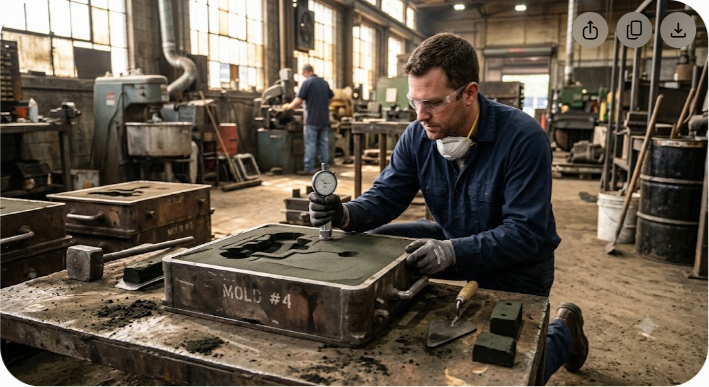
Maintain active clay content between 6.5% and 8.5% of total sand weight depending on core burden and metal choice. Introduce pre-blended additives (bentonite plus carbonaceous additives like sea coal or lustrous carbon formers) to improve surface finish.
Add water gradually to target a compactability range of 38% to 44%. Allow sufficient mulling time for high shear energy to smear the clay thin over every grain.
Pro Tip: Addition order matters. Always dry-mix sand, return sand, and bentonite for 10–15 seconds before adding water. Adding water directly to dry clay clumps creates unhydrated "clay balls" that ruin surface finish.
Test sand samples every 15–30 minutes for three essential indicators:
2 (20–32 psi).
Every time metal enters a mold, a portion of the bentonite clay closest to the casting loses its structural water and dies. This dead clay accumulates in the sand system as inert dust.
$$ ext{Active Clay Ratio} = left( rac{ ext{Methylene Blue Active Clay %}}{ ext{Total Clay Content %}} ight) imes 100$$
If your active clay ratio falls below 70%, the excess dead clay absorbs water without providing strength. This forces operators to add extra moisture, raising steam volume and risking gas blowholes.
?m) without pulling out active, unhydrated bentonite particles.
Foundry operations require steady, uniform mineral inputs. A sudden shift in bentonite swell index or moisture demand can disrupt automated molding lines, causing costly downtime.
When evaluating global suppliers, focus on these logistics and quality benchmarks:
passing 200 mesh / 75 microns).
Foundries operating in high-volume regions—such as North America, Europe, the Middle East, and Southeast Asia—benefit from partnering with vertically integrated producers capable of providing consistent product specifications batch after batch.
Foundry sand technology continues to evolve, driven by environmental regulations and demands for tighter casting tolerances. Three key trends are transforming how foundries use bentonite:
Producers now create customized blends combining high-durability natural sodium bentonite with precisely activated clays. These blends deliver rapid hydration for short mulling cycles while retaining high wet tensile strength under severe heat load.
To improve workplace air quality and reduce silica dust exposure, modern binder systems incorporate dust-suppressed pre-blends that incorporate bentonite, lustrous carbon formers, and organic modifiers in a single low-dust package.
Automated sand plant control systems now measure returned sand temperature, moisture, and compactability instantly, adjusting water and fresh bentonite dosage in real time before the sand reaches the molding machine.
Use this quick diagnostic checklist to evaluate your green sand clay system:
By taking a structured, mineral-first approach to molding sand, foundries can reduce scrap rates, improve casting surface finish, and lower overall operating costs.
In modern metal casting, green sand control remains one of the most reliable ways to achieve lower cost per casting and superior dimensional stability. By choosing high-purity sodium and calcium bentonites tailored to your foundry's thermal and mechanical demands, you build a robust sand system that resists thermal shock, minimizes expansion defects, and keeps shakeout operations running smoothly.
Whether you are producing high-precision aluminum components or heavy gray iron engine blocks, consistent casting quality starts with high-grade, reliably sourced minerals.
For consistent, high-performance binder solutions backed by massive raw reserves and deep mineral expertise, explore how Axewelledge supplies global foundries with premium sodium bentonite designed to meet demanding industrial specifications.













Have questions about our products? We're here to help!