Axewelledge, a leading exporter from India, specializes in high-quality Bentonite. With a commitment to excellence, we supply premium Bentonite to the Middle East and Southeast Asia markets.


North Angle Complex, 304,
150 Feet Ring Rd, Opposite Ambedkar Nagar BRTS Stop,
Madhav Park, Punit Nagar,
Mavdi, Rajkot, Gujarat 360004
© Axewelledge 2026, All Rights Reserved.
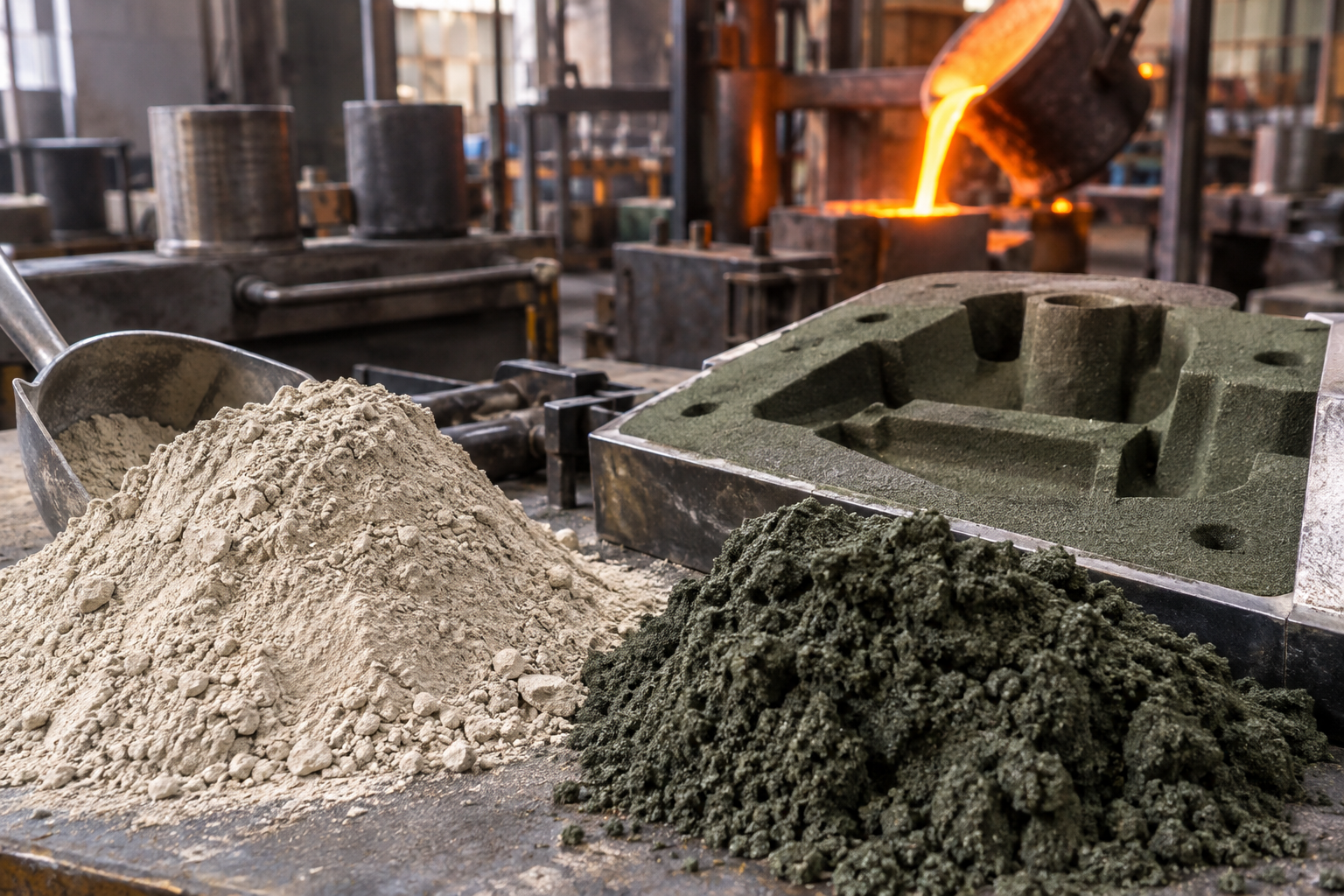
Bentonite casting sand bond strength depends on four things working together: the quality and type of bentonite, the amount of water available to activate it, the way the sand is mulled, and the condition of the circulating sand system. Get that balance right and the mold can compact well, retain its shape, resist erosion, and survive metal pouring without losing its surface integrity.
The important point is that bentonite doesn't simply act like glue. In a green sand system, water activates the clay, the clay coats the sand grains, and mechanical mulling distributes that active clay throughout the mixture. The resulting clay films and grain-to-grain contacts give the molding sand its green strength. At the same time, the system must retain enough permeability for gases to escape.
That balance is what makes foundry sand control a process rather than a single-material decision. Adding more bentonite or more water isn't automatically a way to make a stronger mold. In some cases, either change can make the sand harder to control.
A green sand mold is mainly a mixture of aggregate, usually silica sand, bentonite, water, and smaller amounts of other system materials. The sand provides the structure. Bentonite supplies much of the bonding action, while water activates the clay and gives the mixture the plasticity needed for molding.
Bentonite used in foundry applications contains a significant proportion of montmorillonite, a layered clay mineral. When the clay is properly hydrated, water enters between its mineral layers and changes the clay's physical behavior. The hydrated clay becomes more plastic and can form thin films around the surfaces of the sand grains.
During mulling, those clay films are spread across the aggregate. When the prepared sand is compacted, neighboring grains come into close contact and the hydrated clay helps hold the structure together. This produces the strength needed to transport, handle, pattern, and close the mold before pouring.
The term green strength refers to the strength of the mold while it still contains its working moisture. It is different from dry strength and hot strength. A sand system can perform well in one of these areas and still have a problem in another.
For example, increasing moisture may improve plasticity and help clay films develop, but excessive water can reduce permeability and weaken the compacted structure. Similarly, adding more clay can increase bonding potential but may also increase fines and affect gas flow. Good sand control is therefore about finding the operating range rather than maximizing one number.
The bonding mechanism becomes easier to understand at the particle level.
Dry silica sand has little inherent cohesion. The individual grains can move freely because there is no substantial binder holding them together. Once active bentonite and the correct amount of water are introduced, the situation changes.
Hydrated bentonite develops a plastic, cohesive character. During mulling, this material is distributed over the sand surfaces. The objective isn't to leave visible pockets of clay between the grains. The objective is to develop an even working film throughout the sand mass.
When the molding machine applies pressure, the coated grains rearrange and pack together. The hydrated clay contributes to the cohesion between the particles and helps the mold retain the shape created by the pattern.
Several factors affect the final bond:
This is why a foundry can use the same nominal bentonite addition rate and still see different mold performance from one sand system to another.
The distinction between sodium and calcium bentonite matters because the exchangeable cations associated with montmorillonite influence swelling, water interaction, and bonding behavior.
Sodium bentonite generally has higher swelling capacity than calcium bentonite. That characteristic can make sodium bentonite useful where strong, durable clay bonding and good mold performance are required. Calcium bentonite generally has lower swelling capacity and behaves differently during hydration and heating.
However, it is too simplistic to describe one type as universally suitable and the other as unsuitable. Foundries often use blended systems, and actual performance depends on the grade of bentonite, mineral composition, sand, moisture, additives, molding process, and metal being poured.
| Property | Sodium Bentonite | Calcium Bentonite | Practical Foundry Consideration |
|---|---|---|---|
| Swelling capacity | Generally high | Generally lower | Influences water demand and clay-film development |
| Water response | Strong hydration and swelling | Lower swelling response | Affects preparation and compactability |
| Green bonding | Can provide strong bonding when properly activated | Can provide useful green bonding | Depends on grade and system conditions |
| Dry strength | Often strong | Typically lower than comparable sodium grades | Important for mold handling and drying behavior |
| Thermal behavior | Depends on grade and system chemistry | Depends on grade and system chemistry | Test actual foundry performance rather than relying on clay type alone |
| Typical use | Common in demanding green sand systems | Used in selected systems and blends | Application should be based on testing and process requirements |
For this reason, purchasing decisions should focus on measurable foundry properties rather than the label alone. Swelling behavior, active clay content, moisture demand, green strength, compactability, and thermal performance all matter.
Moisture is one of the most important variables in a green sand system. Bentonite needs water to hydrate and develop its bonding properties, but excess water can create a different set of problems.
When moisture is too low, the clay may not hydrate adequately. The sand can become harsh, difficult to compact, and prone to poor mold surface quality. Green strength may fall because the clay has not developed the plasticity needed to form effective films around the sand grains.
When moisture is too high, the sand may become overly plastic or sticky. Excess water can reduce permeability, increase the amount of vapor generated during pouring, and contribute to defects associated with trapped gases or poor mold venting. It can also change the way the sand compacts and flows through the molding equipment.
There is no single moisture percentage that applies to every foundry. Values often fall within a relatively narrow operating range, but the correct target depends on the sand, bentonite grade, active clay level, additives, grain distribution, compactability target, molding process, and alloy.
A foundry should therefore establish its moisture target from its own process data rather than treating a generic percentage as a universal specification. Routine testing is far more useful than making large adjustments based on mold appearance alone.
Moisture content by itself doesn't tell the whole story. Compactability provides additional information about how the prepared molding sand responds to compaction.
A sand system with low compactability may be too dry, insufficiently mulled, or affected by changes in clay condition and sand distribution. High compactability can indicate excessive moisture or other changes in the system.
The target compactability range is process-specific. Some green sand molding operations may operate around the high-30s to mid-40s percent range, but the correct value should come from the foundry's established process window and testing program rather than a universal target.
The useful approach is to look at moisture, compactability, green compression strength, permeability, active clay, and other relevant tests together. A single number rarely explains a mold failure by itself.
Mulling is where the ingredients become a working molding material. Simply placing sand, bentonite, and water into a mixer isn't enough.
The mulling process supplies mechanical energy that breaks up clay agglomerates, distributes moisture, and works the activated clay onto the sand surfaces. Depending on the equipment, this action can involve compression, shearing, smearing, kneading, or a combination of these effects.
Poor mulling can leave some areas rich in clay while other grains receive inadequate coating. The total bentonite addition may look correct on paper, yet the sand can still produce inconsistent molds.
Over-mulling isn't automatically beneficial either. Excessive mechanical work can alter the sand system, affect temperature, and change the condition of the circulating material. The appropriate mulling cycle should therefore be established for the specific mixer, sand system, and production rate.
A typical preparation sequence includes these steps:
The exact timing depends on the equipment and formulation. A fixed mulling time copied from another foundry isn't necessarily the right answer.
A circulating green sand system changes every time a mold is made, poured, shaken out, cooled, and returned to production. Some of the bentonite remains useful, while another portion can lose its bonding effectiveness after repeated thermal exposure.
Foundry personnel often refer to thermally degraded or otherwise inactive clay as dead clay. This material no longer contributes to bonding in the same way as active bentonite. The exact behavior depends on the temperature history and mineral composition of the system.
Dead clay and other accumulated fines can affect permeability and make the system harder to control. Simply adding more fresh bentonite may not solve the underlying problem because the inactive material remains in circulation.
A better approach is to monitor the condition of the sand system and control the balance between active clay, inactive material, fines, and fresh additions.
The methylene blue test is commonly used to estimate the amount of active clay in foundry sand. It measures the clay's ability to adsorb methylene blue and is useful for monitoring changes in active clay content.
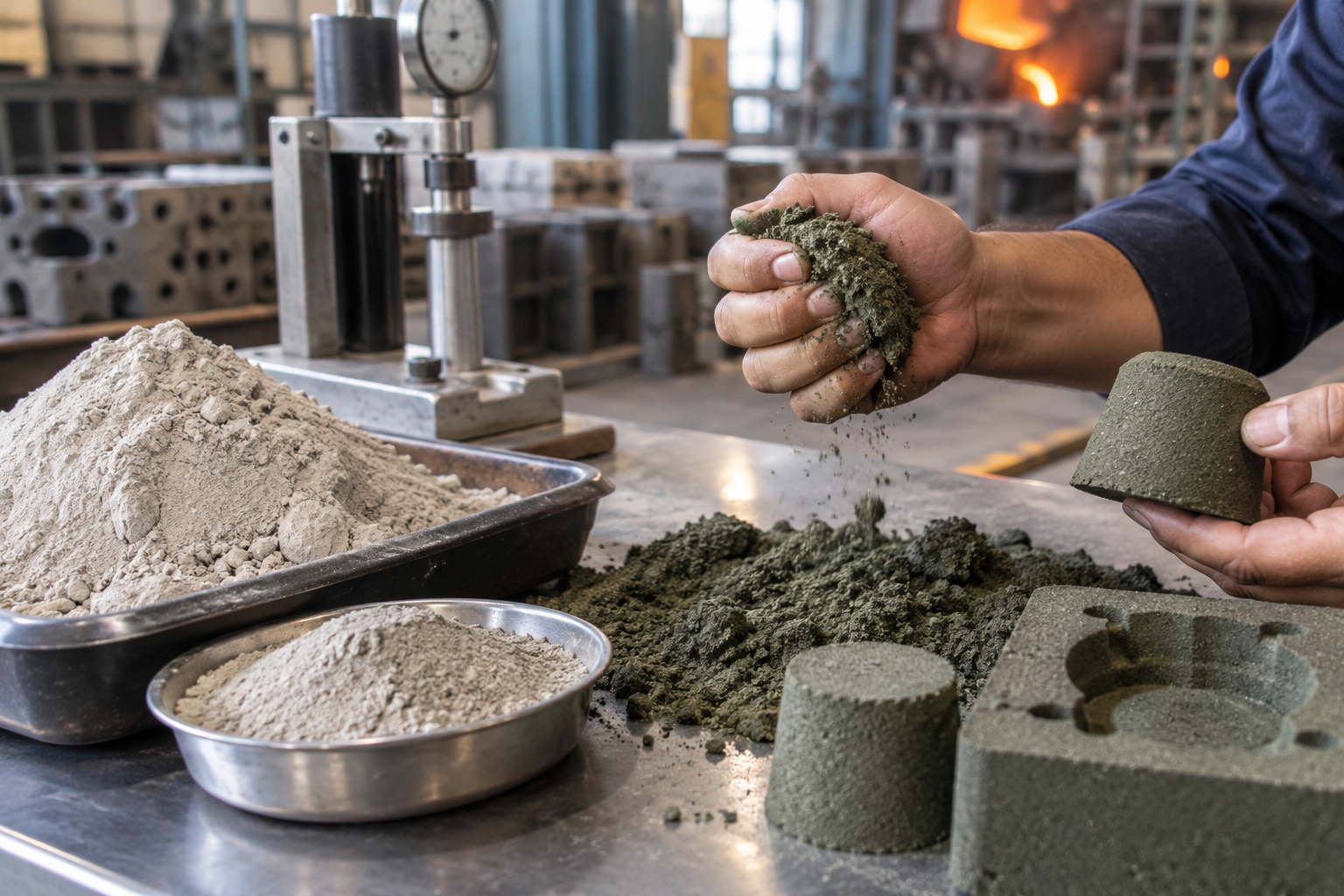
It is important to understand what the test actually tells you. It isn't a direct measurement of every aspect of bentonite performance, and it shouldn't be treated as a complete substitute for strength, moisture, compactability, permeability, or other relevant tests.
For production control, the most useful picture comes from combining several measurements and comparing them with casting results.
If green sand molds are failing, adding more bentonite should not be the first automatic response. Start by identifying what changed.
Confirm the actual moisture content and compare it with the established process range. Check the water addition equipment as well. A blocked spray nozzle, inaccurate flow meter, or uneven water distribution can create a problem even when the total water addition looks normal.
If active clay has fallen below the required level, fresh bentonite may be necessary. But first determine whether the system contains excessive inactive clay or fines that are affecting the balance.
Check whether the mixer is delivering consistent mechanical work. Look at blade or roller condition, loading, cycle time, sand temperature, and discharge consistency.
Compactability can reveal whether the prepared sand is behaving differently from the established process window. Compare the result with moisture and strength measurements rather than interpreting it in isolation.
Changes in grain size distribution can affect both mold strength and permeability. A system that becomes too fine may require different moisture and binder conditions and may also become less permeable.
A mold that breaks during handling has a different problem from a mold that erodes during pouring. Likewise, gas defects aren't automatically evidence of insufficient bond strength. Identify when and where the failure occurs before changing the recipe.
High bond strength isn't the only objective. A good molding sand must also allow gases to escape.
Permeability describes the ability of the mold to allow gases and air to pass through its pore network. If the sand becomes excessively fine, overly compacted, or overloaded with moisture and fines, permeability can fall.
This creates an important process balance. Increasing clay or changing moisture may improve one property while reducing another. The goal is a stable combination of mold strength, compactability, permeability, surface quality, and resistance to erosion.
For example, a very strong mold isn't necessarily a successful mold if gas cannot escape during pouring. Likewise, highly permeable sand isn't useful if the mold surface lacks enough cohesion to resist erosion from the incoming metal.
The correct target is therefore a process window, not the maximum possible strength value.
Foundry discussions sometimes use mold strength as though it were one measurement. In practice, several different properties matter.
Green strength describes the mold's ability to retain its shape while it is still in its prepared, moist condition. It matters during pattern withdrawal, mold handling, closing, and pouring.
Dry strength relates to the strength of the mold after significant moisture has been removed. It can matter in applications where portions of the mold become relatively dry or where mold handling exposes the sand to drying.
Hot strength concerns the behavior of the mold when exposed to the temperatures associated with molten metal. Thermal expansion, binder behavior, sand characteristics, and casting geometry all influence what happens during pouring.
A bentonite grade that performs well in one strength test isn't automatically the best choice for every casting process. The test must match the production problem.
More bentonite isn't always better. Excess clay can increase fines, change permeability, alter moisture demand, and make the system more difficult to control. Make additions based on active clay measurements and established process targets.
The right moisture level changes with the materials and process. Seasonal conditions, sand temperature, grain distribution, bentonite grade, and reclaimed sand condition can all influence water demand.
Return sand that enters the mixer too hot can make water control difficult. Cooling the sand properly before or during preparation can improve consistency and reduce sudden changes in compactability.
Two products both described as sodium bentonite can still have different mineral compositions, swelling characteristics, moisture requirements, and foundry performance. Product qualification should include actual test data.
Strength is important, but it doesn't explain every casting defect. Permeability, moisture, compactability, active clay, sand temperature, grain distribution, and casting conditions may all need to be reviewed.
If moisture, bentonite addition, mulling time, and sand temperature all change on the same day, it becomes difficult to identify the cause of an improvement or deterioration. Controlled adjustments make troubleshooting much easier.
A practical control program should combine frequent operating checks with periodic laboratory analysis.
| Parameter | Why It Matters | What to Watch For |
|---|---|---|
| Moisture | Activates bentonite and affects compactability | Sudden changes from the normal process range |
| Compactability | Shows how the prepared sand responds to molding pressure | Drift that correlates with moisture or strength changes |
| Green strength | Indicates mold handling and shape-retention capability | Weak molds, edge damage, erosion during handling |
| Permeability | Indicates how easily gases can pass through the mold | Falling values alongside moisture or fines increases |
| Active clay | Indicates useful bonding clay in the system | Declining values or unusual makeup requirements |
| Sand temperature | Influences water demand and preparation consistency | Hot return sand or unstable mixer conditions |
| Grain distribution | Affects packing, permeability, and surface quality | Increasing fines or changes in reclaimed sand |
The exact testing frequency should reflect production volume and process sensitivity. High-volume operations generally need tighter and more frequent control than small, intermittent systems.
A good bentonite specification should go beyond a generic statement such as "high-quality sodium bentonite."
Ask for technical data that helps you evaluate how the product will behave in your actual system. Useful information can include montmorillonite or active-clay measurements, swelling behavior, moisture requirements, particle-size information, chemical characteristics, and relevant foundry test results.
Then run a controlled trial. Keep the sand, moisture, mulling conditions, and molding parameters as consistent as possible while comparing the candidate material against the existing bentonite.
Look at the full set of results rather than choosing a product because it produces the highest single strength number. A bentonite that provides stable performance over repeated production cycles may be more useful than one that produces an unusually high result under a single laboratory condition.
For buyers evaluating industrial mineral suppliers, consistency from shipment to shipment is also important. A foundry process is easier to control when the incoming material has predictable properties.
Suppose a molding line begins producing molds that chip around the pattern and occasionally deform during handling. The first reaction might be to increase bentonite.
A more disciplined investigation would start by comparing current test results with the normal process window.
Step 1: Check moisture. If moisture has fallen, the clay may not be adequately hydrated. Correct the water addition system and confirm the result with another test.
Step 2: Check compactability. If compactability is also low, the moisture result and physical behavior may point toward the same issue.
Step 3: Check active clay. If active clay is low, determine whether the system needs fresh bentonite or whether another sand-control problem is responsible.
Step 4: Review mulling. Confirm that the mixer is delivering the normal cycle and mechanical work. Look for equipment wear or changes in loading.
Step 5: Examine reclaimed sand. Check temperature, fines, grain distribution, and the history of recent additions.
Step 6: Recheck mold strength. After correcting one variable, test the sand again before making another major adjustment.
This method takes longer than simply adding clay, but it produces information that can prevent the same failure from returning.
Foundries often ask how much bentonite clay should be added to molding sand. The correct answer depends on the system.
The required addition is influenced by the activity of the bentonite, the active clay already present, the base sand, grain distribution, molding method, moisture level, casting alloy, and the amount of reclaimed sand circulating through the system.
A typical green sand formulation may contain several percent bentonite by weight, but quoting one universal percentage can be misleading. Two foundries using different sands and bentonite grades may need different additions to reach comparable performance.
The better method is to establish the required active clay and process window through testing, then adjust makeup additions according to system losses and measured conditions.
Bentonite exposed to the high temperatures around a casting cavity can lose some of the properties that make it useful as an active binder. Thermal exposure changes the clay structure and reduces its ability to hydrate and contribute to bonding.
This is one reason reclaimed green sand can't be treated as if it were unchanged virgin material. Each cycle through the molding and pouring process alters the system to some degree.
Thermal degradation isn't the only source of system change. Sand breakdown, new fines, additive accumulation, metal contamination, dust losses, and variations in return-sand temperature can all affect performance.
Good sand control accounts for the entire circulating system rather than focusing only on fresh bentonite additions.
Bentonite casting sand bond strength comes from a controlled interaction between clay, water, sand, mechanical work, and compaction.
The most important practical lessons are straightforward:
Strong green sand molds aren't created by one ingredient alone. They come from keeping the entire sand system within a stable operating window. Bentonite provides the bonding potential, but moisture, mulling, sand condition, and process control determine how much of that potential the foundry actually gets.













Have questions about our products? We're here to help!