Axewelledge, a leading exporter from India, specializes in high-quality Bentonite. With a commitment to excellence, we supply premium Bentonite to the Middle East and Southeast Asia markets.


North Angle Complex, 304,
150 Feet Ring Rd, Opposite Ambedkar Nagar BRTS Stop,
Madhav Park, Punit Nagar,
Mavdi, Rajkot, Gujarat 360004
© Axewelledge 2026, All Rights Reserved.
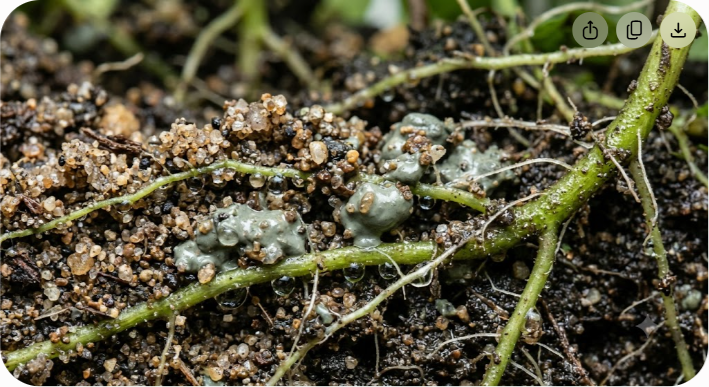
Coarse sandy soils possess excellent aeration and allow roots to penetrate easily, yet they suffer from a severe structural flaw: they cannot hold water or plant nutrients. Rainwater and irrigation pass through the soil matrix like water through a sieve, washing away expensive fertilizers deep beyond the reach of active roots. This process, known as deep percolation and nutrient leaching, leaves crops dehydrated, stressed, and undernourished even under frequent irrigation schedules.
Adding sodium or calcium bentonite clay permanently alters the physical and chemical architecture of sandy ground. Unlike organic matter, which breaks down over 12 to 24 months in warm, well-aerated sands, bentonite is an inorganic mineral amendment. Once incorporated into the topsoil, it stays there indefinitely. By filling the macropores between coarse sand grains with expandable smectite clay platelets, bentonite turns drought-prone ground into a resilient reservoir capable of holding up to five times its dry weight in water.
To understand why bentonite works so effectively, it helps to examine soil texture at a microscopic level. Sandy soils consist of large, quartz-rich mineral particles ranging from 0.05 to 2.0 millimeters in diameter. Because these particles are relatively round and rigid, they stack together loosely, creating large interstitial spaces known as macropores.
Gravity pulls water down through macropores effortlessly. Sandy soils lack the microscopic capillary spaces (micropores) needed to overcome gravitational pull and hold water against downward movement. Consequently, sandy soil typically exhibits a volumetric water-holding capacity of just 4% to 10%. In practical terms, an acre of pure sand might retain less than half an inch of usable water per foot of soil depth.
Surface area dictates a soil's ability to bind water molecules via hydrogen bonding. One gram of coarse sand has a specific surface area of roughly 0.01 to 0.1 square meters. In contrast, one gram of bentonite clay features a surface area exceeding 700 to 800 square meters. The physical surface available for water retention in a single handful of bentonite exceeds that of an entire field of coarse sand.
Sand grains carry no net surface charge. They cannot stick together when wet, nor can they hold onto positively charged nutrient ions (cations) like potassium, calcium, magnesium, and ammonium. Irrigation water moves downward at rates exceeding 20 inches per hour, carrying soluble minerals into underlying aquifers where they become agricultural runoff instead of crop yield.
Bentonite is an absorbent aluminum hydrosilicate clay formed primarily from volcanic ash weathered in the presence of water. Its dominant mineral constituent is montmorillonite, a 2:1 layer-aluminosilicate crystal structure comprising an octahedral sheet sandwiched between two tetrahedral silica sheets.
When water encounters dry bentonite clay particles, polar water molecules are drawn into the interlayer spaces between the crystal sheets. As water hydrates the internal exchangeable cations (such as Na+ or Ca2+), the distance between individual sheets expands dramatically.
High-swelling sodium bentonite can expand up to 15 to 20 times its original dry volume. As these clay particles swell inside sandy soil, they expand directly into the macropores between sand grains. This action transforms large, free-draining channels into an interconnected network of micro-capillaries. Water entering the root zone gets trapped within this hydrated gel matrix, reducing hydraulic conductivity and slowing down percolation.
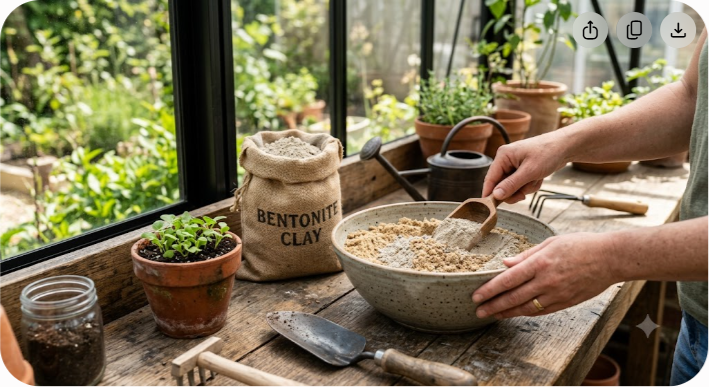
Cation Exchange Capacity measures a soil's ability to hold onto essential nutrients and prevent them from washing away. Sandy soils routinely test at a CEC of 1 to 5 milliequivalents per 100 grams (meq/100g), which is extremely poor.
Pure bentonite boasts a CEC ranging from 70 to 100 meq/100g. Amending sand with even a modest 2% to 5% concentration of bentonite elevates the overall soil CEC to 12-18 meq/100g. Isomorphous substitution within the clay's crystal lattice gives bentonite a permanent negative charge, allowing it to bind positively charged fertilizer nutrients until plant roots actively absorb them.
Choosing the correct type of bentonite clay determines whether your soil transformation succeeds or causes drainage issues.
| Property | Sodium Bentonite | Calcium Bentonite |
|---|---|---|
| Primary Cation | Sodium (Na+) | Calcium (Ca2+) |
| Swelling Capacity | High (10x to 20x dry volume) | Moderate (2x to 4x dry volume) |
| Soil Effect | Maximum water holding, high expansion | Good structural stability, mild swelling |
| Ideal Soil Type | Coarse, highly porous deep sands | Sandy loams, alkaline sands, saline ground |
| Application Rate | Lower volume needed per acre | Higher volume needed per acre |
| Risk Factor | Over-application can reduce aeration | Low risk of soil crusting |
Sodium bentonite provides maximum swelling capacity and water retention. It is ideal for deep, ultra-porous sands where irrigation water vanishes rapidly. However, because sodium can disperse soil particles, it must be thoroughly incorporated into the soil matrix alongside organic matter or gypsum to maintain soil structure.
Calcium bentonite exhibits lower swelling potential but acts as an excellent soil conditioner. It flocculates soil particles, improving soil aggregation, aeration, and workability without creating dense, impermeable clay layers.
Applying bentonite clay to coarse soils delivers immediate and lasting agronomic benefits:
Applying bentonite clay requires thorough incorporation into the topsoil. Simply dumping bentonite on top of dry sand creates a slippery, impermeable surface layer when wet that prevents rain from entering the soil.
| Feature | Bentonite Clay | Biochar | Compost / Organic Matter |
|---|---|---|---|
| Permanence | Permanent (Inorganic) | Long-Term (100+ years) | Short-Term (1-3 years) |
| Mechanism | Macropore filling, expansion | Porous carbon structure | Organic sponge, microbial food |
| Water Retention | Extremely High | Moderate to High | High (while un-decayed) |
| Nutrient Retention (CEC) | High (70-100 meq/100g) | High (when aged) | Moderate (20-40 meq/100g) |
| Cost per Ton | Low to Moderate | High | Moderate |
| Best Used For | Coarse sands needing structure | Carbon sequestration, microbes | Soil biology, immediate nutrients |
Using bentonite alongside compost produces the best results. Bentonite protects organic matter from rapid oxidation in warm sand, while compost prevents clay particles from compacting under heavy equipment traffic.
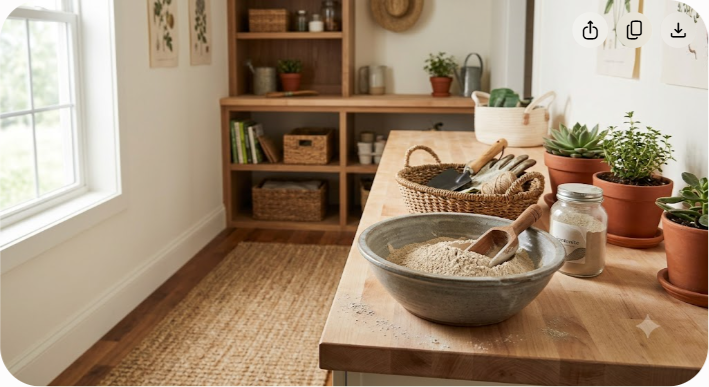
Applying bentonite clay to sandy soil is straightforward, but avoiding these operational errors ensures success:
Achieving consistent agricultural results requires high-purity, uniform bentonite minerals. Low-grade clays contaminated with heavy metals, excessive quartz silt, or unwanted chemical industrial additives can alter soil pH and harm root systems.
Axewelledge is a premier global producer and exporter of high-grade natural sodium and calcium bentonite. Controlling over 60 million tons of high-grade reserves in India, Axewelledge processes agricultural and industrial bentonite to international quality standards. With advanced refinement facilities and established distribution networks spanning the USA, Middle East, and Southeast Asia, Axewelledge delivers specialized soil conditioning bentonite tailored for agricultural reclamation, turf management, and commercial crop production.
Bentonite clay is an inorganic mineral amendment that does not decompose, break down, or wash away. Once incorporated into the root zone, it remains in the soil matrix permanently, providing long-term water and nutrient retention benefit year after year.
Not if applied at correct agricultural rates and incorporated thoroughly into the top 6 to 8 inches of soil. When mixed properly with sand and organic matter, bentonite creates balanced crumbly soil aggregates rather than dense, hard clay layers.
Sodium bentonite provides maximum swelling capacity and water retention for deep, highly porous sands. Calcium bentonite offers moderate water holding with superior soil structure enhancement and lower risk of crusting, making it ideal for lighter sandy loams or alkaline ground.
Yes. Combining bentonite with compost or organic fertilizers creates organo-mineral complexes that improve soil structure. The bentonite binds the nutrients from the compost, preventing them from leaching away when watered.
Results are immediate upon incorporation and hydration. As soon as irrigation or rain reaches the amended soil, the bentonite swells to fill sandy macropores, instantly increasing moisture holding capacity and reducing drainage speed.
High-grade sodium bentonite clay can absorb and hold up to 5 to 10 times its dry weight in water, expanding to 15 to 20 times its original dry volume as it hydrates within the soil matrix.
Natural bentonite clay typically has a neutral to slightly alkaline pH (7.5 to 8.5). When applied at standard agricultural rates, it has a minimal impact on overall soil pH while improving buffering capacity against rapid pH swings.
Coarse sandy soil no longer needs to limit crop yields or waste irrigation water. Amending sandy ground with high-purity bentonite clay fixes the underlying structural issues that cause rapid water drainage and nutrient leaching.
By adding expandable smectite minerals to the root zone, you create a permanent, nutrient-rich moisture reservoir that protects crops from drought, cuts irrigation costs, and boosts fertilizer efficiency. Combined with organic matter and proper field management, bentonite turns unproductive sandy fields into fertile, high-yielding land.
To discover how high-grade, natural bentonite can improve your agricultural soil performance, contact the mineral specialists at Axewelledge today for custom technical specifications and bulk export solutions.













Have questions about our products? We're here to help!