Axewelledge, a leading exporter from India, specializes in high-quality Bentonite. With a commitment to excellence, we supply premium Bentonite to the Middle East and Southeast Asia markets.


North Angle Complex, 304,
150 Feet Ring Rd, Opposite Ambedkar Nagar BRTS Stop,
Madhav Park, Punit Nagar,
Mavdi, Rajkot, Gujarat 360004
© Axewelledge 2026, All Rights Reserved.
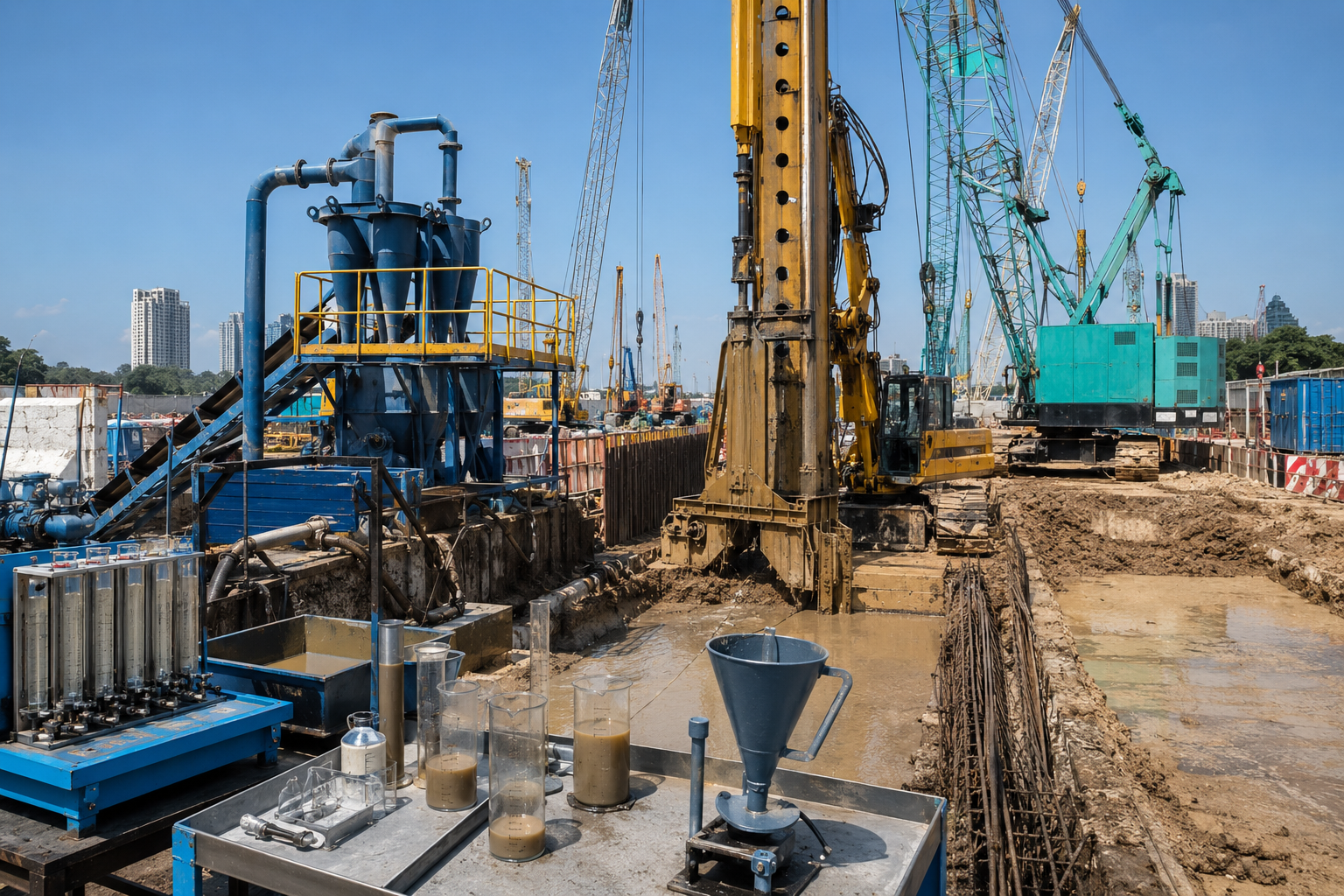
Choosing the wrong support fluid for a diaphragm wall can cost hundreds of thousands of dollars in borehole collapse, contaminated concrete, or bloated disposal fees. While mineral bentonite slurry has been the trusted industry workhorse for over seven decades, synthetic polymer slurries have rapidly captured market share due to their smaller site footprint and rapid mixing times. The core decision hinges on soil geology: bentonite relies on physical filter cake formation to seal permeable sands and gravels, whereas polymers rely on chemical viscosity and pore-space penetration to stabilize cohesive silts and clays.
Selecting between mineral and synthetic fluids is not a matter of brand preference—it is a rigorous geotechnical engineering calculation. In this comprehensive technical guide, we evaluate the rheological mechanics, site logistics, environmental compliance, and total lifecycle costs of bentonite and polymer slurries for deep trenching.
In deep foundation engineering, a diaphragm wall (or slurry wall) is constructed by excavating a deep, narrow trench into the ground using a hydromill (cutter) or mechanical grab. Because these trenches can reach depths exceeding 80 meters (260 feet) while hydrostatic groundwater forces push inward, the excavation would collapse immediately without internal support.
Support fluids—commonly known as slurries—are pumped into the trench during excavation to serve three primary structural functions:
Historically, natural sodium bentonite clay was the sole material capable of delivering these performance requirements. However, advancements in polymer chemistry have introduced high-molecular-weight synthetic polymers that offer alternative mechanisms for stabilizing deep excavations.
Bentonite is a naturally occurring clay composed primarily of sodium montmorillonite. When hydrated in fresh water, sodium bentonite particles hydrate, expand up to 15 to 18 times their original dry volume, and disperse into plate-like structures with negatively charged faces and positively charged edges.
When static, hydrated bentonite forms a weak electrical bond between its clay platelets, creating a delicate three-dimensional gel structure. When mechanical stress is applied—such as the churning action of a trench cutter—the gel liquefies into a fluid state. As soon as movement stops, the fluid reverts back to a stable gel. This reversible behavior is called thixotropy.
The defining technical feature of bentonite is its ability to build an impermeable barrier along the trench wall known as a filter cake.
This physical mechanism makes high-yield sodium bentonite extraordinarily reliable in highly permeable cohesionless soils, such as coarse sands, gravels, and fractured rock formations.
Polymer slurries are synthetic solutions engineered using partially hydrolyzed polyacrylamide (PHPA) or vinyl-based polymers. Unlike bentonite, which is a mineral suspension, polymer slurries are true chemical solutions consisting of long, flexible molecular chains.
When polymer powder dissolves in water, these massive molecular chains unfurl and intertwine. This creates a high zero-shear viscosity without relying on solid particles. The thick fluid resists flow, stabilizing the excavation through cohesive shear drag rather than by forming a physical solid membrane.
Instead of forming a filter cake on the surface of the soil, polymer molecules penetrate into the surrounding soil pore space:
Because polymer solutions contain virtually no solids (typically less than 1% by weight), they remain visually transparent and water-clear compared to opaque clay suspensions.
To select the ideal support fluid, geotechnical engineers evaluate several operational, physical, and environmental parameters. The table below outlines the performance characteristics of both materials.
| Operational Parameter | Sodium Bentonite Slurry | Synthetic Polymer Slurry |
|---|---|---|
| Primary Stabilization Mechanism | External filter cake formation membrane | Pore fluid viscosity & polymer encapsulation |
| Best Suited Soil Types | Coarse sands, gravels, cobbles, high water tables | Cohesive clays, stable silts, homogeneous fine sands |
| Mixing & Hydration Time | 6 to 24 hours full hydration required | 15 to 30 minutes rapid solution |
| Site Footprint Required | Large (silos, hydration tanks, desanding plant) | Small (compact liquid dosing unit, minimal tanks) |
| Fluid Density Range | 1.05 to 1.15 g/cm³ | 1.00 to 1.03 g/cm³ (near water) |
| Marsh Funnel Viscosity | 32 to 50 seconds | 40 to 100+ seconds (adjustable) |
| Filter Cake Thickness | 2 mm to 6 mm plastic skin | None (zero filter cake thickness) |
| Concrete Interface Bond | Moderate risk of cake entrapment; reduces skin friction | Excellent friction; zero solids left on rebar/soil |
| Recycling & Dewatering | Requires mechanical hydrocyclones and shakers | Requires chemical breakers (bleach/oxidizers) |
| Sensitivity to Salt/Hard Water | High (requires soda ash pre-treatment for hard water) | Moderate to high (requires water hardness control) |
| Environmental & Disposal Cost | High waste volume; hazardous landfill fees in some regions | Biodegradable; lower volume; easier land application |
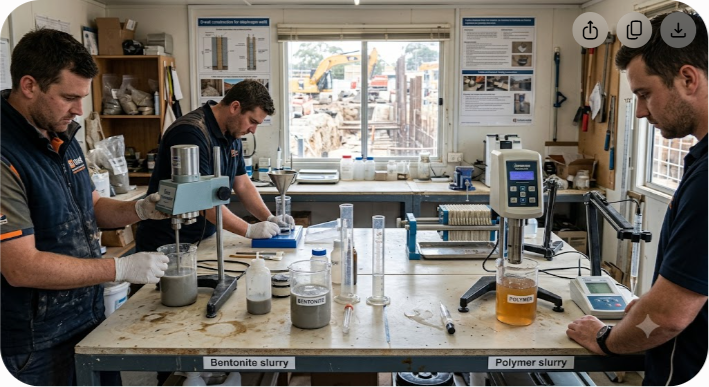
The fundamental criterion for choosing a fluid is the grain size distribution and permeability of the ground strata along the planned trench depth.
Winner: Sodium Bentonite When excavating through highly permeable gravel beds or cobbles, liquid polymer slurry simply leaks continuously into the surrounding formation without forming a seal. This fluid loss leads to immediate drops in trench head levels, risking localized sidewall collapse.
Sodium bentonite's suspended clay particles bridge the gaps between large gravel grains, rapidly establishing an impermeable filter cake that stops fluid loss and maintains full hydrostatic head pressure.
Winner: Polymer Slurry When trenching through active clay layers, natural bentonite slurries often experience severe contamination. The native clay disperses into the bentonite slurry, causing uncontrolled viscosity spikes, thickening, and difficult desanding operations.
Polymer slurries excel in these environments. The synthetic polymer chains coat the trench walls and cuttings, encapsulating reactive clay particles before they can hydrate and disperse. This keeps the fluid viscosity stable throughout the excavation process.
Winner: Specialized Sodium Bentonite or Polymer Complexes Standard sodium bentonite experiences cation exchange when exposed to saltwater (calcium and sodium ions replace original binding ions), causing the clay to flocculate and collapse out of suspension.
In marine environments, engineers must use highly refined, high-yield sodium bentonite pre-treated with polymer additives or specialized salt-resistant bentonite formulations. Alternatively, salt-tolerant synthetic polymers can be deployed alongside soda ash conditioning agents.
Maintaining strict quality control over support fluid parameters is mandatory during diaphragm wall construction. Standard testing protocols established by the American Petroleum Institute (API) and the European Standard EN 1538 dictate daily on-site testing.
Measured using a standardized mud balance. Bentonite slurries must be maintained between 1.05 and 1.10 g/cm³ before concreting to ensure soil particles remain suspended while allowing clean concrete displacement. Polymer density sits lower, typically between 1.00 and 1.04 g/cm³.
Measured by timing how long it takes for 1 quart (946 ml) or 1 liter of fluid to flow through a standard Marsh Funnel orifice.
Fluid is placed in a pressure cell under 100 psi (6.9 bar) for 30 minutes over filter paper.
Determines the volume percentage of solid sand particles larger than 75 microns (200-mesh screen) held in the slurry.
Urban construction sites face increasingly strict environmental regulations regarding wastewater discharge and soil contamination. Support fluid management plays a massive role in overall job site environmental compliance.
Spent bentonite slurry is difficult and expensive to dispose of. It cannot be pumped into public municipal sewers due to high solid contents and pipe-clogging potential. In many jurisdictions, bentonite waste must be treated with flocculants, vacuum-sucked into tankers, and hauled to certified industrial treatment facilities or controlled landfills.
Conversely, waste polymer slurry can often be chemically broken down into water and simple organic compounds, neutralized, and safely discharged into municipal sewer systems or spread on site following local authority testing and approval.

In diaphragm wall construction, tremie pipes are lowered to the bottom of the trench to pour structural concrete. As concrete fills the panel from the bottom up, the lighter support fluid is continuously displaced upward to the surface.
How the fluid behaves during concrete displacement directly impacts the structural integrity of the finished wall panel.
When tremie concrete rises against a bentonite-supported trench wall, it must scour off the existing filter cake along the excavation face and steel rebar cage.
If the filter cake is excessively thick (> 5 mm) or overly stiff due to poor quality bentonite or inadequate fluid maintenance, the rising concrete may fail to fully strip the cake away.
This leads to two critical structural defects:
Polymer slurries leave virtually no physical film or cake on steel rebar or soil faces. As concrete rises, the liquid polymer solution cleanly separates from the dense concrete interface without leaving solid residues.
Comprehensive load testing demonstrates that diaphragm walls cast under high-quality polymer fluids regularly achieve 20% to 40% higher ultimate unit skin friction compared to panels cast under unrefined or poorly maintained bentonite slurries.
Evaluating the cost of bentonite versus polymer purely on a per-kilogram material basis leads to misleading conclusions. A complete lifecycle cost model must account for yield rates, logistics, equipment rental, energy consumption, and waste handling.
While high-performance synthetic polymers cost significantly more per kilogram than raw bentonite powder, you require 95% less total material weight to mix an equivalent volume of slurry.
Consider a standard urban diaphragm wall project requiring 10,000 m³ of fluid capacity:
Transporting 500 tons of raw bentonite requires 20+ flatbed truckloads and dedicated storage silos. Transporting the equivalent 15 tons of concentrated polymer powder requires just a single freight container.
Bentonite mixing units run heavy electric motors continuously for high-shear agitation and hydrocyclone pumping. Polymer units run low-horsepower metering pumps intermittently, reducing site power requirements by up to 60%.
In constrained metropolitan markets, liquid waste disposal costs can equal or exceed original material procurement costs. Polymer's ability to be chemically neutralized on-site dramatically slashes haulage expenses.
Achieving defect-free diaphragm wall panels requires strict adherence to slurry management practices regardless of the fluid system selected.
Both sodium bentonite and synthetic polymers are highly sensitive to water hardness and pH. Hard makeup water containing calcium (Ca²?) or magnesium (Mg²?) ions neutralizes the electrical charges on clay plates and polymer chains.
Do not rely on a one-size-fits-all fluid recipe across an entire site. If trenching passes through top layers of soft clay followed by deep strata of coarse gravel, start with an optimized polymer fluid, but maintain bentonite or bentonite-polymer hybrid additives on site to quickly seal unexpected gravel lenses or water-loss zones.
Before lowering the reinforcement cage and placing concrete, perform a complete bottom-cleaning exchange.
When ground conditions demand a true mineral slurry—such as coarse cobbles, fractured rock, or high water heads—the quality of raw sodium bentonite determines overall job performance. High-yield API-grade sodium bentonite featuring maximum montmorillonite content provides rapid hydration, superior thixotropy, and thin, flexible filter cakes that protect against sidewall failure.
The choice between bentonite and polymer support fluids is not a binary decision—it is an optimization exercise tailored to site geology, space limits, structural specifications, and local environmental laws.
By matching slurry physics to site-specific ground conditions and executing rigorous daily fluid testing, engineering teams can guarantee stable trench excavations, pristine structural concrete placement, and predictable project timelines.
At Axewelledge, we leverage over 15 years of mineral expertise as one of the world's leading miners and exporters of high-yield sodium bentonite. Our vast, high-purity reserves ensure consistent swelling capacity, exceptional thixotropic performance, and reliable filter-cake formation for complex deep foundation and diaphragm wall projects worldwide. Contact our geotechnical mineral specialists today to discuss your trenching requirements, request technical datasheets, or secure premium bentonite supply for your next heavy civil project.













Have questions about our products? We're here to help!