Axewelledge, a leading exporter from India, specializes in high-quality Bentonite. With a commitment to excellence, we supply premium Bentonite to the Middle East and Southeast Asia markets.


North Angle Complex, 304,
150 Feet Ring Rd, Opposite Ambedkar Nagar BRTS Stop,
Madhav Park, Punit Nagar,
Mavdi, Rajkot, Gujarat 360004
© Axewelledge 2026, All Rights Reserved.
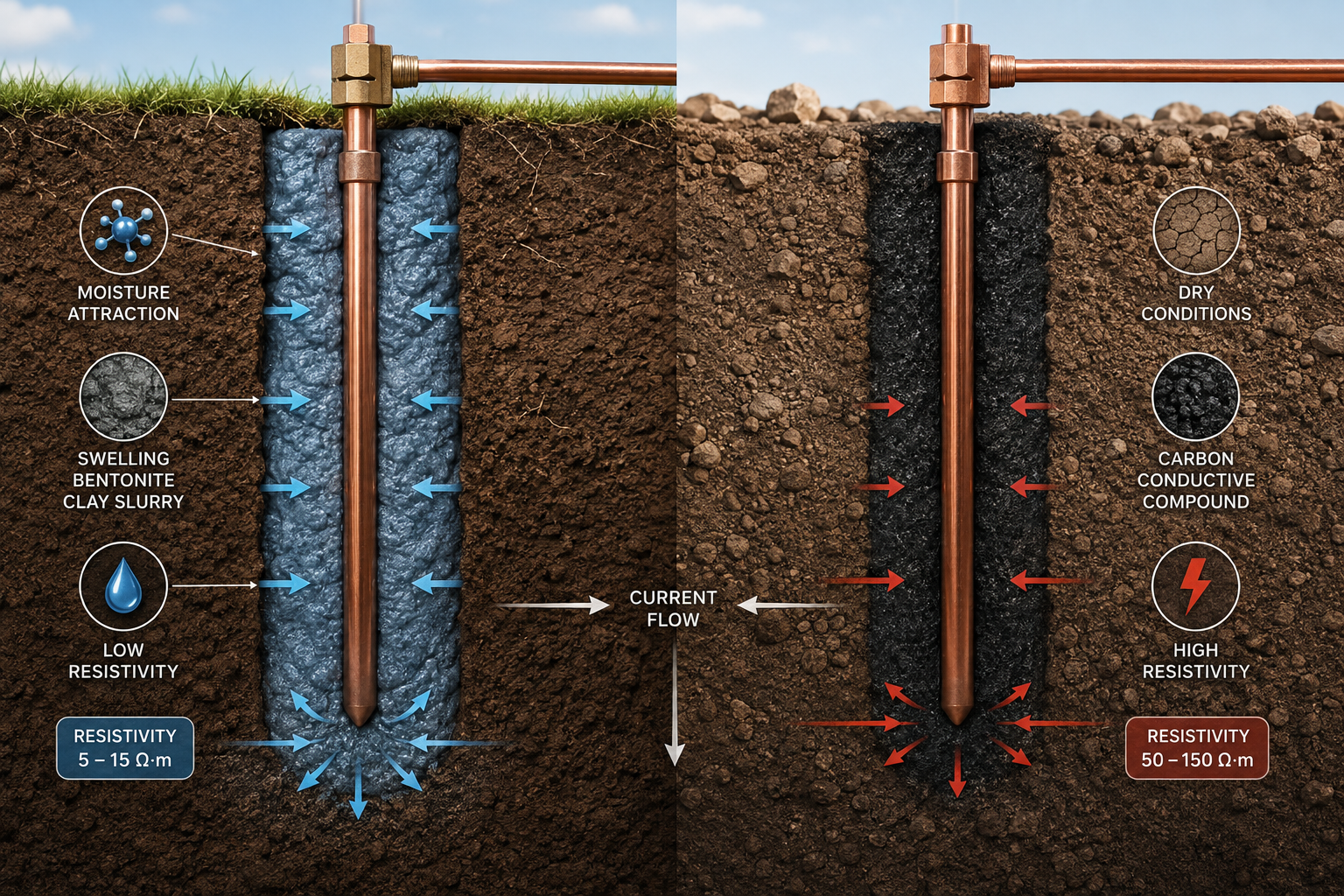
If you need to achieve a ground resistance below 5 ohms in high-resistivity soil, sodium bentonite clay is the most cost-effective solution for moisture-retaining soils, while conductive carbon backfill is the superior choice for hyper-arid, rocky, or non-moist environments.
Grounding systems rely on the surrounding soil to dissipate electrical fault currents, lightning strikes, and static charges safely into the earth. However, natural soil is rarely an ideal conductor. Native soil resistivity can range from 10 ohm-meters in wet clay to over 10,000 ohm-meters in granite or dry sand. To bridge the gap between the copper ground electrode and the earth, engineers specify low-resistivity backfill materials.
Selecting between sodium bentonite clay and carbon-based conductive compounds directly impacts system longevity, maintenance schedules, and upfront capital expenditure.
An electrical grounding system is only as good as its contact with the earth. Under IEEE Std 80 and NEC Article 250 guidelines, commercial and industrial grounding systems typically require resistance levels under 5 ohms, with telecommunications facilities and power substations often demanding under 1 ohm.
When a ground rod is driven into the earth, it makes contact with uneven soil particles, air pockets, and rock fragments. This creates high contact resistance right at the surface of the copper conductor—the precise region where current density is highest during a fault event.
When a surge occurs, fault current travels along the copper conductor. If it meets high-resistance air pockets or dry soil, energy cannot dissipate smoothly into the earth, creating severe system surges and dangerous step-potential hazards for personnel nearby.
By excavating a trench or drilling a borehole around the electrode and filling it with a low-resistivity backfill, you effectively expand the surface area of the electrode. A 5/8-inch (15.8 mm) ground rod encased in a 4-inch (100 mm) cylinder of conductive backfill behaves electrically like a 4-inch solid conductor, drastically lowering the overall resistance to remote earth.
0 ? 3a9?m) or ohm-centimeters ( 0 ? 3a9?cm). Lower values mean current moves more freely.
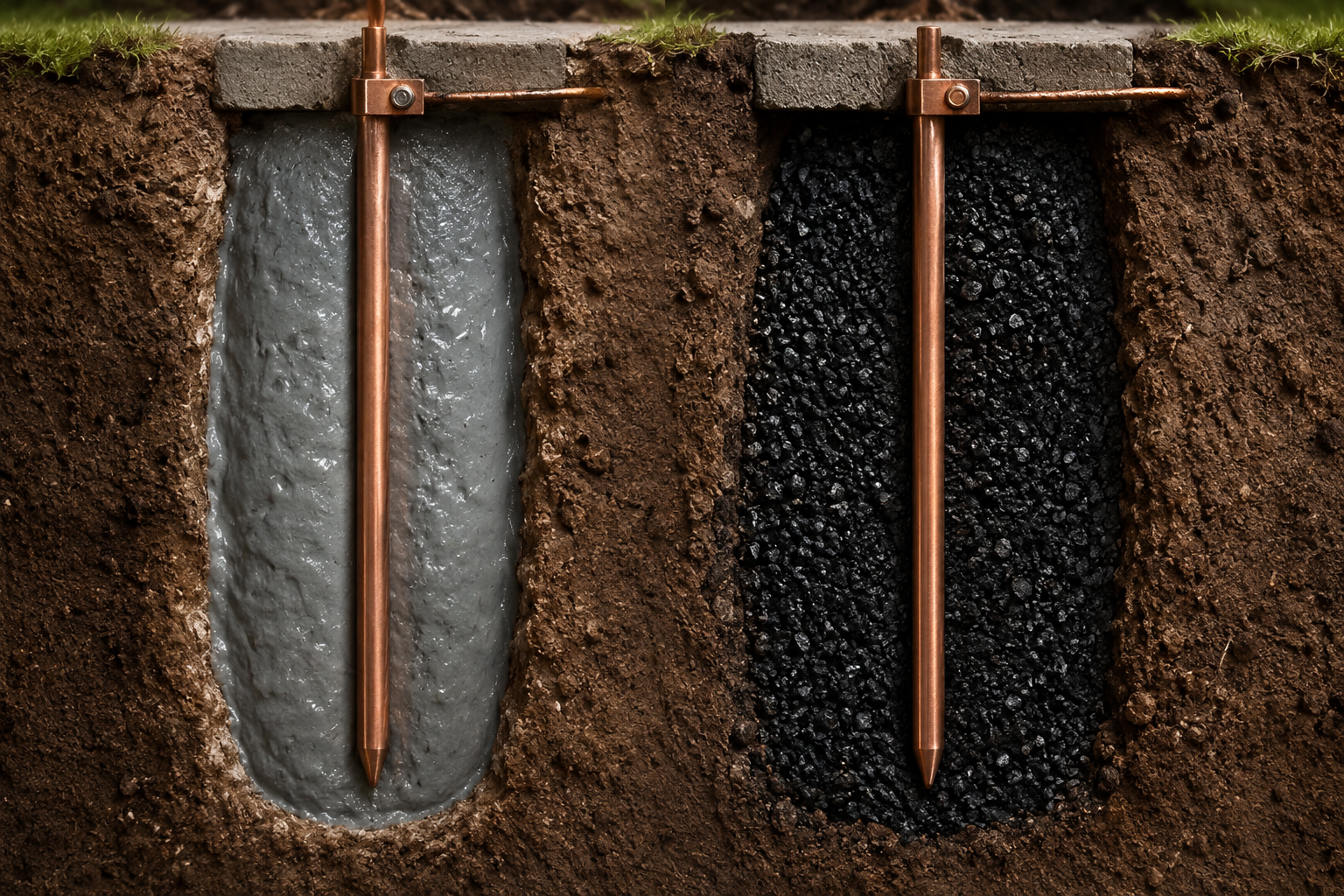
Bentonite is a naturally occurring hydrated aluminum silicate clay formed primarily from weathered volcanic ash. The dominant active mineral in high-performance grounding applications is sodium bentonite (montmorillonite).
When mixed with water, high-purity sodium bentonite swells up to 13 to 18 times its original dry volume. This massive volumetric expansion forces the clay into every micro-fissure, void, and crevice along the borehole or trench wall, eliminating air gaps completely.
Mixing dry sodium bentonite granules with water creates a hydrated montmorillonite lattice, which cures into a dense, highly conductive gel that locks the conductor to the surrounding earth.
Unlike metals, which conduct electricity via free electrons, bentonite conducts electricity through ionic conduction. The sodium (Na + ) and calcium (Ca 2+ ) ions trapped within the hydrated clay lattice allow electrical charge to flow through the bound water molecules.
0 ? 3a9?m (250 to 500 0 ? 3a9?cm) when fully hydrated.
Bentonite acts as a sponge. It absorbs up to five times its dry weight in water and releases it very slowly. In regions with periodic rainfall, bentonite absorbs moisture during wet months and retains it through dry seasons, maintaining stable ground resistance year-round.
However, in extreme, prolonged droughts where soil moisture drops below 10% for extended periods, bentonite can dry out, shrink away from the rod, and lose its ionic conductivity until rehydrated.
Carbon-based grounding backfill consists of processed carbon particles—most commonly calcined petroleum coke breeze, ground graphite, or synthetic carbon matrices blended with hydraulic binders like Portland cement.
Unlike clay-based materials, carbon backfill operates through electronic conduction. Electrons jump directly from one carbon particle to the next through direct physical contact within the dense, compacted matrix.
Because carbon is an inherently conductive element, its performance does not depend on water or dissolved salts.
0 ? 3a9?m (10 to 80 0 ? 3a9?cm).
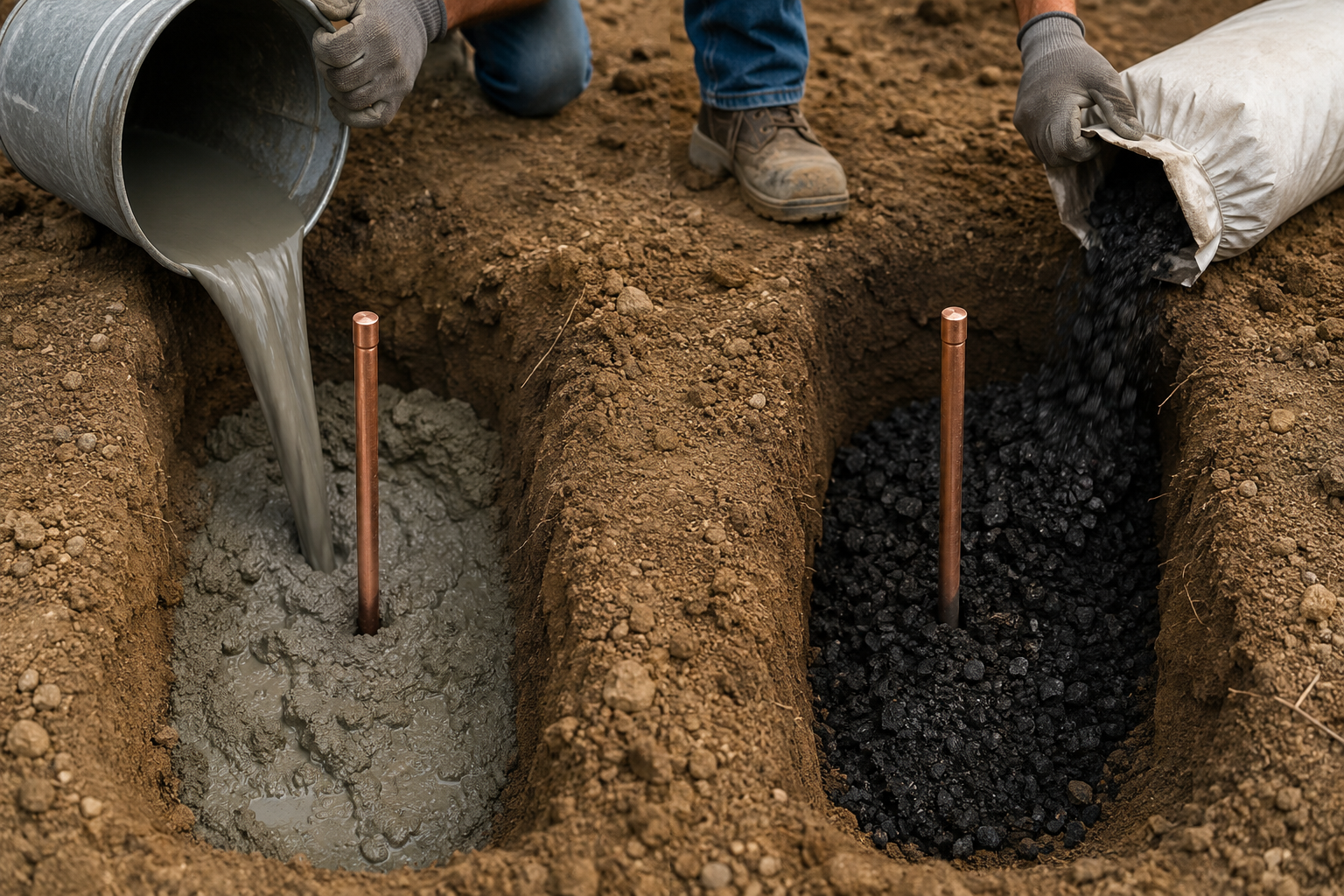
To help design engineers and contractors evaluate these materials side-by-side, the table below breaks down the technical, physical, and economic metrics of both choices.
| Performance Metric | Sodium Bentonite Clay | Conductive Carbon Backfill |
|---|---|---|
| Conduction Mechanism | Ionic (requires bound water) | Electronic (direct electron transfer) |
| Typical Resistivity ( 0 ? 3a9?m) | 2.5 – 5.0 | 0.1 – 0.8 | | Moisture Requirement | Requires ?15 moisture | Independent (0 ? 15%$ moisture). It delivers the lowest cost per ohm of resistance reduction.
Not all bentonite is created equal. Calcium bentonite, for example, lacks the high swelling capacity and moisture-retention properties of true sodium bentonite. Using low-grade or impure clay leads to cracking, poor rod contact, and rising resistance over time.
When specifying bentonite for critical earth enhancement projects, engineering firms rely on established producers with verified mineral reserves.
As India’s largest mine owner and exporter of high-grade bentonite, Axewelledge supplies premium sodium bentonite processed to international quality standards. With over 60 million tons of high-grade reserves, advanced refining technology, and a supply footprint spanning the Middle East, Southeast Asia, and global industrial markets, Axewelledge delivers pure, high-swelling bentonite engineered for demanding civil, drilling, and grounding applications.
Whether you are designing a transmission line grounding array or an industrial substation grid, selecting raw materials with consistent swelling parameters ensures your grounding system performs safely for decades.
To choose the correct earth enhancement backfill for your project, follow this decision framework:













Have questions about our products? We're here to help!