Axewelledge, a leading exporter from India, specializes in high-quality Bentonite. With a commitment to excellence, we supply premium Bentonite to the Middle East and Southeast Asia markets.


North Angle Complex, 304,
150 Feet Ring Rd, Opposite Ambedkar Nagar BRTS Stop,
Madhav Park, Punit Nagar,
Mavdi, Rajkot, Gujarat 360004
© Axewelledge 2026, All Rights Reserved.
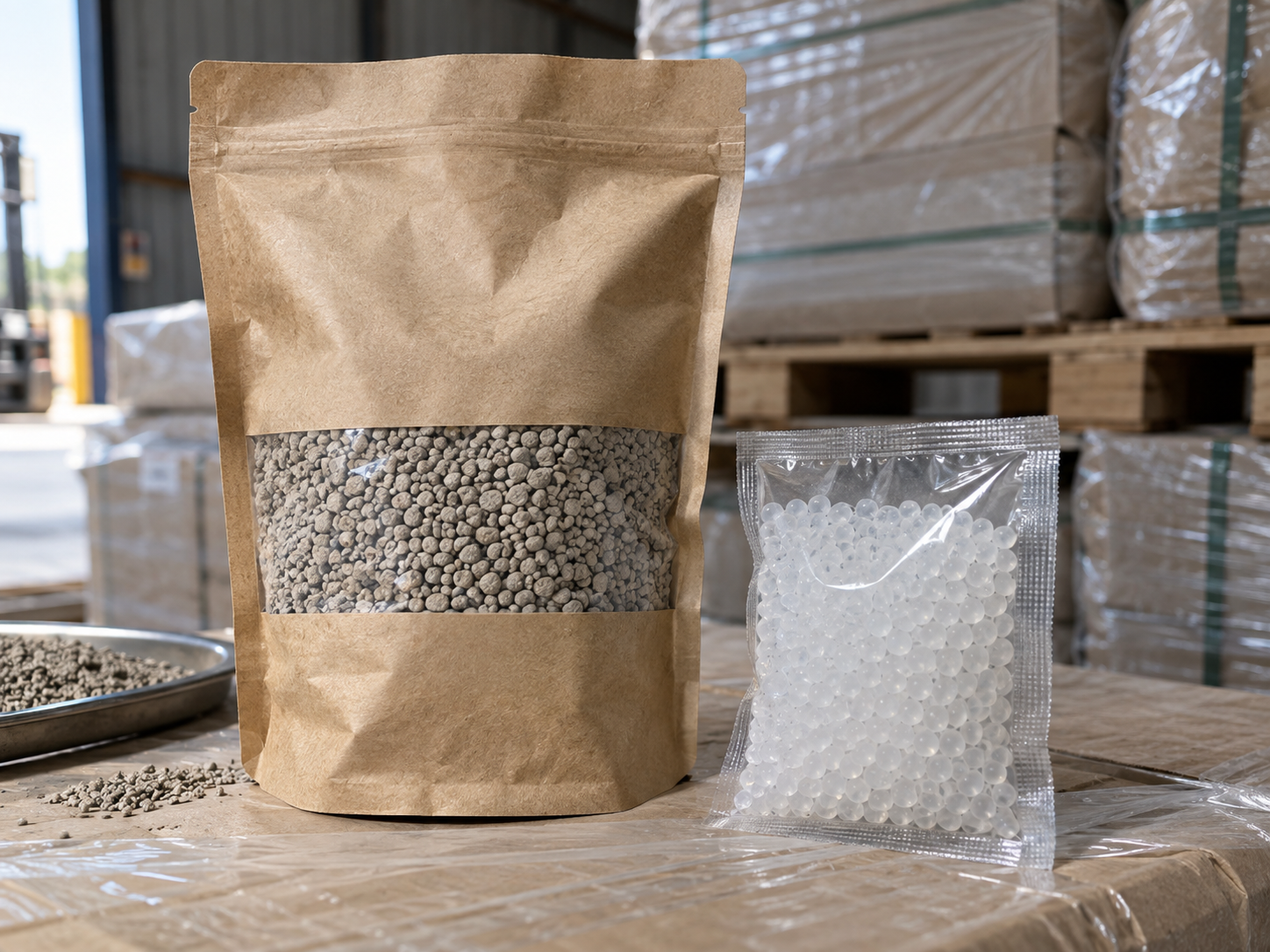
Bentonite desiccant and silica gel both protect products from moisture, but they are not interchangeable in every application. Silica gel is widely used when packaging needs strong moisture adsorption in a small, controlled space. Bentonite clay is a practical option for many industrial and shipping applications, particularly where the environment experiences changing or relatively high humidity and the desiccant needs to be supplied in larger quantities.
The right choice depends on more than the material's maximum moisture capacity. Temperature, relative humidity, package permeability, transit time, product sensitivity, pouch design, and the amount of moisture entering the package all affect performance. A small silica gel sachet can be an excellent solution for an electronics box, while a larger clay-based desiccant system may make more sense for export cargo.
This guide compares bentonite desiccant and silica gel on performance, humidity behavior, cost, safety, regeneration, environmental considerations, and practical applications. It also explains how to choose and size a desiccant without relying on a generic rule that may not fit your shipment.
The simplest distinction is material and moisture behavior. Bentonite desiccant is made from a naturally occurring clay, usually rich in montmorillonite minerals. Silica gel is a porous form of silicon dioxide manufactured for use as an adsorbent.
Both materials capture water vapor, but their adsorption characteristics differ with relative humidity. Silica gel has a highly porous structure and is particularly useful when a package needs effective moisture control at relatively low humidity. Bentonite clay also adsorbs water vapor and is widely used in industrial packaging and shipping desiccants because it is a naturally occurring mineral that can be processed into practical bags, units, and other formats.
There isn't a universal winner. The useful question is: which material fits the humidity range, package size, exposure conditions, and required service life of your application?
Water vapor can damage products long before liquid water is visible. Metal components may corrode, electronics can suffer from oxidation and moisture-related failures, paper packaging can soften, and organic materials can support mold growth when conditions are favorable.
Shipping containers present a particular challenge. A container can experience large temperature changes during loading, storage, and ocean or land transport. The air inside the container also contains moisture, while wood pallets, cardboard, paper, textiles, and some products can release or exchange additional moisture.
When a surface temperature falls below the dew point, water can condense. In containers, this phenomenon is commonly called container rain or container sweat. A desiccant cannot eliminate every source of moisture, but it can reduce water vapor and help limit relative-humidity fluctuations when used as part of a suitable packaging system.
For this reason, moisture control should be treated as a system rather than a single bag of drying material. Barrier packaging, ventilation strategy, pallet materials, cargo arrangement, and desiccant quantity can all affect the result.
Silica gel is a porous, granular form of silicon dioxide. Despite its name, it isn't a conventional gel. Its structure contains a large network of pores that provides a substantial internal surface area for adsorption.
Water molecules attach to the internal surfaces of the material. The process is physical adsorption rather than a chemical reaction with the water. The exact performance depends on the type and grade of silica gel, particle size, temperature, relative humidity, and packaging configuration.
Commercial silica gel is available in several forms, including beads, granules, packets, canisters, and bulk material. Some grades include a humidity indicator that changes color as moisture loading increases.
Silica gel is especially common in relatively small enclosed packages. Typical applications include:
Its established supply chain and wide range of commercial grades make silica gel easy to source for many packaging operations.
Silica gel is often selected when the target environment needs to stay relatively dry. Its porous structure gives it strong adsorption performance over useful humidity ranges, although the exact adsorption curve varies between grades.
A common mistake is to describe silica gel as simply becoming ineffective above one fixed relative-humidity percentage. Real adsorption behavior is continuous and depends on the specific product. Published data from the Canadian Conservation Institute, for example, show that different sorbents have different moisture-reservoir behavior across relative-humidity ranges. The practical lesson is straightforward: use the manufacturer's adsorption isotherm or test data rather than relying on one universal threshold.
Bentonite is a naturally occurring clay formed largely from altered volcanic ash. Many bentonites contain substantial amounts of montmorillonite, a clay mineral with a layered structure and strong affinity for water.
For desiccant applications, bentonite is processed, dried, and prepared in a controlled form suitable for filling bags, pouches, sachets, or larger container products. Some commercial products are formulated or processed specifically to improve handling, moisture capacity, particle strength, and dust control.
Bentonite should not be treated as one uniform material. Mineral composition, activation, particle size, moisture content, and processing method can all affect the final desiccant's performance.
Bentonite can take up water through adsorption and related interactions within its mineral structure. Montmorillonite's layered structure contributes to its ability to interact with water, and the material's moisture capacity changes with relative humidity.
This makes bentonite useful for applications where the surrounding humidity varies rather than remaining at a narrowly controlled level. Commercial bentonite desiccants are used in packaging and moisture-control products because the material can provide useful moisture uptake while remaining relatively inexpensive and easy to process.
Bentonite clay desiccant is commonly considered for:
The correct grade still matters. A clay desiccant intended for a large container should not automatically be substituted for a small sachet product without checking its rated capacity and packaging format.
The following table summarizes the practical differences without treating either material as universally superior.
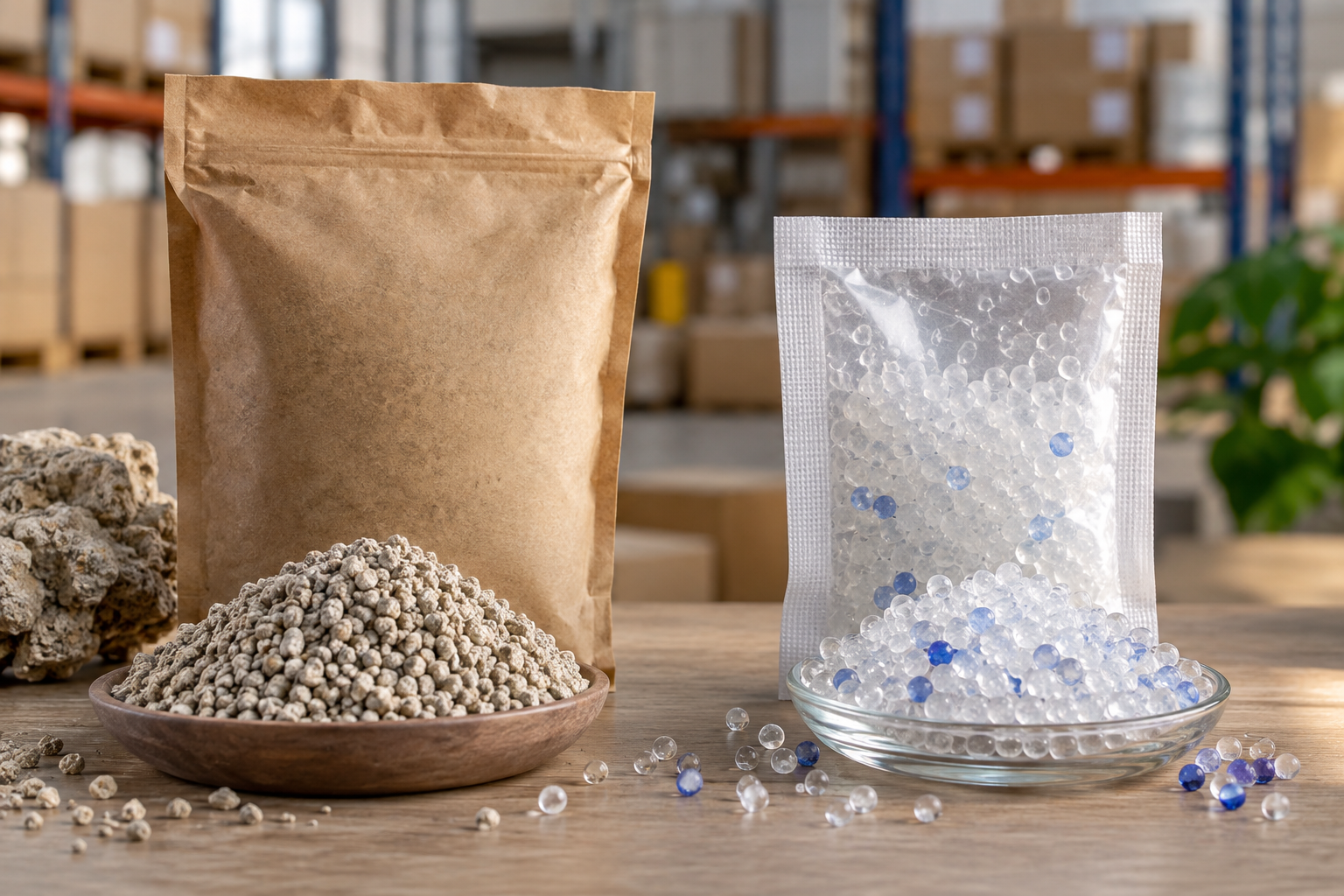
| Feature | Bentonite Clay Desiccant | Silica Gel |
|---|---|---|
| Material origin | Naturally occurring clay mineral | Manufactured porous silicon dioxide |
| Main moisture mechanism | Adsorption and moisture uptake associated with clay structure | Physical adsorption on a highly porous surface |
| Small-package use | Suitable in many applications | Very common |
| Industrial packaging | Widely used | Widely used |
| Container moisture control | Common in larger desiccant formats | Possible, but product format and quantity are important |
| Low-humidity control | Good, depending on grade | Often very strong |
| Humid environments | Performance can remain useful as humidity rises | Capacity also changes substantially with humidity and grade |
| Cost | Often economical for bulk applications | Varies by grade and market |
| Indicator required | Not inherently required | Not inherently required; indicator grades are available |
| Regeneration | Possible for some products if the manufacturer specifies it | Possible for many grades if the manufacturer specifies it |
| Dust control | Depends on particle and pouch design | Generally good in properly manufactured packets |
| Supply format | Bags, pouches, bulk fills, container products | Packets, canisters, beads, bulk material |
| Best selection method | Match grade and capacity to application | Match grade and capacity to application |
The table highlights an important point: the material alone doesn't determine performance. Product formulation and packaging design matter just as much.
Relative humidity, or RH, is one of the most important variables in desiccant selection. It describes how much water vapor is present in air relative to the maximum amount the air can hold at the same temperature.
Desiccant performance is usually described with an adsorption isotherm or capacity curve. Such a curve shows how much moisture a material holds at different relative-humidity levels at a specified temperature.
Silica gel is often attractive when the application requires substantial moisture adsorption in a relatively dry environment. Its extensive internal pore structure provides a large surface on which water vapor can adsorb.
Bentonite can also adsorb moisture at lower humidity levels, but the exact capacity depends heavily on the clay grade and preparation. Published comparisons have shown that both materials can meet common packaging requirements when the desiccant is correctly specified.
The comparison becomes more application-specific as humidity changes. Bentonite has useful moisture capacity across a broad humidity range and is widely used in packaging systems designed for industrial and shipping environments.
Silica gel also continues to adsorb moisture as RH rises. It should not be described as simply stopping at a particular humidity level. Instead, its adsorption capacity changes according to the grade and the surrounding conditions.
For a technical purchasing decision, compare capacity values at the RH and temperature your product will actually experience.
At high humidity, both desiccants can take up significant amounts of water, but the practical result depends on the product's capacity curve and the amount of desiccant used.
This is particularly important for shipping containers. A container can encounter changing temperatures and humidity over several weeks. A desiccant that looks adequate based on a laboratory value at one RH may not provide sufficient protection once package leakage, cargo moisture, and temperature cycling are included.
Desiccant specifications are sometimes reduced to a single number such as "absorbs 30 percent of its weight." That number isn't enough to design a reliable moisture-control system.
A desiccant's moisture uptake depends on conditions. The same material can hold different amounts of water at 20 percent RH, 40 percent RH, and 60 percent RH. Temperature also affects equilibrium behavior.
A useful specification should therefore identify the test temperature, RH, measurement method, and material grade. For example, DIN or other industry specifications may define desiccant capacity under particular test conditions. Those conditions should be compared before using numbers from two different suppliers side by side.
Before selecting a desiccant, ask the supplier for:
This approach is more reliable than comparing a single headline capacity figure.
Shipping containers are different from small product packages. The enclosed air volume is much larger, cargo may contain moisture, and the container can experience significant temperature changes during transit.
A few small silica gel sachets designed for consumer packaging won't automatically protect a full container. For container applications, manufacturers commonly use purpose-designed hanging bags, strips, blankets, poles, or other larger desiccant formats. The amount required should be calculated from the expected moisture load and the characteristics of the cargo.
Bentonite is commonly used in larger industrial desiccant formats because clay can be supplied economically in relatively high quantities. Silica gel can also be supplied in larger formats, so the decision should be based on tested capacity, packaging design, cost, and operating conditions rather than material name alone.
Consider a shipment of machined steel components packed in cardboard boxes and loaded onto pallets inside a container. The main risks include moisture entering through the container environment and moisture released by packaging materials.
A sensible moisture-control system could include a suitable barrier or packaging layer around sensitive components, properly positioned container desiccants, and moisture monitoring during validation shipments. The desiccant quantity should be based on the expected moisture load rather than a generic number of bags.
For a high-value shipment, a packaging engineer may also use humidity loggers or indicators to verify conditions during actual transport.
Small product packaging creates a different set of priorities. The desiccant has to fit inside a limited space, work with the packaging line, avoid contamination, and meet the product's required humidity range.
Silica gel is widely available in small sachets and is therefore convenient for applications such as electronics, optical products, and consumer goods. Bentonite can also be converted into small desiccant sachets and may be selected where its material characteristics and cost fit the application.
The key question isn't whether one material is universally stronger. It is whether the finished sachet provides enough moisture capacity for the package throughout its intended shelf life.
Bentonite's natural mineral origin can be an advantage when companies are evaluating material sourcing and processing. However, it would be inaccurate to describe every bentonite product as automatically biodegradable or environmentally harmless. Mining, transportation, processing, pouch materials, and disposal all contribute to the product's environmental footprint.
Silica gel also needs to be considered across its full life cycle. Its manufacturing process involves industrial chemical processing, while its final form is generally a stable inorganic material.
If environmental performance is an important purchasing criterion, compare supplier-specific life-cycle information rather than relying on labels such as "natural" or "synthetic" alone.
Used desiccant is generally handled according to the material's safety data sheet and local waste requirements. A clay mineral doesn't automatically mean that every pouch or additive can be discarded in the same way as loose natural soil.
The packaging material also matters. A non-woven or laminated pouch may have different disposal characteristics from the mineral inside it.
For industrial buyers, ask the supplier for a current safety data sheet and disposal guidance for the exact product being purchased.
Cost is often one reason manufacturers investigate bentonite desiccant. Bentonite is a naturally occurring mineral available from established mining regions and can be processed for high-volume desiccant applications.
Silica gel pricing varies according to purity, particle size, indicator type, packaging format, and purchase volume. A simple comparison of price per kilogram can therefore be misleading.
The better metric is cost per unit of required moisture protection. If one product requires fewer grams to achieve the required humidity control, a higher price per kilogram may still produce a competitive overall packaging cost.
When comparing suppliers, calculate:
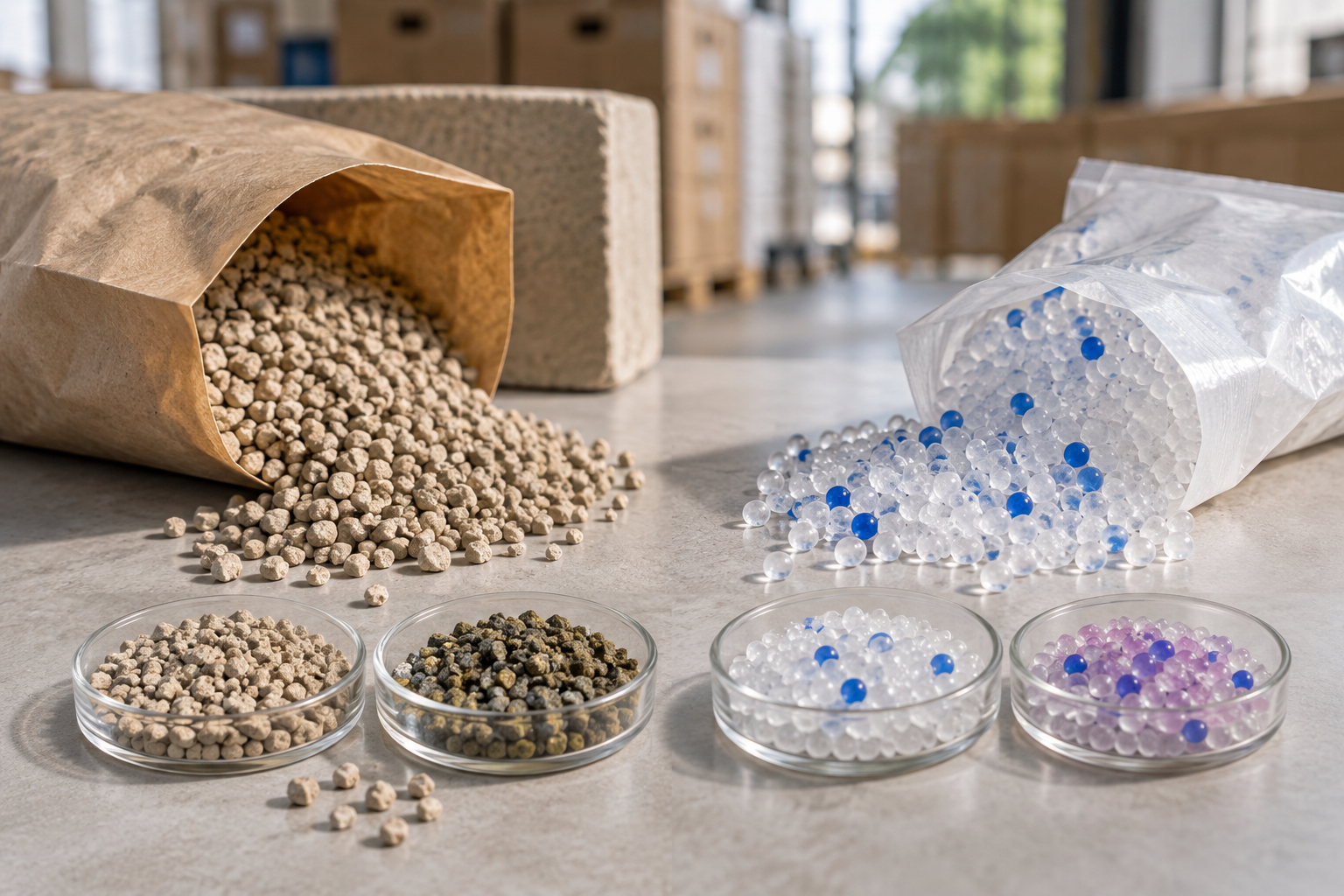
Effective desiccant cost = material cost + packaging cost + handling cost + expected replacement or failure cost.
Then compare the tested moisture capacity under the conditions that matter to your application.
This approach helps avoid choosing a cheaper material that requires substantially more product or provides insufficient protection.
Desiccants used around food, pharmaceuticals, medical products, or other regulated goods require careful specification. It isn't enough to say that a mineral or silica gel is "non-toxic."
Regulatory status depends on the exact substance, formulation, packaging article, intended use, and conditions of contact. In the United States, the FDA maintains regulations and inventories for substances used in food-contact applications, and authorization can depend on the specific intended use.
For this reason, buyers should request product-specific compliance documentation instead of assuming that every bentonite or silica gel product has the same regulatory status.
Some silica gel products contain humidity indicators that change color as moisture loading changes. Older indicator systems may involve substances that raise regulatory or safety concerns, while newer products can use alternative indicator chemistries.
An indicator isn't essential to the moisture adsorption process. If indicator chemistry is important for your application, check the exact formulation and its compliance documentation.
Bentonite desiccant can also be supplied without a color-changing indicator. That can simplify the material composition, although it doesn't remove the need to verify the safety and compliance of the complete pouch or finished desiccant product.
Some bentonite and silica gel products can be regenerated by heating, but regeneration should never be assumed simply because the material is a desiccant.
The required temperature and time depend on the specific product, moisture loading, particle size, packaging, and equipment. A finished sachet may not be designed to withstand the temperature required to dry the desiccant inside it.
If reuse is part of the operating plan, follow the supplier's regeneration instructions for the exact grade. Remove the material from packaging only when the supplier's instructions permit it, and cool and store regenerated desiccant in a moisture-protected environment before reuse.
A maximum moisture figure doesn't tell you how much water the material will hold at your actual operating RH. Always compare capacity under matching test conditions.
A few small packets may be suitable for a shoe box or electronics package but are not a substitute for a properly designed container moisture-control system.
Wood, paper, cardboard, textiles, and some products can contribute moisture. The desiccant calculation should account for more than the air volume inside the package.
Bentonite composition varies by deposit and processing method. Ask for technical data on the actual desiccant grade rather than relying on the generic term "bentonite."
A lower price per kilogram doesn't necessarily mean a lower cost per protected shipment. Compare required dosage, capacity, pouch cost, handling, and expected performance.
A desiccant inside a highly permeable package may continuously receive moisture from outside. In applications requiring tight humidity control, barrier packaging can be just as important as the desiccant itself.
Claims such as "FDA approved" or "food safe" need to be tied to a specific product and intended use. Request documentation before using such claims in procurement or marketing materials.
Use this five-step process before placing a bulk order.
Determine the relative-humidity range you need to maintain. A product that simply needs protection from condensation has different requirements from a moisture-sensitive pharmaceutical or electronic component.
Record internal volume, package dimensions, barrier properties, and the amount of exposed packaging material. For containers, document the container size and cargo arrangement.
Consider the moisture already present in the air, moisture released by cargo and packaging, moisture entering through the package, and expected exposure time.
Ask suppliers for adsorption data at the expected temperature and RH. Don't select a product from a maximum capacity number alone.
For important shipments, test the complete system. Place humidity indicators or data loggers inside representative packages or containers and measure conditions during storage or transport trials.
This final step can reveal problems that aren't visible from laboratory desiccant specifications alone.
Choose silica gel when you need a widely available small-package desiccant with strong adsorption performance and a mature range of sachet and bulk formats. It is particularly common for electronics, optical products, consumer goods, and other applications where the package is relatively small and the moisture target is well defined.
Consider bentonite when you need an economical mineral-based desiccant for industrial packaging, larger quantities, or shipping applications where the humidity environment varies. It is especially worth evaluating when procurement teams want a natural mineral option and the supplier can provide suitable performance data for the application.
Neither material should be selected simply because it is described as more powerful, greener, or cheaper. The finished desiccant product and the conditions in which it will operate determine whether it is suitable.
For high-volume packaging, supplier selection can have as much impact as material selection. A reliable supplier should be able to provide technical specifications for the exact desiccant grade, including moisture capacity, test conditions, packaging format, storage requirements, and relevant compliance documents.
For bentonite products, ask about mineral source, processing, moisture content, particle size, dust control, and consistency between batches. For silica gel, ask about gel type, particle size, indicator chemistry if applicable, adsorption capacity, and packaging.
If you're sourcing from an international supplier such as Axewelledge, provide the intended application rather than asking only for a price per kilogram. Details such as container size, cargo type, route, expected transit time, packaging materials, and target humidity can help the supplier recommend a more appropriate product and quantity.
Bentonite desiccant and silica gel solve the same broad problem but suit different packaging strategies. Silica gel has a long history in small sachets and moisture-sensitive product packaging. Bentonite provides a practical mineral-based option for many industrial and shipping applications, particularly where larger quantities and changing humidity conditions need to be considered.
The most reliable selection starts with the application, not the material name. Define the target humidity, estimate the moisture load, compare capacity data under matching conditions, and validate the finished package or container.
For bulk buyers, that process also makes supplier comparisons much easier. Instead of asking which desiccant is universally better, ask which product provides the required moisture protection at the lowest practical total cost while meeting the safety, quality, and regulatory requirements of the shipment.













Have questions about our products? We're here to help!