Axewelledge, a leading exporter from India, specializes in high-quality Bentonite. With a commitment to excellence, we supply premium Bentonite to the Middle East and Southeast Asia markets.


North Angle Complex, 304,
150 Feet Ring Rd, Opposite Ambedkar Nagar BRTS Stop,
Madhav Park, Punit Nagar,
Mavdi, Rajkot, Gujarat 360004
© Axewelledge 2026, All Rights Reserved.
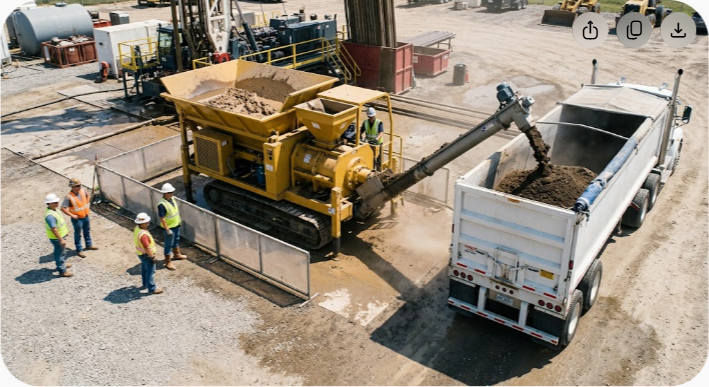
Bentonite can help convert wet drilling cuttings and water-rich drilling mud into a more cohesive, non-flowing material, but it isn't a universal substitute for cement, lime, or other stabilization reagents. Its main advantage is physical water control: sodium bentonite hydrates, swells, and forms a clay network that can immobilize free water when the waste chemistry and mixing conditions are suitable.
That distinction matters. A drilling waste treatment program has to achieve the acceptance criteria set by the receiving facility and the applicable environmental authority. Passing a Paint Filter Liquids Test demonstrates that a sample contains no observable free liquid under that test; it doesn't, by itself, prove that the waste is chemically stabilized or suitable for unrestricted disposal. Likewise, bentonite can adsorb some dissolved species, but it shouldn't be presented as a guaranteed treatment for heavy metals, hydrocarbons, or other contaminants.
For operators, the practical question is straightforward: Can bentonite make this particular drilling waste easier and safer to handle without creating a disposal problem? The answer can be yes, particularly for water-based drilling waste and other high-moisture streams, provided the treatment is established through representative bench testing and verified with field quality control.
This guide explains how the clay works, where it performs well, where it has limitations, how to establish a dosage rate, how to compare it with cement and fly ash, and what to test before a treated load leaves the site.
Bentonite is a clay dominated by smectite minerals, particularly montmorillonite. Its performance depends on mineral composition, exchangeable cations, particle size, moisture, and processing quality. Sodium-dominant bentonite is especially useful where high swelling and water retention are required.
When dry sodium bentonite contacts water, water enters the spaces associated with the clay layers. The clay hydrates and expands, and individual platelets can become highly dispersed. At suitable concentrations, those particles form a network that gives the mixture greater viscosity, gel strength, and resistance to drainage.
That behavior is useful in drilling waste because freshly separated cuttings and spent water-based mud can contain a large amount of mobile water. Instead of relying only on evaporation, an operator can use a properly selected clay additive to retain some of that water within a cohesive matrix.
The mechanism is easier to understand in three stages:
The exact swelling response varies substantially between bentonite sources. A high free-swell value is useful when selecting a product, but it shouldn't be treated as a direct prediction of performance in drilling waste. Salinity, calcium concentration, organic contaminants, oil content, pH, temperature, and the composition of the waste can all change the way bentonite behaves.
The exchangeable sodium associated with sodium-dominant bentonite generally supports greater hydration and swelling than calcium-dominant bentonite. That's why sodium bentonite is widely used where water retention, sealing, or high swelling capacity is important.
Calcium bentonite can still be useful in other industrial applications, but it isn't automatically the right choice for a waste stream that needs strong water retention. Product selection should be based on laboratory performance in the actual waste rather than mineral name alone.
One common purchasing mistake is to treat a bentonite swelling number as though it represents a fixed amount of drilling waste that one kilogram of product can solidify. It doesn't.
Free-swell testing measures how a defined quantity of bentonite behaves under a defined laboratory procedure. Field performance depends on the complete mixture. A salty drilling slurry can suppress swelling dramatically compared with fresh water. A clay-rich waste stream may also respond differently from a dilute slurry.
For that reason, bench-scale dosage testing is more useful than relying on a generic dosage chart.
The terms solidification and stabilization are often used together, but they describe different objectives.
Solidification focuses on changing the physical properties of waste. The treated material becomes less fluid, develops greater structure, and contains less readily mobile liquid.
Stabilization focuses on reducing the mobility or leachability of contaminants through chemical reactions, adsorption, precipitation, encapsulation, or other mechanisms.
Bentonite can contribute to physical solidification and can adsorb certain ions because of its charged clay surfaces. However, that doesn't make every bentonite-treated drilling waste stream chemically stabilized.
If a waste profile requires a TCLP result or another contaminant-specific leaching test, the treatment recipe must be validated against that requirement. A Paint Filter result cannot be used as a substitute for chemical characterization.
Montmorillonite commonly has a relatively high cation exchange capacity, or CEC. Negatively charged surfaces within the clay structure can exchange cations with the surrounding solution. This property is one reason bentonite can interact with dissolved metal ions.
The practical result is more nuanced than saying bentonite simply "locks up" heavy metals. Retention depends on the particular metal, pH, competing ions, salinity, clay mineralogy, concentration, contact conditions, and the chemistry of the final waste matrix.
If heavy-metal leaching is a regulatory concern, treat bentonite as one component of a validated treatment strategy, not as a guaranteed contaminant-removal reagent.
A well-selected sodium bentonite can offer several operational benefits, especially when the primary problem is excess free water.
The most direct benefit is physical. Hydrated bentonite increases the structure and water-holding capacity of the waste. A slurry that previously flowed freely can become a cohesive mass that is easier to handle and transport.
The improvement depends on the starting moisture content and waste chemistry. A small amount of bentonite may be sufficient for damp cuttings, while a very dilute slurry can require considerably more treatment or a different process altogether.
A cohesive waste stream is easier to load, move, and contain than a thin slurry. Reduced free-water mobility can also lower the risk of liquid draining from a roll-off or truck during handling, although the treated material still needs to meet the receiving facility's requirements.
The target isn't necessarily a completely dry product. In many cases, the better objective is a stable material with no unacceptable free liquid and sufficient structure for the planned handling method.
Portland cement relies on hydration reactions that continue as the binder develops strength. Bentonite works through hydration, swelling, dispersion, and physical structuring of the clay-water system rather than through the same cementitious curing mechanism.
That can be useful when an operation primarily needs short-term water control rather than a permanently cemented waste form. It also avoids the strongly alkaline conditions and heat associated with some lime-based treatments.
Bentonite dosage can be adjusted incrementally during bench testing. For example, a laboratory may compare several additions around a preliminary target and measure free liquid, workability, moisture, and other relevant properties.
That approach is preferable to selecting a fixed percentage simply because it worked at another site. Two drilling waste streams with the same apparent moisture content can behave very differently because their clay, salt, polymer, and hydrocarbon compositions differ.
Cement, fly ash, kiln dust, and other mineral additives can require substantial addition rates. Every tonne of additive eventually becomes part of the waste stream unless the process includes separation or recovery.
Bentonite isn't weight-free, and using too much can increase disposal volume and cost. The potential advantage comes from finding the lowest dosage that reliably achieves the required physical performance, rather than simply choosing bentonite because its dosage is theoretically lower.
No single solidification reagent is best for every drilling waste stream. The right selection depends on waste chemistry, moisture, required strength, contaminant profile, equipment, regulatory requirements, and disposal route.
| Reagent | Main mechanism | Typical role | Main advantage | Main limitation |
|---|---|---|---|---|
| Sodium bentonite | Hydration, swelling, clay-network formation | Free-water control and physical solidification | Strong water retention with suitable waste chemistry | Swelling can be suppressed by salts and divalent cations |
| Portland cement | Hydraulic reaction and cementitious bonding | Solidification and strength development | Produces a strong, durable matrix | Adds substantial mass and creates an alkaline mixture |
| Quicklime or lime-based products | Chemical reaction, moisture consumption, drying and stabilization | Moisture reduction and some stabilization applications | Can rapidly change moisture and chemistry | Caustic, heat-generating, and potentially difficult to handle |
| Fly ash | Filling and, for reactive ashes, pozzolanic or cementitious reactions | Bulk solidification or stabilization | Can be useful in formulated binder systems | Performance and regulatory suitability vary by ash source |
| Organic absorbents | Physical absorption and capillary retention | Short-term liquid uptake | Simple handling for some waste streams | Often adds significant volume and doesn't chemically stabilize contaminants |
These categories aren't mutually exclusive. A treatment plant may use bentonite for water control and a cementitious binder for strength, or select a completely different formulation after testing.
The comparison between bentonite and fly ash deserves particular care. Fly ash isn't a single standardized material from a performance perspective. Its chemistry varies by source, and regulatory requirements can also affect whether a particular ash is suitable for use in a waste treatment application.
Bentonite is often attractive when the primary problem is free water and the waste responds well to clay hydration. A cementitious or ash-based formulation can be preferable when long-term compressive strength or chemical stabilization is the main objective.
The correct choice should come from testing the actual waste, not from comparing generic percentages in isolation.
Lime can reduce moisture and alter waste chemistry, but quicklime is strongly alkaline and reacts exothermically with water. That introduces additional handling requirements and can make the process unsuitable for some waste streams.
Bentonite doesn't provide the same drying or pH-driven stabilization mechanism. Its advantage is a different one: it creates a hydrated clay structure that can retain water without the same lime reaction.
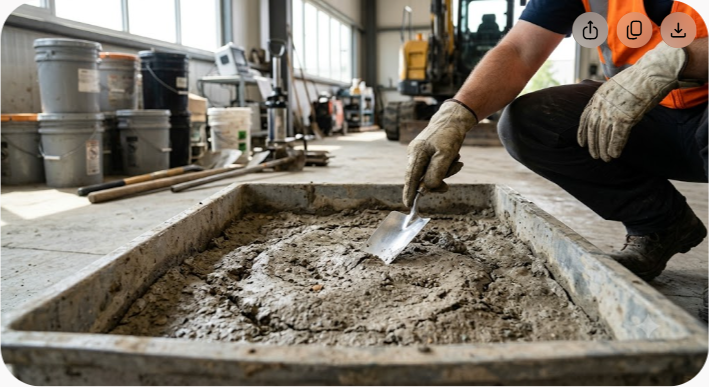
A successful program starts before the additive reaches the mixing equipment. The biggest errors usually come from treating the waste as a uniform material when it isn't.
Collect representative samples from the actual waste being treated. If the pit contains layers of settled solids, water, and concentrated mud, a single surface sample may not represent the whole batch.
At minimum, consider:
The purpose is not to build a laboratory report for its own sake. Each measurement should help explain how the waste will respond to treatment and which disposal criteria apply.
Before selecting a dosage, identify what the treated material has to achieve.
Potential requirements include:
A treatment recipe is only successful if the finished waste meets the criteria that actually govern its disposal.
Start with the untreated waste and create several small test batches. Add progressively higher bentonite concentrations rather than jumping directly to one assumed dosage.
For example, a screening series might compare 2%, 4%, 6%, and 8% bentonite by dry waste mass. Those percentages are test points, not universal field recommendations. The useful range may be lower or higher depending on the waste.
Record the appearance and handling behavior of every mixture. Then conduct the required laboratory or field tests. If the first few additions produce little improvement, investigate salinity, oil content, mixing quality, and particle distribution before simply adding more clay.
Once a suitable dosage has been established, calculate the required bentonite mass using the correct basis.
If the target addition is 4% by dry waste mass and the batch contains 10 tonnes of dry solids, the calculated bentonite requirement would be 0.4 tonnes. If the 10-tonne figure represents wet waste rather than dry solids, the calculation is different.
That distinction is important. A percentage by wet waste mass can produce a very different actual clay-to-solids ratio from a percentage based on dry solids.
Uniform distribution is as important as the nominal dosage. Dumping a large quantity of dry clay into one location can produce lumps and leave other parts of the waste untreated.
For continuous systems, calibrated metering equipment can feed the clay into a pugmill or other mixer. Batch systems can use controlled addition followed by mechanical mixing.
The equipment should be selected for the waste's viscosity and solids loading. A mixer that works well for damp cuttings may struggle with a heavy polymer-rich mud.
Mechanical shear helps distribute dry bentonite through the waste and exposes fresh clay surfaces to water. Poor mixing can leave dry pockets, wet pockets, and partially hydrated lumps.
Common approaches include:
The right equipment depends on the waste and production rate. There is no advantage in specifying high shear simply because it sounds technically superior if the equipment cannot process the required throughput reliably.
Sodium bentonite begins hydrating rapidly, but the finished material may continue changing after initial mixing. Allowing a short conditioning period can help the clay distribute water more evenly.
The appropriate hold time should come from testing. A fixed 10- or 30-minute period shouldn't be treated as a regulatory requirement or universal recipe. Some waste streams may show adequate performance quickly; others may need more conditioning or additional mixing.
Sample the finished material from representative locations. Don't rely solely on a sample taken from the easiest point to reach.
Depending on the disposal requirements, quality control may include:
Document the treatment batch, bentonite quantity, waste quantity, test results, and destination. Good records make it easier to investigate a failed load and demonstrate that the treatment process was controlled.
The Paint Filter Liquids Test, EPA Method 9095B, is commonly used to determine whether a waste contains free liquids. In broad terms, a representative sample is placed in a standardized paint filter and observed for liquid passing through during the specified test procedure.
The important point is what the test does and doesn't show.
A passing result indicates that the sample did not exhibit free liquid under the conditions of the test. It doesn't establish that the waste is non-hazardous, that contaminants cannot leach, or that a landfill must accept the material.
Those questions require separate evaluation.
If free water is the main reason a drilling waste fails the test, bentonite can reduce liquid mobility by creating a hydrated clay structure. A properly mixed treatment can therefore help produce a sample with no observable free liquid.
However, performance should always be verified by testing. A bentonite dosage that passes one waste batch may fail on another because the water chemistry, solids concentration, and clay content have changed.
The Toxicity Characteristic Leaching Procedure, EPA Method 1311, addresses a different question from the Paint Filter test. TCLP evaluates the mobility of specified contaminants under laboratory conditions designed to simulate aspects of waste disposal environments.
Bentonite can interact with dissolved cations through cation exchange and adsorption, and the clay matrix can contribute to physical retention. But those properties don't guarantee a passing TCLP result.
If a drilling waste stream has a known metal contamination problem, the correct procedure is to characterize the untreated waste, select a treatment formulation, and test the treated material using the required method.
For some wastes, a cementitious or chemically reactive stabilizer may be more appropriate than bentonite alone. In other cases, bentonite may be part of a broader treatment system. The chemistry decides.
Water-based mud is often the most straightforward candidate for bentonite-based physical solidification because the waste already contains a water phase that can hydrate the clay.
Even here, the mud composition matters. Polymers, salts, weighting agents, drilled formation solids, and treatment chemicals can alter the rheology and swelling response.
Salinity can reduce the swelling and dispersion of sodium bentonite. High concentrations of dissolved electrolytes compress the diffuse electrical layer around clay particles, reducing the repulsive forces that help the clay disperse.
Calcium and magnesium can be particularly important because divalent cations can promote clay aggregation and reduce swelling compared with sodium-dominated conditions.
If a water-based mud has high chloride or hardness, test the actual mud with the proposed bentonite before setting the field dosage.
Oil-based and synthetic-based drilling waste presents a different challenge because bentonite's strongest swelling mechanism depends on access to water. A hydrocarbon-rich waste stream may not provide enough available water for conventional sodium bentonite to hydrate effectively.
That makes the simple claim that "bentonite solidifies oil-based mud by absorbing hydrocarbons" misleading. Standard sodium bentonite is not a universal hydrocarbon absorbent, and cation exchange doesn't encapsulate hydrocarbons in the same way it can interact with dissolved cations.
For OBM or synthetic-based cuttings, evaluate the waste's water content, oil-on-cuttings ratio, emulsion stability, and disposal route before selecting a treatment. An organophilic clay, polymer, mineral absorbent, cementitious binder, thermal treatment, or another process may be more appropriate depending on the objective.
Bentonite may still have a role, but it should be demonstrated through testing rather than assumed from its performance in water-based mud.
Likely causes:
What to do:
Run a fresh bench test using the current waste. Compare incremental dosage increases and test the effect of mixing time. If the waste is saline, evaluate a suitable salt-tolerant formulation rather than assuming that simply doubling a conventional sodium bentonite dose will solve the problem.
Dry lumps, sometimes called fish-eyes in highly hydrated systems, can form when clay is exposed to water too quickly or isn't distributed properly. The outside of a particle hydrates and forms a gel layer while the dry material inside remains protected from water.
What to do:
Improve metering and dispersion. Feed the bentonite into a high-shear mixing zone rather than dumping it onto the surface of a wet pit. Check whether the mixer has enough capacity for the solids loading and whether the addition rate is overwhelming the mixing system.
A successful free-liquid treatment can still create an operational problem if the mixture becomes too viscous for the available equipment.
What to do:
Reduce the clay dosage only after confirming that the lower rate still meets the disposal criteria. If the waste is being pumped before treatment, consider where in the process the bentonite should be introduced. It may be more practical to dewater or mechanically separate part of the liquid before adding the final solidification reagent.
A treated material can change under vibration, shear, pressure, or additional water exposure. This doesn't necessarily mean the bentonite failed; it may indicate that the mixture was marginally treated or that the selected physical structure isn't robust enough for the transport conditions.
What to do:
Test the material after conditioning and, where practical, simulate the handling conditions. Review the actual solids-to-water ratio and consider whether a binder is needed to achieve the required structural strength.
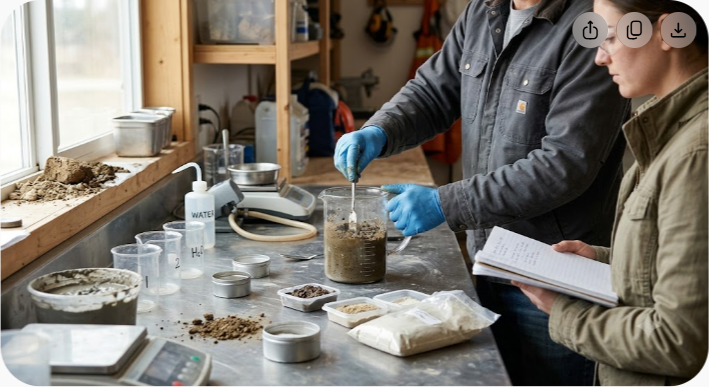
Don't automatically add cement to every failing batch. A cementitious binder changes the chemistry, mass, pH, and final waste characteristics and should be evaluated as a separate treatment decision.
Fine bentonite powder can become airborne during bag dumping, hopper filling, or pneumatic conveying. Dust control is therefore part of the treatment design, not an afterthought.
What to do:
Use enclosed transfer points where practical, minimize free-fall distances, maintain appropriate local ventilation, and follow the product safety data sheet and site respiratory-protection requirements. Avoid describing an N95 respirator as a universal requirement; the correct respiratory protection depends on the measured or expected exposure and the applicable occupational safety program.
There is no universal dosage that guarantees drilling waste solidification. Still, a simple mass calculation helps organize a bench program.
Suppose a treatment trial uses 5 kilograms of wet waste and the first screening level is 4% bentonite by wet waste mass. The initial bentonite addition would be:
Prepare additional batches at different concentrations and compare their performance. If the waste contains a large amount of water, it can also be useful to express the treatment rate relative to dry solids so that results from batches with different moisture contents can be compared more meaningfully.
The final field dosage should be based on the testing protocol and the actual waste characteristics, not on the example above.
Bentonite consumption can rise when the waste has:
These factors explain why a single percentage copied from another drilling site can produce unreliable results.
When purchasing bentonite for industrial waste treatment, don't evaluate the material solely by price per tonne. The useful metric is the cost of achieving the required treatment result.
Ask the supplier for relevant product specifications and a current certificate of analysis where appropriate. Depending on the application, useful parameters may include:
The exact specification should match the treatment application. A drilling-grade bentonite designed for rheology in a drilling fluid isn't automatically optimized for every waste solidification process.
A supplier can provide excellent laboratory data and still offer a product that performs poorly in your particular waste stream. The most useful qualification test combines the proposed bentonite with representative waste.
Ask for a small trial quantity before committing to a large supply contract when the application is new or the waste chemistry is variable.
The lowest price per tonne of bentonite isn't necessarily the lowest treatment cost.
A better calculation includes:
For example, a cheaper clay that requires twice the dosage can easily cost more after transport and disposal are included. Conversely, an expensive high-swelling product isn't economical if the waste chemistry suppresses its performance.
The right question is how much does it cost to produce an accepted tonne or cubic yard of treated waste?
Before shipping treated drilling waste, build the treatment program around the actual requirements of the jurisdiction and receiving facility.
Regulatory requirements vary by jurisdiction, waste classification, and disposal route. A treatment additive doesn't change the underlying legal classification of a waste simply because the material has become solid.
Consider a hypothetical horizontal directional drilling project producing wet cuttings mixed with bentonitic drilling fluid. The material is too fluid for the intended receiving facility and contains substantial free water.
The treatment team first collects representative samples and measures moisture, solids, salinity, and the relevant contaminants. Small batches are then prepared with progressively higher sodium bentonite additions.
At a selected dosage, the material becomes cohesive and shows no free liquid under the applicable test. The team then repeats the trial using samples from different parts of the waste stream to confirm that the result isn't limited to one unusually dry sample.
Once the treatment recipe is established, the field crew meters bentonite into a controlled mixing process. Each production batch is documented and sampled according to the site's quality plan.
This is a better model for field treatment than assuming that a fixed percentage will work simply because another HDD project used it successfully. The useful result isn't the percentage itself. It's a repeatable process that produces waste meeting the actual acceptance criteria.
Suppose two drilling operations generate waste with similar moisture content. The first uses relatively fresh water, while the second operates with highly saline makeup water and significant calcium contamination.
The same sodium bentonite dosage may produce a strong gel in the first waste and a much weaker structure in the second. The difference comes from clay-water chemistry rather than from a simple failure of the product.
A bench test quickly exposes this problem. Instead of increasing dosage blindly, the operator can evaluate a product or treatment formulation better suited to the ionic conditions.
That distinction can prevent unnecessary clay consumption and reduce the risk of creating a treatment process that works only under ideal laboratory conditions.
A 2%, 4%, or 6% dosage isn't a universal rule. Treat those numbers as possible screening points, not guaranteed field recipes.
A sample can pass a free-liquid test and still contain contaminants that require special handling or disposal. Physical solidification and waste classification are separate questions.
Waste pits can stratify. Surface water, settled cuttings, concentrated mud, and chemical-rich layers may have different properties. Representative sampling matters.
Freshwater swelling data can't reliably predict performance in highly saline drilling waste. Test the actual chemistry.
If the clay is clumping, increasing the dosage may make the problem worse. Fix dispersion and mixing first.
Standard sodium bentonite is primarily useful for water-based physical structuring. Hydrocarbon-rich waste requires a separate assessment of the oil phase and disposal requirements.
The treated material should be evaluated under the conditions it will actually encounter. Transport, storage, loading, and receiving-facility handling can reveal weaknesses that aren't obvious immediately after mixing.
For large-scale drilling waste treatment, product consistency is as important as the headline swelling value. Variations in mineralogy, moisture, particle size, and processing can change field performance and make dosage control harder.
When qualifying a supplier, request a clear technical specification and batch documentation. Ask which test methods are used and whether the reported values represent the product supplied to your site rather than a generic specification for the company's entire product range.
For applications involving water-based drilling waste, a useful supplier evaluation can include:
Axewelledge can be evaluated as a potential industrial bentonite supplier when its product specifications, quality documentation, sample performance, and supply terms meet the requirements of the project. Supplier claims about reserves, production capacity, certifications, or geographic coverage should be verified against current company documentation before being used in procurement or published marketing material.
For a high-volume treatment program, the strongest purchasing decision is usually the one supported by a field-relevant trial rather than the lowest quoted price or the largest stated reserve.
Bentonite is easier to use when it arrives dry and remains dry until it enters the treatment process. Moisture absorbed during storage can cause caking, feed problems, and inconsistent dosing.
Store bags or bulk material under cover and protect them from rain, standing water, and condensation. Use intact packaging and keep the product off the ground where site conditions could expose it to moisture.
For bulk handling systems, inspect hoppers and transfer lines regularly. A partially blocked feeder can change the actual dosage without producing an obvious change in the operator's set point.
Keep safety data sheets available and follow the supplier's handling instructions. Fine mineral dust should be controlled through engineering measures and the site's occupational exposure program.
Bentonite isn't the best solution for every drilling waste problem.
Consider another treatment strategy when:
In these situations, cementitious binders, lime-based systems, specialty polymers, organophilic clays, dewatering, thermal processing, separation, or combinations of treatments may be worth evaluating.
The objective isn't to make bentonite fit every waste stream. It's to select a treatment that reliably meets the physical, chemical, environmental, and economic requirements of the job.
Bentonite can be an effective drilling waste solidification agent when the primary challenge is excess free water and the waste chemistry supports clay hydration.
The most important points are:
A good solidification program is therefore less about finding a magic bentonite percentage and more about matching the clay, dosage, mixing process, and verification tests to the waste in front of you. When those pieces are aligned, sodium bentonite can provide a practical way to control free water and improve the handling characteristics of suitable drilling waste.
For projects considering high-yield sodium bentonite, the next step should be a representative waste trial using the proposed product and the acceptance criteria of the intended disposal facility.













Have questions about our products? We're here to help!