Axewelledge, a leading exporter from India, specializes in high-quality Bentonite. With a commitment to excellence, we supply premium Bentonite to the Middle East and Southeast Asia markets.


North Angle Complex, 304,
150 Feet Ring Rd, Opposite Ambedkar Nagar BRTS Stop,
Madhav Park, Punit Nagar,
Mavdi, Rajkot, Gujarat 360004
© Axewelledge 2026, All Rights Reserved.
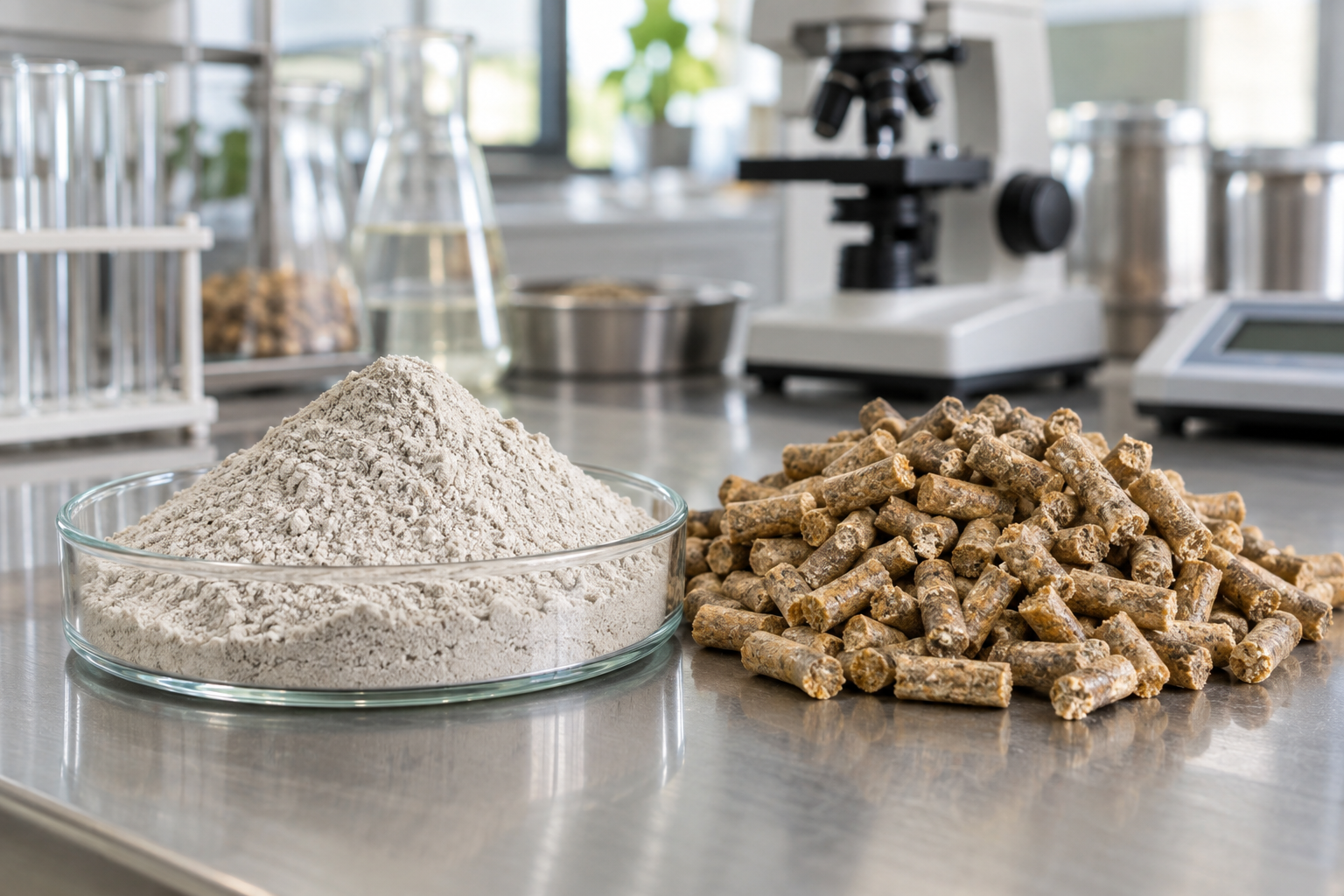
Bentonite can be a useful functional ingredient in animal feed, but buying the right material is not as simple as choosing a clay with a high swelling value. For feed applications, the key questions are where the bentonite comes from, what minerals it contains, how consistently it performs, whether contaminants are controlled, and whether the finished product meets the rules of the market where it will be used.
That distinction matters because bentonite is a natural mineral rather than a chemically uniform material. Deposits differ in mineral composition, exchangeable ions, particle size, impurities, and processing history. A product sold as sodium bentonite, calcium bentonite, montmorillonite, or "mycotoxin binder" can therefore behave quite differently from another product carrying a similar label.
For buyers, the safest approach is to treat feed-grade bentonite as a controlled feed ingredient rather than a generic industrial clay. Ask for a batch-specific Certificate of Analysis (CoA), verify contaminant testing, confirm the intended feed use and inclusion rate, review the supplier's technical documentation, and compare the product against the requirements of your destination market.
This guide explains what to check before purchasing bentonite for animal feed, how sodium and calcium bentonite differ, which laboratory tests are useful, what questions to ask suppliers, and which common buying mistakes can create quality or compliance problems.
Bentonite is a naturally occurring clay containing smectite minerals, with montmorillonite commonly being the dominant component. Its layered structure gives it a high surface area and the ability to exchange cations and interact with water and other compounds.
Those properties can make bentonite useful in several feed-manufacturing and animal-nutrition applications. However, the exact benefit depends on the mineral source, processing method, animal species, diet composition, product characteristics, and inclusion rate.
Some bentonite products are used as mineral adsorbents intended to reduce the biological availability of certain mycotoxins in contaminated feed. The best-established example is aflatoxin B1 adsorption by suitable aluminosilicate materials.
The mechanism is more specific than simply saying that clay "absorbs toxins." Smectite minerals have charged surfaces and interlayer spaces that can interact strongly with some molecules. Aflatoxin B1, for example, can be strongly adsorbed by particular bentonite materials under appropriate conditions.
That does not mean every bentonite is an effective broad-spectrum mycotoxin binder. Adsorption can vary substantially between products and between toxins. A material that performs well against aflatoxin may not provide the same level of protection against toxins such as deoxynivalenol (DON), zearalenone, fumonisins, or ochratoxin A.
For that reason, buyers should be cautious with blanket claims such as "binds all mycotoxins." If mycotoxin control is the reason for purchase, request product-specific efficacy evidence and establish which toxins were actually tested.
Bentonite is also used as a functional binder in some feed-manufacturing applications. Its interaction with water can help bind feed particles during conditioning and pelleting.
A suitable binder can improve pellet quality and reduce the amount of loose material, or fines, generated during production and handling. The actual result depends on the formulation, steam conditioning, die configuration, throughput, particle size, and other binders or processing aids used in the mill.
This is why a supplier's swelling index alone shouldn't be treated as a prediction of pellet performance. A feed mill should validate the material under its own production conditions.
Bentonite may also be used as a technological additive, depending on the regulatory framework and the specific product authorization. Certain clay minerals have been evaluated for effects related to feed flow, binding, or interactions with selected compounds.
Claims about digestion, rumen health, nutrient utilization, or animal performance require more caution. Bentonite isn't a universal rumen buffer, digestive aid, or performance enhancer. Its suitability for a particular nutritional purpose should be supported by evidence for the exact product and use conditions.
The first question for procurement should not be "What is the price per tonne?" It should be "Is this material suitable and legally permitted for the intended feed application?"
Industrial bentonite may be perfectly suitable for drilling fluids, foundry applications, civil engineering, absorbents, or other uses while being unsuitable for animal feed. Industrial specifications aren't a substitute for feed-grade specifications.
A low-priced mineral can become expensive if it creates formulation problems, contaminant concerns, inconsistent pellet quality, rejected shipments, or additional testing requirements.
When sourcing feed-grade bentonite, establish the following before comparing commercial offers:
Only after those specifications are clear does a price comparison become meaningful.
A CoA should identify the material and the batch being supplied. A generic product brochure is useful for understanding the product, but it doesn't demonstrate that a particular shipment meets the stated specification.
The exact test panel should be agreed with the supplier and may vary according to the product's intended use and applicable regulations. The following parameters are useful starting points.
| Parameter | What to Review | Why It Matters |
|---|---|---|
| Montmorillonite or smectite content | Supplier specification and test method | Helps characterize the active clay fraction and distinguish products with different mineral compositions. |
| Moisture | Batch result and agreed maximum | Affects handling, storage stability, dosing accuracy, and the amount of actual dry material purchased. |
| Particle-size distribution | Sieve or laser-diffraction data | Influences mixing, dust generation, flow, and pelleting behavior. |
| Swelling index | Test method and batch result | Useful for characterizing hydration and swelling, especially for sodium-rich bentonite. |
| Cation exchange capacity (CEC) | Reported value with test method | Helps characterize exchange capacity, although it should not be used alone to predict mycotoxin-binding performance. |
| pH | Test method and specified concentration | Provides useful characterization data but isn't, by itself, a measure of feed safety or efficacy. |
| Lead, cadmium, arsenic, mercury | Batch-specific contaminant results | Natural mineral deposits can contain trace elements that must remain within applicable limits. |
| Dioxins and PCBs | Where required by the market or risk assessment | Important for mineral feed materials subject to applicable contaminant controls. |
| Microbiological parameters | Applicable feed-safety tests | Helps verify that handling and processing haven't introduced unacceptable microbial contamination. |
| Mineral composition | Full or agreed mineral profile | Helps identify variability between deposits and batches. |
Do not accept a number simply because it appears precise. Ask how the value was measured. A swelling result from one standardized method isn't necessarily comparable with a result generated using a different method.
Montmorillonite content is commonly used to describe the principal smectite fraction in bentonite. A higher percentage can indicate a more concentrated smectite-rich material, but it doesn't automatically mean better performance in every feed application.
The test method matters, and mineralogical analysis can be more informative than relying on a single percentage printed on a sales sheet. X-ray diffraction (XRD), for example, can help characterize the mineral phases present in a clay.
Rather than setting an arbitrary universal minimum, buyers should establish an agreed specification based on the intended application and the supplier's validated product data.
Moisture affects both economics and handling. Excess moisture can increase the apparent weight of a shipment, encourage caking, and affect dosing and flowability.
At the other extreme, an aggressively dried powder may behave differently during handling and can generate more dust. The right target is therefore the range that provides consistent storage and processing performance for the specific product.
Include moisture in the purchase specification and compare batch results against the agreed range.
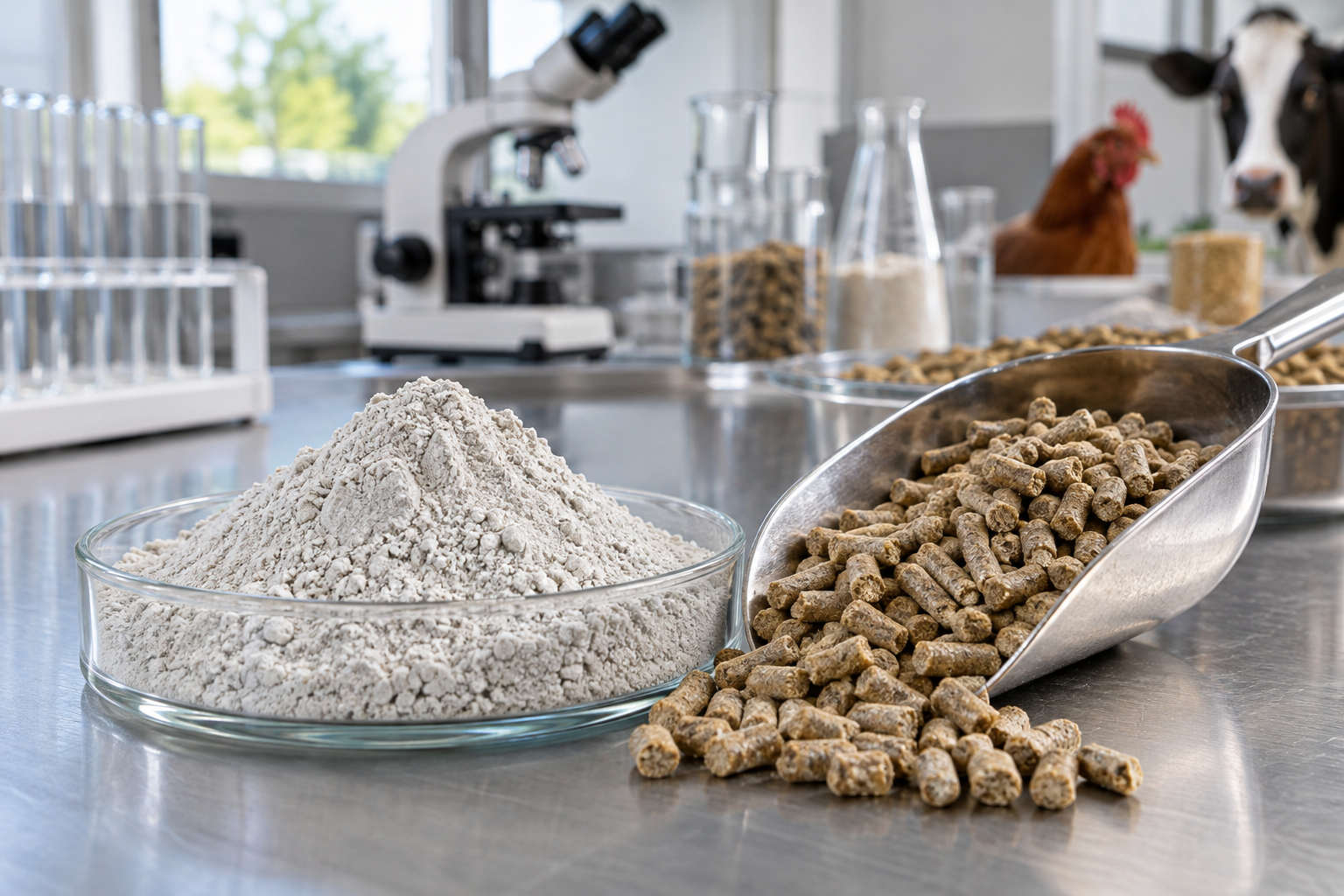
CEC measures how much exchangeable positively charged ions a material can hold. Smectite-rich clays often have relatively high CEC values, which is one reason they are useful in several industrial and agricultural applications.
CEC is valuable characterization information, but it should not be treated as a standalone mycotoxin-binding score. Adsorption depends on the mineral structure, surface chemistry, toxin, pH, competing compounds, and test conditions.
If the product is being purchased as a mycotoxin-control additive, functional testing against the relevant toxin is more meaningful than selecting the product with the highest CEC alone.
Swelling is particularly relevant to sodium-rich bentonite. When hydrated, sodium bentonite can expand substantially and form a gel-like suspension.
A high swelling value can be useful when the material is intended for binding or other applications where hydration behavior matters. It doesn't automatically establish that the product is safer or more effective as a mycotoxin adsorbent.
Always record the test method, sample preparation, particle size, and units when comparing suppliers. Two apparently similar swelling figures can represent different testing conditions.
Sodium and calcium bentonite are useful commercial descriptions, but natural bentonites can contain mixtures of exchangeable cations. The distinction is therefore best understood as a difference in dominant exchangeable chemistry and resulting behavior rather than as two perfectly uniform mineral species.
Sodium-dominant bentonite generally has greater swelling capacity than calcium-dominant bentonite. That property can make it attractive for applications where hydration and binding are important.
For animal feed, however, sodium contribution has to be considered as part of the complete ration. A formulation designed around a sodium-rich mineral needs to account for its contribution to total dietary sodium and chloride balance.
Sodium bentonite may be appropriate for a particular application, but the decision should be based on the formulation and validated technical performance rather than the name alone.
Calcium-dominant bentonite generally swells less than sodium-dominant bentonite. It can still have useful adsorption and processing properties, depending on its mineralogy and processing.
Calcium bentonite shouldn't automatically be described as superior for poultry or swine simply because it contributes less sodium. The correct choice depends on the formulation, intended function, regulatory status, and product performance.
There isn't one universal answer. Start with the job the mineral needs to perform.
| Buying objective | What to prioritize |
|---|---|
| Pellet binding | Hydration behavior, particle size, compatibility with the formulation, and mill trials |
| Aflatoxin adsorption | Product-specific adsorption evidence and appropriate regulatory authorization |
| Minimizing sodium contribution | Mineral composition and total dietary sodium |
| Dust control | Particle-size distribution, granulation, and handling characteristics |
| Automated dosing | Consistent flow properties, moisture, bulk density, and particle size |
A supplier should be able to explain why its product fits the application and provide data to support that explanation.
Natural clay deposits can contain trace elements because the minerals formed through geological processes. The presence of a detectable element isn't automatically evidence of unsafe material; what matters is the concentration, chemical context, applicable maximum levels, animal exposure, and regulatory requirements.
For feed applications, buyers should normally pay particular attention to lead, cadmium, arsenic, and mercury, along with any additional contaminants specified by the destination market.
Lead is a toxic element with no nutritional requirement. Feed materials should therefore be controlled against the applicable regulatory maximum or company safety specification.
Cadmium can occur naturally in mineral materials and is relevant to feed safety because chronic exposure can result in accumulation and toxicity. Testing should be performed using a validated laboratory method and interpreted against the applicable limit.
Arsenic exists in different chemical forms, and regulatory approaches can distinguish between them. Buyers should therefore avoid relying on a generic statement such as "arsenic free." Instead, confirm the relevant specification and analytical method for the market and product.
Mercury is another undesirable contaminant that should be controlled according to applicable feed regulations. A supplier's contaminant panel should clearly state the reporting limits and test results rather than simply claiming that the product is "heavy-metal safe."
Depending on the jurisdiction and the source material, additional contaminant controls may apply to mineral feed ingredients. Dioxins and dioxin-like PCBs are particularly important in regulatory systems that set maximum levels for feed and feed materials.
Don't assume that a clay is automatically free of these contaminants because it is naturally mined. Ask whether the supplier has a documented contaminant-risk assessment and whether routine or periodic testing is performed where required.
The supplier should also be able to explain any processing steps that could affect contamination risk. If the material is activated chemically, dried, blended, or otherwise processed after mining, those operations should be part of the quality review.
Bentonite is an inorganic mineral, so microbiological risks aren't identical to those associated with ingredients such as animal proteins or grains. Even so, contamination can occur through mining, processing, handling, storage, packaging, or transport.
The feed manufacturer's hazard analysis should determine which microbiological controls are appropriate. Depending on the risk assessment and local requirements, this may include testing for Salmonella and other relevant organisms.
A supplier should be able to describe its hygiene controls, storage conditions, cleaning procedures, and sampling plan. Avoid treating a single microbiological test as proof that every future shipment will have identical quality.
Particle size has a direct effect on how bentonite moves through a feed mill. A very fine powder can disperse efficiently but may create more dust. A coarser product may be easier to handle but can require more attention to mixing uniformity.
There is no single mesh size that is ideal for every feed mill. The right distribution depends on the mixing system, dosing equipment, formulation, dust-control measures, and whether the product is used in mash, premix, or pelleted feed.
Fine bentonite can provide good dispersion and a large surface area. It may be appropriate where the material needs to be distributed throughout a complete feed or premix.
The trade-off is handling. Very fine mineral powders can increase airborne dust, which affects housekeeping and occupational exposure controls.
Granulated material can improve flow and reduce dust during bulk handling. It may be useful in automated dosing systems where consistent particle size and flow are important.
However, granulation changes the physical form of the product and can alter its dispersion characteristics. If the product is intended to bind mycotoxins, buyers should confirm that the granulated form retains the required functional performance under actual feed conditions.
Procurement teams sometimes focus heavily on chemical specifications and overlook physical handling properties. Bulk density can affect storage capacity, dosing calibration, transport economics, and the amount of material that fits into a given hopper or container.
Flowability also matters. A mineral that bridges in a silo or forms hard lumps in humid conditions can create dosing errors and production interruptions even when its chemical analysis is excellent.
Ask for bulk-density data and, where relevant, flowability information. Then test the product in the actual receiving and dosing system before approving a large contract.
A reliable supplier should be able to answer technical questions without relying entirely on marketing language. The following checks provide a practical procurement framework.

State exactly where the bentonite will be used: species, feed type, functional purpose, target market, and expected inclusion rate.
A product suitable for pellet binding isn't automatically suitable for use as a mycotoxin-control additive. Likewise, a material used successfully in cattle feed may have different formulation considerations in poultry or swine diets.
The specification should identify the material, key physicochemical properties, contaminant limits, particle-size range, moisture range, packaging format, and recommended use where applicable.
Look for measurable limits rather than vague descriptions such as "premium quality" or "high purity."
A CoA should correspond to the lot being supplied. Check the lot number, production or dispatch date, test dates, laboratory information, units, methods, and actual results.
A generic specification sheet can tell you what the supplier intends to make. A batch CoA tells you what was reported for the shipment.
For critical contaminants, consider verification testing through an appropriately accredited or competent laboratory. The laboratory should use validated analytical methods suitable for the matrix and contaminant being measured.
The goal isn't to test every parameter on every shipment without reason. It is to create a risk-based verification program that confirms the supplier's results and catches meaningful deviations.
Ask where the material was mined, where it was processed, where it was packed, and how lots are identified throughout the supply chain.
A supplier that can trace a finished bag or bulk lot back to its production records is in a much stronger position to investigate quality deviations.
Ask how the supplier retains samples from production lots and how complaints are investigated. A documented process is especially important for long-term supply contracts.
If a shipment behaves differently in the feed mill, both parties need to be able to identify the affected lot and compare retained samples.
Two clays can contain similar minerals and still differ in contaminant profile, processing history, particle size, and regulatory suitability. Feed use requires the appropriate grade and documentation.
A higher stated montmorillonite content isn't a universal guarantee of better feed performance. Mineralogy, particle characteristics, processing, contaminant control, and the intended application all matter.
CEC is a useful mineral-property measurement, but it isn't a direct substitute for toxin-specific adsorption testing. Ask for evidence against the toxin that actually matters to your feed program.
Swelling and adsorption are related to mineral structure but aren't interchangeable measures. A material can have excellent swelling characteristics without being the best choice for a particular toxin.
A product brochure or old test report shouldn't be used as proof of current batch quality. Lot-specific documentation provides much stronger traceability.
If a sodium-rich bentonite is added to a ration, its contribution should be included in the complete mineral formulation. This is particularly relevant where dietary sodium is already carefully controlled.
Laboratory specifications don't capture every interaction inside a feed mill. Before committing to a large volume, run a controlled trial and measure the results that matter to your operation, such as pellet durability, fines, dust, throughput, moisture, and dosing consistency.
When several suppliers appear to offer similar bentonite, compare them using the same criteria.
| Evaluation area | Supplier A | Supplier B | Supplier C |
|---|---|---|---|
| Feed-grade documentation | Verify | Verify | Verify |
| Mine and source traceability | Verify | Verify | Verify |
| Batch-specific CoA | Verify | Verify | Verify |
| Montmorillonite or smectite data | Record result | Record result | Record result |
| Moisture | Record result | Record result | Record result |
| Particle-size distribution | Record result | Record result | Record result |
| CEC and swelling method | Record method and result | Record method and result | Record method and result |
| Heavy-metal testing | Verify | Verify | Verify |
| Dioxin/PCB controls where applicable | Verify | Verify | Verify |
| Mycotoxin efficacy evidence | Review | Review | Review |
| Packaging options | Compare | Compare | Compare |
| Minimum order quantity | Compare | Compare | Compare |
| Lead time | Compare | Compare | Compare |
| Verification sample available | Yes/No | Yes/No | Yes/No |
| Regulatory documentation | Verify | Verify | Verify |
This format keeps procurement decisions from becoming a simple price-per-tonne comparison. A supplier with a slightly higher quoted price may offer better traceability, tighter specifications, stronger verification, or more consistent physical performance.
A structured purchasing process reduces surprises after the contract is signed.
This process is especially important when purchasing bulk bentonite for repeated feed production. Consistency matters just as much as the initial test result.
Feed regulations differ by jurisdiction, animal species, additive category, and intended function. A product legally marketed for one purpose in one country may require different authorization or documentation elsewhere.
For that reason, buyers shouldn't rely on a supplier saying that a bentonite is simply "feed safe." Confirm the regulatory status that applies to the exact product and intended use in the destination market.
For exports, ask for the documents required by the importing country and verify whether the product's claimed function is permitted. Keep records of specifications, CoAs, supplier approvals, test results, and lot traceability as part of the feed-safety system.
In India, buyers should also verify the current requirements that apply to their particular feed operation, ingredient category, and intended market rather than assuming that a specification from another jurisdiction automatically applies.
Even a high-quality bentonite can become difficult to handle if it absorbs moisture during storage or transport.
Keep bags protected from rain, condensation, and direct contact with wet floors. Use appropriate moisture-resistant packaging for the expected storage and shipping conditions. Bulk material should be stored in equipment designed to prevent moisture ingress and minimize bridging or compaction.
Before unloading a shipment, inspect packaging for tears, water damage, hardened lumps, contamination, or evidence of exposure during transport. Record lot numbers and retain representative samples according to the feed manufacturer's quality system.
Do not automatically reject a product because it contains some agglomerates; first determine whether the material can be restored through normal handling and whether the agglomeration affects dosing or dispersion. Persistent hard caking, unusual odor, contamination, or unexplained physical changes should trigger a quality investigation.
A practical bentonite specification should be specific enough that both the buyer and supplier can determine whether a shipment conforms.
At minimum, consider including:
The last point is often overlooked. A change in mine face, processing method, drying conditions, or blending source can change the characteristics of a natural mineral. Buyers should require advance notification of material changes that could affect specification or performance.
Use these questions during supplier qualification:
A supplier that answers these questions clearly is easier to qualify and monitor over time.
Bentonite can provide useful binding, adsorption, and processing functions in animal-feed applications, but the product needs to be evaluated for its specific purpose. Natural bentonite is variable, and a mineral name alone doesn't guarantee consistent performance or feed safety.
The most important checks are straightforward: confirm the feed grade, define the intended application, review a batch-specific CoA, verify critical contaminants, understand mineralogical and physical properties, assess regulatory requirements, and conduct a production trial where performance matters.
For mycotoxin control, don't select a product solely because it has a high CEC or swelling index. Ask for toxin-specific evidence. For pellet binding, evaluate the product in the actual feed formulation and pelleting process. For any application, keep sodium contribution, moisture, particle size, traceability, and contaminant limits in view.
The best supplier is not necessarily the one offering the lowest price. It's the one that can consistently deliver the material you specified, document what was supplied, control foreseeable risks, and support the product's intended use with credible technical evidence.













Have questions about our products? We're here to help!