Axewelledge, a leading exporter from India, specializes in high-quality Bentonite. With a commitment to excellence, we supply premium Bentonite to the Middle East and Southeast Asia markets.


North Angle Complex, 304,
150 Feet Ring Rd, Opposite Ambedkar Nagar BRTS Stop,
Madhav Park, Punit Nagar,
Mavdi, Rajkot, Gujarat 360004
© Axewelledge 2026, All Rights Reserved.
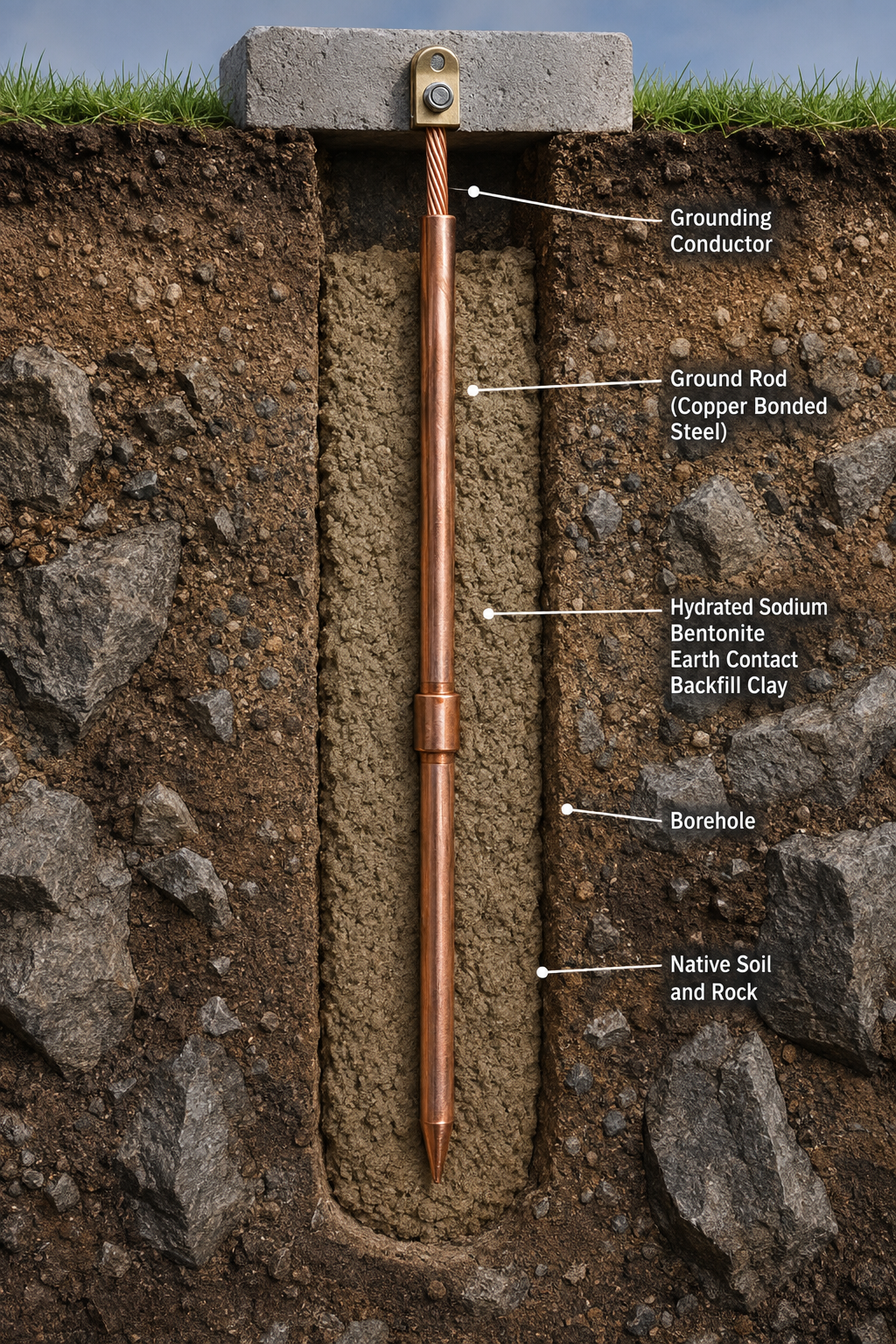
High soil resistivity destroys electrical protection systems. Standard earth electrodes installed in rocky, sandy, or dry soil frequently fail to achieve the standard target of 5 ohms or less required for commercial facilities, and under 1 ohm for power substations. When a high-voltage surge or lightning strike occurs, an inadequately grounded system creates dangerous touch and step potentials, destroys sensitive electronics, and triggers nuisance breaker trips.
Installing longer ground rods or adding parallel grid conductors is expensive, space-prohibitive, and often physically impossible in hard bedrock. Bentonite earth contact backfill solves this challenge directly by replacing high-resistivity soil around the electrode with an engineered clay matrix that exhibits a bulk resistivity of just 2.5 to 5.0 ohm-meters.
By swelling up to 15 times its dry volume when hydrated, sodium bentonite eliminates micro-air gaps between the metal electrode and surrounding earth, dramatically lowering the overall ground resistance of the installation.
To understand why backfill works, we must first look at what governs resistance to earth. The total electrical resistance of a grounding system ($R$) is determined not by the metal rod itself, but by the surrounding soil.
According to Dwight's equation for a single vertical ground rod driven into uniform soil:
Where:
Looking closely at this formula reveals a critical operational fact: ground resistance is directly proportional to soil resistivity ($\rho$). Doubling the diameter of a metal rod ($a$) yields only a logarithmic reduction in resistance. Doubling the rod length ($L$) cuts resistance down, but driving a 20-foot rod into solid granite or dry sand is often impossible.
Different geological formations conduct electricity at drastically different levels depending on moisture, mineral content, and compaction:
| Material Type | Typical Resistivity ($\Omega\cdot\text{m}$) | Grounding Suitability |
|---|---|---|
| Concrete-encased electrode (Ufer) | 30 – 90 | Good |
| Clay / Loam Soil | 10 – 100 | Ideal |
| Sandy Soil / Gravel | 300 – 3,000 | Poor |
| Solid Sandstone / Granite | 1,000 – 10,000+ | Critical / Severe |
| Hydrated Sodium Bentonite Clay | 2.5 – 5.0 | Superior |
Because hydrated bentonite exhibits a fraction of the resistivity of rocky or sandy soil, enveloping the electrode in a layer of bentonite effectively increases the equivalent diameter ($a$) of the rod in Dwight's equation to match the outer diameter of the backfill trench or borehole.
Bentonite is a naturally occurring clay formed primarily from weathered volcanic ash. Its active mineral component is montmorillonite, a 2:1 layer aluminosilicate structure featuring a high cation-exchange capacity.
When processed into electrical backfill, non-treated Sodium Bentonite is preferred over Calcium Bentonite. Sodium bentonite contains interlayer sodium cations ($Na^+$) that attract water molecules into its crystalline lattice. This structural characteristic provides two fundamental mechanisms for grounding:
High-purity industrial bentonite supplied by producers like Axewelledge ensures consistent montmorillonite content, providing predictable swelling pressures and low resistivity performance across harsh operating environments.
Using sodium bentonite backfill around a ground rod or horizontal wire grid changes the electrical dynamics in three distinct ways.
When you pour bentonite slurry into a 6-inch (150 mm) borehole containing a 5/8-inch (16 mm) copper ground rod, the electrical surface area contact with the earth is no longer 5/8 inches. The effective diameter of the ground electrode becomes 6 inches. Because resistance drops as contact area expands, this dimensional shift significantly reduces contact resistance.
Driven ground rods rarely touch 100% of the surrounding soil. Soil settlement, seasonal drying, and ground vibration create microscopic air voids along the rod shaft. Air acts as an electrical insulator. As bentonite hydrates, it swells into a jelly-like gel that expands against both the rod metal and the irregular borehole walls, eliminating air gaps entirely.
Bentonite is thixotropic—it holds bound water internally and does not readily release it to surrounding dry earth. Even during periods of extended drought, high-grade sodium bentonite retains locked-in moisture within its colloidal structure, stabilizing seasonal spikes in ground resistance.
Design engineers often evaluate multiple backfill options, including conductive concrete, carbon-based Ground Enhancement Materials (GEM), and chemical treatment salts. Choosing the correct backfill requires balancing cost, longevity, and environmental safety.
| Evaluation Metric | Sodium Bentonite Backfill | Carbon/Graphite GEM | Chemical Salts ($MgSO_4 / NaCl$) |
|---|---|---|---|
| Bulk Resistivity | 2.5 – 5.0 $\Omega\cdot\text{m}$ | 0.1 – 0.5 $\Omega\cdot\text{m}$ | Highly variable (Initial < 1 $\Omega\cdot\text{m}$) |
| Material Cost | Low to Moderate | High | Low |
| Long-Term Stability | Permanent (Does not leach) | Permanent | Poor (Leaches out with rain) |
| Corrosion Protection | High (Passivates steel/copper) | Moderate to High | Severe (Accelerates rod corrosion) |
| Environmental Impact | Eco-friendly natural clay | Neutral | High risk of groundwater contamination |
| Best Application | High-resistivity soils, deep wells, large grids | Ultra-rocky terrain, limited footprint | Temporary earthing (Not recommended) |
While carbon-based GEM offers lower raw material resistivity, bentonite is far more economical for large-scale grounding grids, transmission towers, and long trench runs. Furthermore, unlike chemical salts that wash away into the water table over 2 to 3 years—requiring constant maintenance—bentonite remains permanently stable in the soil.
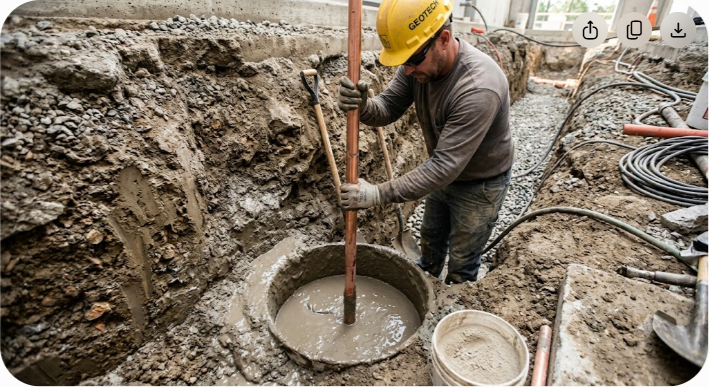
Proper installation is essential for long-term performance. Improperly mixed or dry-dumped bentonite forms hollow clumps and air pockets, completely defeating the purpose of the enhancement material.
Vertical boreholes reach deeper soil layers that stay moist year-round, bypassing dry surface soil.
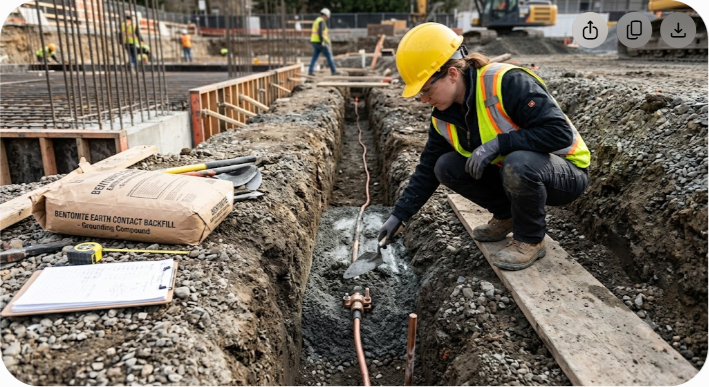
Horizontal trenching is ideal where shallow bedrock prevents deep vertical drilling.
To ensure your ground enhancement system lasts for 30+ years, follow these practical installation rules:
Estimating material requirements accurately prevents costly job site delays. Use the geometric volume formula for vertical boreholes:
Where:
Below are real-world estimating figures for vertical boreholes using standard commercial sodium bentonite mixed to a pourable slurry consistency:
| Borehole Diameter | Borehole Depth | Volume Required | Approx. 50 lb (22.7 kg) Bags Required |
|---|---|---|---|
| 4 inches (100 mm) | 10 feet (3.0 m) | 0.87 $\text{ft}^3$ ($0.025 \text{ m}^3$) | 1 to 2 Bags |
| 4 inches (100 mm) | 20 feet (6.1 m) | 1.74 $\text{ft}^3$ ($0.049 \text{ m}^3$) | 3 Bags |
| 6 inches (150 mm) | 10 feet (3.0 m) | 1.96 $\text{ft}^3$ ($0.055 \text{ m}^3$) | 3 Bags |
| 6 inches (150 mm) | 20 feet (6.1 m) | 3.92 $\text{ft}^3$ ($0.111 \text{ m}^3$) | 6 to 7 Bags |
| 6 inches (150 mm) | 50 feet (15.2 m) | 9.81 $\text{ft}^3$ ($0.277 \text{ m}^3$) | 15 to 16 Bags |
Note: Add 10% to 15% extra material to account for slurry penetration into soil voids and bedrock fractures along the borehole wall.
Substations demand ultra-low ground resistance ($\,\le 1.0\, \Omega$) to keep step and touch voltages within safe thresholds specified by IEEE Std 80. Encasing perimeter ground grid conductors and deep earth wells in sodium bentonite lowers total grid impedance while protecting large underground copper networks against galvanic corrosion.
Cellular towers located on mountain peaks and rocky hillsides face severe soil resistivity. Drilling shallow radial trenches or vertical wells filled with bentonite backfill provides the lightning protection needed to safely dissipate direct strikes without destroying sensitive transceiver equipment.
Solar farms cover huge land footprints, often situated in dry, sandy plains. Using horizontal bentonite backfill along cable trenches lowers the grounding resistance for central inverter stations and transformer pads efficiently without requiring extensive deep drilling across hundreds of acres.
Not all bentonite clays perform equally in electrical earthing applications. Low-grade agricultural or drilling mud clays may contain non-expanding fillers, high silt ratios, or acidic contaminants that fail to maintain low resistivity over time.
Engineers specify non-treated, high-purity Sodium Bentonite with high montmorillonite content, guaranteeing consistent swelling capacity, high moisture retention, and long-term chemical stability.
As one of the world's premier mineral exporters, Axewelledge leverages over 60 million tons of high-grade bentonite reserves to produce superior earth contact backfill materials. Axewelledge supplies refined sodium bentonite solutions that strictly meet international industrial standards. Whether you are designing grounding grids for telecommunication networks, utility substations, or industrial complexes, Axewelledge delivers stable, high-performance backfill products globally to keep your infrastructure safe and low-resistance.













Have questions about our products? We're here to help!