About Us

Axewelledge, a leading exporter from India, specializes in high-quality Bentonite. With a commitment to excellence, we supply premium Bentonite to the Middle East and Southeast Asia markets.


Contact Info

  • Address

    North Angle Complex, 304,
    150 Feet Ring Rd, Opposite Ambedkar Nagar BRTS Stop,
    Madhav Park, Punit Nagar,
    Mavdi, Rajkot, Gujarat 360004

  • Email

    info@axewelledge.com

© Axewelledge 2026, All Rights Reserved.
Organoclay vs Raw Bentonite for Industrial Spill Remediation | Axewelledge – Leading Bentonite Exporter from India | Quality Bentonite for USA & Europe
Organoclay vs Raw Bentonite for Industrial Spill Remediation
  • Jul 30, 2026

Organoclay vs Raw Bentonite for Industrial Spill Remediation

The Core Verdict: Which Clay Belongs in Your Remediation Protocol?

If you are dealing with pure water, aqueous inorganic solutions, or dissolved heavy metals, standard raw bentonite—specifically natural sodium bentonite—is the most cost-effective and structurally reliable absorbent you can deploy.

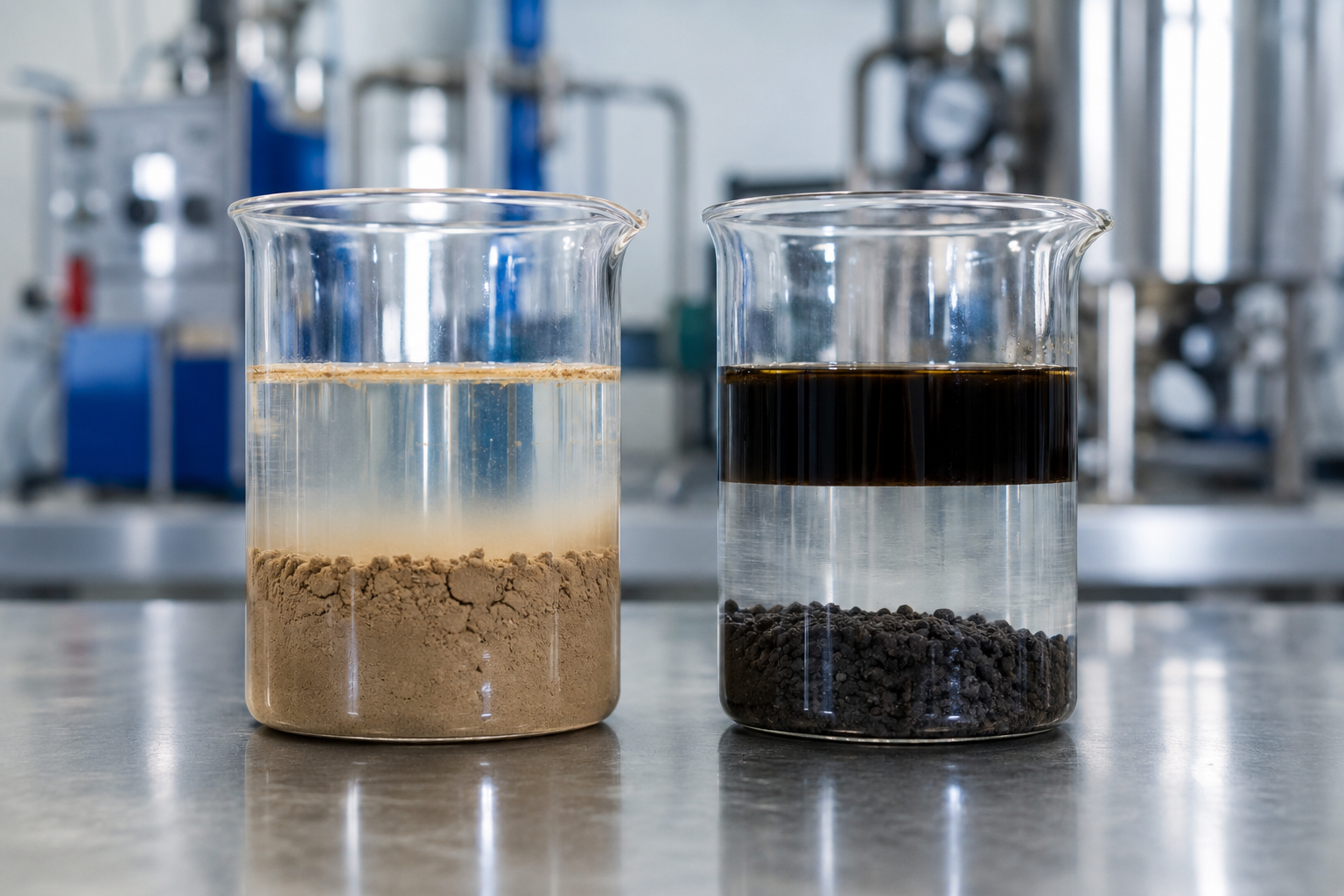
However, if your facility manages hydrocarbons, fuels, organic solvents, chlorinated compounds, or emulsified oils, raw bentonite will fail. Raw bentonite is naturally hydrophilic (water-loving) and oleophobic (oil-repelling). When exposed to free-phase hydrocarbons or organic solvents, raw clay cannot bind the contaminant effectively. It leaves behind an unmanageable, toxic sludge that easily leaches back into groundwater.

For organic contaminants, you need organoclay: a modified bentonite clay rendered hydrophobic (water-repelling) and organophilic (oil-loving) through surface treatment with quaternary ammonium cations. Organoclay adsorbs between 50% and 100% of its own weight in non-polar organic compounds, maintaining structural integrity and passing Toxicity Characteristic Leaching Procedure (TCLP) tests where raw clay fails.

Here is how their core functional parameters stack up side-by-side:

Operational ParameterRaw Bentonite (Sodium/Calcium)Organoclay (Modified Bentonite)
Primary AffinityHydrophilic (Water, Aqueous Ions)Organophilic / Hydrophobic (Oils, Organics)
Oil Absorption CapacityLow (< 0.2 g oil / g clay)High (0.5 to 1.2+ g oil / g clay)
Water Swelling RatioHigh (15x to 20x volume expansion)Low to None (Resists swelling in pure water)
Sorption MechanismHydration, Cation Exchange, Pore SealingHydrophobic Partitioning, Intercalation
VOC / Solvent RetentionPoor (High leaching potential)Excellent (Locks volatile organics in matrix)
Structural Integrity in OilBreaks down into unmanageable pasteMaintains granular form for easy removal
Cost per Metric TonBaseline (Low cost commodity mineral)4x to 8x higher than raw bentonite
Primary Use CasesPonds, Slurry Walls, Heavy Metals, WaterOil Spills, Solvent Remediation, Fuel Leaks

Understanding the Mineralogy: Why Raw Clay and Organoclay Act Differently

To understand why these two minerals behave so differently during an emergency industrial spill, you have to examine their molecular architecture.

The Native Structure of Raw Bentonite

Raw bentonite is a natural clay rock composed primarily of montmorillonite, a 2:1 expandable smectite clay mineral. Its crystalline structure consists of an octahedral sheet of alumina sandwiched between two tetrahedral sheets of silica.

In its natural state, the octahedral layer has isometric substitutions—aluminum ions (Al 3+ ) are replaced by magnesium ions (Mg 2+ ). This leaves a net negative charge across the surface of the silicate sheets. To balance this negative charge, naturally occurring alkali counter-ions reside in the interlayer spaces between the sheets:

  • Sodium Bentonite (Na

+ ): High swelling potential. When exposed to water, sodium ions hydrate, forcing the silica sheets apart. The clay swells up to 15 to 20 times its original dry volume, forming a dense, low-permeability gel (<1×10 ?7 cm/s).

  • Calcium Bentonite (Ca

2+ ): Lower swelling potential (typically 2 to 4 times dry volume). While highly absorbent for aqueous liquids, it does not form the impermeable gel layer characteristic of sodium bentonite.

Because the silicate sheets are heavily hydrated and carry a permanent negative charge, raw bentonite attracts polar molecules like water and positively charged inorganic ions like Pb 2+ , Cd 2+ , and Cu 2+ . Non-polar molecules like benzene, toluene, diesel fuel, and heavy transformer oils cannot overcome the hydration energy of the interlayer spaces. They are physically repelled by the water-laden surface of the raw clay.

The Chemistry of Organoclay Synthesis

Organoclay is produced by taking high-purity sodium bentonite and subjecting it to chemical surface modification via cation exchange.

When sodium bentonite is slurry-mixed with organic compounds—specifically quaternary ammonium salts (quats) such as dimethyl dialkyl ammonium chloride or benzyl trialkyl ammonium chloride—the ammonium cations replace the native sodium ions (Na + ) inside the clay's interlayer space.

The chemical reaction follows this fundamental ion-exchange process:
Organoclay vs Raw Bentonite for Industrial Spill Remediation

$$ ext{Clay}^- - ext{Na}^+ + [ ext{R}_4 ext{N}]^+ ext{Cl}^- longrightarrow ext{Clay}^- - [ ext{NR}_4]^+ + ext{NaCl}$$

Where R represents long-chain hydrocarbon tails (often derived from tallow, containing 12 to 18 carbon chains).

When these long-chain organo-cations attach to the negative silicate walls, two things happen:

  1. Hydrophobic Shielding: The long hydrocarbon tails cover the hydrophilic silicate surface, preventing water molecules from hydrating the interlayer.
  2. Organophilic Interlayer Expansion: The bulky organic chains push the silicate sheets permanently apart, creating a permanent, non-polar organic environment inside the clay matrix.

When an industrial spill containing oils, aromatic hydrocarbons, or chlorinated solvents hits organoclay, the organic contaminants do not rely on surface tension or pore capillary action to stick. Instead, they dissolve directly into the organic organoclay matrix through a mechanism called hydrophobic partitioning. The clay acts like a solid-phase organic solvent, locking the contaminants tightly inside its structural layers.


Industrial Spill Remediation Performance: Head-to-Head Comparison

When an industrial fluid line bursts or a tank truck leaks, response crews need an absorbent that works immediately, holds onto liquid under mechanical stress, and complies with waste disposal regulations.

Here is how organoclay and raw bentonite perform across key spill criteria:

1. Hydrocarbon and Fuel Spills (Diesel, Crude Oil, Jet Fuel, Gasoline)

  • Raw Bentonite Performance: Poor. If applied to a diesel spill on a concrete pad, raw bentonite soaks up a small amount of liquid through capillary void spaces between crushed particles. However, because it lacks affinity for non-polar molecules, the oil stays on the outside of the mineral grains. The moment you compress or sweep the spent clay, the hydrocarbon squeezes right back out. If water is present, the clay prioritizes absorbing water, shedding whatever fuel it temporarily held.
  • Organoclay Performance: Superior. Organoclay actively attracts non-polar hydrocarbons. It physically swells in organic liquids (organophilization), trapping up to 1.2 grams of oil per gram of clay inside its interlayer structure. It binds fuel tightly enough to resist leaching under mechanical pressure or rainwater exposure.

2. Solvent and Volatile Organic Compound (VOC) Spills (BTEX, Trichloroethylene, Acetone)

  • Raw Bentonite Performance: Unacceptable. Volatile organic compounds like Benzene, Toluene, Ethylbenzene, and Xylene (BTEX) do not bind to raw smectite clays. The solvent evaporates into the surrounding air, creating acute inhalation hazards for spill response teams, while the unabsorbed liquid flows underneath the clay layer.
  • Organoclay Performance: Outstanding. Organoclay's tailored interlayer space acts as a high-capacity sink for aromatic and chlorinated solvents. It significantly reduces VOC off-gassing at the spill site by lowering the solvent's vapor pressure once bound within the organic matrix.

3. Heavy Metal and Inorganic Chemical Spills (Lead, Cadmium, Acidic Wash Wastewater)

  • Raw Bentonite Performance: Superior. Natural sodium bentonite has a high Cation Exchange Capacity (CEC), typically ranging from 80 to 100 meq/100g. In aqueous spills containing dissolved heavy metals (Pb

2+ , Ni 2+ , Zn 2+ ), raw bentonite exchanges its native sodium ions for toxic metals, immobilizing them in its crystal structure while forming an impermeable seal to stop fluid migration.

  • Organoclay Performance: Moderate to Low. Because the cation exchange sites in organoclay are already occupied by bulky quaternary ammonium cations, its ability to bind inorganic heavy metal cations via exchange is dramatically reduced. It should not be used as a primary absorbent for pure heavy metal plating wastes.

4. Emulsified Oil-in-Water Wastes (Bilge Water, Coolant Leaks, Cutting Fluids)

  • Raw Bentonite Performance: Fails. Emulsified oils (where microscopic oil droplets are suspended in water by surfactants) pass directly through standard raw clay filters or absorbents. The water hydrates the clay, and the droplets bypass the structure entirely.
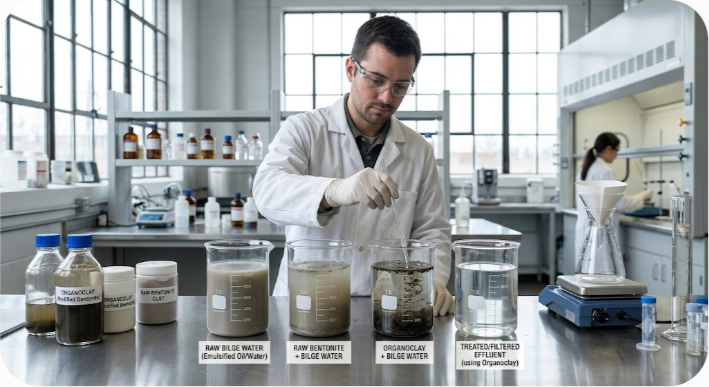
  • Organoclay Performance: Industry Standard. Organoclay excels at breaking oil-in-water emulsions. The organophilic tails strip the surfactant away from oil droplets, absorbing the pure hydrocarbon phase while allowing clean water to pass through. It is routinely used in groundwater remediation pump-and-treat systems as a pre-filter before granular activated carbon (GAC).

Practical Deployment: Step-by-Step Response Protocols

Deploying these materials requires distinct operational strategies. Mixing up application techniques can result in widespread contamination or wasted material.

Protocol A: Deploying Organoclay for Hydrocarbon or Solvent Land Spills

  1. Establish Perimeter Containment: Do not throw loose organoclay directly into the center of a flowing oil plume. First, spread a thin barrier ring of organoclay powder or fine granules around the outer downstream edge of the spill to stop surface migration.
  2. Direct Broadcast Application: Working from the windward side, broadcast granular organoclay (typically 10/30 or 8/20 mesh size) directly over the hydrocarbon pool. Aim for a 1:1 weight-to-weight ratio for heavy oils, or a 1:2 ratio (clay-to-fluid) for light fuels.
  3. Mechanical Aggregation: Use non-sparking shovels or stiff bristles to agitate the clay into the liquid. You will observe the liquid change consistency from a fluid pool to a stable, non-sticky granular mass within 5 to 15 minutes.
  4. Containment Verification: Sweep the bound organoclay into heavy-duty hazardous material bags or drum containers. Perform a paint-filter liquid test on site (EPA Method 9095B) to confirm that no free liquids remain.
  5. Disposal Routing: Route the spent material for incineration or hazardous waste landfilling based on local environmental regulations. Because organoclay binds VOCs tightly, spent material routinely passes TCLP leach testing.

Protocol B: Deploying Raw Sodium Bentonite for Water-Based Chemical and Seepage Containment

  1. Assess Fluid Composition: Ensure the spilled fluid is primarily water-based (e.g., acid leaks, industrial wash waters, slurry runoff, or heavy metal plating baths). Do not use on pure organic solvents.
  2. Create a Swelling Trench or Dam: For migrating aqueous plumes, dig a shallow trench along the flow pathway and fill it with high-swelling granular sodium bentonite.
  3. Hydration Phase: As the water-based spill hits the raw bentonite, the clay absorbs water molecules, expanding up to 20 times its dry volume. It forms an impermeable, self-healing clay barrier that halts liquid advancement.
  4. Neutralization & Recovery: For acidic or basic spills, alkaline or buffered raw bentonite formulations can neutralize pH while binding suspended solids. Collect the thick gel using vacuum trucks or mechanical loaders.

Total Cost of Ownership & Lifecycle Economics

When evaluating spill response materials, focusing solely on the purchase price per bag leads to poor purchasing decisions. You must factor in performance efficiency, labor time, disposal fees, and regulatory penalties.
Direct Material Cost Analysis

Organoclay vs Raw Bentonite for Industrial Spill Remediation
  • Raw Bentonite: Highly economical. Unmodified sodium bentonite is a mined commodity, typically costing anywhere from $150 to $400 per metric ton in bulk, or $10 to $20 per 50 lb bag, depending on mesh size and processing purity.
  • Organoclay: Specialty chemical product. Because it requires high-purity sodium bentonite feedstocks, chemical reagents (quaternary ammonium compounds), and multi-stage chemical processing, organoclay ranges from 1,800 to $3,500+ per metric ton ($45 to $90 per 50 lb bag).

The Real Economics: Disposal & Efficiency Metrics

While organoclay carries a higher initial price tag, its cost performance flips in favor of organoclay when treating organic spills:

Example Scenario: Treating a 100-Gallon (approx. 730 lbs) Diesel Fuel Spill

  • Using Raw Bentonite:
  • Because raw bentonite has a low oil adsorption capacity ($approx 0.15 ext{ g/g}$), you require roughly 4,860 lbs of raw clay to physically hold the diesel through surface wetting.
  • Total Waste Weight to Landfill: $730 ext{ lbs fuel} + 4,860 ext{ lbs clay} = mathbf{5,590 ext{ lbs total waste}}$.
  • Leachate Risk: Extremely high. The material will likely fail TCLP tests, subjecting your facility to hazardous waste transport surcharges.
  • Using Organoclay:
  • With an adsorption capacity of $approx 0.85 ext{ g/g}$, you need only 860 lbs of organoclay to lock up the same 100 gallons of diesel.
  • Total Waste Weight to Landfill: $730 ext{ lbs fuel} + 860 ext{ lbs clay} = mathbf{1,590 ext{ lbs total waste}}$.
  • Leachate Risk: Low. Fuel is bound inside the clay interlayer, passing TCLP tests easily and allowing for lower-cost waste classification in many jurisdictions.

Key Takeaway: Using raw bentonite on oil spills results in over 3.5 times more physical waste weight to transport and dispose of compared to organoclay. Savings in hazardous waste hauling and disposal fees frequently offset the initial purchase cost of organoclay.


Environmental Impact and Regulatory Compliance

Both raw bentonite and organoclay offer distinct environmental profiles, but regulatory authorities evaluate them under different operational frameworks.

Toxicity and Ecotoxicity Profile

  • Raw Bentonite: Environmentally benign and chemically inert. It is an ideal natural mineral choice for aquatic applications, groundwater sealing, and agricultural runoff remediation. It introduces no synthetic chemicals into the ecosystem.
  • Organoclay: Chemically stable under normal environmental temperatures ($< 100^circ ext{C}). However, because organoclay contains quaternary ammonium compounds, low-grade or improperly washed organoclays can potentially leach unreacted quats into water bodies if deployed in bulk aquatic settings without proper quality controls. High-grade organoclay manufactured under strict standards ensures that 99.5%+ of the organo-cation is tightly bound to the clay matrix.

EPA and RCRA Compliance Considerations

In the United States, under the Resource Conservation and Recovery Act (RCRA), spent spill absorbents must pass the Paint Filter Liquids Test (EPA Method 9095B) to verify that no free liquids are present prior to landfill disposal.

Furthermore, for volatile organics and fuels, spent absorbents must undergo the Toxicity Characteristic Leaching Procedure (EPA Method 1311). Raw bentonite soaked in diesel or solvents frequently releases trapped contaminants under the acidic extraction conditions of Method 1311. Organoclay retains organic molecules within its hydrophobic interlayer structure, preventing contaminant leaching and helping industrial facilities remain fully compliant with regional regulatory standards.


Common Industry Pitfalls (And How to Avoid Them)

Over fifteen years of supplying industrial mineral solutions to global markets, we have seen facility managers make repeatable, expensive errors when selecting and deploying clay absorbents:

1. Using Raw Bentonite as a Direct Floor Absorbent for Solvent Leaks

  • The Pitfall: A facility maintenance team keeps bags of cheap, raw bentonite clay in the warehouse for all leaks. When a drum of xylene or trichloroethylene (TCE) leaks, they throw raw bentonite over it.
  • The Result: The solvent fails to bind to the clay, off-gasses rapidly into the building's HVAC system, and creates a severe chemical fire and inhalation risk.
  • The Fix: Standardize spill kits by chemical type. Keep designated organoclay emergency response kits clearly labeled in solvent storage and chemical processing areas.

2. Expecting Organoclay to Seal Water Leaks or Create Pond Liners

  • The Pitfall: Attempting to use organoclay to seal an environmental containment basin or stop a water leak.
  • The Result: Because organoclay is hydrophobic, it will not hydrate or swell when exposed to clean water. Water flows right past the unexpanded granules.
  • The Fix: Use high-swelling, raw Sodium Bentonite with a high mesh count for pond sealing, slurry walls, and groundwater cut-off barriers.

3. Purchasing Unwashed or Low-Substitution Organoclays for Water Treatment Filters

  • The Pitfall: Purchasing cheap organoclay for use in fixed-bed pump-and-treat water filter vessels.
  • The Result: Poorly manufactured organoclay with low cation substitution fails to capture light hydrocarbons, while excess unreacted quaternary amine washes into the discharge stream.
  • The Fix: Ensure your organoclay supplier specifies the exact quaternary compound used, the degree of cation exchange (CEC coverage), and provides batch-tested leach resistance documentation.

Decision Matrix: Choosing the Right Clay for Your Facility

To select the correct material for your operational requirements, follow this decision framework based on your target contaminant:

  1. Is the spill liquid primarily water or inorganic?
  • YES (Heavy metals, Acid/Base, Water leaks, Slurry walls): Use RAW BENTONITE.
  • Choose High Swelling (Sodium Type) for sealing and groundwater containment.
  • Choose Low Swelling (Calcium Type) for simple water absorption.
  • NO (Hydrocarbons, Fuels, Solvents, Emulsified Oils, Coolants): Use ORGANOCLAY.
  • Choose Granular Format for fixed-bed water filters and emergency response spill kits.
  • Choose Powder Format for direct surface slurry treatment.

How Axewelledge Delivers Engineered Clay Solutions

Selecting between organoclay and raw bentonite isn't just about picking a product; it's about matching precise mineral chemistry to your site's specific environmental liabilities.

At Axewelledge, we manage over 60 million tons of high-grade bentonite reserves, operating advanced processing facilities in India supported by regional hubs across the Middle East. Whether you require high-swell natural sodium bentonite for environmental sealing and water containment, or surface-engineered organoclays formulated for heavy hydrocarbon capture and industrial wastewater polishing, our technical team ensures your supply chain is reliable, compliant, and cost-effective.

Contact our mineral engineering specialists today to review your chemical safety data sheets (SDS), request bulk product samples, or structure a custom supply contract tailored to your facility's spill response protocols.


×

We'd Love to Hear from You










