Axewelledge, a leading exporter from India, specializes in high-quality Bentonite. With a commitment to excellence, we supply premium Bentonite to the Middle East and Southeast Asia markets.


North Angle Complex, 304,
150 Feet Ring Rd, Opposite Ambedkar Nagar BRTS Stop,
Madhav Park, Punit Nagar,
Mavdi, Rajkot, Gujarat 360004
© Axewelledge 2026, All Rights Reserved.
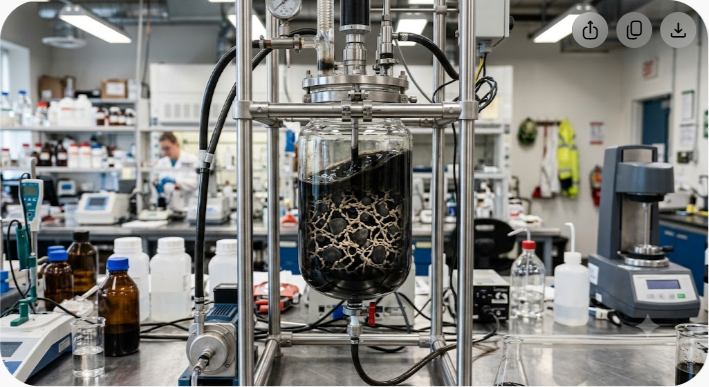
Asphalt emulsion stability depends on much more than simply keeping bitumen and water mixed. Droplet size, emulsifier chemistry, pH, temperature, viscosity, ionic conditions, and the properties of the dispersed and continuous phases all influence how an emulsion behaves during storage, pumping, and application.
So, can bentonite improve asphalt emulsion stability? Yes, in the right formulation. Finely dispersed sodium bentonite can act as a mineral rheology modifier by increasing low-shear viscosity and developing a weak, reversible structure in the water phase. That structure can reduce the movement of dispersed asphalt droplets and help limit settling, creaming, and other forms of physical instability.
The important qualification is that bentonite isn't a universal replacement for an asphalt-emulsion emulsifier or polymer modifier. It works as part of a formulation. The clay must be compatible with the emulsifier system, adequately hydrated, properly dispersed, and used at a level that improves stability without making the emulsion difficult to pump, spray, mix, or break on the pavement.
This guide explains the mechanism, the role of sodium bentonite, formulation considerations, testing methods, common mistakes, and the points buyers should check when sourcing bentonite for asphalt emulsion applications.
An asphalt emulsion is a dispersion of asphalt droplets in a continuous water phase. The droplets are deliberately kept apart with an emulsifier system, which helps prevent them from immediately joining together and separating from the water.
An emulsion is therefore not a permanently stable mixture. It is a carefully engineered dispersion designed to remain sufficiently stable during its intended storage, transport, mixing, and application period and then break at the appropriate stage after application.
That distinction matters. The goal isn't to make the emulsion impossible to break. The goal is to control when and how it breaks.
A well-formulated emulsion should remain reasonably uniform in the storage tank, tolerate normal handling, pass through pumps and spray equipment, mix appropriately with aggregate when required, and then release the asphalt phase under the conditions intended by the formulation.
Several factors can disturb this balance:
Bentonite addresses only part of this problem, but that part can be valuable: rheology control in the continuous water phase.
The terms used to describe emulsion instability are sometimes treated as interchangeable, but they describe different physical processes.
If the dispersed asphalt droplets have a density different from the surrounding water phase, gravity can cause them to migrate. Droplets that move upward produce creaming, while downward migration is generally described as sedimentation or settlement.
The rate of movement depends on factors such as droplet size, density difference, continuous-phase viscosity, and interactions between droplets. Smaller droplets generally move more slowly than larger ones, while increasing the low-shear viscosity of the continuous phase can restrict movement further.
Flocculation occurs when droplets come together into loose clusters without necessarily merging into one larger droplet. A flocculated emulsion can show changes in viscosity and flow behaviour even though complete separation has not occurred.
This stage is particularly relevant when assessing storage stability because a formulation may still appear uniform at first glance while its internal structure is already changing.
Coalescence is more serious. When the protective interfacial film between neighbouring droplets becomes insufficient, droplets can merge. The resulting droplets are larger and generally more difficult to keep dispersed.
Once substantial coalescence has occurred, restoring the original emulsion structure may not be practical.
Breaking is the intended or unintended loss of the emulsion's dispersed structure, with the asphalt phase separating from the water. In pavement applications, breaking is normally an essential part of curing. The problem is premature breaking, which can occur during storage, transportation, mixing, or application.
This is why an effective asphalt emulsion formulation needs a balance between storage stability and controlled breaking.
Bentonite is a clay material composed predominantly of smectite minerals, commonly montmorillonite. Its behaviour varies considerably with mineralogy, exchangeable cations, particle size, impurities, and processing history.
For applications that depend on strong hydration and swelling, sodium-rich bentonite is generally more suitable than calcium-rich bentonite. When sodium bentonite contacts water, water enters the clay structure and the particles can hydrate and expand. Under appropriate conditions, dispersed clay platelets create a structured suspension with significantly higher low-shear viscosity than water alone.
That structure is the main reason bentonite can help an asphalt emulsion.
It does not simply act as a heavy solid that fills space. Properly dispersed clay changes the flow behaviour of the continuous phase, making it harder for dispersed asphalt droplets or other suspended particles to move under gravity when the material is at rest.
The result can be better physical stability without necessarily preventing the emulsion from flowing when shear is applied.
The useful behaviour of sodium bentonite comes from its extremely fine particle size, high specific surface area, surface charge, and interaction with water.
When dry bentonite is introduced into water, the particles must first become wetted and dispersed. Water interacts with the clay surfaces and enters between layers within the smectite structure. The particles can then separate into much finer platelets or aggregates of platelets.
The quality of this dispersion depends on several variables, including water chemistry, mixing intensity, clay concentration, temperature, particle size, and the presence of other formulation ingredients.
Simply adding more clay does not guarantee better performance. Poorly dispersed clay can produce lumps, inconsistent viscosity, or filtration problems rather than a useful rheological structure.
A common way to describe hydrated bentonite suspensions is the house-of-cards structure. Bentonite platelets have charged surfaces and edges, and under suitable chemical conditions they can form a three-dimensional network through electrostatic interactions.
The model is useful for understanding why a clay suspension can support a measurable yield stress and develop higher apparent viscosity at low shear. However, the exact structure in a real asphalt emulsion is more complicated because the clay interacts with salts, emulsifiers, asphalt droplets, pH, and other additives.
For formulation work, the house-of-cards concept should therefore be treated as a useful rheological model rather than a literal description of every particle arrangement.
A structured bentonite suspension can develop yield stress. In simple terms, a material with yield stress resists flow until sufficient applied stress is available to disrupt its internal structure.
That behaviour can be useful in a storage tank. Instead of allowing asphalt droplets to move freely through a low-viscosity water phase, the structured medium can slow their movement and reduce the rate of separation.
The objective is not to make the emulsion rigid. Excessive yield stress can create its own problems, including poor pumpability, difficult transfer, inaccurate dosing, and poor spray performance.
Thixotropy describes time-dependent shear thinning followed by recovery when the material is left at rest. Bentonite suspensions can display this type of behaviour when their particle network is disrupted by shear and subsequently rebuilds.

This is particularly useful for materials that must alternate between two very different conditions.
The emulsion is mostly at rest. A structured continuous phase can slow droplet migration and help maintain a more uniform distribution.
The material experiences shear as it moves through pipes, pumps, valves, and other equipment. The clay structure can partially break down, reducing resistance to flow.
The emulsion must remain fluid enough to pass through application equipment or mix with aggregate. Excessive clay loading can work against this requirement, which is why viscosity must be measured rather than estimated from clay dosage alone.
The formulation eventually needs to break and cure according to its intended chemistry. Bentonite should not be expected to create a permanent barrier against asphalt-water separation after application. Its role is to support the desired rheological behaviour before and during application.
Bentonite can provide several practical benefits, but each should be verified with the specific emulsion rather than assumed from the clay's general properties.
Increasing the low-shear viscosity of the water phase can reduce the rate at which asphalt droplets migrate under gravity. This can help maintain a more uniform emulsion during storage.
The improvement depends on droplet size distribution, emulsifier chemistry, clay concentration, and the rest of the formulation. A formulation that is unstable because of inadequate emulsification cannot necessarily be repaired by adding bentonite.
Bentonite provides a way to tune the relationship between low-shear and high-shear behaviour. A useful formulation can be relatively structured at rest while remaining pumpable under shear.
This is one reason clay-based rheology modifiers are used in many water-based industrial systems beyond asphalt.
Some asphalt products contain mineral fillers or other fine solids. A properly designed bentonite system can help maintain their suspension and reduce settling during storage.
This benefit is particularly relevant to products where uniformity of the entire formulation matters, not just the asphalt droplets.
Bentonite is an inorganic mineral rather than a synthetic polymer. That can make it attractive to formulators looking for mineral rheology modifiers, although environmental performance should always be evaluated for the complete formulation rather than inferred from the word "natural."
Bentonite can be economical compared with some specialty rheology modifiers, particularly where locally available, consistent industrial grades can deliver the required rheological effect at relatively low addition rates.
Cost should be assessed on a performance basis. A cheaper clay that requires a much higher dosage or produces inconsistent viscosity may cost more at the formulation level.
Bentonite doesn't compete directly with every additive used in asphalt emulsions. Different ingredients solve different formulation problems.
| Feature | Sodium Bentonite | Cellulosic Thickeners | Synthetic Polymers | Emulsifier System |
|---|---|---|---|---|
| Main role | Rheology and suspension control | Water-phase viscosity and rheology | Polymer modification and performance enhancement | Stabilizes asphalt-water interface |
| Main mechanism | Hydrated clay structure | Polymer chain interactions | Polymer network or asphalt modification | Interfacial stabilization |
| Low-shear viscosity | Can increase substantially | Can increase substantially | Depends on polymer | Depends on formulation |
| Thixotropic behaviour | Often significant | Depends on grade and system | Varies | Not normally the primary purpose |
| Primary function in emulsion | Physical structure and suspension | Thickening and flow control | Performance modification | Maintaining dispersed asphalt droplets |
| Compatibility requirement | High | High | High | Essential |
| Typical use | Storage and rheology control | Viscosity modification | Cured asphalt performance or specialized emulsion systems | Core emulsion stabilization |
The most important point is that bentonite does not replace the emulsifier system. The emulsifier is central to maintaining the asphalt droplets as a dispersed phase. Bentonite can complement that chemistry by changing the rheology of the continuous phase.
Likewise, bentonite should not be described as a substitute for SBS, SBR, or other polymer modification when the objective is to change the mechanical properties of the cured asphalt binder.
The value of bentonite depends on the application. Some systems benefit mainly from storage stability, while others need careful control of flow and suspended solids.
Water-based asphalt sealers and related pavement-preservation products may contain asphalt emulsion, mineral fillers, water, and other additives. Rheology control helps keep the formulation uniform during storage and supports consistent application.
Where fillers or aggregate are present, suspension behaviour becomes especially important. A formulation that settles heavily in the container can deliver a different composition from the first portion to the last.
Slurry systems combine asphalt emulsion with aggregate, mineral filler, water, and additives. The formulation must remain workable long enough for mixing and placement while still developing the intended setting characteristics after application.
Bentonite may contribute to water-phase rheology, but the exact effect on mixing time and setting must be established experimentally. Adding clay without checking the complete formulation can slow breaking or change workability.
Cold mix materials rely on asphalt emulsion rather than hot asphalt to coat aggregate at relatively low temperatures. Storage and handling requirements vary considerably between products.
A bentonite-modified emulsion may help control the liquid phase and reduce unwanted migration of the binder. However, the final cold-mix performance depends on aggregate characteristics, residual moisture, emulsion chemistry, mixing method, and curing conditions as well.
Tack coats need to form a reasonably uniform adhesive film between pavement layers. Rheology can influence how an emulsion spreads, flows, and remains on sloped or textured surfaces.
A bentonite addition should be approached cautiously here. Excessive structure can interfere with spraying and may leave an application that is too viscous for the selected equipment.
There is no single bentonite dosage that works for every asphalt emulsion. The correct level must be established experimentally because clay grade, asphalt chemistry, emulsifier type, water quality, pH, temperature, and application requirements all affect performance.
Before selecting a dosage, define what needs to improve.
For example, the target might be:
A formulation target is more useful than simply specifying a percentage of bentonite.
Important specifications can include:
Free swelling alone does not tell a formulator how the clay will behave in an asphalt emulsion. A supplier should provide a technical data sheet and, where appropriate, a certificate of analysis for each lot.
Sodium bentonite generally needs effective contact with water to develop its rheological properties. Adding dry powder directly into an oil-rich phase is unlikely to produce the same result as dispersing and hydrating the clay in the intended aqueous phase.
The exact procedure depends on the plant and formulation. In some systems, the clay is dispersed in water before the asphalt emulsion is formed. In others, a prepared clay dispersion may be introduced at a controlled stage.
The critical point is to follow a validated process rather than assume that simply adding dry clay to the finished emulsion will produce uniform hydration.
Bentonite can form lumps or partially hydrated agglomerates if it is added too quickly or under unsuitable mixing conditions. Those agglomerates consume clay without contributing uniformly to the desired rheology.
High-shear dispersion may be useful during clay preparation, but the appropriate equipment and shear history should be established experimentally. Excessive mechanical treatment of the complete emulsion can also change its behaviour, so the process needs to be considered as a whole.
A broad laboratory screening range may be used during development, but the correct dosage cannot be selected from a generic industry percentage alone.
A practical trial might compare several clay concentrations while measuring low-shear viscosity, high-shear viscosity, storage separation, sieve residue, pumping behaviour, and breaking characteristics.
The best concentration is the one that meets the complete specification, not simply the one that produces the highest viscosity.
One of the most important formulation questions is whether bentonite will interact adversely with the emulsion's charge and emulsifier system.

Anionic emulsions generally involve negatively charged asphalt droplets, while cationic emulsions involve positively charged droplets. Bentonite itself has complex surface-charge behaviour, with negatively charged faces and edge charges that depend on pH and surrounding chemistry.
This makes compatibility more nuanced than saying that bentonite is automatically suitable for one emulsion type and unsuitable for another.
In cationic systems, clay can interact with cationic surfactants and other charged species. That interaction can change clay dispersion, emulsion stability, viscosity, or breaking behaviour. An apparently successful clay grade in one formulation may therefore perform poorly in another.
The right approach is to run compatibility trials with the actual emulsifier package, water source, asphalt, and intended process conditions.
A bentonite-modified emulsion should be judged by measurable performance rather than appearance alone. A smooth-looking sample can still develop significant separation during storage.
Viscosity measurements provide an initial indication of how the clay has changed the continuous phase. Depending on the application, rotational rheometry can provide more useful information than a single viscosity value because it can show shear-rate dependence, yield behaviour, and recovery after shear.
For production control, the chosen test method should be standardized so that results can be compared between batches.
Storage-stability procedures commonly compare material sampled from different levels of a container after a defined period. Asphalt residue, viscosity, or other properties may be measured depending on the applicable specification.
For asphalt emulsions, relevant ASTM methods include procedures within ASTM D244, the standard test methods and practices used for asphalt emulsions. The exact test selected should match the emulsion type and applicable product specification.
A laboratory storage test should never be interpreted as a guarantee of months of field storage. Actual tank geometry, temperature cycling, agitation, contamination, and handling conditions can produce different results.
Sieve testing can identify coarse particles, agglomerated material, or other residues that may indicate formulation or manufacturing problems. Excessive residue can affect spray equipment and may signal inadequate dispersion or premature instability.
A formulation that looks excellent in a beaker may still fail at plant scale. Pump pressure, line size, valve design, nozzle selection, temperature, and shear history can all affect handling.
For that reason, pilot-scale testing should follow laboratory screening before commercial production whenever a new bentonite grade or substantially different dosage is introduced.
A controlled screening programme makes it easier to identify whether bentonite is actually solving the stability problem.
Prepare the existing asphalt emulsion without bentonite and record its baseline viscosity, storage stability, sieve residue, appearance, and breaking behaviour.
Use the selected water quality and a controlled mixing procedure. Record the clay concentration, mixing time, temperature, and equipment used.
Prepare multiple formulations covering a sensible laboratory range. Avoid assuming that the highest clay concentration will perform best.
Record viscosity under the shear conditions relevant to storage, pumping, and application. If possible, evaluate recovery after shear to understand how quickly the structure rebuilds.
Compare top and bottom samples after the selected storage period. Look for changes in asphalt residue, viscosity, particle distribution, and visual appearance.
A formulation that remains perfectly uniform but refuses to break at the intended stage isn't necessarily an improvement. Check the effect of bentonite on the actual application process.
Once the laboratory formulation performs well, reproduce it using plant-relevant mixing, pumping, and storage conditions. This is where differences in shear history and residence time often become apparent.
Several recurring mistakes can undermine an otherwise sound clay-based formulation.
High swelling can be useful, but it doesn't automatically mean that a particular bentonite will provide the required rheology in an asphalt emulsion. Mineralogy, particle-size distribution, exchangeable ions, purity, and processing all matter.
Dry powder can form fish-eyes or partially hydrated lumps when introduced too quickly. The result is inconsistent viscosity and poor use of the clay.
Separation may be caused by inadequate emulsification, unsuitable droplet size, incompatible additives, temperature problems, or water chemistry. More bentonite isn't a universal cure.
Storage stability and breaking behaviour are linked. An additive that makes an emulsion extremely resistant to separation may also interfere with the rate at which the product is supposed to break on the road.
Real products may encounter substantial temperature variation during storage, transportation, and application. Testing should reflect the expected service conditions wherever practical.
Clay is a natural mineral, so deposits and processing methods can produce meaningful variation. A reliable industrial supplier should be able to provide defined specifications, lot-level documentation, and a consistent processing route.
When evaluating a supplier, don't ask only whether the company sells "sodium bentonite." Ask for the properties that affect your process.
A useful technical specification may include:
| Property | Why It Matters |
|---|---|
| Mineralogical composition | Indicates the dominant clay minerals and potential formulation behaviour |
| Swelling or free swell | Helps assess hydration and water interaction |
| Particle-size distribution | Influences dispersion and hydration rate |
| Moisture content | Affects dosing, storage, and handling |
| Grit content | Coarse particles can affect equipment and product uniformity |
| Rheology data | Helps connect the clay grade with the required viscosity response |
| pH of dispersion | Relevant to formulation compatibility |
| Lot consistency | Reduces batch-to-batch formulation variation |
| Certificate of analysis | Provides documented quality-control information |
For an industrial application, a supplier should also be able to discuss packaging, storage, production capacity, lead times, and export logistics rather than treating the clay as a generic commodity.
The performance of bentonite depends on more than the name printed on the bag. Two products sold as sodium bentonite can behave differently because of mineral composition, processing, particle-size distribution, moisture, and impurity levels.
High grit content is particularly undesirable in systems that use fine spray equipment or high-shear processing. Coarse mineral particles can contribute to nozzle blockage, equipment wear, and inconsistent product quality.
Consistent milling is also important. Very coarse material may hydrate slowly, while excessive fines can create handling and dust-control challenges. The useful particle-size range depends on the formulation and processing equipment.
For asphalt emulsion manufacturers, the most valuable supplier relationship is therefore one based on a defined technical specification and repeatable lot quality rather than a generic swelling claim.
Axewelledge supplies industrial bentonite for applications where controlled mineral properties and consistent processing are important. Its product positioning includes sodium bentonite for industrial uses, with processing and export capabilities intended for international customers.
For an asphalt emulsion formulation, the relevant point is not simply the scale of the mineral resource. The buyer should evaluate the specific grade against the requirements of the emulsion: swelling behaviour, particle size, moisture, grit, rheology, dispersion characteristics, and batch consistency.
Axewelledge's reported access to substantial bentonite reserves and its India and UAE supply infrastructure can support customers that need industrial quantities, but technical qualification should still be completed against the customer's own formulation and specification.
A sensible procurement process includes a representative sample, technical data sheet, certificate of analysis, laboratory trial, and confirmation of the quality parameters that will be controlled during commercial supply.
When a clay-modified emulsion does not behave as expected, changing the dosage should not be the first response. Diagnose the failure mode first.
| Problem | Possible Causes | What to Check |
|---|---|---|
| Separation during storage | Low continuous-phase viscosity, inadequate emulsification, unsuitable clay level | Droplet size, viscosity, storage stability, emulsifier chemistry |
| Excessive viscosity | Too much clay, poor water quality, excessive hydration | Clay dosage, solids content, water chemistry, rheology |
| Lumps or fisheyes | Poor clay dispersion or rapid powder addition | Mixing procedure, addition rate, hydration time |
| Poor pumpability | Excessive yield stress or viscosity | Flow curve, pump pressure, temperature |
| Premature breaking | Incompatible additives, charge interactions, contamination | Emulsifier system, pH, ionic strength, clay compatibility |
| Slow breaking | Excessive structure or altered formulation chemistry | Residual formulation, clay dosage, break test |
| Sieve residue | Poor dispersion or coarse material | Particle-size distribution, sieve test, mixing efficiency |
| Batch variation | Variable raw material or inconsistent process | Supplier CoA, moisture, milling, mixing conditions |
This approach separates a clay-quality problem from an emulsion-chemistry problem. That's important because the solutions are different.
Bentonite can be evaluated in both cationic and anionic asphalt emulsions, but compatibility isn't automatic. Clay surface chemistry can interact with emulsifiers, pH, salts, and asphalt droplets. Cationic systems require particular attention because positively charged emulsifier chemistry can interact with negatively charged clay surfaces. Laboratory compatibility and storage tests should be completed before commercial use.
There is no universal dosage that applies to every asphalt emulsion. The required level depends on clay grade, asphalt content, emulsifier chemistry, water quality, target viscosity, and application. Rather than relying on a generic percentage, formulators should screen several concentrations and measure rheology, storage stability, pumpability, sieve residue, and breaking behaviour before selecting a commercial dosage.
No. Bentonite and polymer modifiers generally serve different purposes. Bentonite can modify the rheology of the water phase and help control physical stability before application. Polymers such as SBR or SBS are used in suitable asphalt systems to modify binder or cured-film properties such as elasticity and resistance to deformation. A formulation may use clay, polymer, emulsifier, or other additives together.
Bentonite develops its useful rheological properties through interaction with water. Proper wetting, dispersion, and hydration allow the clay particles to develop a structured aqueous suspension. If dry clay forms agglomerates or is introduced into an unsuitable phase, much of its potential rheological effect can be lost. The exact hydration procedure should follow laboratory and plant validation.
Thixotropy describes time-dependent structural breakdown under shear followed by recovery when the material rests. A bentonite-containing aqueous system can become less resistant to flow during pumping and then rebuild some structure after shear is removed. This behaviour can support storage stability and handling, but the actual degree of thixotropy depends on clay grade, concentration, water chemistry, and the complete emulsion formulation.













Have questions about our products? We're here to help!