Axewelledge, a leading exporter from India, specializes in high-quality Bentonite. With a commitment to excellence, we supply premium Bentonite to the Middle East and Southeast Asia markets.


North Angle Complex, 304,
150 Feet Ring Rd, Opposite Ambedkar Nagar BRTS Stop,
Madhav Park, Punit Nagar,
Mavdi, Rajkot, Gujarat 360004
© Axewelledge 2026, All Rights Reserved.
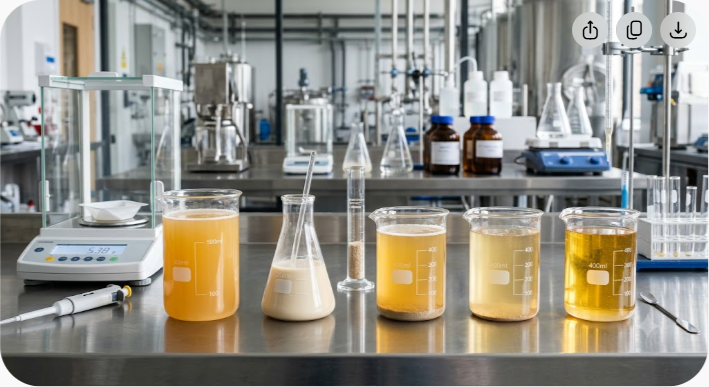
A clear beer isn't automatically a better beer, but unwanted haze can be a genuine quality problem. Bentonite can help reduce protein-related haze, yet it isn't a universal beer fining agent. Used too aggressively, it can create more sediment and remove proteins that contribute to foam stability.
The practical approach is straightforward: choose a bentonite suitable for the intended beverage application, hydrate it properly in water, run a small bench trial, add the lowest effective dose to the beer, allow enough time for settling, and assess the result before treating the full batch. When hydrated, bentonite develops a negatively charged surface that can adsorb certain positively charged proteins. Those interactions help form heavier material that can settle from suspension.
There is an important trade-off for brewers. Bentonite isn't highly selective. It can remove proteins associated with haze as well as proteins that help support beer foam. Research on beer stabilization has shown this distinction when bentonite is compared with more selective treatments such as silica gel. That is why dosage, contact conditions and trial work matter.
Bentonite is a naturally occurring clay in which montmorillonite is the principal mineral component of many commercial grades. When properly hydrated, its layered structure expands and exposes a large surface area. The hydrated clay has an overall negative charge and can interact with certain positively charged materials, including proteins in beverages.
In brewing, that property makes bentonite useful as a fining or stabilization aid when protein-related turbidity is the problem. The clay interacts with suspended or colloidal material, helping form larger aggregates that can settle. The clearer beer can then be separated from the sediment by careful transfer or filtration.
Bentonite has a long history in beverage processing, particularly in wine. Its use in beer is more specialized. Beer stabilization has increasingly favored products such as silica gel because they can target haze-active proteins more selectively and may produce less sediment. Bentonite remains useful when its particular protein-adsorption behavior fits the process.
That distinction is worth keeping in mind. If you're producing wine, bentonite may be a routine protein-stabilization tool. If you're producing beer, first ask whether bentonite actually matches the type of haze you're trying to remove.
Not every cloudy beer has the same cause. Haze can come from yeast, proteins, polyphenols, carbohydrates, processing conditions or deliberate recipe choices. Treating every cloudy beer with bentonite is a common mistake.
Bentonite is most relevant when protein is a significant contributor to the haze. Beer proteins originate largely from malt, and some can interact with polyphenols to form colloidal particles that scatter light.
Chill haze is a familiar example. A beer can look reasonably clear at a warmer temperature and become noticeably hazier after cooling. Interactions between proteins and polyphenols are important to this type of haze.
Bentonite can adsorb proteins, reducing the amount available to participate in haze-forming interactions. However, removing protein isn't automatically beneficial. Some beer proteins also contribute to foam formation and stability, so aggressive treatment can reduce head retention.
If cloudiness is mainly suspended yeast, patience, cold conditioning, yeast selection or a yeast-targeted fining treatment may be more appropriate.
Bentonite can contribute to clarification because it creates settling solids, but it isn't necessarily the most efficient choice when the main problem is simply yeast remaining in suspension.
Before reaching for bentonite, look at the sediment. A yeast-heavy haze that gradually settles under cold conditions calls for a different approach from a persistent colloidal haze that remains suspended.
Polyphenols can interact with proteins and contribute to colloidal haze. Bentonite primarily addresses the protein side of that relationship. Other treatments, including PVPP, can target polyphenolic material more directly.
This is one reason commercial stabilization programs may use more than one technology. Bentonite, silica gel and PVPP do not perform identical jobs, and the best choice depends on which compounds are driving the haze.
Don't clarify a beer simply because it isn't brilliantly bright if the style is supposed to be hazy. New England IPA, hazy IPA, hefeweizen, wheat beer and other intentionally turbid styles can lose part of their expected appearance and character if aggressively fined.
The first question should always be simple: Is this haze actually a defect?
The mechanism becomes easier to understand if you think about charge and surface area rather than simply calling bentonite a clarifier.
Dry bentonite has a compact layered structure. Hydration causes the layers to separate and expand, increasing the accessible surface area. The hydrated clay has an overall negative charge and can interact with positively charged molecules such as certain proteins.
When these interactions produce larger aggregates, the material becomes easier to remove through sedimentation or, where appropriate, subsequent filtration.
A practical clarification sequence looks like this:
The actual chemistry is more complicated than this sequence suggests. Beer pH, ionic strength, protein composition, temperature, bentonite properties and preparation conditions can all influence performance. That's why a dosage copied from another beer isn't necessarily the right dosage for your batch.
If you've decided bentonite is appropriate, use a controlled, incremental process. Don't add dry clay directly to a finished tank and expect the beer to clear uniformly.
Start with the problem, not the fining agent.
Take a representative sample of the beer and inspect it under both warm and cold conditions. If the beer becomes significantly hazier after chilling, protein-polyphenol haze may be involved. If the haze remains similar at different temperatures and gradually settles, suspended yeast or other solids may be contributing more strongly.
Also review the brewing process. Changes in malt, mash conditions, lautering, wort clarification, yeast strain, fermentation performance, dry hopping and cold conditioning can all change the type and amount of haze.
A useful diagnosis doesn't need to be complicated. Compare a fresh sample with one that has had more time to settle. Chill another sample and observe whether the haze increases. Look at the sediment that eventually forms. These observations can tell you whether a fining treatment is worth testing.
Use a bentonite specifically supplied for an appropriate food or beverage application and follow the supplier's specification. A material intended for drilling, construction, foundry work or another industrial application isn't automatically suitable for direct beverage processing.
For brewing, ask the supplier for relevant technical and quality documentation. Depending on the application and market, this may include specifications for purity, moisture, particle size, microbiological quality and contaminants such as heavy metals.
Don't choose a product simply because it is called sodium bentonite or calcium bentonite. The important question is how the specific product behaves after hydration and whether its intended use and documentation match beverage processing.
Mineralogy still matters, but the commercial product specification matters just as much. Two bentonites with similar mineral descriptions can behave differently during dispersion, hydration and clarification.
Proper hydration is one of the most important parts of the process.
Bentonite behaves differently after hydration because its layered structure expands and exposes substantially more accessible surface area. Hydrate the material in water rather than adding dry powder directly to an acidic finished beverage.
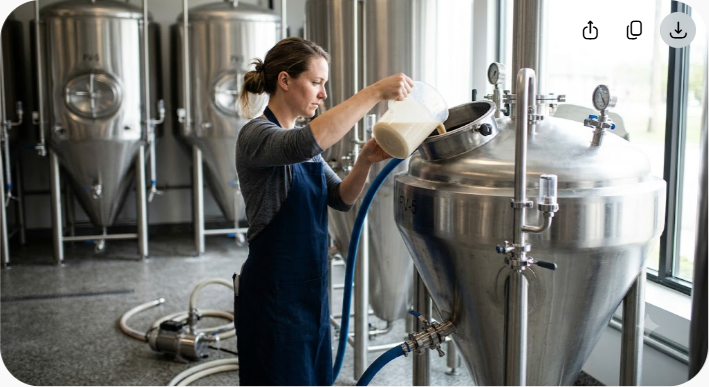
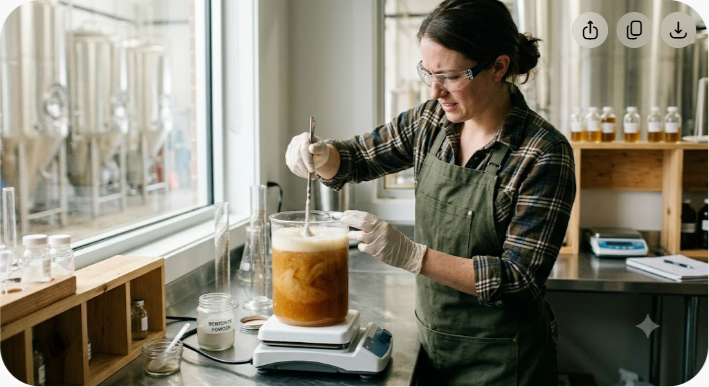
A practical preparation method is to slowly disperse the required bentonite into clean water while mixing sufficiently to prevent dry clumps. Allow it to hydrate for the period specified by the supplier before adding the slurry to beer.
The exact water-to-bentonite ratio and hydration time should come from the product specification because different products have different swelling and dispersion characteristics. A generic recipe can be misleading.
If you see dry lumps in the slurry, don't assume they're harmless. Poorly hydrated bentonite can behave very differently from a fully dispersed product, making your dosage trial less reliable.
Use the same water source and preparation method when comparing trials. Consistency in slurry preparation makes it much easier to understand whether a change in clarity came from the dose or simply from different hydration conditions.
This is the step that separates controlled clarification from guesswork.
Instead of treating an entire tank, divide a representative beer sample into several identical containers. Keep one sample untreated as the control. Test several bentonite concentrations across a conservative range and compare the samples after the same contact and settling period.
Published beer-clarification research has evaluated bentonite at concentrations in the low hundreds of milligrams per liter, including systems using 140 mg/L alongside another flocculant. That demonstrates that relatively low bentonite concentrations can be relevant in beer processing, but the experimental dose should not be treated as a universal recipe.
For a practical trial, you might test 50, 100, 150 and 200 mg/L if those levels are compatible with the supplier's product guidance. For a 1-liter sample, those concentrations correspond to 0.05, 0.10, 0.15 and 0.20 grams of bentonite respectively.
The purpose isn't to assume one of those numbers will work. It's to identify the lowest dose that produces the required improvement without unnecessarily affecting foam or sensory quality.
At these low quantities, weighing accuracy matters. A kitchen spoon isn't a reliable dosing tool for a controlled brewing trial. Use a suitable precision balance and calculate the amount for the exact sample volume.
Once you've selected a trial dose, add the hydrated bentonite slurry to the beer while mixing gently enough to distribute it uniformly.
The goal is contact, not violent agitation.
Excessive splashing can introduce oxygen, particularly in finished beer. Oxygen pickup can create staling problems that are much harder to fix than haze. Closed transfers, low-shear mixing and careful handling are preferable wherever practical.
Make sure the slurry is reasonably uniform before dosing. If the clay has settled heavily in the preparation vessel, remix it according to the product instructions so that the concentration being added is consistent.
Bentonite doesn't instantly turn cloudy beer into brilliant beer. After addition, the clay and adsorbed material need time to interact, form aggregates and settle.
The required time depends on the beer, dose, temperature, tank geometry and whether filtration follows. Evaluate trials at consistent intervals rather than judging the result immediately after addition.
A practical trial can be checked after several hours and then again at approximately 24 and 48 hours if the process allows. Some beers will show a clear difference quickly; others need longer before the sediment becomes compact enough for clean separation.
Don't confuse a large amount of loose sediment with successful clarification. What matters is the quality of the beer above the sediment and how easily that beer can be recovered without carrying solids forward.
Bentonite treatment can create a substantial sediment layer. This is one of its practical disadvantages in beer production.
Once the solids have compacted, remove the clearer beer without disturbing the sediment. In a larger brewery, filtration or another separation step may be used. At small scale, careful racking can be sufficient for a trial.
Commercial breweries should include sediment volume and beer loss in the process evaluation. A treatment that produces excellent visual clarity but leaves a large amount of recoverable beer behind may not be the best production option.
There is no single universal bentonite dosage for beer.
That's an important point because generic brewing guidance sometimes presents one number as though every beer responds identically. In reality, dosage depends on the beer's protein load, haze characteristics, bentonite properties, preparation, contact conditions and desired clarity.
Published research has evaluated bentonite at 140 mg/L in specific beer clarification systems, including combinations with other flocculants. That provides useful context but doesn't establish 140 mg/L as a standard dose for every beer.
For perspective, the following concentrations can be used as a trial framework when they fall within the supplier's guidance:
| Bentonite dose | Equivalent per 1 L beer | Equivalent per 100 L beer | Practical interpretation |
|---|---|---|---|
| 50 mg/L | 0.05 g | 5 g | Very light trial |
| 100 mg/L | 0.10 g | 10 g | Conservative trial |
| 150 mg/L | 0.15 g | 15 g | Moderate trial |
| 200 mg/L | 0.20 g | 20 g | Higher trial level |
These are trial concentrations, not universal recommendations. Follow the specification of the bentonite you're using and validate the result on your own beer.
For commercial production, establish a dose-response curve using a representative batch. The lowest concentration that delivers the required clarity is generally more attractive than simply using the highest amount that works.
That approach also gives you a useful operating window. If the beer changes from hazy to bright between two doses, test the area between them rather than automatically choosing the higher concentration.
It's better not to.
Dry bentonite can hydrate unevenly when introduced directly into finished beer. The outside of a particle can hydrate while the interior remains dry, creating lumps that don't provide the same accessible surface area as a properly prepared slurry.
Hydrating the bentonite separately also gives you better process control. You know the concentration of the slurry, can measure the addition accurately and can reproduce the preparation from one batch to another.
Water quality matters as well. Bentonite performance can vary with the composition of the hydration water. If you're developing a repeatable brewery procedure, use the same water source and preparation method for every trial.
The slurry should be prepared close enough to the addition step that its concentration and physical condition remain predictable. If storage of prepared slurry is part of the process, validate that procedure separately rather than assuming a freshly hydrated and stored slurry will perform identically.
Yes. This is one of the most important trade-offs to understand before using bentonite on beer.
Beer foam depends partly on surface-active proteins and other compounds that stabilize bubbles. Bentonite doesn't perfectly distinguish between proteins that contribute to haze and proteins that support foam. Research on beer protein stabilization has found that bentonite can remove both haze-active and foam-active proteins, while silica gel can show greater selectivity toward haze-active protein.
That doesn't mean every bentonite treatment will ruin head retention. It means over-treatment creates an avoidable risk.
If foam matters to the beer you're producing, include head retention in the bench-trial assessment. Don't judge the treatment only by visual clarity.
A useful trial evaluates at least four things:
The clearest sample isn't necessarily the best sample.
For a commercial beer, you can take this further by using the same glassware, pouring method, serving temperature and observation time for each sample. The comparison doesn't need to be elaborate; it just needs to be consistent.
At a properly controlled dose, bentonite is intended to be removed with the settled solids rather than remain as a sensory component of the finished beer. The larger concern is indirect: excessive adsorption can remove desirable beer components along with haze-related material.
That's why sensory comparison matters.
If a treated sample looks brilliant but tastes thinner, has weaker foam or shows a noticeable reduction in aroma, the treatment may be too aggressive. In that situation, reduce the bentonite dose rather than assuming that more settling time will solve the problem.
Sensory changes can also arise when a brewer compares samples at different temperatures or carbonation levels. Keep those conditions consistent during the trial so the evaluation reflects the fining treatment rather than unrelated process differences.
You should also avoid introducing non-beverage-grade mineral material into beer. A technically effective clay isn't automatically an acceptable brewing ingredient.
Bentonite is only one tool in the brewer's clarification toolbox. Choosing the right treatment depends on what is actually causing the haze.
| Treatment | Main target or role | Main advantage | Main limitation |
|---|---|---|---|
| Bentonite | Proteins and suspended colloids | Effective protein adsorption | Can also remove foam-active protein |
| Silica gel | Haze-active protein | More selective protein removal | Product-specific handling required |
| PVPP | Polyphenols | Useful for polyphenol reduction | Doesn't replace protein-focused treatment |
| Gelatin | Yeast and other suspended particles | Strong flocculation | Animal-derived and less selective |
| Isinglass | Yeast and suspended particles | Effective flocculation in suitable beers | Animal-derived and process-sensitive |
| Cold conditioning | Yeast and some haze-forming material | No fining addition required | Takes time and may not solve persistent haze |
| Filtration | Suspended particles | Consistent physical separation | Requires equipment and can cause product loss |
The key point isn't that one method is always better. Each method addresses a somewhat different problem.
For beer protein stabilization, silica gel may be preferable when preserving foam-active protein is a high priority. Bentonite can remove both haze-active and foam-active proteins, while silica gel can be more selective toward haze-active proteins.
That doesn't make silica gel automatically superior. Product formulation, dose, beer composition and process conditions all affect performance. A bench comparison on the actual beer is more useful than relying on a general ranking.
PVPP is primarily used to reduce polyphenolic material. It therefore addresses a different part of the protein-polyphenol haze problem.
If testing suggests that polyphenols are a major contributor, increasing bentonite may not solve the underlying issue efficiently. A polyphenol-focused treatment may be more appropriate.
Cold conditioning gives yeast and some suspended material additional time to settle without adding a fining agent. It can be an effective low-intervention step, but it takes time and won't necessarily resolve persistent colloidal haze.
Filtration physically removes suspended particles and can deliver highly consistent brightness when the equipment and process are well controlled. It also requires suitable equipment and can introduce product loss or filtration-related process challenges.
A brewery may therefore use conditioning, fining and filtration as complementary steps rather than treating them as mutually exclusive choices.
If you don't know what is causing the haze, you're choosing a treatment blindly. Diagnose the beer first and determine whether protein is likely to be involved.
A dose that works in one beer can be excessive in another. Differences in malt, hopping, protein content, yeast and processing can change the result.
More clay doesn't automatically mean clearer or better beer. Excess treatment can increase sediment, beer losses and the risk of reduced foam stability.
Poorly hydrated bentonite can produce inconsistent clarification and make bench trials difficult to reproduce. Follow the product-specific hydration procedure instead of relying on a generic slurry recipe.
Clarity is easy to see, but foam, aroma, flavor and mouthfeel also matter. Compare treated and untreated samples side by side under consistent conditions.
Bentonite needs good contact with the beer, but finished beer shouldn't be unnecessarily exposed to oxygen. Mix enough for distribution without creating excessive turbulence or splashing.
Bentonite treatment can generate a noticeable sediment layer. In a commercial brewery, that translates into tank capacity, handling requirements and potential beer loss.
Industrial bentonite isn't interchangeable with material intended for beverage processing. Verify the intended application and relevant quality documentation with the supplier before use.
If you're testing bentonite for the first time, keep the experiment controlled and easy to repeat.
Take four or five identical samples of the same beer. Keep one untreated as the control. Prepare a fresh bentonite slurry according to the supplier's instructions and dose the remaining samples at progressively higher concentrations.
Keep everything else constant: temperature, sample volume, contact time, storage conditions and evaluation method.
For example, with 1-liter samples you could create a trial series around 50, 100, 150 and 200 mg/L, provided those concentrations are compatible with the supplier's product guidance. Measure the required powder accurately because small weighing errors become significant at low doses.
After the planned contact and settling period, compare the samples.
Record:
If 100 mg/L gives nearly the same clarity as 200 mg/L but produces better foam and less sediment, the lower dose is usually the more sensible process choice.
You can make the trial more useful by recording observations at several time points. A sample that looks slightly better after four hours but significantly better after 24 hours tells you something different from a treatment that reaches its maximum effect quickly.
The result is more valuable than a generic online dosage because it gives you a repeatable treatment window for your own beer.
Timing depends on the process and the reason for treatment, but bentonite is generally more useful once you have a defined clarification or stabilization objective rather than as an automatic addition to every batch.
For finished-beer clarification, a practical approach is to make the addition after fermentation and once the beer's basic processing conditions are stable. That lets you evaluate the actual haze rather than treating wort before you know what the finished beer will look like.
Adding bentonite too early can complicate process control because the beer may still undergo substantial changes in yeast concentration, protein interactions and solids content.
If you're developing a commercial process, compare addition timing as part of your trials rather than assuming that a timing recommendation used for wine applies directly to beer. Bentonite behavior is strongly influenced by the beverage matrix.
The best timing is therefore the one that fits the rest of the brewery process while giving the bentonite sufficient contact and settling time before the next separation step.
There isn't one fixed clearing time.
The rate depends on the beer, bentonite preparation, dosage, temperature, particle concentration and settling conditions. Some treated samples can show substantial clarification within a day, while others require longer before the sediment becomes compact enough for clean separation.
For process development, evaluate the beer at defined intervals rather than deciding immediately that a treatment has failed.
A simple trial schedule might compare samples after several hours, approximately 24 hours and approximately 48 hours. If clarity continues improving after 24 hours, additional settling time may be worthwhile. If the beer remains hazy despite a higher dose, increasing bentonite indefinitely is unlikely to be the best answer. Reconsider the type of haze and the treatment strategy.
Temperature also matters. A beer that appears clear at one temperature may develop haze after chilling, so the final assessment should reflect the conditions under which the beer will actually be stored and served.
No.
The most obvious examples are intentionally hazy beers. If the beer's identity depends on haze, aggressive clarification defeats the purpose.
Even among clear beer styles, the decision depends on the target. A highly filtered commercial lager may justify a different stabilization strategy from a lightly processed craft ale.
Define the desired appearance before choosing a fining agent. "Clear" can mean brilliantly bright, visibly bright with slight haze or simply free of coarse suspended yeast. Those are different process targets.
A brewer should also consider the sensory character of the beer. Some styles depend on protein-derived body, persistent foam or particulate character that another beer would be expected to eliminate. Clarification should support the intended product rather than become an objective in its own right.
For larger breweries, bentonite selection is only one part of the decision. The process needs to be economically and operationally repeatable.
Consider the following factors:
For international breweries and ingredient buyers, also check local regulatory and labeling requirements before commercial use. Requirements can differ between countries and between beverage categories.
A successful commercial process should be reproducible by more than one operator. Write down the bentonite grade, slurry concentration, hydration method, mixing conditions, dose, contact time and separation method. That record becomes the basis for troubleshooting when a later batch behaves differently.
A supplier should be able to tell you more than the product name and a swelling value.
Ask for the technical specification, intended application, batch consistency information and available quality documentation. If the bentonite is going into a beverage process, confirm that the material is supplied for an appropriate food or beverage application.
Particle size and hydration performance matter because they influence how easily the clay disperses and develops its active surface area. Mineral composition and impurities matter because the raw material is ultimately part of a food-processing system, even though the bentonite is intended to be removed.
For buyers comparing suppliers, consistency can be more valuable than chasing the lowest price per kilogram. A cheaper material that produces variable clarification can cost more through repeated trials, filtration problems and inconsistent finished beer.
Axewelledge supplies processed bentonite for industrial applications and works with international buyers seeking consistent mineral quality. For a brewery application, the important step is to discuss the intended beverage process and confirm that the selected grade and documentation match that use rather than choosing a product solely by mineral name.
Before adding bentonite to a beer batch, ask:
If the answer to these questions is yes, you're much more likely to get a useful result without over-treating the beer.
Bentonite can clarify beer by adsorbing proteins and helping haze-forming material settle, but its lack of selectivity is both its strength and its limitation. It can remove proteins that you want gone as well as proteins that help your beer maintain a good head.
The better approach isn't to search for one magic dosage. Identify the haze, choose an appropriate beverage-grade product, hydrate it properly, run a controlled bench trial and use the lowest effective concentration.
If you're sourcing bentonite for a commercial beverage process, product consistency and application-specific documentation matter just as much as price. Axewelledge can help buyers evaluate bentonite requirements based on the intended application, processing conditions and supply needs.
A clearer beer is the goal. The better process is the one that gets you there without taking away what makes the beer worth drinking.













Have questions about our products? We're here to help!