Axewelledge, a leading exporter from India, specializes in high-quality Bentonite. With a commitment to excellence, we supply premium Bentonite to the Middle East and Southeast Asia markets.


North Angle Complex, 304,
150 Feet Ring Rd, Opposite Ambedkar Nagar BRTS Stop,
Madhav Park, Punit Nagar,
Mavdi, Rajkot, Gujarat 360004
© Axewelledge 2026, All Rights Reserved.
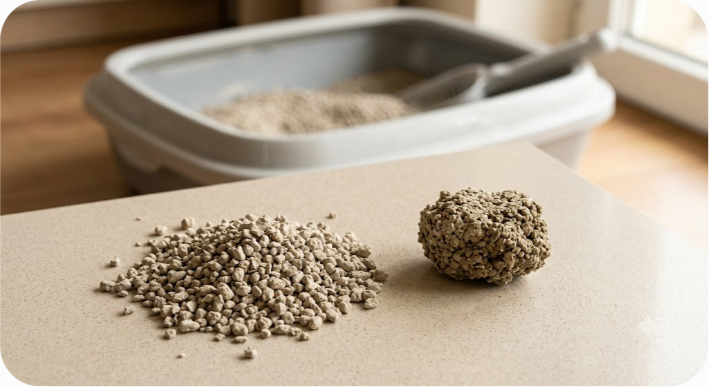
Bentonite for cat litter works because sodium-rich montmorillonite clay absorbs urine quickly, swells when hydrated, and binds some positively charged ions through cation exchange. That combination keeps liquid concentrated in removable clumps and helps limit the conditions that produce persistent ammonia odors. It does not simply cover smells with fragrance, and it does not chemically destroy every odor compound. Its main advantage is controlling moisture and containing waste before odors become a larger problem.
That distinction matters when comparing clay litters. A strong clumping litter depends on more than the word "bentonite" printed on a bag. Mineral composition, sodium activation, particle size, swelling capacity, dust control, litter depth, and daily scooping all affect the result.
For pet owners, the practical lesson is straightforward: choose a well-processed sodium bentonite litter, keep enough material in the tray to absorb urine before it reaches the bottom, and remove formed clumps regularly. For manufacturers and industrial buyers, the same principle means evaluating the clay's mineralogy and processing specifications rather than relying on a generic bentonite grade.
Bentonite is a clay-rich mineral material whose principal functional component is usually montmorillonite. Montmorillonite belongs to the smectite group of clay minerals and has a layered structure that can take up water between its microscopic sheets.
Sodium bentonite is particularly useful in cat litter because water causes it to swell substantially. When urine contacts the granules, the clay hydrates and the wetted particles bind together. Instead of allowing urine to spread throughout the tray, the litter creates a localized clump that can be removed with a scoop.
This behavior solves two problems at once. First, it keeps the liquid from spreading through otherwise clean litter. Second, it makes routine waste removal practical. The more completely a litter can separate wet material from dry material, the easier it is to maintain the tray without replacing the entire contents every day.
Odor control follows from that containment strategy. Cat urine itself is not simply a source of ammonia. Fresh urine contains mostly water together with urea, salts, creatinine, uric acid, and other dissolved compounds. As urine sits in a warm, moist litter environment, microorganisms can contribute to the breakdown of urea and the formation of ammonia and other odor compounds. Removing the wet clump promptly removes much of the material that would otherwise remain available for continued odor formation.
The familiar sharp smell of an older litter box is largely associated with ammonia, but ammonia is only part of the odor profile.
Fresh cat urine is mostly water. Urea is one of its major nitrogen-containing waste products. Microbial urease can break urea down into ammonia and carbon dioxide. In water, ammonia and ammonium exist in a reversible chemical equilibrium:
mathrmNH 3 ?
+H 2 ?
OrightleftharpoonsNH 4 + ?
+OH ?
The balance between ammonia and ammonium depends strongly on conditions such as pH and temperature. The uncharged ammonia form is volatile, so it is more readily released into the surrounding air. This is why a neglected tray can develop a strong ammonia smell even when the litter initially seemed effective.
Other compounds contribute to the overall odor. Fecal material can release sulfur-containing compounds and volatile organic compounds as it breaks down. Urine may also contain compounds that contribute to the characteristic odor of individual cats. A litter material therefore does not need to solve a single chemical problem; it needs to manage moisture and waste effectively while limiting the release of several types of volatile compounds.
Bentonite's most important contribution is controlling the physical environment in which these reactions occur. It absorbs urine, concentrates it into a removable mass, and reduces the amount of free liquid left in the tray.
Not all bentonite behaves the same way. The distinction between sodium bentonite and calcium bentonite is especially important for cat litter because the exchangeable ions between montmorillonite layers influence how strongly the clay swells.
Sodium bentonite generally has high swelling capacity. When hydrated, water enters the spaces between montmorillonite layers and causes the clay to expand. The particles become cohesive and form the firm clumps associated with modern clumping litter.
The exact performance varies with mineral composition, sodium content, processing, particle size, and test method. For that reason, manufacturers should compare measured swelling, absorption, moisture, and clump-strength specifications rather than treating a single swelling number as a universal standard.
Calcium bentonite generally has lower swelling capacity than sodium-dominant bentonite. It can still absorb liquids effectively, but it does not naturally produce the same type of strong, expanding clump.
Some calcium bentonites can be sodium-activated using sodium carbonate. This treatment changes the exchangeable cation balance and can improve swelling and clumping performance. The resulting material should be evaluated as a processed litter grade rather than assumed to behave exactly like naturally occurring sodium bentonite.
| Property | Sodium-Dominant Bentonite | Calcium-Dominant Bentonite |
|---|---|---|
| Main exchangeable cation | Sodium | Calcium |
| Swelling tendency | High | Lower |
| Clumping potential | Strong | Limited without activation |
| Typical litter role | Clumping litter | Absorbent or activated litter |
| Moisture containment | Strong | Moderate to strong, depending on grade |
| Processing requirements | Drying, sizing, dedusting and grading | May require activation for strong clumping |
The important point is not that calcium bentonite is useless. It is that the clay's mineral chemistry must match the intended litter application.
Bentonite odor control is best understood as a combination of moisture management, waste containment, and ion exchange. Claims that bentonite simply "neutralizes all odors" oversimplify the chemistry.
When urine contacts dry sodium bentonite, water moves into and around the clay particles. Montmorillonite can hydrate between its layers, while capillary forces also move liquid through the particle network.
Fast absorption matters because free liquid is the starting point for many litter box problems. If urine spreads across the bottom of the tray, a much larger area remains wet. If it stays concentrated in a clump, the owner can remove that wet material quickly.
Bentonite does not sterilize the litter box or guarantee that bacterial activity stops. Its value is more practical: it removes free liquid from the environment and makes the waste removable.
Montmorillonite has a permanent negative charge associated with substitutions within its crystal structure. Exchangeable cations occupy sites that balance that charge. Depending on the clay, these ions can include sodium, calcium, magnesium, and others.
Ammonium is a positively charged ion. Under suitable conditions, it can participate in cation exchange with the mineral. This can reduce the amount of exchangeable ammonium remaining in the liquid phase, although the extent of odor reduction depends on the clay, urine chemistry, pH, moisture, and other factors.
This is an important correction to a common marketing claim: bentonite does not simply grab ammonia gas and permanently neutralize it. The clay's cation-exchange behavior concerns ions such as ammonium. The relationship between ammonium and gaseous ammonia is governed by chemical equilibrium.
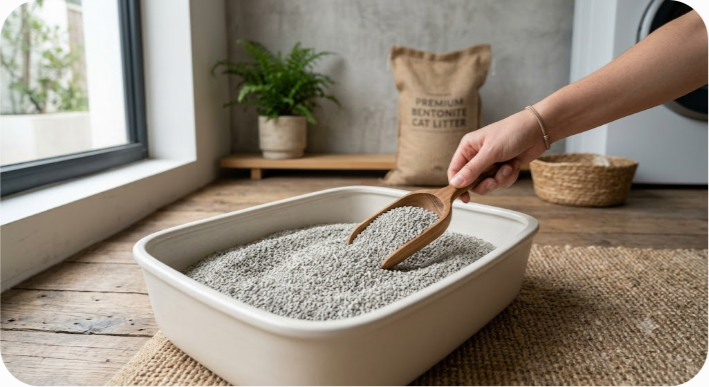
Swelling creates the hard, cohesive clump that makes sodium bentonite so useful in litter. The liquid becomes concentrated within a mass of hydrated clay rather than remaining as a thin film across the tray.
A dense clump can physically restrict the movement of moisture and some volatile compounds. More importantly, the entire contaminated mass can be removed. That is why clumping performance and odor control are closely connected.
A litter that absorbs urine but leaves it distributed throughout the tray creates a different maintenance problem from one that forms a removable clump.
Consider two trays with the same amount of urine. In the first, the urine spreads through the litter and eventually reaches the bottom of the box. In the second, sodium bentonite forms a localized clump around the deposit. The second tray gives the owner a much easier way to remove the contaminated material without disturbing the rest of the litter.
The clump does not need to be perfectly airtight to be useful. Its main function is to concentrate waste into a scoopable form.
Clump-setting time varies by formulation. Particle size, clay quality, liquid volume, litter depth, and additives can all change how quickly a clump becomes firm enough to remove.
Bentonite is a material category, not a guarantee of a particular litter performance level. Natural deposits contain different proportions of montmorillonite and other minerals. Processing also changes the final product.
Montmorillonite is the mineral primarily responsible for the swelling and ion-exchange properties that make bentonite useful in clumping litter. Higher montmorillonite content can support stronger performance, but mineral purity alone does not determine the finished product.
Two clays with similar montmorillonite content can behave differently because of differences in exchangeable cations, particle morphology, moisture, processing history, and particle-size distribution.
Cation exchange capacity, usually reported in milliequivalents per 100 grams, measures how much exchangeable positive charge a clay can hold under a defined test method. It is useful when comparing bentonite grades, but it should not be treated as a direct measurement of odor-control performance.
A high CEC can indicate substantial ion-exchange capacity, yet a litter's real-world performance also depends on swelling, absorption rate, clump strength, pH, particle size, and how quickly the used material is removed.
Free swelling is another useful specification for sodium bentonite. It indicates how much the clay expands when hydrated under a particular test procedure.
Higher swelling can support strong clumping, but excessive fines or poor granulation can create dust and tracking problems. The goal is not simply maximum swelling. The goal is a balanced litter that absorbs quickly, forms durable clumps, and remains comfortable to handle.
Raw bentonite ore is not ready to become finished cat litter. Mining produces a mineral material with variable moisture and particle sizes. Industrial processing typically includes crushing, drying, milling or granulation, screening, and dust removal.
Fine particles provide a large surface area relative to their mass and can absorb liquid quickly. They also fill gaps between larger granules, helping a clump become dense.
The drawback is dust. Excessive fines can become airborne during filling, pouring, transport, and use. They can also increase tracking because small particles are more likely to adhere to paws.
Larger granules improve flow through the litter bed and can reduce tracking. They also create larger spaces between particles, which affects how urine moves before being absorbed.
A well-designed product often uses a controlled distribution rather than a single particle size. Fine material contributes surface area and cohesion, while larger granules provide structure and improve handling.
A litter described simply as "fine" or "coarse" does not tell the whole story. Manufacturers should evaluate the full particle-size distribution, including the percentage of material below the target size.
Two products can have the same nominal median particle size but behave differently if one contains significantly more fines. For industrial buyers, sieve analysis and dust measurements are therefore useful quality-control tools.
Bentonite is not the only effective litter material. Different substrates solve different problems, and no single litter is ideal for every household.
| Litter Material | Main Moisture Strategy | Clumping | Ammonia Management | Typical Advantages | Common Limitations |
|---|---|---|---|---|---|
| Sodium bentonite | Swelling and absorption | Strong | Moisture containment plus ion exchange | Fast clumping and easy waste removal | Weight, dust and tracking can vary |
| Silica gel | Pore-based absorption | Usually non-clumping | Moisture adsorption | Lightweight and good moisture capacity | Does not provide the same clay clumping behavior |
| Wood | Fiber absorption | Usually non-clumping | Primarily moisture management | Renewable feedstock options and low tracking with pellets | Odor control varies by formulation |
| Corn and grain | Plant-fiber and starch absorption | Can form clumps | Primarily moisture management | Biodegradable feedstock | Performance depends strongly on formulation and storage |
| Paper | Fiber absorption | Usually non-clumping | Primarily moisture management | Low dust and soft texture | Lower clumping and moisture containment |
The comparison should be based on the property that matters most to the user. If firm clumping and straightforward daily waste removal are priorities, sodium bentonite has a clear functional advantage. If low weight, renewable feedstocks, or low dust are more important, another litter may be a better fit.
No. A better claim is that bentonite can substantially reduce the conditions that produce and release odor when the litter is properly formulated and maintained.
Even excellent clay becomes less effective once it is saturated. A litter box also contains feces, which introduces odor compounds that aren't solved by ammonium exchange alone. Fragrances can mask some smells, activated carbon can adsorb certain organic compounds, and zeolites can provide additional ion-exchange capacity, but none removes the need for regular cleaning.
The biggest practical mistake is treating litter material as a substitute for maintenance. A high-quality bentonite litter with infrequent scooping can smell worse than an ordinary litter that is cleaned consistently.
A sufficiently deep litter bed gives urine enough material to interact with before it reaches the plastic base. Around 7 to 10 cm is a common practical range for clumping litter, although the best depth depends on the box design, the cat's behavior, and the manufacturer's instructions.
Too little litter makes bottom sticking more likely. Too much can make the box difficult for some cats to use and increases waste. The aim is a stable layer that allows clumps to form without reaching the tray floor.
Daily scooping is one of the most effective ways to prevent ammonia odor. In homes with several cats, more frequent cleaning may be necessary.
Remove urine clumps and feces without aggressively breaking the clumps apart. The cleaner the remaining litter stays, the longer it can perform effectively.
Every removed clump takes some clean litter with it. Add fresh litter as needed to maintain the intended depth and provide enough dry clay for new deposits.
Constantly topping up without ever cleaning the tray is not a substitute for a full change. Fine fragments and small amounts of contaminated material eventually accumulate and can contribute to odor.
Moisture outside the normal urine deposits can reduce litter performance. Store unused bentonite in a dry, closed container or its original sealed packaging. Humid storage can allow the granules to absorb moisture before they ever enter the litter box.
A strong ammonia odor can indicate that urine is remaining in the tray too long, clumps are being missed, the litter layer is insufficient, or the box is overcrowded for its cleaning schedule.
It can also indicate that the litter has reached its practical absorption capacity. Changing brands may help, but first check cleaning frequency and tray conditions.
Weak clumps can result from low swelling clay, unsuitable particle sizing, insufficient contact time, or a formulation designed for a different performance target.
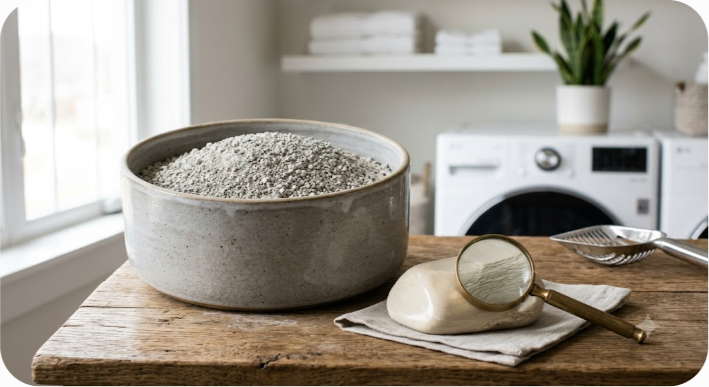
If the problem persists, compare the manufacturer's clump-strength and swelling specifications rather than relying solely on marketing terms such as "premium" or "ultra clumping."
Bottom sticking usually means the urine has reached the base before enough clay could absorb and contain it. Possible causes include insufficient litter depth, very large urine deposits, a saturated litter bed, or poor absorption performance.
A clean tray, adequate litter depth, and regular removal usually solve the problem. If they don't, the litter itself may not be suitable for the box or household's usage pattern.
Dust is influenced by mineral composition, granulation, handling, transport, and the amount of fine material in the finished product. Look for products with documented low-dust processing rather than assuming that every sodium bentonite litter has the same dust level.
Manufacturers can reduce fines through screening and dedusting, and they can improve granule durability through controlled processing. Packaging and transportation also matter because fragile granules can generate additional fines before the product reaches the consumer.
Bentonite is widely used in commercial cat litter, but safe use depends on the finished product and normal handling practices. Cats should not be encouraged to ingest litter, regardless of whether it is clay, silica, paper, or plant based.
Kittens that explore their surroundings by eating non-food materials may require additional consideration. Owners should follow veterinary guidance and the litter manufacturer's age recommendations rather than assuming that one litter type is appropriate for every kitten.
Dust is another practical consideration. A low-dust product can reduce airborne particles during pouring and use. If a cat repeatedly coughs, sneezes, or shows respiratory discomfort around a particular litter, discontinue the product and consult a veterinarian.
Bentonite litter should also be kept away from drains and toilets. Its swelling behavior makes flushing unsuitable for household plumbing.
Sodium bentonite is designed to absorb water and swell. That is exactly why it works in a litter box and exactly why it should not enter plumbing.
A clump that survives the litter tray can continue taking up water after it is flushed. In pipes, the expanding clay can settle in bends or restricted sections and contribute to blockages.
Dispose of used clumps according to local household-waste rules. Do not assume that a bag labeled biodegradable makes the clay itself suitable for flushing or composting.
For industrial buyers, the finished litter's behavior begins with raw mineral selection. A reliable supply program should evaluate the clay before it reaches the production line.
The deposit should provide consistent montmorillonite content and predictable swelling behavior. Buyers should request technical specifications and representative test data rather than relying on a generic mineral name.
Controlled drying brings the material to a suitable moisture level for subsequent processing. Overly wet material can be difficult to granulate and may reduce usable absorption capacity. Excessive drying or aggressive thermal treatment can also affect performance, depending on the mineral and process conditions.
Granulation creates the particle profile needed for the final litter. Screening removes oversized and undersized material and helps manufacturers maintain batch-to-batch consistency.
Dedusting is important because handling can create fine particles that affect both user experience and workplace conditions. Industrial plants may use mechanical screening, aspiration, cyclonic separation, or other dust-control systems appropriate to the production line.
A serious bentonite cat litter specification can include:
No single laboratory value predicts consumer satisfaction. The best evaluation combines raw-clay testing with finished-litter performance testing.
Some formulations combine bentonite with other minerals or adsorbents. These additions can broaden odor-management performance, but their value depends on dosage and the specific odor compounds being targeted.
Activated carbon has a highly porous structure and can adsorb many organic compounds. It is particularly useful for compounds that are not effectively addressed by bentonite's ion-exchange mechanism.
However, activated carbon does not replace the need for clumping and moisture management. If urine remains spread through a tray, adding carbon alone will not solve the underlying maintenance problem.
Natural zeolites such as clinoptilolite have ion-exchange properties and can interact with ammonium. They are therefore used in some odor-control formulations.
A bentonite-zeolite blend can provide complementary functions: bentonite supplies swelling and clumping, while zeolite contributes additional ion-exchange capacity. The actual benefit should be verified in finished-product testing rather than assumed from the properties of either ingredient in isolation.
Whether you're buying litter for one cat or sourcing mineral feedstock for a private-label product, a few questions can reveal more than a long marketing description.
Look for:
Don't choose a product solely because it claims to have "maximum odor control." The quality of the clay and the cleaning routine matter more than a slogan.
Ask suppliers for:
A supplier that can provide reproducible technical data is easier to qualify than one that relies on broad claims about purity or absorption.
Bentonite is not a standardized single-performance material. Sodium-dominant, calcium-dominant, activated, and differently processed grades can behave very differently.
A strong fragrance can make a tray smell different without reducing the source of the odor. Moisture containment and waste removal are the foundation of effective odor management.
Once urine repeatedly reaches the plastic base, cleaning becomes harder and odors become more persistent. Maintaining adequate depth and removing clumps promptly is more effective than simply adding fragrance.
A litter can have excellent clumping performance and still provide a poor user experience if it generates excessive fines. Dust control should be evaluated separately from absorption and swelling.
Bentonite absorbs moisture even before it enters the litter box. A damaged bag or humid storage area can reduce the material's remaining absorption capacity.
Bentonite for cat litter is effective because its mineral structure provides several useful properties at the same time. Sodium-rich montmorillonite hydrates and swells when it contacts urine, creating cohesive clumps that isolate wet waste from the rest of the litter.
Its cation-exchange capacity can also interact with ammonium ions, helping manage one of the chemical pathways associated with ammonia odor. That does not mean bentonite chemically destroys every odor molecule. The strongest real-world benefit comes from combining mineral performance with good litter-box maintenance.
For pet owners, the priorities are simple: choose a well-processed clumping litter, maintain an adequate litter depth, scoop regularly, keep unused litter dry, and never flush clay litter.
For manufacturers and bulk mineral buyers, the evaluation should go deeper. Montmorillonite content, exchangeable cations, swelling, moisture, particle-size distribution, dust, granule durability, and finished-product clump strength all deserve attention. A consistent raw material is the starting point for consistent litter performance.
The reason sodium bentonite remains so widely used is ultimately practical. It turns liquid waste into a removable solid mass quickly and reliably. That makes the litter box easier to clean, limits the spread of moisture, and helps keep odor under control without relying entirely on fragrance or chemical masking.













Have questions about our products? We're here to help!