Axewelledge, a leading exporter from India, specializes in high-quality Bentonite. With a commitment to excellence, we supply premium Bentonite to the Middle East and Southeast Asia markets.


North Angle Complex, 304,
150 Feet Ring Rd, Opposite Ambedkar Nagar BRTS Stop,
Madhav Park, Punit Nagar,
Mavdi, Rajkot, Gujarat 360004
© Axewelledge 2026, All Rights Reserved.
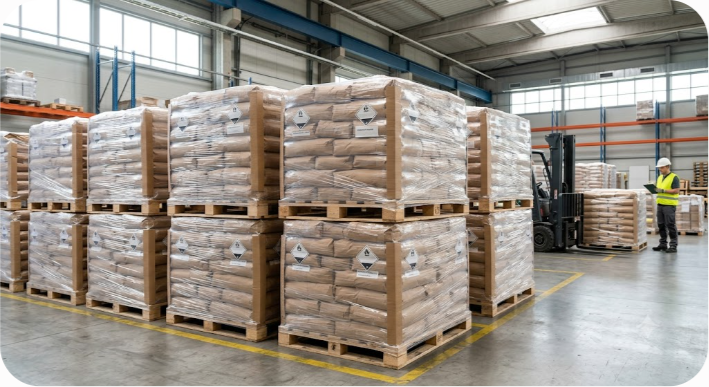
A Bentonite SDS is more than a document to file in your purchasing records. For industrial buyers, it can determine how the material is classified, what dust controls are needed, which exposure limits apply, how spills should be handled, and whether the product can be shipped under ordinary freight rules.
The key point is simple: do not assume that every bentonite product has the same hazard classification. Bentonite is a naturally occurring clay mineral, but mined material can contain other minerals, including crystalline silica. The actual composition and classification depend on the specific deposit, processing method, grade, and supplier's formulation. That is why the SDS for the exact product you purchase matters more than a generic bentonite specification.
If you're buying sodium bentonite or calcium bentonite in bags, super sacks, bulk trucks, or other large-volume formats, review the SDS before the material reaches your facility. Pay particular attention to Sections 2, 3, 7, 8, 9, 10, 11, 13, 14, and 15. Those sections provide the information your procurement, operations, EHS, logistics, and waste-management teams are most likely to need.
A Safety Data Sheet, or SDS, is a standardized document used to communicate information about a chemical or material's identity, hazards, safe handling requirements, emergency measures, and regulatory status. The term MSDS, or Material Safety Data Sheet, is still used informally in some industries, but SDS is the current term used by modern hazard communication systems.
SDS requirements vary by jurisdiction. In the United States, OSHA's Hazard Communication Standard establishes requirements for SDSs and workplace hazard communication. Other markets use their own implementations of the Globally Harmonized System of Classification and Labelling of Chemicals, commonly known as GHS. The European Union also has additional requirements under REACH and the CLP Regulation.
For an industrial buyer, the SDS answers several practical questions:
The SDS should be treated as one part of a wider risk assessment. It does not replace workplace exposure monitoring, site-specific procedures, applicable legislation, or professional industrial hygiene advice.
You don't need to read all 16 sections in the same order. For a first review, start with the sections that can change your purchasing decision or facility controls.
| SDS Section | What It Covers | What Industrial Buyers Should Check |
|---|---|---|
| Section 1 | Identification | Product name, supplier, intended use, emergency contact information |
| Section 2 | Hazard identification | Classification, signal word, hazard statements, precautionary statements |
| Section 3 | Composition | Bentonite identity and any reportable hazardous components, including crystalline silica where applicable |
| Section 6 | Accidental release | Spill containment, cleanup methods, and precautions against dust exposure |
| Section 7 | Handling and storage | Dust control, ventilation, storage conditions, incompatibilities |
| Section 8 | Exposure controls and PPE | Applicable exposure limits, engineering controls, respiratory and eye protection |
| Section 9 | Physical and chemical properties | Appearance, odor, pH where relevant, particle characteristics, density, solubility, and other grade-specific data |
| Section 10 | Stability and reactivity | Stability, conditions to avoid, incompatible materials, hazardous decomposition products |
| Section 11 | Toxicological information | Routes of exposure and health effects associated with the product and its components |
| Section 13 | Disposal considerations | Waste-handling recommendations and regulatory considerations |
| Section 14 | Transport information | Applicable transport classification and shipping requirements |
| Section 15 | Regulatory information | Relevant jurisdiction-specific regulatory information |
If the SDS doesn't match the product specification, packaging label, Certificate of Analysis, or purchase documentation, stop and ask the supplier to reconcile the discrepancy. A clean-looking document is not enough; it has to describe the material you're actually receiving.
Bentonite is not a single pure chemical compound. It is a naturally occurring clay material dominated by minerals in the smectite group, particularly montmorillonite. Its mineral composition varies with the geological deposit and processing method.
The commonly used CAS Registry Number for bentonite is 1302-78-9. This identifier is useful when checking supplier documents, regulatory databases, and purchasing records, but the CAS number alone doesn't tell you everything about the product's hazard profile.
Natural bentonite can contain accessory minerals such as quartz, feldspar, calcite, and other mineral phases. The proportions vary substantially between deposits. Consequently, buyers should not assume a fixed crystalline silica concentration simply because a material is described as bentonite.
Crystalline silica deserves special attention because respirable crystalline silica can present a serious occupational health hazard when workers inhale sufficient concentrations over time. Quartz is one form of crystalline silica that can occur naturally in mineral deposits.
The important distinction is between total crystalline silica in the product and the respirable fraction that can become airborne and reach the deepest parts of the lungs. A product may contain crystalline silica, but the workplace risk depends on factors including its concentration, particle-size distribution, dust generation, handling method, duration of exposure, and effectiveness of controls.
Do not insert a generic silica percentage into a risk assessment simply because a website or another supplier lists one. Ask the supplier for the composition information for the specific grade and, where appropriate, supporting analytical data.
The concentration at which a component must be disclosed or a mixture classified depends on the applicable regulatory framework and classification rules. It is therefore inaccurate to treat a single percentage, such as 0.1 percent, as a universal trigger for every SDS requirement worldwide.
Sodium bentonite and calcium bentonite are both bentonitic clays, but their performance characteristics can differ considerably. Sodium-rich bentonite generally has greater swelling capacity and can form stronger gels in water. Calcium-rich bentonite generally has lower swelling capacity and different rheological and adsorption properties.
That distinction matters for purchasing, but it does not automatically determine the product's hazard classification. Hazard classification should be based on the actual composition and applicable regulatory criteria shown in the supplier's SDS.
Section 2 is where you find the supplier's hazard classification, signal word, hazard statements, precautionary statements, and applicable pictograms.
A common mistake is to assume that every bag of industrial bentonite should carry the same GHS classification. That isn't necessarily true. Two bentonite products from different deposits can have different mineral compositions and different classifications.
Review these fields carefully:
If crystalline silica is identified as a hazardous component, check whether the classification relates specifically to respirable crystalline silica and whether the supplier's wording matches the jurisdiction in which the product will be used.
Bentonite dust can irritate the eyes, nose, throat, and skin simply because fine mineral particles are physically irritating. That is different from the long-term occupational risk associated with repeated inhalation of respirable crystalline silica.
This distinction matters when designing controls. A facility shouldn't treat every dust exposure as though it were identical, but it also shouldn't dismiss mineral dust simply because bentonite itself is commonly regarded as a low-toxicity material. The right approach is to control airborne dust at the source and use exposure monitoring where the risk assessment indicates it is necessary.
For many industrial users, Section 8 is the most operationally important part of the SDS. It connects the material's identified hazards with exposure limits and control measures.
Exposure limits are jurisdiction-specific. They can also differ by substance and particle fraction. For example, OSHA's respirable crystalline silica standard in the United States sets a permissible exposure limit of 0.05 mg/m3 as an 8-hour time-weighted average, with an action level of 0.025 mg/m3.
Those numbers apply to respirable crystalline silica under the relevant OSHA requirements. They should not be copied into a general risk assessment for total bentonite dust.
ACGIH publishes its own occupational exposure guidelines, which may differ from legally enforceable limits. Other countries may apply different statutory limits. Always identify the jurisdiction, substance, sampling convention, and exposure period before comparing values.
For general mineral dust, the applicable limit can also depend on whether the material is regulated as a particular substance or under a broader particulate category. Section 8 should therefore be read together with the relevant workplace regulations rather than treated as a universal safety threshold.
If your facility handles dry bentonite, controlling dust at the point where it is generated is usually more effective than relying on respirators alone.
Practical controls can include:
A respirator is not a substitute for a poorly designed dust-control system. Respiratory protection should be selected and managed as part of a compliant respiratory protection program where required.
The SDS may recommend respiratory protection, eye protection, gloves, or protective clothing depending on the product and exposure conditions.
For dusty operations, suitable eye protection can prevent particles from contacting the eyes. Gloves can reduce skin irritation and help protect workers during prolonged handling. Respiratory protection should be selected according to measured or reasonably anticipated exposure, the applicable standard, and the facility's respiratory protection program.
Avoid writing a generic statement such as "use an N95" into a site procedure without first checking the exposure assessment. The correct respirator depends on the contaminant, concentration, task, fit, filtration requirements, and applicable regulations.
Section 9 contains physical and chemical properties that can help engineering and operations teams understand how a particular bentonite grade behaves during storage and processing.
Typical properties can include appearance, odor, pH of a specified aqueous suspension, density, solubility, particle characteristics, and other product-specific information. These values can vary considerably by grade and supplier, so generic ranges should never replace the manufacturer's specification.
Bulk density affects silo sizing, truck loading calculations, hopper capacity, and material-flow behavior. Loose and compacted bulk density can differ significantly, particularly after vibration or transportation.
If you are designing a receiving system, use the supplier's current technical specification and test the actual grade when the flow behavior is critical. A single generic density value is not sufficient for detailed equipment design.
Bentonite is generally insoluble in water in the conventional sense. Instead, its fine particles disperse and can form a suspension or gel depending on mineralogy, chemistry, concentration, and mixing conditions.
The reported pH is meaningful only when the SDS states how the measurement was made. A pH value for a specified slurry concentration should not be treated as the intrinsic pH of dry bentonite.
Sodium bentonite generally has greater swelling capacity than calcium bentonite, but swelling is not a single fixed number. Water chemistry, exchangeable cations, particle size, test method, and product grade all influence the result.
For industrial purchasing, ask for the supplier's test method and specification rather than relying on broad claims such as "swells 15 times". In drilling, civil engineering, and sealing applications, performance specifications are often more useful than a simple volume-swelling figure.
Sections 6 and 7 provide practical guidance for handling and storage, but site conditions still need to be considered.
Dry bentonite can cake when exposed to moisture. Caking can reduce flowability and create problems at bag-dumping stations, feeders, hoppers, and silos.
Store packaged material in a dry area and protect bags and super sacks from rain, condensation, standing water, and damaged roofing. Use appropriate pallets or storage systems to keep packaging off the floor.
For bulk silos, evaluate the product's flow characteristics before selecting aeration, vibration, bin activators, or other flow aids. Equipment that works well for one grade may not perform the same way with another.
Fine dry powders can create dust during pneumatic conveying and other high-energy transfer operations. Electrical and process safety requirements should therefore be considered when designing conveying and collection systems.
Ground and bond equipment where required by the facility's electrical and process hazard assessment. Also evaluate the dust collector, filter media, ducting, and any ignition-control requirements applicable to the material and process.
Do not assume that bentonite is combustible simply because it produces dust, or that it can never create a dust hazard. The relevant determination depends on the actual material and process conditions. Where combustible-dust hazards are plausible, obtain appropriate testing and professional assessment.
There is no universal rule that every bentonite pallet should be stacked only two units high. Safe stacking height depends on packaging design, pallet construction, bag strength, warehouse equipment, rack design, floor loading, and the supplier's instructions.
Follow the packaging manufacturer's stacking limits and your facility's storage procedures rather than applying a generic number to every product.
Spills of dry bentonite are usually managed as housekeeping and dust-control events, but the cleanup method still matters.
Avoid stating that water must never be used for bentonite cleanup. The appropriate method depends on the location, amount spilled, dust potential, drainage controls, and the risk created by wet clay.
Bentonite is a naturally occurring inorganic clay, and its environmental behavior is different from that of many synthetic chemicals. However, "natural" does not mean that every release or disposal method is automatically acceptable.
Large quantities of suspended clay entering surface water can increase turbidity and suspended solids. Outdoor storage and loading areas should therefore be designed to control stormwater runoff and prevent bulk releases from reaching drains or waterways.
Unused or uncontaminated bentonite may often be managed as non-hazardous mineral waste, but the correct disposal route depends on local regulations and the material's actual composition.
Do not state categorically that every bentonite product can be placed in a standard landfill or used for agricultural soil conditioning. Local waste rules, product specifications, contamination status, and the intended application all matter.
Once bentonite has absorbed or mixed with another substance, its waste classification may change. Bentonite used to absorb oils, solvents, heavy-metal solutions, or other hazardous materials should be assessed based on the contaminant and applicable waste regulations.
The same principle applies to drilling and industrial process wastes. The disposal status of spent material cannot be determined from the original bentonite SDS alone.
Section 14 identifies information relevant to transportation by road, rail, sea, or air. It can include the UN number, proper shipping name, transport hazard class, packing group, environmental hazards, and special precautions where applicable.
Many ordinary bentonite products are not regulated as dangerous goods under major transport frameworks. However, that conclusion must come from the actual product and applicable transport rules. It should not be copied into shipping paperwork from a generic bentonite description.
For a particular shipment, confirm the current supplier SDS and the rules applicable to the mode of transport and destination. A material can be non-hazardous under one regulatory framework while still requiring other customs, environmental, packaging, or documentation controls.
Bentonite is commonly classified under HS heading 2508 for customs purposes, with specific subheadings depending on the applicable tariff schedule. The exact tariff code can vary by country and must be confirmed with the customs authority, broker, or current tariff schedule.
Do not treat an HS code as a substitute for a transport classification. Customs classification and dangerous-goods classification serve different purposes.
The choice between sodium and calcium bentonite should be driven by application requirements rather than the names alone.
| Property | Sodium Bentonite | Calcium Bentonite |
|---|---|---|
| Dominant exchangeable cation | Sodium | Calcium |
| Typical swelling behavior | Higher | Lower to moderate |
| Water interaction | Strong swelling and gel formation in suitable grades | Generally lower swelling |
| Common industrial uses | Drilling fluids, civil engineering, foundry binders, sealing applications | Absorbents, foundry uses, adsorption applications, selected agricultural and industrial uses |
| Key purchasing concern | Swelling, rheology, filtration, particle size, and dust control | Adsorption performance, particle size, moisture control, and dust control |
| SDS review priority | Composition, silica content, classification, exposure controls | Composition, silica content, classification, exposure controls |
These are general distinctions, not guarantees. Two products sold under the same commercial category can perform differently because of deposit mineralogy, activation, beneficiation, particle size, and processing.
A good SDS provides the baseline safety information, but industrial buyers should also evaluate the standards and specifications that apply to the intended use.

Bentonite is widely used as a binder in green-sand molding systems. Buyers should evaluate the grade's swelling behavior, bonding performance, moisture requirements, particle-size distribution, and thermal behavior alongside the SDS.
A common mistake is to treat the SDS as a complete technical specification. It isn't. Foundry purchasing decisions should also use the supplier's technical data sheet, product specification, Certificate of Analysis, and application test results.
Bentonite used in drilling fluids may be purchased against industry specifications such as API Specification 13A. The applicable specification depends on the product category and intended drilling application.
The SDS and the API or technical specification answer different questions. The SDS addresses hazards and safe handling; the technical specification addresses performance characteristics such as viscosity, filtration, yield, and other relevant test criteria.
Buyers should also distinguish the clay itself from drilling-fluid formulations containing additional chemicals. The SDS for a bentonite product cannot be used as the SDS for a finished drilling-fluid system containing other additives.
Bentonite slurries are used in diaphragm walls, tunneling, bored piling, slurry trenching, pipe jacking, and sealing applications. In these settings, buyers need more than a generic safety profile.
Important technical considerations can include slurry yield, viscosity, filtration behavior, gel strength, particle size, swelling performance, and compatibility with local water chemistry. Environmental requirements can also vary by project and jurisdiction.
A systematic SDS review can prevent avoidable problems after delivery.
Check the product name, grade, revision date, supplier identity, and intended use. Make sure the document applies to the material quoted in your purchase order.
Look for the bentonite identity and any hazardous components that require disclosure. If crystalline silica is relevant, confirm that the supplier provides appropriate composition information rather than relying on a generic statement.
Check the classification, signal word, hazard statements, and precautionary statements. Make sure your labels and training materials reflect the actual product classification.
Record the exposure limits that apply to your jurisdiction and process. Confirm whether the values relate to respirable crystalline silica, total dust, respirable particulate, or another substance or fraction.
Compare Section 7 with your warehouse, silo, conveying, and bag-dumping arrangements. Identify any gap between the supplier's recommendations and your existing controls.
Review Sections 5 and 6 with your emergency response and maintenance teams. They should know how to control dust, isolate spills, and prevent material from entering drains or waterways.
Confirm that your disposal contractor and logistics provider have the information they need. Verify the transport classification for the actual shipment rather than copying information from an older order.
SDS documents can be revised when classifications, formulations, regulations, or supplier information change. Establish a process for obtaining current revisions from suppliers and removing obsolete copies from operational use.
Bentonite itself may have a relatively low hazard profile, but the final classification depends on the actual product and its constituents. Naturally occurring crystalline silica is one reason a product may require additional hazard controls.
A sodium bentonite used in drilling may not have the same composition or classification as a calcium bentonite used for another application. Always match the SDS to the purchased grade.
A limit for respirable crystalline silica is not automatically a limit for total bentonite dust. Check the substance, particle fraction, averaging period, and jurisdiction.
Respirators and eye protection are important when required, but engineering controls should address the source of airborne dust whenever feasible.
Transport classification and occupational health risk are different questions. A material can be non-dangerous-goods cargo while still requiring effective workplace dust controls.
The SDS is not a substitute for a technical data sheet or Certificate of Analysis. Use each document for its intended purpose.
Bentonite performance varies by deposit, processing, particle size, test method, and water chemistry. Ask the supplier how the value was measured before using it for equipment or process design.
Before approving a supplier, confirm the following:
Not necessarily. Many bentonite products are not classified as hazardous under certain regulatory systems, but classification depends on the actual product composition and applicable rules. Naturally occurring crystalline silica or other constituents can affect the classification. Always review Section 2 of the SDS for the exact grade you purchase rather than assuming that all bentonite has the same hazard status.
Bentonite is commonly identified by CAS Registry Number 1302-78-9. Because bentonite is a naturally occurring mineral mixture rather than a single pure compound, the CAS number does not describe every constituent or determine the product's complete hazard profile. Section 3 of the supplier's SDS should be reviewed for additional components that may require disclosure.
Some natural bentonite deposits contain crystalline silica, including quartz, while the concentration varies by deposit and processing method. The presence and amount should be confirmed from the SDS and, when necessary, supporting analytical information for the specific product. Buyers should not assume a fixed silica percentage based only on the word bentonite or on data from another supplier.
PPE depends on the product, task, exposure level, and site risk assessment. Eye protection and gloves may help control irritation during dusty handling. Respiratory protection may be necessary where airborne dust cannot be adequately controlled by engineering or administrative measures. Select respirators through a compliant respiratory protection program rather than prescribing one model for every bentonite-handling task.
Many commercial bentonite products are not regulated as dangerous goods under major transport frameworks, but the answer must be confirmed for the specific product, transport mode, and destination. Section 14 of the current SDS should be checked before shipment. Customs classification, environmental requirements, and workplace safety requirements are separate matters and should not be inferred from transport status alone.
Keep dry bentonite protected from moisture and physical damage. Bags and super sacks should normally be stored in suitable dry conditions, off the floor where appropriate, and within the packaging manufacturer's stacking limits. Bulk silos should be designed around the grade's actual flow characteristics. Good dust control is also important around transfer points, bag dumping, and pneumatic conveying systems.
Uncontaminated bentonite may often be managed as non-hazardous mineral waste, but disposal requirements vary by jurisdiction and product. Contaminated bentonite can have a different waste classification because the absorbed or mixed substance may introduce additional hazards. Before disposal, confirm the material's status with the applicable waste authority or qualified waste contractor.
An SDS communicates hazard, handling, emergency, and regulatory information. A Certificate of Analysis, or CoA, documents test results for a particular batch against specified product criteria. Industrial buyers often need both. The SDS helps determine how the material should be managed safely, while the CoA helps verify that the delivered batch meets the agreed technical specification.
A reliable bentonite supply program should include more than competitive pricing and consistent delivery. For industrial applications, the supplier should be able to provide a current SDS, technical specification, batch documentation, and meaningful support when your team has questions about handling or performance.
Axewelledge supplies sodium and calcium bentonite for industrial applications and provides technical documentation for buyers evaluating mineral grades. When assessing any supplier, ask for the SDS for the exact product, the current technical specification, and a representative Certificate of Analysis. If crystalline silica or another constituent is important to your risk assessment, ask the supplier to explain the relevant composition data and testing basis.
For bulk procurement, it is also worth discussing packaging, particle size, moisture content, loading method, storage conditions, delivery format, and application requirements before the first shipment. A clear technical conversation at the purchasing stage can prevent problems with dust control, material flow, or product performance after delivery.
The safest way to evaluate bentonite is to connect the SDS with the actual material, process, and workplace where it will be used. Review the document against your site's requirements, confirm any jurisdiction-specific obligations, and ask the supplier to resolve discrepancies before the product is approved for routine use.













Have questions about our products? We're here to help!