Axewelledge, a leading exporter from India, specializes in high-quality Bentonite. With a commitment to excellence, we supply premium Bentonite to the Middle East and Southeast Asia markets.


North Angle Complex, 304,
150 Feet Ring Rd, Opposite Ambedkar Nagar BRTS Stop,
Madhav Park, Punit Nagar,
Mavdi, Rajkot, Gujarat 360004
© Axewelledge 2026, All Rights Reserved.
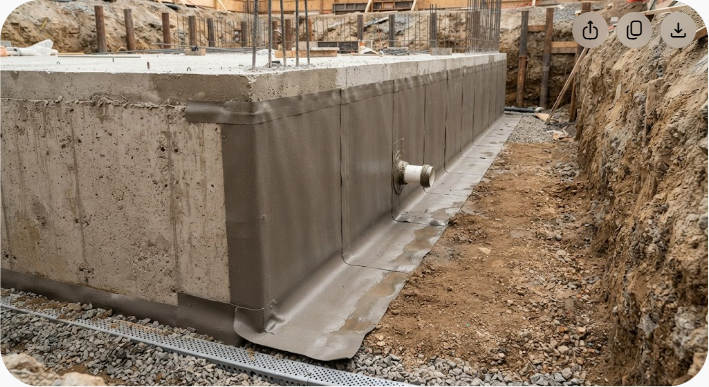
Bentonite can be an effective waterproofing material for concrete, but it doesn't work simply because clay is present in or around the concrete. Its main value comes from the swelling behavior of sodium bentonite. When the clay contacts water and is properly confined, it hydrates, expands, and forms a dense, low-permeability barrier that can restrict water movement.
That makes bentonite particularly useful for below-grade construction, including foundation walls, basement slabs, elevator pits, pile caps, footings, grade beams, tunnels, and other buried concrete structures. UFGS 07 17 00, the U.S. Department of Defense specification for bentonite waterproofing, addresses several of these below-grade applications.
The important qualification is that bentonite is a system, not a magic additive. Its performance depends on confinement, substrate preparation, membrane continuity, joint and penetration detailing, groundwater conditions, protection during construction, and correct backfilling. A well-selected bentonite system can provide dependable water control; a poorly detailed one can still leak.
Bentonite waterproofing is a water-control system that uses bentonite clay, commonly sodium bentonite, as its active mineral component. Depending on the application, the clay may be incorporated into a manufactured membrane, panel, granular product, mastic, waterstop, or another proprietary waterproofing assembly.
The mechanism is relatively simple. Sodium bentonite takes up water and expands. When that swelling occurs inside a confined system, the hydrated clay becomes dense and restricts the movement of water through the layer. If a small void or discontinuity exists within the confined bentonite, swelling can help fill that space.
This is different from a conventional liquid-applied coating. A coating typically works by forming a continuous cured film over the substrate. Bentonite depends on hydration, swelling, and physical confinement.
That difference affects how the material should be installed. A bentonite membrane that is left exposed to rain before it is properly positioned can hydrate prematurely. A membrane that is punctured during construction can lose continuity. A pipe penetration or construction joint that is poorly detailed can become a leakage path even when the main wall area is installed correctly.
UFGS 07 17 00 addresses continuous membrane installation, lap treatment, penetrations, joints, openings, and protection from premature wetting. These details illustrate a broader principle: the quality of the waterproofing assembly matters as much as the swelling capacity of the clay itself.
The waterproofing mechanism begins with the structure of the clay mineral.
Bentonite commonly contains a high proportion of montmorillonite, a layered clay mineral that can take up water between its microscopic layers. Sodium bentonite is widely used in sealing applications because it can develop substantial swelling when hydrated.
When water reaches a properly confined bentonite layer, the process can be understood in four stages:
The fourth point is important, but so is the word "confined." Bentonite isn't at its best as a loose pile of clay sitting in unrestricted flowing water. The surrounding construction must hold the swelling material in its intended location.
This is why bentonite waterproofing products are normally incorporated into a designed assembly. Depending on the product, confinement may come from adjacent soil, concrete, a manufactured membrane structure, a compatible protection layer, or another part of the construction system.
Bentonite isn't one uniform material. Different bentonite deposits and mineral chemistries can produce different swelling and sealing behavior.
Sodium bentonite is commonly selected for waterproofing because of its strong hydration and swelling characteristics. Calcium bentonite also absorbs water, but its swelling behavior is generally different. When swelling and low permeability are central to the waterproofing design, the clay's chemistry and performance need to match the requirements of the finished system.
For industrial buyers, this means a generic purchase specification such as "bentonite clay" is rarely enough. The supplier should be able to identify the material type and provide relevant information on swelling performance, moisture, particle size, mineral quality, and consistency.
The finished waterproofing product should then be evaluated against its own performance requirements. Raw bentonite quality is important, but the final membrane, panel, mastic, or waterstop is what the structure ultimately depends on.
Bentonite waterproofing is most closely associated with below-grade construction, where concrete may be exposed to persistent soil moisture, groundwater, or hydrostatic pressure.
Typical applications include:
UFGS 07 17 00 specifically identifies applications including below-grade concrete walls, wall footings, slabs, pile caps, grade beams, elevator pits, and bulkhead walls.
The application alone doesn't determine whether bentonite is suitable. The design team also needs to consider water pressure, construction sequence, movement, groundwater chemistry, drainage, access, and how the waterproofing will be protected after installation.
Foundation walls are one of the most familiar uses for bentonite waterproofing. Soil around a basement or buried structure can remain wet for extended periods, and groundwater may create pressure against the exterior wall.
A properly installed bentonite membrane can form the external water-control layer before moisture reaches the concrete surface. In many systems, the surrounding soil provides part of the confinement once backfilling is complete.
The large wall area is usually straightforward. The difficult parts are the details: inside and outside corners, laps, terminations, penetrations, joints, footing transitions, and changes between horizontal and vertical surfaces.
A good installation plan therefore treats those details as part of the waterproofing design from the beginning rather than as site fixes after the main membrane has been installed.
Bentonite systems can also be installed beneath concrete slabs to control water moving upward from the ground.
This application requires coordination between the waterproofing layer, prepared subgrade, drainage system, slab reinforcement, penetrations, joints, and concrete placement sequence. The membrane needs to remain in the correct position while subsequent work takes place.
Water can also find routes around the edge of a slab or through service penetrations. A membrane beneath the main slab area cannot compensate for missing details at those locations.
Elevator pits sit below finished floor level and can be difficult to access after the building becomes operational. Water intrusion can create maintenance problems and interfere with equipment spaces.
For this reason, bentonite systems are sometimes specified for elevator pits and similar below-grade structures. UFGS 07 17 00 explicitly includes elevator pits among its bentonite waterproofing applications.
The design still needs to address joints, penetrations, corners, water pressure, and the construction sequence. The fact that a product is suitable for below-grade use doesn't remove the need for project-specific detailing.
Pile caps and grade beams introduce changes in geometry that can make continuous waterproofing more complicated. The waterproofing system must follow those changes without leaving gaps or weak transitions.
Bentonite membranes can be used in these areas when the selected system provides appropriate detailing. Penetrations, corners, interfaces with other structural elements, and transitions between different planes deserve particular attention.
Tunnels and other underground structures can remain in contact with surrounding soil and groundwater for long periods. Bentonite-based systems may form one part of a larger waterproofing strategy in these environments.
The design becomes more demanding as groundwater pressure, structural movement, construction access, chemical exposure, and long-term inspection or repair requirements increase. In those conditions, the waterproofing system should be selected as part of the overall underground structure design rather than as an isolated material choice.
"Bentonite waterproofing" can refer to several product formats, and those formats don't have identical roles. The right choice depends on where the material is being used and how the system will be confined.
| Bentonite format | Typical role | Main advantage | Important limitation |
|---|---|---|---|
| Bentonite membrane | Below-grade walls and slabs | Factory-manufactured, controlled waterproofing layer | Requires correct installation and protection |
| Bentonite panels | Walls, slabs, and specialized assemblies | Defined product configuration and straightforward handling | Fastening and joint treatment must follow the system design |
| Granular bentonite | Local detailing and void treatment | Flexible for irregular areas | Needs proper placement and confinement |
| Bentonite mastic | Penetrations, corners, and transitions | Useful for detailed areas | Not normally a substitute for the main waterproofing layer |
| Bentonite-containing waterstop | Concrete joints | Provides localized joint sealing | Must match joint movement and exposure requirements |
Product construction varies by manufacturer. A granular bentonite product, membrane, mastic, and waterstop shouldn't be mixed together simply because they contain the same mineral. Compatibility, swelling behavior, confinement, and installation requirements all need to be confirmed.
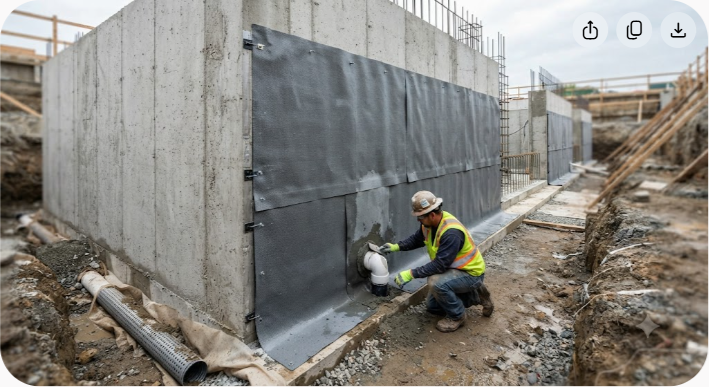
The most useful way to understand bentonite is to look at the construction problems it can address. It isn't simply a generic material for making concrete "waterproof."
External foundation walls are a strong application because the bentonite layer can be confined by the surrounding construction after installation. The waterproofing becomes part of the external water-control assembly.
The system should be continuous across the wall and properly connected at corners, footings, penetrations, joints, and terminations. These areas deserve as much attention as the main field membrane.
An underslab bentonite system can help control water entering from the ground beneath a structure. It may be considered where groundwater or persistent soil moisture presents a concern.
The system needs to work with the subgrade, drainage layer, reinforcement, penetrations, slab placement, and perimeter details. If those components aren't coordinated, a strong membrane in the center of the slab may still leave vulnerable paths around its edges.
Construction joints and penetrations interrupt an otherwise continuous waterproofing layer. They therefore require specific treatment.
Depending on the system, details may incorporate bentonite mastic, granular bentonite, a bentonite-containing waterstop, or a proprietary joint assembly. The selected detail should account for the type of joint, expected movement, water pressure, and surrounding materials.
Concrete joints commonly require sealing against the passage of liquids or other unwanted substances. ACI guidance on joints also emphasizes the need to match joint treatments to service conditions and movement.
A waterproofing membrane can be installed perfectly over a large wall area and still leak around one poorly detailed pipe sleeve.
That's why penetrations should be identified before installation and treated according to the waterproofing system's requirements. UFGS 07 17 00, for example, calls for through-wall openings and penetrations to receive appropriate bentonite mastic, granular bentonite, or both before membrane placement, as applicable to the specified system.
Transitions between footings, foundation walls, slabs, and other structural elements can create changes in plane and potential discontinuities in the waterproofing layer.
The waterproofing detail must preserve continuity through these changes. Depending on the system, this may involve additional bentonite material, compatible mastic, a waterstop, or another proprietary transition detail.
Bentonite has several properties that make it useful in buried construction, but each benefit comes with conditions that need to be respected.
Sodium bentonite's ability to swell after hydration is central to its sealing behavior. Within a properly confined system, expansion can help fill small voids and maintain a dense clay barrier.
That doesn't mean bentonite automatically seals every concrete crack. Structural cracks, large openings, actively moving joints, and poorly detailed penetrations require their own engineering and repair strategy.
The difference is important. Swelling is a property of the waterproofing material; structural crack repair is a separate engineering problem.
Bentonite systems can tolerate some minor surface variation because the clay layer can hydrate and consolidate rather than relying entirely on a thin rigid film.
The concrete still needs to be prepared properly. Loose material, debris, laitance, sharp projections, large voids, honeycombing, and other defects can interfere with installation or create weak points. UFGS 07 17 00 requires the substrate to be prepared and significant concrete defects to be repaired before membrane installation.
A properly installed bentonite system can become part of the below-grade assembly once it is confined and protected. That makes it particularly relevant to foundations and underground structures where the surrounding construction can support the system's design requirements.
A complete below-grade water-control strategy may include bentonite alongside drainage layers, joint treatments, waterstops, sealants, protection boards, and other compatible materials.
The goal isn't to add as many products as possible. Each component should have a defined purpose, and the components need to work together without creating installation or compatibility problems.
The exact procedure varies by product and project, but a typical installation follows a logical sequence. The manufacturer's installation instructions and project specification should always take precedence over a general guide.
Start by understanding what the structure will actually face.
Consider:
A system intended for ordinary soil moisture isn't automatically suitable for sustained hydrostatic pressure or unusual groundwater chemistry.
The substrate should be clean and suitable for the selected waterproofing system. Remove loose material, dirt, debris, laitance, and contaminants that could interfere with adhesion, fastening, contact, or confinement.
Repair large voids, honeycombing, tie-rod holes, and other defects before installing the membrane. UFGS 07 17 00, for example, specifies repair of concrete defects greater than 6 mm, or 1/4 inch, for the referenced application.
The exact preparation requirements should come from the selected system rather than from a generic bentonite specification.
Don't leave pipe sleeves, drains, joints, corners, and changes in plane until the day of installation.
Identify them on the construction drawings, confirm the required waterproofing details, and make sure the crews understand the sequence before the field membrane is installed.
This planning step is often where preventable leakage problems are avoided.
Install the membrane or panels according to the specified orientation, fastening method, overlaps, end joints, and joint treatment.
As one example, UFGS 07 17 00 specifies minimum 127 mm, or 4 inch, laps for the referenced bentonite membrane application and includes requirements for end-joint staggering and penetration treatment. Those dimensions apply to that specified system and should not be copied automatically into another product specification.
The manufacturer's instructions and project documents control the installation.
Treat pipe penetrations, drains, corners, joints, terminations, and changes in plane with the products and methods specified for the system.
Inspect these details before they are covered. Once the membrane is buried behind backfill or concrete, finding a small installation defect becomes considerably more difficult.
Construction traffic, sharp objects, equipment movement, and premature exposure to water can damage bentonite membranes and panels.
Protection is particularly important when there is a delay between membrane installation and backfilling. UFGS 07 17 00 requires damaged areas to be repaired before backfill and includes measures for protecting exposed material from precipitation when backfill is delayed.
Backfilling is part of the waterproofing sequence, not simply the final step in excavation work.
For systems that depend on confinement, the surrounding construction helps keep the bentonite where it needs to be. Backfill should therefore be compatible with the waterproofing system and placed using the specified method so the membrane isn't punctured, displaced, or otherwise damaged.
Bentonite offers several practical benefits for suitable below-grade projects.
Water-reactive swelling: Sodium bentonite responds to water by swelling, which is central to its sealing behavior.
Low-permeability hydrated clay: When properly hydrated and confined, bentonite can form a dense barrier with very low hydraulic conductivity.
Suitable for buried structures: Bentonite systems fit naturally into foundation and underground construction where the surrounding assembly can provide the required confinement.
Mineral-based active material: Bentonite is a naturally occurring clay. The complete waterproofing product, however, may also contain membranes, fabrics, adhesives, polymers, or other components.
Flexible product formats: Membranes, panels, granular bentonite, mastics, and bentonite-containing waterstops can address different parts of a waterproofing assembly.
Integration with construction sequencing: In appropriate projects, bentonite waterproofing can be installed before final backfill and incorporated into the external foundation assembly.
These advantages don't eliminate the need for engineering. They simply explain why bentonite has a useful role in the right below-grade applications.
A sound specification should identify limitations before installation begins.
Loose bentonite exposed to unrestricted flowing water isn't equivalent to a properly installed membrane. The clay must remain in the intended location so swelling produces the designed sealing layer rather than allowing hydrated material to disperse.
If bentonite becomes wet before it is properly positioned and confined, it can swell prematurely. That can make handling, fastening, joint formation, and placement more difficult.
Protecting the material from rain and other unintended water exposure during installation is therefore important. UFGS 07 17 00 includes provisions addressing premature wetting and protection.
Membranes and panels can be punctured, displaced, torn, or otherwise damaged before they are covered. Heavy equipment, sharp aggregate, tools, and careless backfilling are common sources of construction damage.
The installed system should be inspected before it is concealed, and any damage should be repaired using the manufacturer's approved method.
Bentonite does not respond identically to every type of water. Dissolved salts and other ions can alter clay hydration, swelling, dispersion, and stability.
FHWA guidance concerning bentonite slurry, for example, notes that saline water can cause flocculation and reduce suspension stability. Waterproofing systems are formulated differently from drilling or excavation slurries, so that information should not be treated as a direct prediction of membrane performance. It does, however, reinforce the need to evaluate unusual groundwater chemistry rather than assuming that all water exposure is equivalent.
A material that can seal a relatively static gap isn't automatically suitable for a joint that opens, closes, shears, or moves repeatedly.
ACI guidance on concrete joint sealants recognizes that joints may experience repeated movement as well as moisture, temperature, sunlight, and chemical exposure. Movement joints therefore need a waterproofing detail designed around the expected movement.
Bentonite-containing waterstops may be appropriate for certain joints, but the selected product must be compatible with the joint's movement and service conditions.
No single waterproofing approach fits every concrete structure. Bentonite should be compared with alternatives according to location, water exposure, movement, construction sequence, access, protection requirements, and repair strategy.
| Waterproofing approach | Typical location | Main mechanism | Key consideration |
|---|---|---|---|
| Bentonite membrane | Below-grade concrete | Swelling clay barrier | Needs appropriate confinement and protection |
| Cementitious waterproofing | Concrete surfaces | Cement-based barrier or pore treatment | Surface preparation and moisture conditions matter |
| Crystalline waterproofing | Concrete surfaces or integral systems | Formation of insoluble crystalline products within suitable concrete pores | Product chemistry and concrete conditions matter |
| Sheet membrane | Foundations and below-grade walls | Continuous physical barrier | Seams, penetrations, and construction damage require careful control |
| Liquid-applied membrane | Walls, slabs, and transitions | Cured waterproof film | Applied thickness and substrate preparation must be controlled |
| Joint sealant or waterstop | Concrete joints | Localized joint sealing | Product must suit joint movement and exposure |
ACI guidance on concrete protective treatments covers several approaches, including crystalline technology, and emphasizes selecting treatments according to the conditions affecting the concrete and the intended protection.
The practical lesson is simple: choose the waterproofing strategy based on the building and its exposure, not because one material sounds inherently better than another.
Using bentonite in a waterproofing system is not the same as adding bentonite powder to ordinary structural concrete.
Research has examined bentonite-modified concrete, but those mixes should not be confused with dedicated bentonite waterproofing membranes. A 2026 study indexed by the American Concrete Institute investigated bentonite modification and reported changes in hydration, porosity, toughness, and strength, including strength reductions under the tested conditions.
That is one reason a contractor shouldn't simply add bentonite to a concrete mix and assume the finished concrete has become waterproof.
Structural concrete has its own requirements for strength, workability, durability, shrinkage, air content, and other performance characteristics. Adding a clay material can affect those properties. If bentonite is being evaluated as part of a concrete mix, the formulation needs controlled laboratory testing and appropriate engineering review.
For conventional bentonite waterproofing applications, the more established approach is a dedicated bentonite-based membrane, panel, mastic, waterstop, or other engineered waterproofing product installed as part of the complete system.
Waterproofing failures often have less to do with the clay itself than with how the system was specified, detailed, protected, or installed.
Bentonite can swell into small voids under suitable conditions, but that doesn't make it a substitute for structural crack repair or movement-joint design.
First determine why the crack exists and whether it is active. Then select the appropriate structural repair and waterproofing detail.
A system exposed to ordinary soil moisture isn't necessarily equivalent to one exposed to saline groundwater or chemically aggressive water.
If unusual groundwater chemistry is expected, obtain representative water data and confirm compatibility with the selected waterproofing system before installation.
Premature hydration can make bentonite difficult to handle and install correctly. Keep the material protected until the installation sequence places it in the intended confined environment.
A large membrane area can be installed correctly while one poorly detailed pipe penetration creates a leakage path.
Penetrations, drains, joints, corners, and transitions should receive the same planning attention as the main membrane.
Sharp rocks, equipment movement, careless compaction, and construction debris can puncture or displace waterproofing.
Inspect the system before covering it and follow the selected manufacturer's requirements for protection and backfilling.
A lower purchase price doesn't help if the material fails to provide the required swelling behavior, moisture range, particle-size distribution, mineral quality, or consistency.
For bulk procurement, request a technical data sheet and certificate of analysis appropriate to the intended application. Compare materials against the finished product's actual specification rather than against price alone.
If you're purchasing bentonite for a waterproofing-related application, start with the performance requirements of the finished product rather than a generic description such as "high-quality bentonite."
Useful questions for a supplier include:
For manufacturers producing bentonite waterproofing products, consistency is particularly important. The finished product controls the final waterproofing performance, but reliable raw material quality makes formulation and process control much more predictable.
A supplier should therefore be evaluated on more than a single swelling number. Documentation, batch consistency, moisture control, particle size, packaging, logistics, and technical support can all affect manufacturing reliability.
Before approving a bentonite waterproofing system, review the following with the design and construction teams:
That last point matters. Waterproofing and drainage solve related but different problems. Waterproofing limits water entry, while drainage can reduce the amount of water and pressure acting against the structure. A well-planned below-grade assembly considers both.
Bentonite waterproofing can be used in below-grade systems exposed to hydrostatic pressure, but its suitability depends on the complete assembly and the product's specified performance.
The important question isn't simply whether bentonite swells. The design team needs to determine whether the installed system can remain continuous, confined, protected, and properly detailed under the project's expected water exposure.
For structures that may remain below the water table, select a waterproofing system specifically intended for long-term water exposure and the expected water head. Building guidance distinguishes ordinary below-grade moisture control from conditions where specialized waterproofing is needed for sustained water-table exposure.
Drainage should also be considered. Reducing water pressure around the structure can complement the waterproofing system, but drainage doesn't replace a properly designed waterproof barrier where the project requires one.
No. Bentonite is generally most suitable where the construction geometry and surrounding conditions allow the material to remain correctly positioned and confined.
Another waterproofing approach may be more appropriate when:
The useful question isn't simply, "Is bentonite waterproof?" It is, "Is this bentonite system suitable for this structure, exposure, and construction sequence?"
Three practical habits can prevent many avoidable problems.
First, design the details before the membrane arrives. Joints, penetrations, corners, terminations, and transitions should already have approved details and a clear installation sequence.
Second, protect the waterproofing as carefully as you protect the concrete. A membrane that is punctured during subsequent construction cannot perform as designed, regardless of how well the undamaged areas were installed.
Third, manufacturers should buy consistent raw bentonite when producing their own waterproofing products. Swelling performance, moisture, particle size, mineral quality, and batch consistency all influence manufacturing control.
For bulk industrial buyers, supplier capability matters at this stage. A technically suitable bentonite grade is useful only when its quality can be maintained across the volumes and deliveries required by the production schedule.
Axewelledge supplies industrial bentonite for applications where swelling, absorption, binding, and sealing properties are important. For a waterproofing manufacturer, the appropriate grade should be selected against the final product specification and validated through the manufacturer's formulation and quality-control process.
Bentonite is useful for concrete waterproofing because water activates its swelling behavior. When sodium bentonite is incorporated into a properly designed and confined system, the hydrated clay can form a low-permeability barrier for foundations, below-grade walls, slabs, elevator pits, pile caps, grade beams, tunnels, and other buried concrete structures.
Its performance depends on much more than swelling capacity. Groundwater conditions, confinement, substrate preparation, membrane continuity, joints, penetrations, backfill, drainage, and construction protection all influence the result.
For project teams, the practical approach is to select the complete waterproofing system first and then verify that the bentonite product meets the required performance. For manufacturers, consistent sodium bentonite quality provides an important foundation for producing reliable waterproofing products.
If you're sourcing bentonite for a construction waterproofing product, define the required bentonite type, swelling specification, particle size, moisture range, packaging, quality documentation, and expected volume before comparing suppliers. The right material should be matched to the finished application rather than selected from a generic bentonite specification.













Have questions about our products? We're here to help!