Axewelledge, a leading exporter from India, specializes in high-quality Bentonite. With a commitment to excellence, we supply premium Bentonite to the Middle East and Southeast Asia markets.


North Angle Complex, 304,
150 Feet Ring Rd, Opposite Ambedkar Nagar BRTS Stop,
Madhav Park, Punit Nagar,
Mavdi, Rajkot, Gujarat 360004
© Axewelledge 2026, All Rights Reserved.
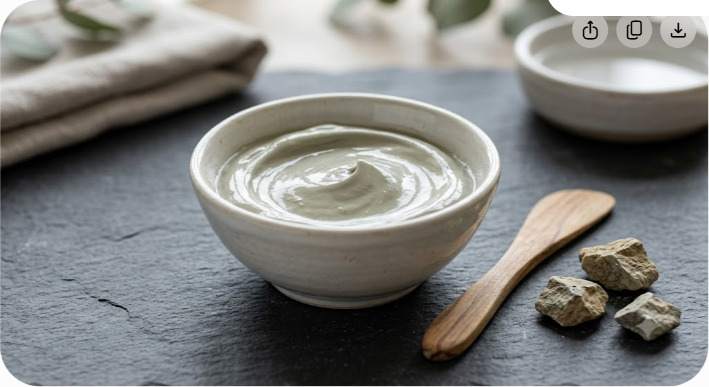
Bentonite for cosmetics is mainly valued for one practical property: its fine mineral particles can absorb oil, bind water, and change the texture and rheology of a skincare formula. That makes bentonite useful in rinse-off masks, cleansing products, and other formulations designed for oily or combination skin.
It is also important to separate what bentonite can realistically do from common clay-mask marketing claims. Bentonite doesn't literally pull toxins out of living skin, permanently shrink pores, or detoxify the body. Its benefits are mostly physical and formulation-driven: it can absorb some surface oil, hold water, provide a soft mineral feel, and contribute to a mask that dries and rinses cleanly.
For cosmetic formulators, the details matter. Bentonite varies by mineral composition, source, processing, particle size, purity, swelling behavior, and cation exchange capacity. Sodium-rich and calcium-rich bentonites can behave very differently in water, and a raw industrial clay isn't automatically suitable for topical use.
This guide explains how bentonite works in cosmetics, which benefits are realistic, how to formulate with it, how to choose between sodium and calcium bentonite, and what manufacturers should check before buying a cosmetic-grade material.
Bentonite is a naturally occurring clay material formed largely from volcanic ash that has undergone geological alteration. Its most important clay mineral is usually montmorillonite, a member of the smectite group.
Montmorillonite has a layered structure. Small substitutions within those layers create a net negative charge on the clay surface. Exchangeable cations, such as sodium, calcium, magnesium, and potassium, occupy spaces between the layers and help balance that charge.
That structure explains several properties that matter in cosmetics:
The exact performance depends on the grade. Two materials both sold as bentonite may have noticeably different swelling, viscosity, color, particle size, and absorption behavior.
A bentonite face mask works primarily at the skin surface rather than by extracting material from deep inside pores. When the hydrated clay is spread over the skin, its fine particles form a water-rich layer. As the mask loses water, the structure becomes more concentrated and eventually dries.
Several things happen during application and removal:
The result can be a cleaner, less oily skin surface. The effect is temporary, and it doesn't mean the clay has physically emptied every pore.
These terms are often used interchangeably in skincare marketing, but they describe different processes.
Adsorption occurs when a substance accumulates on the surface of another material. Clay minerals have extensive surface area, so they can adsorb water, ions, and certain organic compounds.
Absorption involves a substance entering the interior of another material. In practical cosmetic discussions, bentonite is often described as absorbing water and swelling, although the underlying behavior is more complicated because water can interact with external surfaces and expand the spaces between clay layers.
For a face mask, the distinction isn't just academic. A supplier's claim about high absorption doesn't automatically tell a formulator how the clay will behave in a finished emulsion or suspension. Swelling index, viscosity, particle-size distribution, moisture content, and cation exchange capacity can all affect performance.
Montmorillonite's negative layer charge is a genuine mineral property, but it shouldn't be translated into the claim that bentonite acts like a magnet that pulls toxins or heavy metals out of living skin.
Cation exchange means that certain positively charged ions can interact with and exchange on clay surfaces. It does not mean that every pollutant, bacterium, toxin, or molecule on the skin carries a positive charge, nor does it demonstrate that a face mask removes contaminants from deep tissue.
For cosmetic communication, a more defensible description is that bentonite provides surface adsorption, oil absorption, water-binding, and rheology-modifying properties that support the cleansing and sensory performance of rinse-off products.
The distinction between calcium and sodium bentonite is important because the dominant exchangeable cation influences hydration and swelling.
| Property | Calcium Bentonite | Sodium Bentonite |
|---|---|---|
| Dominant exchangeable cation | Calcium | Sodium |
| Typical swelling behavior | Lower to moderate | Higher |
| Water demand | Moderate | High |
| Hydrated texture | Often relatively creamy or smooth | Can become highly viscous or gel-like |
| Typical formulation value | Gentle clay masks and mineral blends | Strong swelling and viscosity contribution |
| Common industrial uses | Foundry, absorbents, selected clay products | Drilling fluids, sealing, pelletizing, absorbent applications |
| Cosmetic suitability | Depends on tested cosmetic grade | Depends on tested cosmetic grade and formulation |
These categories are useful, but they aren't absolute. Natural deposits contain mixtures of minerals and exchangeable ions, and commercial grades may be processed or activated to achieve particular performance characteristics.
Not automatically. Calcium-rich bentonite is often easier to formulate into a creamy facial mask because it generally swells less aggressively than highly sodium-rich material. That can make the finished product easier to spread and rinse.
However, the best clay depends on the formulation objective. A formulator may deliberately choose a more swelling bentonite when higher viscosity or stronger water binding is desirable. Another formula may use bentonite alongside kaolin or another clay to balance absorption with skin feel.
Rather than choosing a clay solely by its calcium or sodium label, manufacturers should evaluate the actual specification sheet and test the material in the finished formula.
Sodium bentonite is known for strong swelling in water. That property is valuable in many industrial applications and can also be useful in cosmetics when the formulation calls for substantial water binding or viscosity development.
The challenge is control. A highly swelling clay can change a formula's viscosity dramatically, demand more water than expected, and affect filling, spreading, drying time, and rinseability. Cosmetic-grade sodium bentonite therefore needs to be selected for the intended formulation rather than treated as a universal substitute for calcium bentonite.
Bentonite can contribute several useful functions to a rinse-off facial mask. The strongest claims are the ones tied directly to the material's known physical and mineral properties.
Bentonite can help reduce the feel and appearance of surface oil because its fine mineral particles interact with sebum and other oily material during application and rinsing.
This is particularly useful in masks intended for oily or combination skin. After rinsing, the face may feel cleaner and less greasy. The effect isn't permanent, though. Sebaceous glands continue producing sebum after the mask is removed.
A good formulation also needs to avoid excessive oil removal. A mask that leaves skin tight, rough, or uncomfortable isn't necessarily performing better.
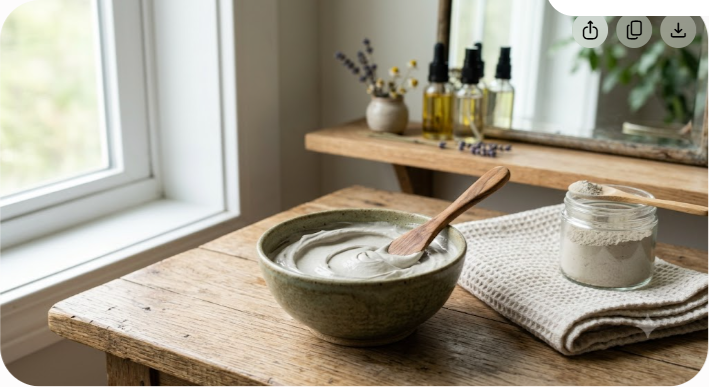
Clay masks can remove accumulated surface material, including some oil, cosmetic residue, and loose debris. Bentonite's fine particle structure contributes to this cleansing effect without requiring a traditional detergent system.
That makes bentonite useful when a formulator wants a mineral-based rinse-off product with a distinctly clean after-feel.
The phrase "deep cleansing" can be used cautiously, but claims that the clay physically vacuums impurities from deep inside pores aren't supported by the basic mechanism of a topical clay mask.
Bentonite isn't only an active-looking ingredient. It can be a functional formulating material.
When properly hydrated, smectite clay can increase viscosity and contribute suspension and body to a mask. This helps a product stay where it is applied rather than immediately sliding off the face.
Its effect depends strongly on concentration, hydration method, electrolyte content, pH, shear, and the other ingredients in the formula. That's why simply copying the percentage used in another clay mask may produce a very different result.
Because bentonite can remove some surface oil, a clay mask may leave skin looking temporarily less shiny. This can be useful in products marketed for oily and combination skin.
The effect should be described as temporary rather than as a permanent change in sebum production. There is also no reliable basis for saying that bentonite permanently tightens or shrinks pores. Pore size is influenced by genetics, skin structure, sebum production, and other factors.
The characteristic drying and tightening sensation is part of why consumers associate clay masks with cleansing. As water evaporates, the concentrated clay layer becomes less flexible and can contract.
That sensation doesn't prove that impurities are being pulled from the skin. It mainly reflects changes in the physical state of the mask as moisture leaves it.
A well-designed product should therefore balance the desired clay-mask sensation with comfortable rinseability. Excessive drying can leave skin feeling tight and dehydrated.
Bentonite's cation exchange capacity is an important mineral property. Positively charged ions can interact with the negatively charged clay surfaces, and exchangeable ions can move between the clay and surrounding liquid.
This property is valuable in industrial and technical applications and contributes to bentonite's behavior in cosmetic formulations. It should not, however, be turned into a blanket claim that the clay removes heavy metals or toxins from the human body.
For skincare copy, phrases such as "helps adsorb surface impurities" or "supports oil-absorbing cleansing" are more technically defensible than claims about detoxifying tissue.
A clay mask can temporarily leave skin feeling smoother because it removes some surface oil and loose material. The rinse-off process also removes the dried clay film, leaving a clean surface.
If a formula contains coarse particles, however, rubbing the mask aggressively during removal can irritate skin. Bentonite itself doesn't need to be used as a physical scrub. For facial products, a smooth suspension is generally preferable to a gritty one.
Bentonite can make sense in a rinse-off mask for oily or acne-prone skin because it can absorb surface oil and provide a cleansing effect. That doesn't make it an acne treatment in the medical sense.
Acne involves follicular plugging, sebum production, inflammation, and microbial factors. A clay mask may temporarily reduce oiliness, but it doesn't address every part of that process.
It's also inaccurate to describe early blemishes after a clay mask as proof of "purging." Purging is generally associated with ingredients that increase skin-cell turnover, such as certain retinoids and exfoliating acids. Bentonite doesn't work that way. If a new clay product consistently causes pimples, irritation, or itching, the better assumption is that the product or another ingredient may not be suitable for the skin.
Sensitive skin requires a more conservative approach. Bentonite isn't inherently irritating for everyone, but a clay mask can become uncomfortable when it removes too much surface oil, dries completely, contains a highly acidic or alkaline liquid, or includes irritating fragrance or essential oils.
For sensitive skin, consider a lower clay concentration, a shorter contact time, and a formula designed to rinse easily. Avoid treating tightness or burning as evidence that the product is working.
A patch test is sensible when trying a new formulation, especially if it contains several unfamiliar ingredients.
pH is one of the areas where DIY clay-mask advice often becomes misleading.
Bentonite doesn't have one universal pH value. The measured pH of a clay slurry depends on the clay's mineral composition, source, processing, concentration, water quality, and test method. A powder's specification may therefore report a different value from a finished cosmetic suspension.
Skin is generally mildly acidic, but that doesn't mean every clay mask must automatically be adjusted to exactly the same pH as skin. The finished formula, preservative system, other ingredients, intended contact time, and product type all matter.
For commercial products, pH should be measured in the finished formula, not inferred from the raw clay's reputation or from a recipe found online.
There is no general formulation rule requiring apple cider vinegar in a bentonite face mask. In fact, applying an unstandardized vinegar mixture to facial skin can introduce unnecessary irritation because vinegar is acidic and its exact composition varies.
The common recommendation to mix equal parts bentonite and apple cider vinegar and assume that the result will reach a skin-friendly pH is not scientifically reliable. The final pH depends on the clay, vinegar, water content, ratio, and buffering capacity of the mixture.
If pH matters, measure it with a suitable calibrated pH meter. Don't estimate it from ingredient ratios.
For a simple DIY mask, plain water is a more predictable starting liquid. For a commercial product, use a properly designed aqueous phase and adjust pH with a validated system when required.
For a single-use mask, the simplest formulation is often the safest starting point: cosmetic-grade bentonite combined with enough clean water to make a smooth, spreadable paste.
Because this is a fresh, water-containing mixture without a validated preservation system, it should be made immediately before use and discarded rather than stored for later applications.
Essential oils aren't necessary for a bentonite mask. Adding them can increase the risk of irritation or sensitization, particularly on facial skin.
If fragrance is important in a commercial product, it should be selected and dosed according to the applicable cosmetic safety requirements and assessed as part of the complete formulation.
Commercial products require much more control than a single-use DIY paste. A stable clay mask needs to remain homogeneous, preserve its texture, resist microbial growth, fill consistently, and remain acceptable throughout its intended shelf life.
A typical development process looks like this:
The following is a development framework rather than a production-ready formula. Exact percentages need to be established through laboratory testing and adjusted to the selected raw materials.
| Phase | Typical materials | Primary purpose | Development considerations |
|---|---|---|---|
| Aqueous phase | Purified water, humectant | Carrier and moisture retention | Water quality and preservation matter |
| Clay phase | Bentonite, optional kaolin | Oil absorption, body, texture | Grade and concentration strongly affect viscosity |
| Rheology phase | Suitable gum or polymer | Texture and suspension | Check compatibility with clay and electrolytes |
| Emollient phase | Appropriate cosmetic emollients | Skin feel | Balance richness against rinseability |
| Active phase | Selected cosmetic actives | Product-specific claims | Confirm stability and compatibility |
| Preservation phase | Validated preservative system | Microbial protection | Confirm efficacy in the complete formula |
| pH adjustment | Suitable acid or base | Final pH control | Measure the finished product |
Bentonite should be hydrated according to the supplier's technical guidance. There is no universal rule that every bentonite must be heated to a particular temperature for a fixed number of minutes.
Some grades develop their desired viscosity efficiently with controlled room-temperature hydration, while others may benefit from a specific processing sequence. Excessive heat can also be undesirable when the formula contains heat-sensitive ingredients.
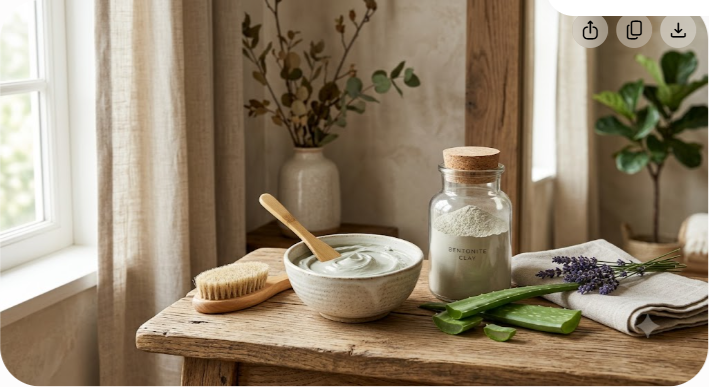
A useful development test is to compare the same clay at different hydration times and mixing conditions. Record viscosity and appearance at fixed intervals. This gives the formulator actual data instead of relying on a generic processing instruction.
A clay mask containing water can support microbial growth even though the dry clay itself has a low water activity. Once hydrated, the finished product needs an appropriate preservation strategy.
Don't assume that a mineral ingredient makes a formula self-preserving. Cosmetic manufacturers should evaluate the complete system through appropriate microbiological testing and, where applicable, preservative efficacy testing.
The preservative must also remain effective in the presence of clay, gums, surfactants, botanical extracts, salts, and other ingredients. Bentonite can interact with formulation components, so preservation needs to be evaluated in the finished product rather than selected from a list of commonly used preservatives.
Industrial bentonite can be excellent for its intended application and still be unsuitable for cosmetics. Industrial grades may have different particle sizes, purity specifications, microbiological controls, mineral impurities, or heavy-metal limits.
For facial products, use a raw material supplied with documentation appropriate to cosmetic use and verify the specification against the requirements of the target market.
Increasing clay concentration can increase absorption and viscosity, but it can also make a mask harder to spread, harder to rinse, more drying, or less pleasant to use.
The goal is not maximum clay loading. It's the best balance between performance, texture, stability, and skin tolerance.
Bentonite doesn't behave in isolation. Salts and other charged ingredients can alter swelling and viscosity. Polymers may also interact with clay particles, sometimes producing unexpected thickening or thinning.
This is why a raw-material specification cannot predict every finished-product behavior. Bench testing is essential.
A recipe that says a certain amount of vinegar, lemon juice, or acid will automatically create a safe pH isn't enough for commercial development.
Measure the finished formula. If the pH changes during stability testing, investigate why rather than simply adjusting it once at the beginning.
A completely dry, cracking mask isn't necessary for oil absorption. Excessive drying can leave the skin feeling tight and uncomfortable.
For consumer instructions, recommend removing the mask when it has dried sufficiently to be removed comfortably rather than instructing users to wait for deep cracking.
Bentonite can create a temporary tightening sensation as a clay mask dries and contracts, and the reduction in surface oil can make pores look less prominent. It doesn't permanently reduce pore diameter.
Pores are anatomical structures associated with hair follicles and sebaceous glands. Their visible appearance varies with skin type, sebum production, age, and other factors.
A cosmetic claim such as "temporarily minimizes the appearance of pores" is therefore more defensible than "shrinks pores permanently."
Bentonite isn't automatically the best clay for every skin type or product. Formulators often combine different clays to achieve a particular balance of absorption, texture, color, and sensory performance.
| Clay | General characteristics | Common cosmetic use |
|---|---|---|
| Bentonite | Strong swelling and water interaction; useful oil absorption | Purifying and oil-control masks |
| Kaolin | Generally mild, low-swelling clay with smooth feel | Gentle masks and sensitive-skin products |
| Rhassoul | Mineral-rich clay with distinctive texture and color | Masks, cleansers, and hair products |
| Illite/French green clay | Often more absorbent than kaolin; composition varies | Combination and oily-skin masks |
These are broad formulation categories, not guarantees. The performance of any clay depends on its geological source, processing, particle size, and specification.
Kaolin is generally less swelling and less rheologically demanding than bentonite. It can therefore be useful when a formulator wants a gentler-feeling clay mask or a smoother, less viscous system.
Bentonite may contribute more structure and stronger water interaction. A blend of bentonite and kaolin can be useful when neither property alone gives the desired product feel.
Rhassoul, also called ghassoul, is a clay traditionally associated with deposits in Morocco. Its mineral composition differs from bentonite, and it produces a distinctive sensory profile in masks and hair products.
The choice comes down to the finished formula. There is no scientifically meaningful universal ranking in which one clay is always "strongest" or "best."
For a skincare manufacturer, supplier qualification is just as important as the formulation itself.
A useful specification review should cover:
A facial mask should feel smooth rather than gritty. Coarse particles can create an unpleasant sensory experience and may encourage users to scrub aggressively during removal.
Mesh numbers can be useful for describing processing, but they don't tell the whole story. A supplier should be able to provide a particle-size distribution using an appropriate analytical method.
Cation exchange capacity is commonly expressed in milliequivalents per 100 grams. It describes how much exchangeable cation capacity a material has under the conditions of the chosen test method.
High CEC can indicate substantial smectite content, but it shouldn't be presented as a direct measurement of how well a face mask will remove sebum. Finished-product testing remains necessary.
Procurement teams should avoid choosing a supplier solely on price or a broad claim such as "premium bentonite." The useful question is whether the material has a controlled specification and performs consistently in the intended formula.
For large-volume purchasing, request representative samples from multiple lots and compare them under identical laboratory conditions. Measure hydration behavior, viscosity contribution, color, odor, particle size, and finished-mask performance.
If a supplier also provides technical support, ask for guidance on recommended dispersion order, hydration conditions, storage, and compatibility with common cosmetic ingredients.
Companies such as Axewelledge may be considered as potential mineral suppliers, but buyers should independently verify current product specifications, cosmetic suitability, certifications, documentation, and regulatory support for the target market before qualification. Supplier size or stated mineral reserves should not be treated as a substitute for raw-material testing.
There is no scientifically established frequency that applies to every person. Use should depend on the formulation, contact time, skin type, and how the skin responds.
A practical starting point is once a week or less, especially for a strong clay mask. People with oily skin may tolerate more frequent use, while dry or sensitive skin may need longer intervals.
If the mask leaves persistent tightness, flaking, burning, or redness, reduce frequency or stop using it. More frequent application isn't necessarily more effective.
The skin barrier contains lipids and structural components that help limit water loss and protect against external stressors. A clay mask can temporarily make skin feel dry because it removes surface oil and because water evaporates from the mask during application.
That doesn't mean bentonite inherently damages the skin barrier. The risk depends on the complete product and how it is used.
A well-designed mask can reduce unnecessary drying by controlling clay concentration, contact time, pH, humectants, emollients, and other formulation variables. Consumer instructions should also discourage prolonged drying and aggressive scrubbing.
Before using or launching a bentonite face mask, keep these points in mind:
Bentonite is a useful cosmetic clay because its mineral structure gives it strong water interaction, cation exchange capacity, surface area, and rheological functionality. In facial masks, those properties can support oil absorption, cleansing, texture, and a temporary matte or tightened appearance.
The strongest formulation decisions are based on the actual raw material rather than generic claims about "detoxification" or "drawing toxins." Sodium-rich and calcium-rich bentonites behave differently, and neither should be selected without considering the finished product.
For DIY users, a simple fresh mixture of cosmetic-grade bentonite and clean water is more predictable than an unmeasured vinegar recipe. For commercial formulators, the process is more demanding: qualify the raw material, control hydration and dispersion, measure finished-product pH, establish preservation, and test stability.
Used thoughtfully, bentonite can be a valuable ingredient in rinse-off skincare. Its real strengths are already useful enough without overstating what the mineral can do.













Have questions about our products? We're here to help!