Axewelledge, a leading exporter from India, specializes in high-quality Bentonite. With a commitment to excellence, we supply premium Bentonite to the Middle East and Southeast Asia markets.


North Angle Complex, 304,
150 Feet Ring Rd, Opposite Ambedkar Nagar BRTS Stop,
Madhav Park, Punit Nagar,
Mavdi, Rajkot, Gujarat 360004
© Axewelledge 2026, All Rights Reserved.
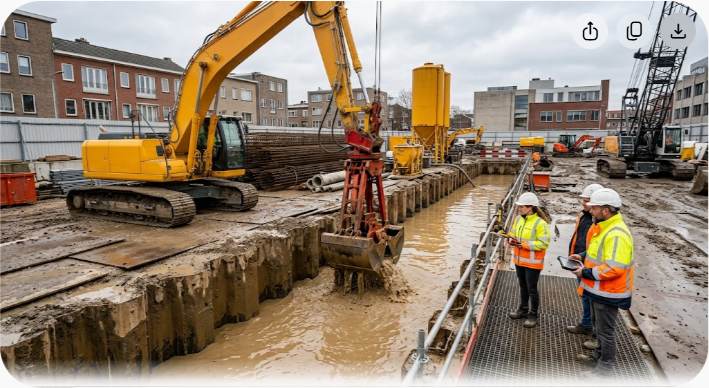
Sodium bentonite slurry is used in diaphragm wall construction because it can stabilize a deep, narrow excavation while allowing the trench to remain workable until reinforcement and concrete are placed. Its value comes from several properties working together: hydrostatic pressure, low fluid loss, filter-cake formation, particle suspension, and controlled rheology.
A diaphragm wall trench may extend tens of metres below ground and pass through loose sand, silt, gravel, clay, groundwater, or mixed strata. Excavating such a trench without temporary support can lead to sidewall instability, excessive ground movement, slurry loss, or soil entering the excavation. Bentonite slurry provides temporary support while the permanent reinforced-concrete wall is constructed.
The important point is that bentonite isn't simply added to make the excavation fluid thicker. A properly designed slurry has to develop the right density, viscosity, gel strength, filtration behaviour, and sand content for the ground conditions and construction method. Those properties must also remain within the project specification as excavation progresses.
This guide explains how bentonite for diaphragm wall construction works, the seven main benefits it provides, how slurry is mixed and maintained, which tests matter on site, how bentonite compares with polymer slurry, and what common mistakes can undermine trench stability or concrete quality.
A diaphragm wall is a continuous reinforced-concrete wall constructed in a narrow trench below ground. It is usually built in panels, with each panel excavated, supported temporarily with slurry, reinforced, and concreted before the next section is constructed.
Diaphragm walls are common on projects where excavation depth, groundwater, limited site space, or neighbouring structures make conventional open-cut retaining systems difficult to use. Typical applications include:
The permanent concrete wall performs the structural role. During excavation, however, the trench needs temporary support. This is where bentonite slurry becomes important.
A slurry-supported trench isn't kept open by the clay alone. Stability results from the interaction of slurry pressure, the filter cake at the excavation face, the soil profile, groundwater conditions, trench geometry, and excavation practices. Good slurry management is therefore part of the overall geotechnical control system rather than a standalone material choice.
The short answer is that hydrated sodium bentonite can create a stable suspension that exerts hydrostatic pressure and forms a low-permeability filter cake against the exposed soil. Together, these effects reduce fluid loss and help prevent the trench walls from collapsing during excavation.
When sodium bentonite is dispersed in water, its montmorillonite-rich clay particles hydrate and develop a network that gives the slurry useful rheological properties. The slurry can flow while it is being pumped or disturbed, yet develop gel strength when it is left relatively undisturbed.
The slurry also interacts with the soil at the trench wall. Under pressure, some water filters into the surrounding formation while bentonite particles accumulate at the soil interface. The resulting filter cake reduces further filtrate loss and helps maintain the hydraulic conditions needed for trench stability.
This is why the performance of bentonite slurry depends on more than swelling capacity alone. A construction-grade product must hydrate reliably, produce suitable rheology, control filtration, and remain manageable during circulation and concrete placement.
Bentonite is a clay dominated by the mineral group smectite, particularly montmorillonite. Its ability to absorb water and develop swelling and rheological properties makes it useful in several construction applications.
For diaphragm wall work, sodium-dominant bentonite is commonly selected because it generally develops greater swelling and dispersion in fresh water than calcium-dominant bentonite. The exact performance depends on mineralogy, processing, water chemistry, concentration, temperature, and the surrounding ground conditions.
When bentonite powder is properly dispersed in water, individual clay particles become hydrated. Their interaction creates a structured suspension. At suitable concentrations, this suspension can develop enough viscosity and gel strength to keep excavated fines suspended and enough filtration control to form a relatively low-permeability cake against the trench wall.
That balance is critical. A slurry that is too thin may not provide sufficient support or particle suspension. A slurry that is unnecessarily thick can increase pumping resistance, complicate desanding, and make concrete displacement more difficult.
Thixotropy describes a time-dependent reduction in apparent viscosity or structure under shear, followed by recovery when the shear is removed. In practical construction terms, a well-conditioned bentonite slurry becomes easier to move when it is agitated and develops gel structure while it is allowed to rest.
During excavation, pumps and cutting equipment keep the slurry moving. The fluid therefore remains workable around the excavation tools. When movement decreases, the clay structure can rebuild, helping suspended particles remain in the slurry rather than rapidly settling.
This behaviour is useful, but it shouldn't be treated as a substitute for proper trench design. Bentonite slurry cannot compensate for an unsuitable excavation method, inadequate slurry level, excessive groundwater gradients, poor panel sequencing, or uncontrolled sand contamination.
The following benefits explain why sodium bentonite remains widely used for slurry-supported diaphragm wall excavation.
The first job of the slurry is to help keep the excavation open.
A column of slurry creates hydrostatic pressure against the exposed trench walls. If the slurry level is maintained above the surrounding groundwater level, the hydraulic head can contribute to a positive pressure condition at the trench boundary. The actual stability of the excavation still depends on soil strength, groundwater pressure, trench depth, geometry, and the properties of the slurry.
For this reason, slurry level is monitored continuously during excavation. Loss of slurry level can reduce the available hydraulic support, particularly in permeable ground.
Slurry density also matters. Increasing density can increase hydrostatic pressure, but simply making the slurry heavier isn't a reliable solution. Excessive density may indicate high solids content and can create problems during desanding and concrete displacement.
The practical objective is to maintain the slurry properties specified by the project engineer while keeping the excavation filled and hydraulically stable.
Hydrostatic pressure is only part of the mechanism. The slurry also needs to limit fluid loss into the surrounding soil.
When bentonite slurry contacts a permeable formation, filtrate can initially move into the soil. Bentonite particles are retained at the soil interface and progressively form a filter cake. This cake reduces further filtration and helps maintain the slurry column inside the trench.
A good filter cake is thin, relatively impermeable, and sufficiently strong to support the required hydraulic conditions. Its quality depends on bentonite concentration, particle-size distribution, slurry age, water chemistry, soil permeability, and other factors.
Filter-cake formation is particularly important in sandy or otherwise permeable ground. If the slurry loses water too quickly, the fluid level and pressure inside the trench can change, while the surrounding soil may also experience changes in effective stress.
Excavation produces soil cuttings continuously. Sand, silt, and fine particles enter the slurry as the grab or cutter removes material from the trench.
Without adequate suspension, these solids settle toward the bottom and can create problems before concreting. Excessive sediment at the base can interfere with the quality of the concrete-to-ground interface and increase the risk of inclusions or contaminated concrete at the base of the panel.
The gel structure and rheology of bentonite slurry help keep fine particles suspended between circulation cycles. Larger or heavier particles, however, still need to be removed through desanding and bottom cleaning. Bentonite isn't a replacement for solids-control equipment.
This distinction matters on large projects. The objective isn't to keep every particle in suspension indefinitely. It is to control solids so that the slurry entering the concreting stage meets the specified acceptance criteria.
Bentonite slurry can reduce friction between excavation equipment and the surrounding soil. The slurry contacts the grab, cutter, cables, and exposed trench surfaces during excavation.
This can help the excavation equipment operate through difficult ground with less direct contact between moving components and soil. The effect should be regarded as a secondary operational benefit rather than the primary reason for using bentonite.
Equipment life and excavation productivity are also strongly influenced by cutter condition, ground hardness, operator technique, depth, panel geometry, and maintenance. Bentonite doesn't eliminate mechanical wear, but a well-managed slurry can contribute to smoother excavation conditions.
After excavation and cleaning, the reinforcement cage is lowered into the slurry-filled panel. Concrete is then placed from the bottom upward through tremie pipes.
Fresh concrete is substantially denser than normal bentonite slurry. As concrete enters at the bottom, it forms a rising concrete column and displaces the slurry upward. The displaced slurry can be recovered at the surface for treatment or disposal, depending on its condition and the project procedure.
Successful displacement requires careful control. The tremie pipe must remain adequately embedded in fresh concrete, the pour must proceed continuously enough to maintain a sound concrete column, and the slurry must meet the required properties before concreting begins.
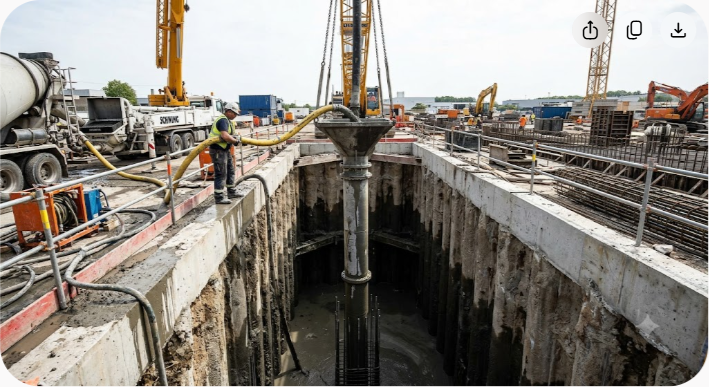
If the slurry contains excessive sand, has unsuitable rheology, or has been contaminated with cement, the risk of poor displacement and concrete contamination increases. Slurry quality is therefore directly connected to concrete quality.
Bentonite slurry doesn't necessarily become waste after one excavation cycle. On projects with suitable soil and a properly designed circulation system, displaced or return slurry can be processed and reused.
A typical treatment system may include screens, desanders, hydrocyclones, tanks, pumps, and mixing equipment. Coarser particles are removed first, while finer suspended solids are managed according to the project's slurry-control system.
The cleaned slurry is then tested. Depending on its condition, operators may add water, fresh bentonite, or other approved treatment materials before returning it to service.
Reuse can reduce bentonite consumption, water demand, handling requirements, and waste volumes. It also creates a practical reason to monitor slurry properties throughout the excavation cycle rather than treating every batch as disposable.
Bentonite is a naturally occurring clay mineral and is widely used in construction because it can provide filtration and rheological control without relying solely on synthetic polymers.
That doesn't mean bentonite slurry can be discharged anywhere without controls. Used slurry may contain excavated soil, cement, salts, hydrocarbons, or other contaminants acquired during construction. Disposal and reuse must follow the project's environmental management plan and local regulations.
The environmental profile of the finished slurry therefore depends on both the bentonite itself and what the material has encountered on site. Proper containment, testing, recovery, and disposal remain essential.
The exact procedure varies with the equipment, soil profile, project specification, and wall depth. A typical workflow includes the following stages.
Water quality affects bentonite hydration. Hard water containing significant concentrations of calcium or magnesium can reduce the performance of sodium bentonite. Salinity can also affect clay dispersion and rheology.
Before large-scale mixing begins, the construction team should establish whether the available water is suitable for the specified bentonite. If treatment is required, it should be based on actual water chemistry rather than an assumed dosage.
Bentonite powder is dispersed into water using equipment capable of producing the required mixing energy. Colloidal mixers are commonly used where rapid and thorough dispersion is needed.
After mixing, the slurry may require a hydration or maturation period before it reaches the properties specified for excavation. The required time depends on the bentonite product, mixing method, water chemistry, temperature, and project specification. A blanket rule such as exactly 12 or 24 hours should not replace the manufacturer's recommendations and site testing.
The key test is performance. Slurry should not be released for critical excavation work simply because a predetermined number of hours has passed.
As excavation begins, bentonite slurry is introduced and maintained at the required level. The slurry level should be monitored continuously because loss of fluid can reduce trench support.
As soil is removed, the slurry becomes contaminated with excavated material. Return slurry is therefore circulated through the solids-control system, where sand and other unwanted solids are removed.
Panel excavation and slurry circulation need to be coordinated. Poor circulation can leave contaminated slurry in parts of the trench, particularly where geometry or equipment limits flow.
Desanding is an important part of slurry management. The return fluid may pass through vibrating screens, hydrocyclones, desanders, or other equipment selected for the project's soil and slurry characteristics.
The goal is to reduce unwanted solids without stripping out the useful clay fraction unnecessarily. After treatment, the slurry is tested for density, viscosity, sand content, filtration behaviour, and other parameters specified by the project.
Before reinforcement and concreting, accumulated sediment must be controlled. Depending on the construction system, the bottom may be cleaned using the excavation equipment, pumps, airlift systems, or other approved methods.
Bottom cleanliness is especially important because sediment left beneath the concrete can affect the quality of the panel base. The acceptance criterion should come from the project specification rather than a generic number applied to every site.
The prefabricated reinforcement cage is carefully lowered into the slurry-filled trench. Cage geometry, lifting points, spacers, centralizers, and clear cover requirements need to be coordinated with the panel dimensions and concreting method.
The cage must enter the slurry without excessive disturbance that could destabilize the trench or introduce unnecessary soil into the suspension.
Tremie pipes are positioned so that concrete can be placed from the bottom upward. The first concrete entering the trench displaces slurry. The concrete level then rises progressively while the slurry is recovered at the surface.
Concrete placement should be controlled to maintain continuous flow and adequate tremie embedment. The displaced slurry should be collected rather than allowed to contaminate surrounding areas.
Slurry testing should be linked to the project's approved specification and the ground conditions. There is no single set of values that applies to every diaphragm wall project.
Four commonly monitored properties are density, viscosity, sand content, and filtration behaviour.
Typical tool: Mud balance or approved density measurement equipment.
Density affects the hydrostatic pressure produced by the slurry and also provides an indication of solids loading. Freshly prepared bentonite slurry may have a relatively low density, while return slurry can become heavier as soil particles accumulate.
A project specification may establish limits for fresh slurry, in-trench slurry, and slurry immediately before concreting. Values around 1.03 to 1.10 g/cm³ are common in some applications, but they should not be treated as universal acceptance limits.
The important question is whether the measured density meets the project's requirements for the current stage of work.
Typical tool: Marsh funnel, rotational viscometer, or another specified rheology test.
Viscosity provides information about the slurry's resistance to flow and its ability to transport or suspend particles. Marsh funnel results are useful for field control, while rotational measurements can provide more detailed information about rheological behaviour.
A Marsh funnel reading in the range of roughly 32 to 40 seconds is sometimes used for particular bentonite slurries, but specifications vary significantly. A number should never be selected solely because it is commonly quoted online.
Too little viscosity can allow fines to settle rapidly. Excessive viscosity can increase pumping resistance and make desanding or concrete displacement more difficult.
Typical tool: Sand-content test equipment or an approved equivalent.
Sand content is especially important before concreting. Sand and coarse solids don't contribute the useful colloidal behaviour provided by hydrated bentonite. They increase slurry density and can settle at the trench bottom.
Project specifications commonly impose a maximum sand content before concrete placement. Depending on the standard and project, values such as 1% or 2% may be used, while other specifications allow different limits.
The correct target is the approved project requirement, not a generic percentage copied from another site.
Typical tool: Filter press or project-specified filtration equipment.
Fluid-loss testing indicates how readily water can pass from the slurry into a porous medium under pressure. Filter-cake thickness provides additional information about the layer left behind.
Low fluid loss is generally desirable because it indicates good filtration control. However, an extremely thick filter cake isn't automatically better. Excessive cake thickness can affect the interface between the temporary slurry support system and the subsequently placed concrete.
Testing should therefore consider both fluid loss and cake characteristics, along with the actual soil conditions and project requirements.
Large diaphragm wall projects often require more than four field measurements. Depending on the specification, engineers may also monitor:
These measurements help the team distinguish between a bentonite-quality problem and a process problem. For example, a rise in density and sand content may indicate inadequate desanding rather than a defective bentonite product.
Polymer-based support fluids are another option for temporary trench stabilization. Whether bentonite or polymer is appropriate depends on the soil profile, groundwater conditions, excavation equipment, environmental requirements, slurry treatment system, and project specification.
| Feature | Sodium Bentonite Slurry | Polymer Slurry |
|---|---|---|
| Main stabilizing mechanism | Hydrostatic pressure combined with clay-based filtration and filter-cake formation | Hydrostatic pressure and polymer interaction with soil and suspended particles |
| Filter cake | Typically forms a low-permeability bentonite cake | Often produces less conventional filter-cake behaviour, depending on polymer system and soil |
| Water loss control | Strong filtration control in suitable soils | Can provide good performance when correctly formulated and matched to the ground |
| Sand and solids management | Requires effective desanding and slurry conditioning | Also requires solids management; treatment requirements vary by system |
| Reuse | Often practical after desanding and conditioning | Can be practical, but depends strongly on polymer chemistry and contamination |
| Water sensitivity | Performance can be affected by hardness and salinity | Performance depends on polymer type and water chemistry |
| Equipment | Requires mixing, circulation, and usually solids-control equipment | Equipment requirements depend on the polymer system and project scale |
| Disposal | Must comply with local rules and account for excavated solids and contaminants | Disposal requirements depend on the specific polymer and contaminants present |
Neither system should be selected solely on material price. The slurry has to work with the actual ground conditions and construction sequence.
Bentonite may be particularly useful where filter-cake formation and filtration control are important. Polymer systems can offer advantages in specific soils and construction methods. The appropriate choice should be based on laboratory trials, site conditions, project specifications, and the experience of the specialist contractor.
Most slurry problems are easier to correct when the team identifies the cause early. A change in density, viscosity, sand content, or filtration behaviour often points to a process issue before it becomes a trench-stability or concreting problem.

Calcium, magnesium, and dissolved salts can interfere with the hydration and dispersion of sodium bentonite. This may show up as weaker rheology, poorer filtration control, or inconsistent slurry behaviour.
What to do: Test the mixing water before large-scale production. If treatment is necessary, use the approved water-conditioning procedure and dosage. Soda ash may be used in some systems to reduce the effect of calcium hardness, but its quantity should be established from water testing rather than guessed.
A rising sand-content result usually indicates that solids are entering the slurry faster than the treatment plant can remove them, or that the desanding system isn't operating effectively.
What to do: Check excavation practices, pump rates, screens, hydrocyclones, slurry circulation, and equipment condition. Do not solve a sand problem simply by adding more bentonite. More clay won't remove coarse sand from the system.
Very high viscosity can make pumping difficult and may reduce the efficiency of desanding. It can also complicate concrete displacement during tremie placement.
What to do: Check whether the increase comes from excessive bentonite concentration, fine soil contamination, poor desanding, or water chemistry. Adjust the slurry according to the approved mix-design procedure rather than diluting blindly.
Low viscosity or weak gel development may result from insufficient bentonite concentration, inadequate hydration, unsuitable water, or excessive dilution.
What to do: Check the mixing water, bentonite dosage, hydration procedure, and actual solids concentration. Fresh bentonite may be required, but the corrective action should be based on test results.
Slurry that comes into contact with fresh cement or highly cement-contaminated concrete returns can show a significant change in pH and rheology. Cement contamination can reduce the usefulness of the slurry for subsequent excavation.
What to do: Separate heavily contaminated slurry from reusable fluid. Do not assume that every batch can be restored economically. Reuse should follow the project's approved treatment and testing procedure.
Poorly hydrated bentonite may fail to develop the expected viscosity and filtration-control properties even when the nominal powder dosage looks correct.
What to do: Review mixing energy, powder addition rate, water quality, temperature, and hydration time. Follow the bentonite supplier's technical data and verify performance through testing.
A sudden drop can indicate leakage into permeable strata, an underground connection, pump-out, poor monitoring, or another site-specific problem. Loss of slurry level can reduce the hydraulic support available to the trench.
What to do: Restore the required slurry level promptly and investigate the cause. The corrective response may involve adjusting the slurry formulation, reducing excavation exposure, improving circulation, or implementing a ground-specific treatment method approved by the geotechnical team.
A good slurry mix begins with the soil and water conditions, not with a fixed recipe copied from another project.
Review the geotechnical profile before selecting the bentonite concentration. Sand, gravel, silt, clay, fractured rock, groundwater chemistry, and permeability all influence slurry behaviour.
Highly permeable strata may require stronger filtration control. Fine soils can increase suspended solids and change viscosity. Saline groundwater can affect clay hydration.
Before full production, prepare trial slurries using the actual mixing water and candidate bentonite. Measure density, viscosity, filtration, sand response, and other specified properties.
Laboratory trials help establish a practical starting formulation and identify water-chemistry problems before they appear during excavation.
The slurry that enters the trench isn't necessarily the same slurry that comes out. Excavated solids, groundwater, evaporation, dilution, and repeated circulation can all change its properties.
A robust quality-control plan therefore specifies when and where samples are taken. Typical checkpoints include fresh slurry, in-trench slurry, return slurry, treated slurry, and slurry immediately before concreting.
A common mistake is to optimize the slurry around viscosity alone. A slurry can have an acceptable Marsh funnel value while still carrying too much sand or showing poor filtration control.
Density, viscosity, sand content, filtration, pH, and other project-specific parameters need to be considered together.
The supplier's role extends beyond delivering bags of clay. Consistency matters because changes in mineralogy or processing can alter slurry yield, hydration behaviour, and filtration performance.
When evaluating a bulk bentonite supplier, ask for:
For international projects, logistics can be just as important as laboratory performance. Delays in critical mineral supply can interrupt excavation sequences and create avoidable site costs.
Axewelledge supplies bentonite for industrial and construction applications, including projects where controlled swelling, rheology, and filtration performance are required. For diaphragm wall work, the appropriate product should be selected against the project's slurry specification rather than by brand name alone.
When evaluating Axewelledge or any other bentonite supplier, project teams should request the relevant technical data, batch quality documentation, recommended dosage, and application guidance. The final product selection should then be validated using the project's mixing water and representative soil conditions.
For large infrastructure projects, a supplier that can support bulk material planning, consistent production, documentation, and international logistics can simplify procurement and slurry quality control. Those factors are particularly relevant when a project involves repeated panel excavation over an extended construction programme.
Even a high-quality bentonite can perform poorly when slurry management is weak. The following mistakes are particularly costly.
A slurry recipe that worked on one site may not work on another. Water chemistry and soil permeability can change the required formulation significantly.
Hard or saline water can reduce bentonite performance. Water testing should happen before the main mixing operation begins.
Higher density doesn't automatically mean better trench stability. Excessive solids can increase density while making the slurry harder to circulate and displace.
Reusing contaminated slurry without adequate solids removal can gradually increase density and sand content. The result may only become obvious when the panel is ready for concrete.
A slurry that was acceptable during excavation may no longer meet the concreting specification after accumulating sand or fine solids. Always test the slurry at the stage required by the project specification.
Reuse is valuable, but not unlimited. Cement contamination, excessive fines, chemical contamination, or unsuitable rheology may make disposal more practical than further treatment.
Before and during diaphragm wall excavation, the site team can use the following checklist as a starting point. The project specification remains the controlling document.
Bentonite is hydrated with water to create a slurry that temporarily supports the trench during excavation. The slurry contributes hydrostatic pressure, forms a low-permeability filter cake against the soil, and helps suspend fine excavated material. Before concreting, the slurry is conditioned to meet project requirements and is displaced upward as concrete is placed through tremie pipes.
Thixotropic bentonite slurry can flow more readily when it is disturbed by pumping or excavation equipment and develop gel structure when left relatively undisturbed. This behaviour helps the slurry remain workable during excavation while supporting the suspension of fine particles between periods of circulation. Its performance still depends on concentration, water chemistry, solids content, and other slurry properties.
Yes, bentonite slurry can often be recovered and reused when its condition remains suitable. Return slurry is normally processed to remove sand and other unwanted solids, then tested and adjusted as necessary. Reuse depends on contamination, solids concentration, rheology, filtration properties, and the project's acceptance criteria. Cement-contaminated or otherwise unsuitable slurry may need separate treatment or disposal.
A bentonite filter cake is a relatively low-permeability layer that develops where slurry contacts permeable soil. Under pressure, water can filter into the formation while bentonite particles are retained at the soil interface. The accumulated clay reduces further fluid loss and helps maintain the hydraulic conditions required for temporary trench stability. Filter-cake quality depends on slurry and soil conditions.
There is no universal choice for every project. Bentonite can provide effective filtration control and filter-cake formation, while polymer systems can perform well in selected soils and construction methods. The appropriate slurry should be chosen according to soil permeability, groundwater chemistry, excavation equipment, environmental requirements, concrete-placement method, and the project specification rather than material price alone.
Common field tests include density using a mud balance, viscosity using a Marsh funnel or rheometer, and sand content using a sand-content test. Depending on the specification, teams may also measure fluid loss, filter-cake thickness, pH, temperature, and other rheological properties. Testing frequency and acceptance limits should come from the approved project quality-control plan.
Bentonite for diaphragm wall construction is primarily a temporary excavation-support system. Its effectiveness comes from several properties working together rather than from swelling alone.
The main points to remember are:
The permanent strength of a diaphragm wall comes from its reinforced concrete and its interaction with the surrounding ground. During construction, however, the quality of the temporary slurry-support system can have a major influence on whether excavation and concreting proceed safely and predictably. Good bentonite, a suitable mix design, continuous testing, effective desanding, and disciplined site control are what turn a clay slurry into a reliable construction system.













Have questions about our products? We're here to help!