Axewelledge, a leading exporter from India, specializes in high-quality Bentonite. With a commitment to excellence, we supply premium Bentonite to the Middle East and Southeast Asia markets.


North Angle Complex, 304,
150 Feet Ring Rd, Opposite Ambedkar Nagar BRTS Stop,
Madhav Park, Punit Nagar,
Mavdi, Rajkot, Gujarat 360004
© Axewelledge 2026, All Rights Reserved.
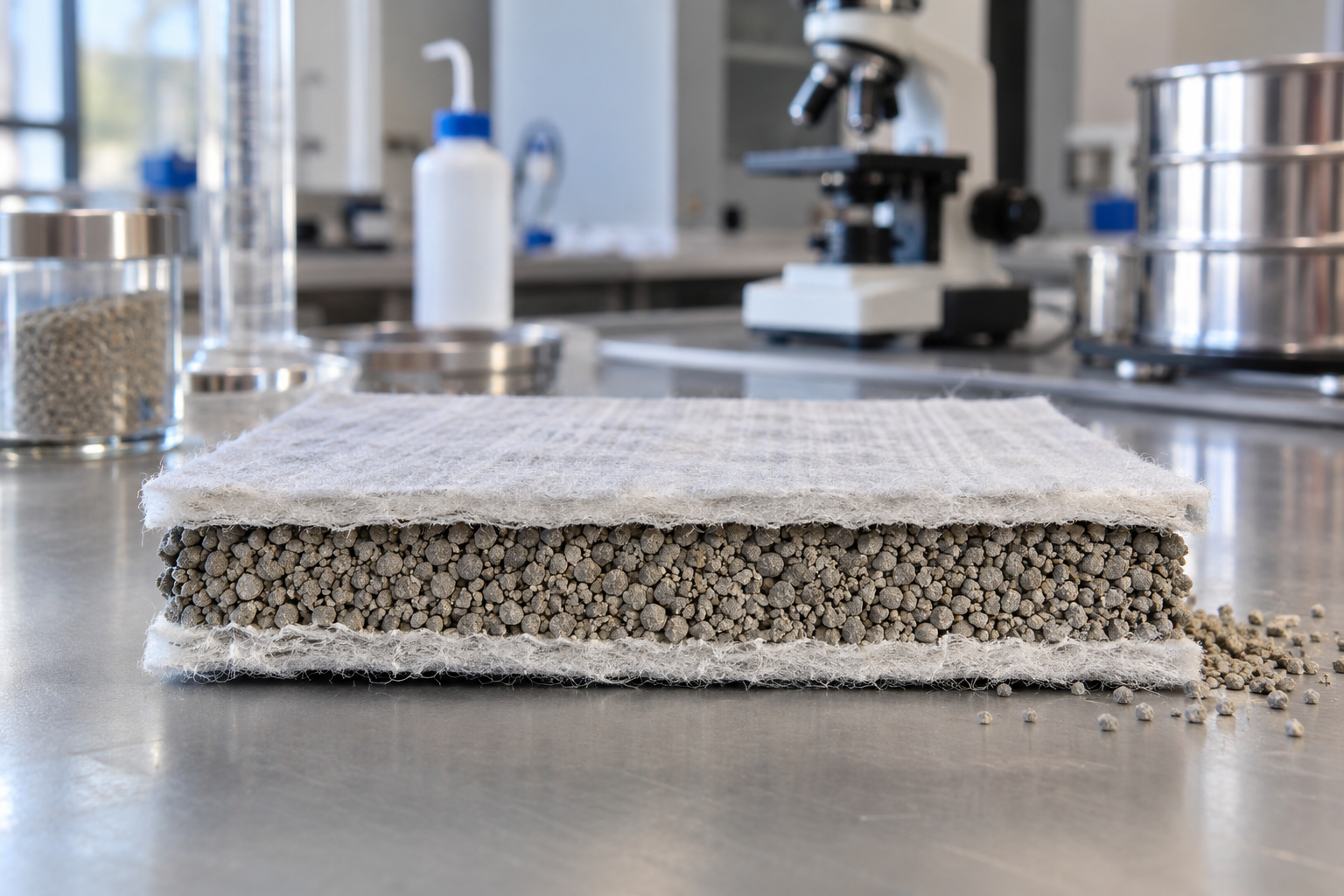
Bentonite is the sealing component that gives a geosynthetic clay liner (GCL) its low-permeability behavior. But choosing a GCL clay isn't as simple as buying a material with a high swelling number. Mineralogy, exchangeable cations, fluid loss, particle size, mass per unit area, hydration conditions, chemical compatibility, and the properties of the finished GCL all matter.
For most demanding containment applications, natural sodium bentonite is a strong starting point because its smectite-rich structure can hydrate and swell effectively. Even so, the right specification depends on the project. A landfill cell, mining containment system, industrial waste facility, or closure application can expose the GCL to very different loads, liquids, temperatures, and hydration conditions.
The practical approach is to evaluate the bentonite as both a raw material and part of the finished GCL. Raw bentonite tests can identify important quality characteristics, but they don't replace testing of the manufactured liner under representative conditions. This guide explains the properties that matter, the ASTM tests commonly used to evaluate GCL materials, the mistakes to avoid, and the questions to ask a bentonite supplier before approving a source.
A geosynthetic clay liner generally contains a layer of bentonite supported or encapsulated by geotextiles. Depending on the product design, the bentonite may be granular, powdered, or a controlled blend. Manufacturing methods can include needle punching, adhesive bonding, stitching, or other configurations designed to hold the clay in place and provide the required mechanical performance.
The bentonite supplies the primary sealing function. Once it receives sufficient water, the smectite minerals hydrate and swell. Confinement within the GCL restricts the clay from simply expanding into open space. Instead, the hydrated bentonite fills available voids and develops a dense clay layer through which liquid moves slowly.
That basic mechanism explains why bentonite quality matters so much. A clay with inadequate swelling potential, unsuitable mineralogy, poor chemical compatibility, or inconsistent processing may not form the same low-permeability structure as a properly selected material.
GCLs are used in applications such as landfill liners and covers, mining facilities, ponds, wastewater containment, and other environmental barrier systems. In each case, the liner must be selected as part of a complete barrier system rather than treated as an isolated material.
A typical GCL may contain three functional elements:
The exact construction varies between manufacturers and applications. That's why a raw bentonite specification should always be connected to the requirements of the finished GCL.
The most important selection factors are mineralogy, swelling behavior, fluid loss, chemical compatibility, particle size distribution, consistency, and the performance of the finished GCL. No single laboratory number tells the whole story.
A useful procurement process starts by defining the project conditions, then establishing raw-material requirements, followed by qualification testing and batch-level quality control.
Before comparing bentonite suppliers, establish how the GCL will actually be used. Consider the expected liquid or leachate chemistry, hydraulic head, confining stress, subgrade conditions, slope geometry, installation method, temperature, and whether the liner will remain hydrated or experience repeated wetting and drying.
Chemical exposure deserves particular attention. A bentonite that performs well in deionized or relatively clean water can behave differently when exposed to solutions containing elevated concentrations of salts or multivalent cations.
The project specification should therefore avoid selecting a clay solely because it has a high free swell value in fresh water. The relevant question is whether the finished GCL can maintain the required hydraulic and mechanical performance under the actual service conditions.
Bentonite is a naturally occurring clay-rich material rather than a single pure mineral. Smectite, particularly montmorillonite, is primarily responsible for the swelling and sealing behavior that makes bentonite useful in GCLs.
A higher proportion of swelling clay generally provides more active material, but the percentage reported by a laboratory depends on the analytical method. For that reason, mineralogical results should be interpreted alongside other performance tests rather than used as a standalone acceptance criterion.
Non-swelling minerals such as quartz, feldspar, mica, and other accessory minerals can dilute the active clay fraction. Their presence isn't automatically a defect; natural bentonite deposits commonly contain accessory minerals. The important issue is whether the overall mineral composition provides the required performance consistently.
Free swell index is one of the most widely used indicators when evaluating bentonite intended for GCL applications. ASTM D5890 provides a standardized method for determining the swell index of the clay mineral component of a GCL.
The test indicates how much the clay expands when dispersed in water under specified laboratory conditions. Sodium-dominant smectite generally shows stronger swelling than calcium-dominant smectite, which helps explain the preference for sodium bentonite in many GCL products.
A value around or above 24 mL/2 g is commonly associated with bentonite meeting established GCL specifications, but the applicable acceptance limit should come from the project or product specification. A higher number isn't automatically proof of better field performance.
Free swell testing also needs to be interpreted carefully. The test uses controlled conditions and does not reproduce every chemical, loading, and hydration condition found in the field. Use it as an important screening and quality-control measure, not as the sole design criterion.
Fluid loss testing provides another useful indication of bentonite's filtration and water-retention behavior. ASTM D5891 is commonly used for the clay component of GCLs.
In the test, a bentonite suspension is subjected to controlled filtration conditions. The amount of filtrate collected provides an indication of how effectively the clay can form a low-permeability filter cake.
Lower fluid loss is generally desirable for GCL bentonite because it indicates effective filtration and the ability to form a relatively tight clay structure. However, the result should be considered with mineralogy, swell, and finished-GCL hydraulic conductivity rather than treated as an isolated pass-or-fail measure.
When comparing suppliers, ask whether the reported fluid loss comes from a consistent test method and whether the result represents routine production material or a selected laboratory sample. Consistency across production batches is more useful than an unusually strong result from one sample.
The exchangeable cations associated with smectite have a major influence on swelling. Sodium, calcium, magnesium, and other cations can occupy exchange sites on the clay surface and affect how the clay interacts with water.
Sodium-dominant bentonite generally develops greater diffuse double-layer expansion in low-salinity water than calcium-dominant bentonite. Calcium and other divalent cations can compress that layer, reducing swelling and potentially increasing hydraulic conductivity.
Cation exchange capacity (CEC) can help characterize the clay, but CEC alone doesn't tell an engineer whether a particular bentonite will meet a GCL's performance requirements. It is best used as part of a broader mineralogical and performance profile.
Particle size distribution affects both manufacturing and hydration. GCL producers often use carefully processed bentonite with a specified balance of granular and finer material.
Fine particles can hydrate quickly and help fill smaller voids. Granular particles can improve handling characteristics and reduce problems associated with excessive dust during manufacturing. The correct distribution depends on the GCL design and manufacturing process.
A material that is excessively fine can create dust-management and handling problems. Material that is too coarse may hydrate less uniformly or require additional processing. The objective isn't to make the bentonite as fine as possible; it is to achieve a controlled gradation that works with the manufacturer's production process.
Particle size should therefore be specified using measurable limits rather than vague descriptions such as "fine" or "high quality." A supplier should be able to provide a representative particle-size distribution and explain how it is controlled during processing.
The distinction between sodium and calcium bentonite is important because exchangeable cations influence hydration and swelling behavior.
| Property | Sodium-Dominant Bentonite | Calcium-Dominant Bentonite |
|---|---|---|
| Typical swelling behavior in fresh water | Higher | Lower |
| Dominant exchangeable cation | Sodium | Calcium |
| Hydration in low-salinity water | Strong | More limited |
| Suitability for many GCL formulations | Commonly preferred | Requires careful evaluation |
| Chemical compatibility | Depends on permeant chemistry | Depends on permeant chemistry |
Natural sodium bentonite is often selected for demanding GCL applications because of its strong hydration and swelling characteristics. However, the phrase "sodium bentonite" shouldn't be treated as a complete quality specification. Two deposits can both be described as sodium bentonite while having different mineralogy, accessory minerals, moisture content, processing characteristics, and performance.
Some calcium bentonites are treated with sodium carbonate, commonly called soda ash, to modify their exchangeable cations and increase swelling in fresh-water testing. Activated materials can be useful in appropriate applications, but their long-term behavior under chemical exposure needs careful evaluation.
The concern is not that activation automatically makes a material unsuitable. The concern is that fresh-water test results may not fully describe performance when the clay encounters a chemically aggressive permeant. Multivalent ions in the permeant can exchange with sodium and alter the clay's swelling behavior.
For a critical containment project, the appropriate choice should be based on the finished GCL's demonstrated performance under the expected chemical conditions rather than on the material label alone.
Hydraulic conductivity describes how readily water or another fluid moves through a porous material under a hydraulic gradient. For a GCL, it is one of the most important indicators of barrier performance.
ASTM D5887 provides a method for measuring the index hydraulic conductivity of GCLs using a flexible-wall permeameter. The test is performed on the finished composite rather than relying solely on properties measured from loose bentonite.
Many GCL specifications use a maximum index hydraulic conductivity in the range of 5 × 10^-9 cm/s or lower, although the exact acceptance criterion should always be taken from the applicable project specification, regulatory requirement, and GCL manufacturer's certified properties.
This distinction is important: a raw bentonite may have excellent swelling and fluid-loss results while the finished GCL performs differently because of bentonite mass per unit area, geotextile configuration, manufacturing quality, hydration conditions, confining stress, and test permeant.
Mass per unit area is another critical GCL property. ASTM D5993 is commonly used to measure the mass per unit area of the GCL.
The amount of bentonite in the product needs to be sufficient to create the required sealing layer after hydration. If the mass varies significantly across a roll, areas with less clay may have different hydration and hydraulic behavior from the rest of the liner.
Standard GCL products can use bentonite masses around 4,000 to 5,000 g/m², but there is no universal value that applies to every product or application. Product construction, required hydraulic performance, chemical exposure, and mechanical design all influence the appropriate mass per unit area.
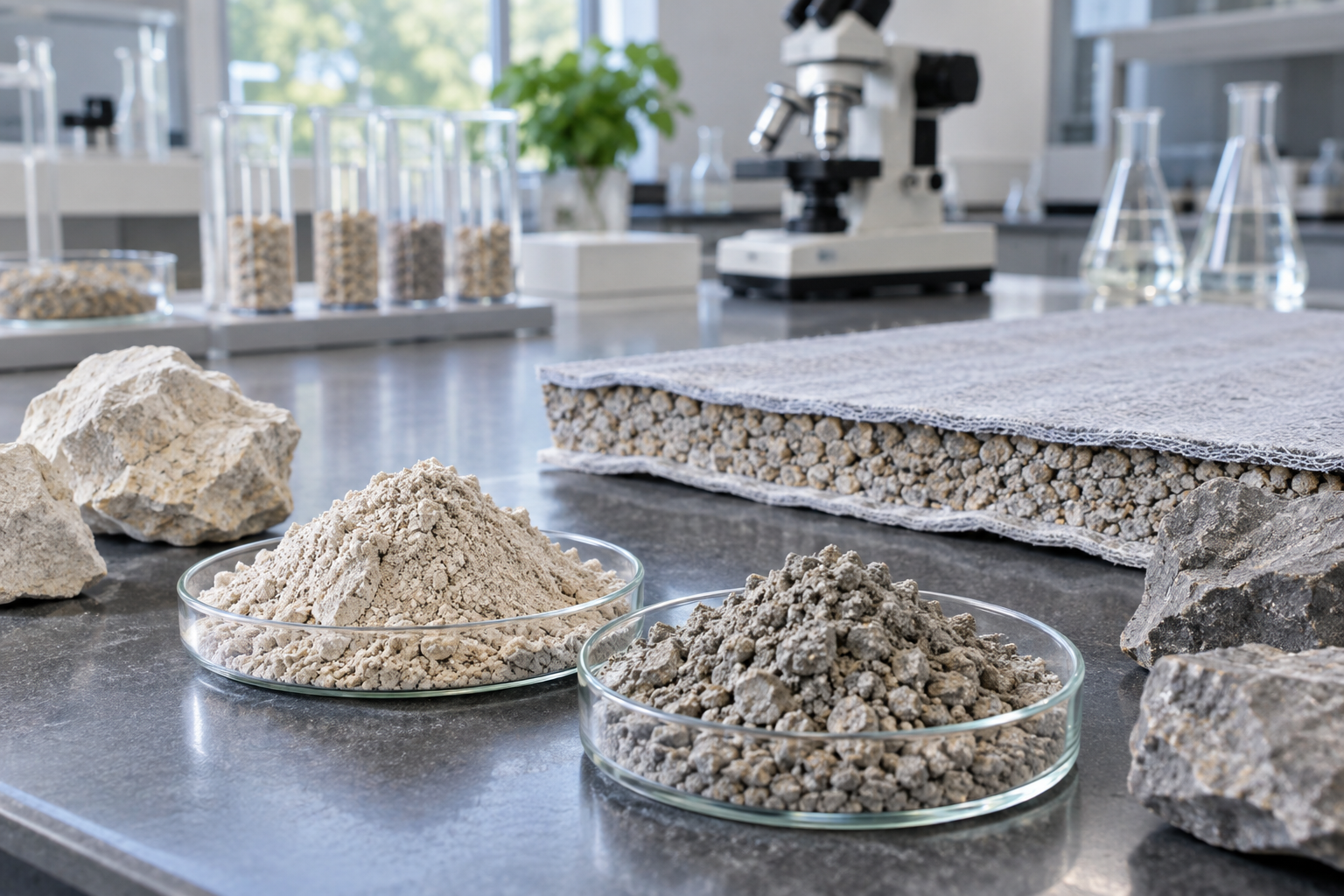
For procurement, look for both an average specification and an allowable minimum. A strong quality-control program should also demonstrate that production remains within the agreed limits across the roll width and from batch to batch.
Fresh water is a convenient laboratory medium, but environmental containment systems often encounter more complicated liquids. Landfill leachate, mining process water, industrial wastewater, and saline solutions can contain dissolved salts and multivalent cations that influence bentonite behavior.
Chemical compatibility depends on the actual permeant and the clay. High ionic strength can reduce the thickness of the diffuse double layer around clay particles. Certain multivalent cations can also exchange with sodium on the clay and alter swelling behavior.
That doesn't mean every chemically exposed GCL will fail. Modern GCL products can be engineered and selected for specific conditions. The important point is to test or otherwise document performance using representative conditions when chemical exposure is significant.
Before approving a bentonite or GCL for a chemically demanding project, ask:
The answers should be documented rather than based on general statements about the clay being "high quality."
Hydraulic performance is only one part of GCL selection. On slopes, the liner must also remain stable as part of the complete containment system.
GCL shear behavior is affected by the bentonite, geotextiles, reinforcement, interface materials, normal stress, hydration state, and adjacent layers. The relevant failure surface may occur within the GCL or at an interface between the GCL and another geosynthetic or soil layer.
For that reason, engineers should not try to infer slope stability from the bentonite's free swell or fluid loss alone. Interface shear testing and internal shear testing should be performed when required by the project design, especially for steep slopes and critical containment systems.
Needle-punched GCLs use fibers driven through the bentonite layer to connect the supporting geotextiles and improve internal reinforcement. The performance of the finished composite depends on the entire product structure, not simply the clay's mineralogy.
Standardized testing helps buyers, manufacturers, and engineers compare materials using consistent methods. The following ASTM methods are particularly relevant to GCL specifications:
| ASTM standard | What it evaluates | Why it matters |
|---|---|---|
| ASTM D5890 | Swell index of the clay mineral component | Indicates swelling potential under specified laboratory conditions |
| ASTM D5891 | Fluid loss of the clay component | Indicates filtration and water-retention behavior |
| ASTM D5993 | Mass per unit area of GCL | Helps verify the quantity and consistency of bentonite in the product |
| ASTM D5887 | Index hydraulic conductivity of GCL using a flexible-wall permeameter | Directly evaluates hydraulic performance of the finished GCL |
These tests shouldn't be viewed as interchangeable. D5890 and D5891 characterize important properties of the clay component, while D5993 and D5887 address properties of the finished GCL.
A project specification may also require additional physical, mechanical, chemical, or interface testing. The appropriate test program depends on the containment application and design conditions.
A supplier qualification program should look beyond a single certificate or one laboratory sample. The objective is to establish that the material will remain consistent throughout production and shipment.
Request documentation covering:
The processing plant should have documented controls for drying, milling, blending, screening, granulation, and packaging where those operations apply.
Ask how the producer prevents cross-contamination between different grades and how it identifies individual production lots. A material specification has limited value if the supplier cannot connect test results to actual production batches.
For the finished liner, review:
The exact list will vary by GCL construction and project specification.
The cheapest bentonite is not necessarily the lowest-cost option once processing, rejection, installation problems, and project risk are considered. A lower-priced material may contain more non-swelling minerals, show greater batch variability, or require additional processing to meet the manufacturer's formulation requirements.
Compare suppliers using the complete specification and delivered performance rather than price per tonne alone.
Free swell is useful, but it doesn't describe every property that controls GCL performance. A clay can produce a strong swell result while still requiring closer evaluation of fluid loss, mineralogy, chemical compatibility, particle size, and finished-product hydraulic conductivity.
Use a property profile rather than a single headline number.
The term "sodium bentonite" describes an important characteristic, but it doesn't guarantee identical performance between sources. Deposit geology, mineral composition, exchangeable cations, processing, moisture, and particle size can all vary.
A proper supplier-qualification process compares test data from representative production material.
A fresh-water test cannot automatically predict performance in concentrated leachate or saline process water. Chemical compatibility needs to be considered whenever the GCL will be exposed to significant dissolved salts or multivalent cations.
The finished GCL is the barrier installed on the project. Raw bentonite data are important, but they don't replace finished-product testing.
A reliable specification connects the raw material to the manufacturer's GCL formulation and verifies the final product's hydraulic and mechanical performance.
A supplier that provides excellent test results but weak batch traceability creates unnecessary procurement risk. Certificates should identify the relevant production lot and use consistent test methods so that results can be compared over time.
When evaluating an industrial bentonite exporter or mine owner, ask for more than a product brochure. A technically capable supplier should be able to explain where the material comes from, how it is processed, how quality is monitored, and which specifications it can consistently meet.
A useful supplier comparison can include the following criteria:
| Supplier criterion | What to verify |
|---|---|
| Mineral source | Consistent deposit and documented raw-material control |
| Bentonite type | Natural sodium, activated, or other specified grade |
| Mineralogy | Relevant smectite or montmorillonite characterization |
| Swelling | Free swell results from representative production lots |
| Fluid loss | Consistent results using the agreed method |
| Particle size | Controlled distribution appropriate for GCL manufacturing |
| Production capacity | Ability to support the required volume without changing material characteristics |
| Quality assurance | Documented sampling, testing, and batch traceability |
| Logistics | Packaging, loading, export capability, and shipment consistency |
| Technical support | Ability to provide specifications and discuss application requirements |
Long-term supply matters for large infrastructure projects. If a GCL manufacturer qualifies a particular bentonite formulation, unexpected changes in the raw material can affect production and product consistency. Establishing a clear specification and change-control process with the supplier helps reduce that risk.
Landfill projects place demanding requirements on barrier systems because the liner may be exposed to leachate for many years. The GCL is typically used as one component of a composite containment system, often alongside geomembranes and prepared soil or drainage layers.
The right bentonite specification should therefore reflect the complete design. Questions about hydraulic conductivity, mass per unit area, chemical compatibility, interface shear, and long-term behavior should be addressed at the system-design stage.
Mining applications can present a different challenge. Process solutions may have higher ionic strength or unusual chemistry, and the liner can be installed on slopes where interface stability is critical. A bentonite that performs well in a municipal landfill application isn't automatically the best choice for every mining containment project.
Industrial containment systems also vary widely. Wastewater, process liquids, and other stored fluids can expose the GCL to chemical conditions that aren't represented by standard fresh-water testing. Application-specific evaluation is therefore essential.
A procurement specification should be measurable and tied to recognized test methods wherever possible. Avoid relying on descriptions such as "premium grade," "high purity," or "super swelling" without numerical acceptance criteria.
A well-structured specification can include:
The finished GCL specification should be coordinated with the raw bentonite specification. That prevents a common procurement problem in which a raw material technically meets its own requirements but doesn't deliver the required performance after incorporation into the manufactured liner.
For critical projects, a simple qualification sequence works well.
Define the expected hydraulic, chemical, mechanical, and environmental conditions before selecting the clay.
Focus on suppliers that can provide consistent natural sodium bentonite or another technically justified material that fits the GCL manufacturer's formulation.
Don't qualify a supplier using an isolated hand-selected sample. Test representative production material using the agreed laboratory methods.
Where practical, evaluate the candidate bentonite in the intended GCL formulation. This is where interactions between clay, geotextiles, processing, and manufacturing conditions become visible.
Measure the finished GCL against the relevant hydraulic, mass, and mechanical requirements. Add chemical compatibility testing when the service environment warrants it.
Once the source is approved, define acceptable ranges, sampling frequency, documentation requirements, and procedures for handling changes in the mine source or processing conditions.
This approach turns bentonite procurement from a commodity purchase into a controlled engineering input.
For GCL manufacturers and environmental containment projects, supplier capability extends beyond having access to a large bentonite reserve. Consistent mineral quality, controlled processing, laboratory testing, production capacity, packaging, and export logistics all contribute to dependable supply.
Axewelledge supplies bentonite from India for industrial and environmental applications, including high-purity natural sodium bentonite. When evaluating any supplier, including Axewelledge, buyers should request current technical data, representative test certificates, product specifications, and information about batch traceability before qualification.
The strongest supplier relationship is built around measurable requirements. Instead of asking only whether a supplier has "high-quality bentonite," ask which test values it can guarantee, how those values are monitored, and whether the material remains consistent across the volume required for the project.
Selecting bentonite for geosynthetic clay liners requires more than finding a clay with a high swelling number. The most important considerations are the interaction between mineralogy, hydration, chemistry, manufacturing, and finished-product performance.
For most GCL formulations, natural sodium bentonite is attractive because of its strong swelling behavior in suitable hydration conditions. Still, the material should be evaluated using a broader set of properties, including free swell index, fluid loss, mineralogical composition, particle size distribution, moisture, and chemical characteristics.
The finished GCL should then be evaluated for mass per unit area, hydraulic conductivity, and mechanical properties appropriate to the installation. Where chemical exposure is significant, compatibility testing with representative permeants can be essential.
Finally, treat quality control as an ongoing process. A reliable specification, representative sampling, standardized testing, traceable batches, and a supplier with consistent production capabilities provide much stronger protection than a one-time laboratory result.
The right bentonite is not simply the clay with the highest laboratory number. It is the material that consistently produces the required GCL performance under the conditions the liner will face in service.













Have questions about our products? We're here to help!