Axewelledge, a leading exporter from India, specializes in high-quality Bentonite. With a commitment to excellence, we supply premium Bentonite to the Middle East and Southeast Asia markets.


North Angle Complex, 304,
150 Feet Ring Rd, Opposite Ambedkar Nagar BRTS Stop,
Madhav Park, Punit Nagar,
Mavdi, Rajkot, Gujarat 360004
© Axewelledge 2026, All Rights Reserved.
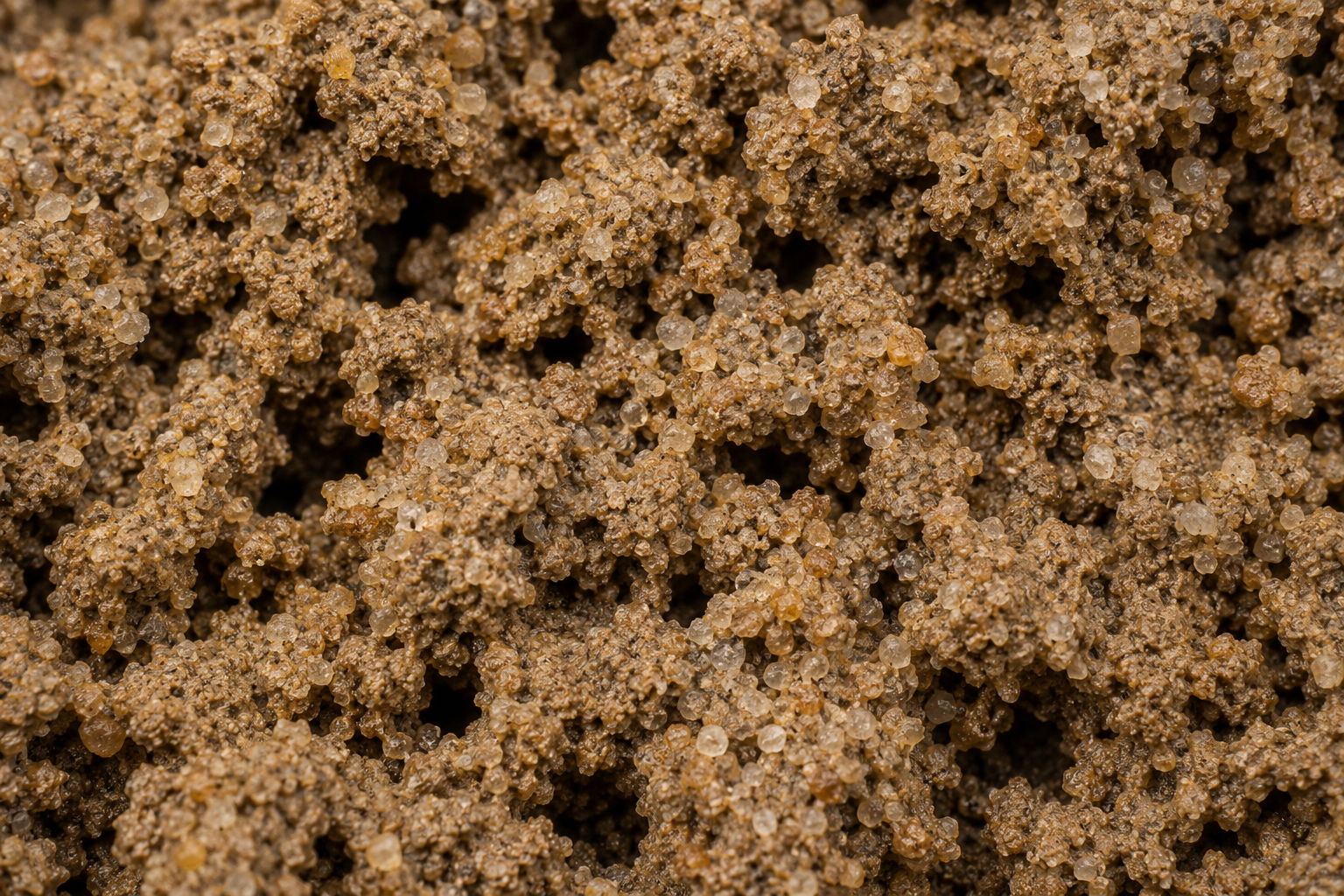
Bentonite plays an important role in green sand mold permeability, but it does not improve or reduce permeability on its own. The result depends on how much bentonite is used, how well it is activated and mulled, the moisture level, the sand grain distribution, and the amount of accumulated fines in the circulating sand system.
That distinction matters. A green sand mold needs enough binder to hold its shape and resist erosion, but it also needs interconnected pores so air, steam, and other gases can leave the mold as molten metal enters the cavity. Too much fine material or excess moisture can restrict those pathways. Too little binder or poorly conditioned sand can create weak molds, erosion, penetration, and other casting problems.
For foundries, the practical objective is not simply to maximize permeability. It is to maintain the right permeability for the casting, metal, sand system, and molding process while keeping green strength, compactability, moisture, and hot behavior under control.
Green sand is a mixture of sand, clay binder, water, and, depending on the application, other additives. The word "green" refers to the mold being used in its moist, unbaked condition. It does not describe the color of the material.
A typical green sand system contains:
The exact percentages vary considerably by foundry, alloy, molding equipment, sand system, and casting geometry. There is no single recipe that works for every green sand operation.
Permeability describes how readily a gas can pass through the interconnected spaces in the compacted mold. During pouring, the mold is exposed to intense heat. Moisture turns into steam, organic additives can generate gaseous products, and air already present in the cavity and mold must move somewhere as molten metal fills the pattern.
If the sand cannot vent those gases efficiently, gas-related defects become more likely. If the mold is excessively open or poorly compacted, however, other problems can appear, including metal penetration, poor surface finish, erosion, and insufficient mold strength.
Permeability therefore has to be considered alongside green strength, compactability, moisture, clay content, grain fineness, and casting geometry. A high permeability number is not automatically a sign of healthy molding sand.
Bentonite is a clay dominated by smectite minerals, particularly montmorillonite. Its value in green sand comes from its ability to interact with water and develop bonding properties around the sand grains.
When bentonite is properly hydrated and mechanically worked, its fine clay particles disperse through the sand. The hydrated clay forms films around aggregate grains and creates the cohesion needed to make a mold that can be compacted, stripped from the pattern, transported, and filled with molten metal without losing its shape.
That binder film also changes the pore structure of the sand. Bentonite particles are much finer than the main sand grains. Increasing the amount of active clay can therefore fill some of the spaces between grains and reduce the pathways available for gas flow.
The important point is that bentonite improves mold performance through controlled bonding, not by simply increasing the amount of clay. A well-conditioned, high-quality binder can provide the required strength at an appropriate addition rate. Over-bonding, poor dispersion, or excessive moisture can have the opposite effect.
Several variables determine how bentonite affects the permeability of a green sand system. Four deserve particular attention: binder level, clay distribution, hydration, and the accumulation of inactive fines.
Bentonite is considerably finer than the aggregate used in most green sand systems. As active clay content increases, more of the void space between sand grains can become occupied by fine material.
That is why adding bentonite simply to increase mold strength can eventually work against permeability. The goal is to use enough active clay to meet the strength and molding requirements without filling unnecessary pore space.
The optimum level depends on the sand system. Casting size, alloy, molding method, sand grain distribution, compactability, and the required surface finish all influence the appropriate target.
A better approach than asking, "How much bentonite should we add?" is to ask, "What active clay level gives us the required properties with the least unnecessary fine material?"
That shift in thinking is especially useful in continuously recycled sand systems, where every additional fine particle can affect the behavior of later batches.
Bentonite must be properly distributed through the sand. Simply putting dry clay, sand, and water into a mixer does not guarantee effective conditioning.
A foundry muller applies mechanical energy that helps distribute water and clay across the aggregate. The objective is to develop the bentonite and create a consistent coating rather than leaving pockets of concentrated clay or areas with insufficient binder.
Poor mulling can produce several problems at once. Clay that has not been properly dispersed may contribute less effectively to strength. Localized clay concentrations can occupy pore space, while poorly conditioned areas can remain weak and susceptible to erosion.
Mulling time should not be treated as a universal number. The required cycle depends on the muller design, sand temperature, moisture, clay type, starting condition of the return sand, additive package, and production rate. Foundries should establish the cycle through testing rather than copying a setting from another operation.
The swelling behavior of bentonite is an important indicator of its interaction with water. Sodium bentonite generally develops greater swelling than calcium bentonite, although actual performance depends on mineral composition, activation, particle size, and processing.
Greater swelling does not mean a foundry should simply add less clay without testing. What matters is the amount of active binder required to achieve the desired green strength, compactability, hot behavior, and other sand properties.
A bentonite with consistent performance can make the sand system easier to control because operators are less likely to compensate for weak or variable binder by adding excessive clay or water.
Moisture is one of the most important variables in green sand control. Water activates bentonite and gives the molding sand its working properties, but excess water can occupy pore space and increase the amount of steam generated during pouring.
This creates a difficult relationship. The sand needs enough water for the clay to develop its bonding properties, yet too much free moisture can reduce permeability and increase gas generation.
For that reason, moisture should never be adjusted in isolation. Operators should consider moisture alongside compactability, active clay, permeability, green strength, sand temperature, and the condition of the return sand.
High-quality bentonite can contribute to more predictable moisture response, but it cannot compensate for an incorrectly controlled sand system.

The choice between sodium and calcium bentonite can influence strength, swelling, thermal behavior, and the way a recycled sand system responds over time.
| Feature | Sodium Bentonite | Calcium Bentonite |
|---|---|---|
| Typical swelling behavior | Higher | Lower to moderate |
| Binder development | Strong when properly hydrated | Strong, depending on mineral quality and activation |
| Green strength | Generally high | Can be high, depending on grade and formulation |
| Thermal durability | Generally better suited to repeated green sand recycling | Generally less thermally durable without suitable formulation or activation |
| Reclamation behavior | Depends on grade and system conditions | Depends on grade and system conditions |
| Foundry use | Widely used in demanding green sand systems | Used in selected systems and formulations |
These are general characteristics, not guarantees. Bentonite grades vary significantly, so foundries should evaluate a supplier's material using actual sand-system testing rather than relying on the name of the clay type alone.
Sodium bentonite is widely used in green sand foundries because it can provide strong bonding and good durability through repeated processing. This can be valuable in systems where sand is returned, cooled, conditioned, and reused many times.
Calcium bentonite has useful properties too, and some foundries use calcium-based or blended binders successfully. The right choice depends on the molding process and the performance targets of the particular operation.
The key is consistency. A foundry needs to know how its binder behaves after hydration, molding, pouring, shakeout, cooling, and reclamation. A clay that performs well in a laboratory sample but behaves unpredictably in the circulating sand system is not a good practical choice.
One of the most important concepts in recycled green sand is dead clay. The term generally refers to clay that has lost its useful bonding activity because of thermal exposure or other degradation and remains in the circulating sand as fine material.
During pouring, the sand close to the mold-metal interface is exposed to very high temperatures. Some of the clay binder loses its original structure and bonding ability. Repeated thermal cycles can therefore increase the inactive clay fraction of a sand system.
Dead clay matters because it can continue to occupy space without contributing the same level of useful bonding as active bentonite. As inactive fines accumulate, the foundry may need additional binder or water to restore working properties. Those additions can further change permeability and compactability.
This is why sand control programs distinguish between active clay and total clay or fines. Knowing only the total fine fraction does not tell an operator how much of it is still functioning as an effective binder.
Fines can enter a green sand system from several sources:
As the fine fraction increases, the pore structure can become less favorable for gas movement. This is one reason a foundry can experience declining permeability even when the nominal sand recipe has not changed.
Regular testing helps identify that trend before it becomes a casting problem.
Low permeability is one possible contributor to gas-related casting defects, but it is rarely the only variable. Defect diagnosis should consider mold permeability, moisture, pouring practice, metal chemistry, core gases, venting, mold hardness, and casting geometry together.
Blowholes are relatively large gas cavities that can occur at or near the casting surface. They can result when gases generated in the mold or core cannot escape efficiently and become trapped in the metal.
Poor sand permeability, excessive moisture, inadequate venting, and excessive gas generation can all contribute. Reducing bentonite alone will not necessarily solve the problem and may create weak molds instead.
Small gas cavities may appear as pinholes or subsurface porosity. Their causes vary with alloy and process. Hydrogen-related porosity is particularly important in aluminum alloys, while moisture, mold materials, cores, and pouring conditions can contribute to gas defects in other systems.
The correct response is to identify the source of the gas and determine whether the mold is restricting its escape. A permeability test is useful, but it should be interpreted alongside the rest of the process data.
Scabs and rat tails are primarily associated with mold-surface expansion and deformation rather than simple low permeability. However, the sand's moisture, thermal behavior, compactability, strength, and additive balance can influence their occurrence.
A well-controlled bentonite system helps produce a mold with consistent strength and working properties. That makes it easier to control expansion-related defects, but it does not make bentonite a single-cause solution.
Foundries commonly use standardized permeability testing to track changes in their molding sand. The American Foundry Society has published methods and terminology used widely in foundry sand testing.
A laboratory permeability test typically uses a standardized compacted specimen and measures the passage of air through it under controlled conditions. The resulting permeability number provides a comparative measure of how readily air passes through the prepared sample.
The exact specimen preparation and test procedure should follow the standard used by the foundry and the equipment manufacturer. Small differences in sample preparation can affect results, so consistency is essential.
A higher permeability number generally indicates that air passes through the test specimen more readily. A lower number indicates greater resistance to gas flow.
There is no universal permeability target that applies to every green sand mold. A suitable value depends on the alloy, casting size, section thickness, mold hardness, sand grain distribution, molding method, and other process variables.
Instead of chasing a particular number from another foundry, establish a validated operating range for each major casting family. Then monitor deviations from that range.
This is more useful than treating permeability as a pass-or-fail measurement.
When permeability suddenly falls, resist the temptation to change several variables at once. A controlled troubleshooting sequence makes the cause much easier to identify.
Compare the current moisture reading with the normal operating range. Verify the water-addition system, sensor calibration, sand temperature, and cooling performance.
Excess moisture is a common cause of changing green sand behavior, but a low moisture reading does not automatically mean the system needs more water. The relationship between moisture and compactability should be considered together.
Measure active clay using the test method appropriate for the foundry and compare it with the total fine material. If total fines are rising while active clay is not, the system may be accumulating inactive material.
This distinction is important. Adding more active bentonite to a system already overloaded with dead clay can increase total fines without fixing the underlying problem.
The aggregate itself strongly influences permeability. A sand containing a broad distribution of particle sizes may pack more densely because smaller particles occupy spaces between larger grains.
Review sieve analysis and monitor changes in the reclaimed sand. If the grain distribution is drifting, the correct solution may involve sand replacement, reclamation changes, or tighter control of incoming aggregate rather than another binder adjustment.
Confirm that the muller is delivering the required mechanical work and that water and additives are being introduced consistently. Look for changes in cycle time, wheel pressure, plow condition, batch size, and sand temperature.
A process that worked six months ago may not be delivering the same result after equipment wear or changes in production rate.
Excess fines must have a route out of the system. Inspect dust collection, shakeout, cooling, screening, and reclamation equipment when the fine fraction continues to rise.
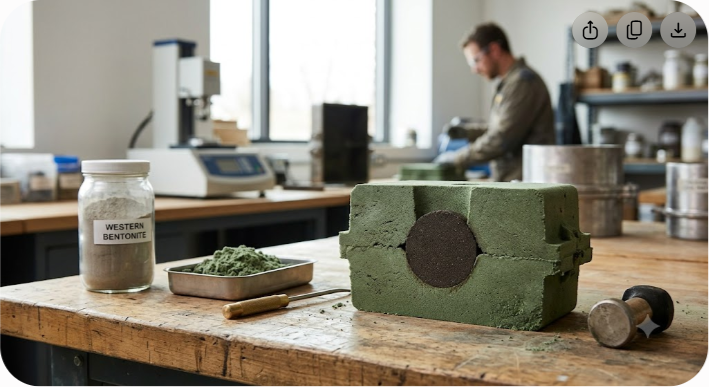
If the system is continuously generating fines faster than it removes them, changing the bentonite grade alone will not restore long-term permeability.
Mulling is one of the most overlooked parts of green sand preparation. It determines how effectively the binder, water, aggregate, and additives become a working molding material.
A muller does more than blend ingredients. Mechanical action develops the clay and distributes it through the sand. The exact energy required depends on the equipment and recipe, so mulling time should be validated rather than treated as a fixed rule.
Under-mulling can leave bentonite insufficiently developed or poorly distributed. Over-mulling can also be undesirable in some systems because excessive mechanical action may alter sand temperature, grain condition, or other properties.
The right question is not "How long should we mull?" but "What mulling conditions consistently produce the required sand properties?"
Track the resulting permeability, compactability, moisture, active clay, and green strength. Those measurements tell you whether the muller settings are doing their job.
Adding more binder may increase strength, but it also adds fine material. If permeability is already low, extra bentonite can make the problem worse.
Adjust binder based on active clay and actual sand performance rather than operator instinct.
Water is easy to adjust, which makes it tempting to use as a quick fix. But changing moisture without checking compactability and active clay can create a cycle of over-wetting and drying that never stabilizes the sand system.
The base aggregate determines much of the pore structure before bentonite is added. Changes in grain size distribution can therefore produce large changes in permeability.
Sieve analysis should be part of routine sand control, especially when new sand sources or reclamation conditions are introduced.
Core sand can alter the chemistry, fine fraction, and binder balance of a green sand system. Track how much core material enters the return sand and make sure the reclamation process is designed to handle it.
The cheapest clay per tonne is not necessarily the lowest-cost binder. A variable or inefficient bentonite can require higher addition rates, produce less predictable molding properties, and complicate sand control.
Compare suppliers using actual performance data: active clay development, swelling behavior, moisture response, green strength, thermal durability, and consistency between lots.
Bentonite is only one part of the molding sand system. Other additives can change both gas generation and pore structure.
Seacoal has traditionally been used in many iron foundry systems to improve surface finish and reduce certain metal-sand reactions. Because it is a fine carbonaceous material, excessive additions or accumulated residues can increase the fine fraction and affect permeability.
The correct level depends on the casting and the formulation. More is not automatically better.
Cereal and other organic additives can influence mold strength, collapsibility, and resistance to certain expansion-related defects. They also interact with water and therefore can change the way the sand responds during conditioning.
Any additive change should be evaluated as part of the whole sand system rather than independently.
Core materials can introduce resin-coated sand, different grain sizes, and additional thermal residues into the green sand circuit. A foundry with a high core-to-casting ratio should pay particular attention to this source of contamination.
The best results come from balancing several variables rather than maximizing one.
A practical improvement program can follow these steps:
This approach prevents the common mistake of treating bentonite as the only lever available to the foundry engineer.
Permeability control has a direct connection to foundry economics because unstable molding sand can create scrap, rework, downtime, and additional material consumption.
Gas defects, erosion, penetration, and expansion defects can all increase rejection rates. When sand properties are stable, operators can hold molding and pouring conditions closer to the process window established for the casting.
The savings are not limited to the cost of the rejected casting. Scrap also represents wasted melting energy, labor, mold preparation, machining capacity, and production time.
A consistent bentonite can make binder additions more predictable. The goal is not to minimize bentonite at any cost, but to achieve the required sand performance with a controlled and repeatable addition rate.
If a foundry repeatedly increases binder because green strength is inconsistent, the underlying problem may be clay quality, moisture control, mulling, sand temperature, or inactive fines rather than insufficient nominal binder quantity.
Efficient control of fines and binder activity can help a foundry manage its return sand more effectively. However, the actual amount of sand that must be removed from a system depends on the complete process, including reclamation efficiency, core sand input, casting production, additive package, and contaminant buildup.
Claims about specific disposal savings should therefore be based on the foundry's own operating data.
When evaluating a bentonite supplier, ask for technical data and, where possible, test the material in the actual sand system.
Important characteristics include:
The right binder is the one that gives predictable results in the application, not simply the one with the highest swelling figure on a specification sheet.
Axewelledge is referenced here as a bentonite supplier option, but foundries should evaluate any supplier's material against their own technical requirements and production data. For a high-volume green sand operation, consistency from shipment to shipment is particularly important because changes in binder behavior can affect the entire sand-control program.
Before changing the bentonite grade or addition rate, review the complete system:
These questions help separate a genuine binder problem from a moisture, aggregate, equipment, reclamation, or process problem.
Bentonite has a major influence on green sand mold permeability because it binds the sand grains while also occupying part of the pore structure through which gases must travel. The objective is not maximum permeability. It is controlled permeability combined with sufficient strength, compactability, and thermal performance.
The most important points are straightforward:
A stable green sand system is built through measurement and control. Bentonite is an important part of that system, but its performance depends on everything around it. When binder quality, moisture, mulling, aggregate distribution, reclamation, and fines control work together, the foundry has a much better chance of maintaining predictable permeability and producing sound castings.













Have questions about our products? We're here to help!