Axewelledge, a leading exporter from India, specializes in high-quality Bentonite. With a commitment to excellence, we supply premium Bentonite to the Middle East and Southeast Asia markets.


North Angle Complex, 304,
150 Feet Ring Rd, Opposite Ambedkar Nagar BRTS Stop,
Madhav Park, Punit Nagar,
Mavdi, Rajkot, Gujarat 360004
© Axewelledge 2026, All Rights Reserved.
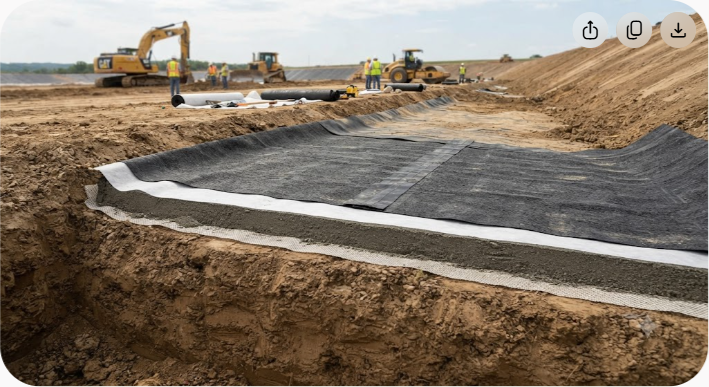
Bentonite for landfill liners is selected primarily for one reason: its ability to form a very low-permeability barrier when properly hydrated and confined. In a geosynthetic clay liner (GCL), a thin layer of bentonite is held between geotextiles and used as part of a broader composite containment system. Its performance depends on much more than a high swelling number. Mineral composition, bentonite mass per unit area, hydration conditions, confining stress, leachate chemistry, panel installation, and interface shear behavior all matter.
For designers and specifiers, the key question is not simply whether a bentonite is called sodium bentonite. The useful question is whether the selected GCL or bentonite material can meet the project's hydraulic, mechanical, chemical, and installation requirements under representative conditions.
This guide explains the main performance factors to evaluate, how sodium and calcium bentonite differ, what laboratory tests can and cannot tell you, and which specification and construction mistakes can compromise an otherwise well-designed containment system.
Bentonite is a clay dominated by smectite minerals, particularly montmorillonite. Its layered crystal structure and high specific surface area allow it to interact strongly with water. Sodium-rich montmorillonite generally develops greater swelling than calcium-dominated material when hydrated with low-ionic-strength water.
In a GCL, bentonite is placed between geotextiles that provide structural support and help maintain the clay layer in position. Once the bentonite hydrates, the clay particles swell and the resulting gel fills much of the available pore space. Under suitable confinement, this produces a barrier with very low hydraulic conductivity.
The result isn't a completely impenetrable membrane. A GCL is a hydraulic barrier whose performance depends on the material, its manufacturing, installation, hydration, confinement, and chemical environment. It is commonly used with other components, such as geomembranes and compacted soil layers, to form a composite liner system.
That distinction matters. A bentonite that performs well in a simple laboratory swelling test may not produce the same hydraulic result when exposed to concentrated salts, multivalent ions, desiccation, or an unfavorable installation condition.
Several properties should be evaluated together rather than treated as independent pass-or-fail numbers. The appropriate test methods and acceptance criteria should come from the project specification, applicable regulations, and the selected GCL manufacturer's published data.
Mineralogy provides the foundation for understanding bentonite performance. Montmorillonite is the smectite mineral primarily responsible for swelling and water retention, while non-clay minerals such as quartz, feldspar, calcite, and other constituents contribute little to the swelling mechanism.
A higher proportion of suitable smectite generally supports stronger swelling and lower hydraulic conductivity, but mineral percentage alone doesn't tell the entire story. Exchangeable cations, particle-size distribution, processing history, moisture content, and the chemistry of the test fluid can all change measured performance.
For procurement, it is therefore better to review a complete technical specification and certificate of analysis than to specify a single mineralogical number in isolation.
Free swell testing is a useful screening tool for bentonite quality. It measures how much a specified mass of dry bentonite expands when dispersed in a defined liquid under a standardized test procedure.
A high free swell value can indicate strong hydration and colloidal behavior, particularly for sodium-rich bentonite. However, a free swell result should not be treated as a direct prediction of field hydraulic conductivity. The test uses a particular liquid, concentration, sample mass, and procedure, while a landfill GCL may encounter confinement, applied stress, saline pore water, and site-specific leachate.
Some bentonite specifications use a minimum free swell value such as 24 mL per 2 g, but that figure should be treated as a specification requirement only when the applicable product standard or project specification calls for it. It is not a universal acceptance limit for every GCL or landfill application.
For quality control, compare test results using the same method and conditions. Comparing numbers generated by different procedures can create a false impression of material differences.
Hydraulic conductivity is one of the most important performance measures for a landfill containment barrier. It describes how readily a fluid moves through a porous material under a hydraulic gradient.
Hydrated bentonite can achieve extremely low hydraulic conductivity because swelling reduces connected pore space and creates a long, tortuous path for fluid movement. In a properly manufactured and installed GCL, the bentonite layer can therefore act as an effective low-permeability component of a composite liner.
The commonly cited value of 1 x 10^-9 cm/s should not automatically be treated as a universal regulatory requirement for every landfill liner component. Regulatory requirements vary by jurisdiction, waste type, facility design, and liner configuration. Project specifications may also impose additional requirements.
Hydraulic conductivity testing should therefore use the fluid, confining stress, hydraulic gradient, and testing procedure that are appropriate to the design. Testing only with deionized water can overstate performance when the actual pore fluid contains significant dissolved salts or multivalent cations.
Fluid loss testing measures the amount of liquid that passes through a bentonite suspension or filter cake under specified conditions. It is widely used to characterize bentonite in drilling-fluid applications, where filtration control is critical.
The test can provide useful information about bentonite's colloidal and filtration behavior, but it shouldn't be used as a substitute for GCL hydraulic conductivity testing. A bentonite that produces a strong filter cake in a drilling-fluid test still needs to demonstrate appropriate performance in the configuration and chemical environment of the proposed containment system.
When reviewing supplier data, check the actual test method and fluid used. A value without its test conditions is difficult to interpret.
The amount of bentonite incorporated into a GCL directly affects the thickness and continuity of the hydrated clay barrier. Manufacturers commonly specify bentonite mass per unit area as part of the product's construction and quality-control requirements.
This measurement is especially useful during manufacturing inspection and field quality assurance. A product can contain high-quality bentonite but still fail to meet the intended design if the mass is inconsistent or locally reduced.
Moisture content also needs to be considered. Wet and dry mass aren't interchangeable when comparing production batches. Specifications should clearly define whether the required mass is reported on an as-received basis or corrected to a stated moisture condition.
Bentonite needs access to water before it can develop its full swelling behavior. Hydration may occur from the underlying subgrade, overlying materials, precipitation, or controlled construction procedures, depending on the liner design.
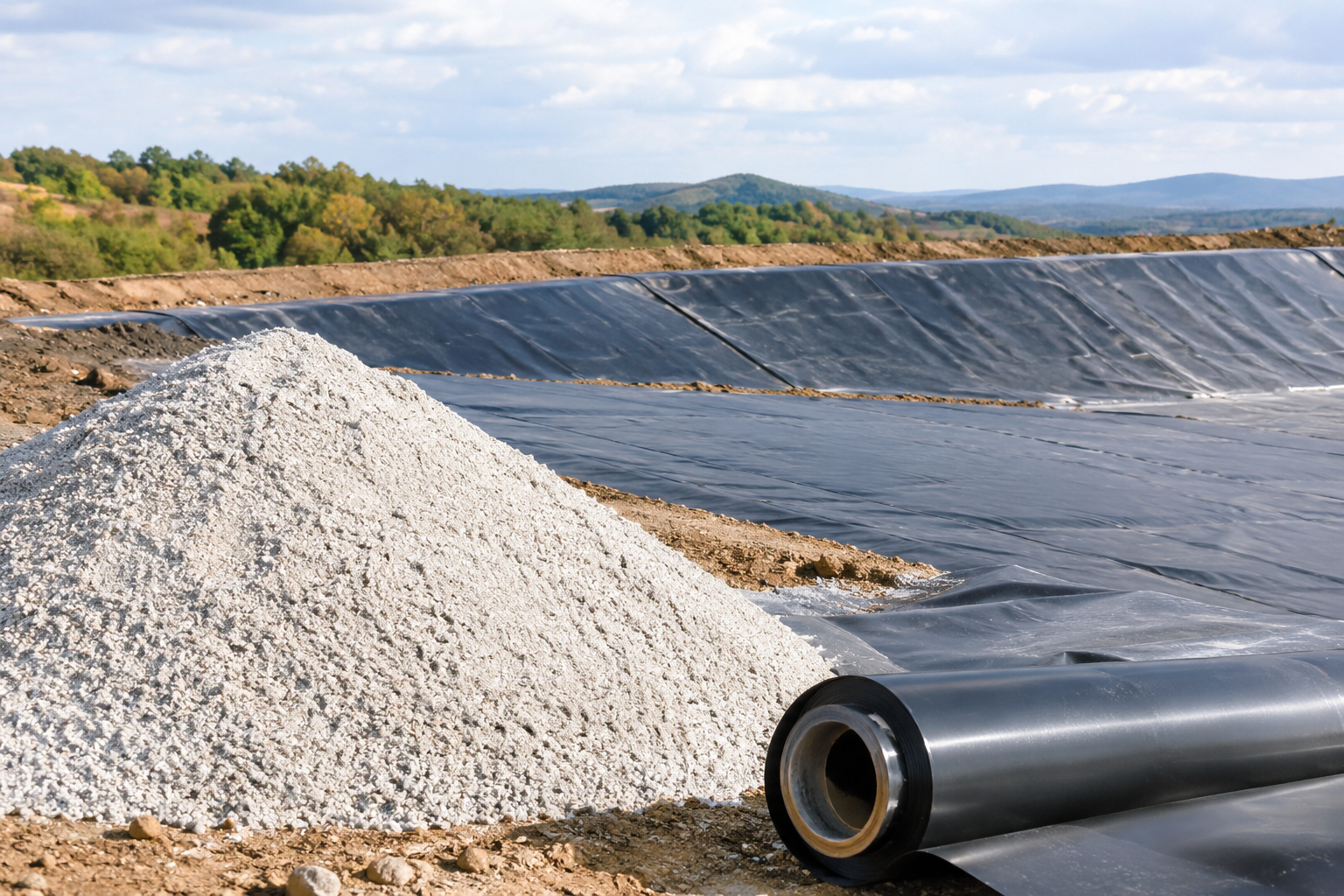
Subgrade conditions therefore deserve close attention. A dry, highly absorbent subgrade can draw water away from the bentonite and delay hydration. Conversely, uncontrolled hydration before confinement can cause handling and installation problems for some GCL configurations.
The correct procedure depends on the product and system design. Some GCLs are designed to hydrate from natural site moisture, while other applications may require specific wetting, covering, or construction controls. Follow the manufacturer's installation requirements rather than assuming that all GCLs behave identically.
Leachate chemistry can substantially influence bentonite performance. Sodium-rich bentonite generally swells strongly in low-ionic-strength water, but dissolved salts can suppress swelling. Multivalent cations such as calcium and magnesium are particularly important because they can alter the clay's diffuse double layer and exchange with sodium associated with the clay surfaces.
The result can be reduced swelling, increased pore connectivity, and higher hydraulic conductivity under some conditions. High concentrations of dissolved solids can therefore make a laboratory result obtained with deionized water a poor representation of field behavior.
Chemical compatibility testing is especially important where the leachate is expected to have elevated ionic strength or unusual chemistry. Ideally, the testing program should use representative site leachate or a carefully justified synthetic solution and should evaluate hydraulic conductivity under relevant confinement and testing conditions.
Cation exchange is central to bentonite behavior. Montmorillonite has negatively charged surfaces that attract positively charged ions. Sodium, calcium, magnesium, and other cations can occupy exchange sites associated with the clay.
Cation exchange capacity (CEC) can help characterize a clay's ability to hold exchangeable cations, but CEC alone does not determine whether a bentonite will perform adequately as a landfill barrier. The type and proportion of exchangeable cations are also important.
For environmental containment, the practical issue is how the selected bentonite responds to the actual fluid chemistry. Two materials with similar CEC values can behave differently when exposed to a particular leachate because their mineralogy and exchangeable-cation populations differ.
Hydraulic performance is only one part of GCL design. The liner must also remain stable during installation and throughout the life of the containment system.
Hydrated bentonite can have low shear resistance compared with many surrounding materials. On landfill side slopes, this makes interface shear testing particularly important. The relevant failure surface may occur within the GCL or at the interface between the GCL and an adjacent geomembrane, geotextile, soil layer, or other component.
Designers should evaluate peak and, where relevant, large-displacement or residual shear behavior under representative normal stresses and moisture conditions. The results should be incorporated into slope-stability calculations for the complete liner system.
It isn't enough to know the shear properties of bentonite powder in isolation. The actual GCL interfaces and construction configuration control field stability.
Sodium and calcium bentonite differ mainly in the dominant exchangeable cation associated with the smectite structure. This difference has a major effect on hydration and swelling behavior.
| Property | Sodium-Dominant Bentonite | Calcium-Dominant Bentonite | Polymer-Modified Bentonite |
|---|---|---|---|
| Water swelling | Generally high | Generally lower | Can be engineered for high swelling under selected conditions |
| Low-permeability potential | Strong under suitable conditions | Can be suitable in specific formulations and designs | May provide improved performance in selected chemical environments |
| Sensitivity to ionic strength | Can be significant | Also affected by solution chemistry | Depends strongly on polymer chemistry and formulation |
| Typical containment use | Common in GCL products | Less common as an unmodified GCL clay | Used for selected challenging chemical conditions |
| Quality-control focus | Swell, hydraulic conductivity, mineralogy, mass and moisture | Hydraulic conductivity, compatibility and formulation | Polymer content, compatibility, durability and hydraulic performance |
Natural sodium bentonite is widely used in GCL products because of its strong swelling and low-permeability characteristics under suitable conditions. Calcium bentonite is not automatically unsuitable, but untreated calcium-dominant material generally has lower swelling than sodium-dominant bentonite and may not meet the same product requirements without modification or formulation changes.
Polymer-enhanced bentonite products can be developed for environments where conventional bentonite may experience substantial swelling suppression. Their performance, however, depends on the specific polymer system, fluid chemistry, concentration, temperature, confinement, and long-term compatibility. They should be evaluated using product-specific test data rather than assumed to be universally resistant to aggressive leachate.
A useful specification should evaluate the complete GCL rather than treating bentonite as a commodity powder with one universal performance number.
A project team will commonly review several groups of properties:
This approach avoids a common mistake: choosing a bentonite solely because it has a high free swell value.
A requirement such as “use sodium bentonite” isn't enough to establish performance. Sodium-dominant bentonites from different deposits can have different mineralogy, swelling characteristics, exchangeable-cation composition, and processing properties.
Specify measurable performance requirements and the applicable test methods. Then verify that the delivered product matches the approved material.
Free swell is useful, but it doesn't reproduce every field condition. A bentonite can show strong swelling in dilute water while responding differently to concentrated leachate.
Use free swell as one part of a broader quality-control program that includes hydraulic conductivity and, where relevant, compatibility testing.
Testing only with deionized water can miss chemical effects that matter in the field. If the project will generate or receive high-ionic-strength leachate, representative fluid testing can provide a much more useful indication of performance.
Two GCL products with similar bentonite mass can behave differently because their bentonite, geotextile configuration, manufacturing process, and bonding system differ.
Evaluate the complete product against the project specification rather than comparing mass per unit area alone.
A GCL installed over a very dry or highly absorbent subgrade may not hydrate as expected. Construction specifications should address subgrade moisture, exposure time, precipitation, and the timing of cover placement.
Adjacent GCL panels must overlap according to the manufacturer's installation instructions and project requirements. Inadequate overlap can create a discontinuity in the bentonite barrier and compromise the intended containment system.
Where the installation procedure calls for supplemental bentonite at overlaps or penetrations, the specified material and application rate should be followed carefully.
GCLs can be damaged by equipment traffic, sharp subgrade objects, excessive stretching, folds, or prolonged exposure before the protective cover is installed. A good material cannot compensate for poor field handling.
A practical QA/QC program connects supplier documentation, laboratory testing, field inspection, and construction records.
Before selecting the material, establish the waste type, expected leachate chemistry, liner configuration, normal stresses, slope geometry, climatic conditions, and applicable regulatory requirements.
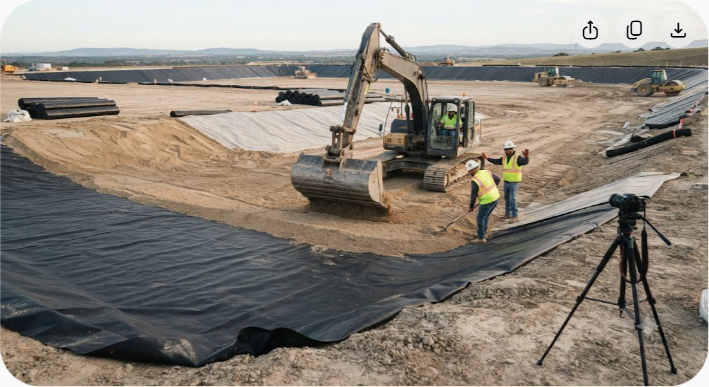
These conditions determine which bentonite and GCL properties need the closest scrutiny.
Obtain the manufacturer's technical data, quality-control documentation, product specifications, test methods, and installation instructions. Check that the stated values correspond to the same product configuration being proposed for the project.
Avoid comparing isolated numbers from different test procedures as though they were directly equivalent.
Depending on the project specification, testing may include free swell, moisture content, mass per unit area, particle-size distribution, mineralogical characterization, fluid loss, and other relevant properties.
Acceptance criteria should be established before material delivery rather than changed after a test result is received.
Where leachate chemistry could suppress bentonite swelling, carry out compatibility testing under representative conditions. Hydraulic conductivity testing with the relevant fluid is often more informative than relying on a simple water-based swelling test.
The testing period and conditions should be sufficient for the project team to understand whether the material's hydraulic performance remains acceptable as the chemical environment changes.
The subgrade should be prepared to the required smoothness, density, grade, and moisture condition. Remove objects that could damage the GCL or create local discontinuities.
Document the inspection before panels are placed. Correcting a subgrade problem after the liner is installed is considerably more difficult.
Install panels according to the approved layout and manufacturer's instructions. Maintain the required overlap widths, minimize wrinkles and folds, and prevent unnecessary traffic over exposed GCL.
At seams, penetrations, terminations, and other details, use the specified supplemental bentonite or accessory materials where required.
Once the GCL is installed, protect it from prolonged weather exposure and construction traffic. The required cover thickness and placement sequence depend on the complete liner design.
Cover placement should be controlled so that equipment does not damage, displace, or excessively stress the underlying GCL.
Record product identification, delivery batches, test results, panel locations, overlap inspections, repairs, weather conditions, and cover placement. Good documentation makes it easier to trace a problem to a specific material batch or construction area if an issue is discovered later.
Consider a landfill expansion where the proposed liner includes a geomembrane, GCL, and compacted soil component. The project team initially identifies a high-swelling sodium bentonite product based on its free swell result.
That is a useful starting point, but it isn't enough for final selection.
The team should first identify the expected leachate composition and determine whether elevated ionic strength or multivalent cations are likely to affect the clay. The proposed GCL can then be evaluated using hydraulic conductivity testing under representative fluids and confining conditions.
Next, the team examines side-slope geometry and obtains interface shear data for the actual liner components. This information is incorporated into slope-stability calculations rather than relying on a generic bentonite friction value.
Finally, the construction specification addresses subgrade preparation, panel overlaps, weather exposure, cover placement, inspection, and repair procedures.
The important lesson is simple: the selection isn't based on one impressive laboratory number. It is based on whether the complete GCL system can satisfy the hydraulic, chemical, mechanical, and construction requirements of the project.
Compatibility testing becomes especially valuable when a landfill is expected to produce unusual or concentrated leachate. Important variables can include total dissolved solids, ionic strength, pH, calcium, magnesium, sodium, potassium, and other constituents relevant to the waste stream.
The exact test program should reflect the project rather than follow a one-size-fits-all recipe. Useful questions include:
Testing should also distinguish between initial compatibility and long-term behavior. A short test can reveal an immediate response, but it may not capture all changes associated with prolonged chemical exposure.
Containment projects often involve large quantities of GCL or bentonite, so consistency between production batches matters. Natural deposits can vary across a mine, and processing can further affect particle size, moisture, and blending characteristics.
A reliable procurement program should therefore define how batches are identified, sampled, tested, and accepted. Certificates of analysis are useful, but project-specific verification testing can provide an additional layer of confidence when the application is sensitive.
For industrial mineral suppliers, the important capability isn't simply access to a large bentonite deposit. Consistent processing, documented quality control, traceability, and the ability to supply material that matches the agreed specification are equally important.
At Axewelledge, bentonite supply for environmental and industrial applications can be evaluated around the technical requirements of the intended use, including mineral characteristics, processing specifications, and quality-control needs. For a landfill or other containment project, the final material specification should be developed around the required GCL or barrier performance rather than a generic bentonite grade.
Bentonite provides the low-permeability clay component in many geosynthetic clay liners. When suitable bentonite hydrates under confinement, its swelling reduces connected pore space and restricts fluid movement. The GCL normally works as one component of a composite containment system, alongside materials such as geomembranes and compacted soil layers.
Sodium-dominant bentonite generally develops greater swelling and lower hydraulic conductivity than calcium-dominant bentonite when hydrated with low-ionic-strength water. That behavior makes it widely used in GCL products. However, performance depends on the complete formulation and field chemistry, so product-specific hydraulic and compatibility data remain important.
Leachate with high ionic strength or elevated concentrations of multivalent cations such as calcium and magnesium can reduce bentonite swelling. Cation exchange and changes in the clay's diffuse double layer can alter pore structure and increase hydraulic conductivity. Representative compatibility testing helps determine whether the selected GCL remains suitable under expected chemical conditions.
No. A free swell value such as 24 mL per 2 g is used in some bentonite and GCL specifications, but it isn't a universal acceptance limit for every landfill project. The applicable regulatory requirements, product standard, and project specification should determine the acceptance criterion. Free swell should also be considered alongside hydraulic conductivity and other relevant properties.
The required hydraulic conductivity depends on the jurisdiction, waste type, containment design, and applicable regulatory and project requirements. A value around 1 x 10^-9 cm/s is commonly associated with low-permeability bentonite barriers, but it shouldn't be assumed to be the universal requirement. Testing should use the specified fluid and conditions relevant to the design.
Engineers evaluate the shear behavior of the complete GCL system and its interfaces with adjacent liner components. Testing can include peak and large-displacement or residual interface shear behavior under representative normal stresses. The resulting parameters are then incorporated into slope-stability calculations, with panel layout, drainage, cover loading, and construction conditions also considered.
Bentonite needs water to hydrate and develop its swelling behavior. A very dry or highly absorbent subgrade can draw moisture away from the GCL and delay hydration. Installation requirements therefore address subgrade condition, exposure time, weather, and cover placement. The correct hydration procedure should always follow the selected GCL manufacturer's instructions.
A supplier should be able to provide consistent material identification, applicable technical specifications, certificates of analysis, relevant test data, and traceability for supplied batches. For demanding containment applications, buyers may also require mineralogical, swelling, hydraulic, moisture, mass-per-unit-area, or compatibility data. The exact documentation should match the project's specification and quality-assurance plan.













Have questions about our products? We're here to help!