Axewelledge, a leading exporter from India, specializes in high-quality Bentonite. With a commitment to excellence, we supply premium Bentonite to the Middle East and Southeast Asia markets.


North Angle Complex, 304,
150 Feet Ring Rd, Opposite Ambedkar Nagar BRTS Stop,
Madhav Park, Punit Nagar,
Mavdi, Rajkot, Gujarat 360004
© Axewelledge 2026, All Rights Reserved.
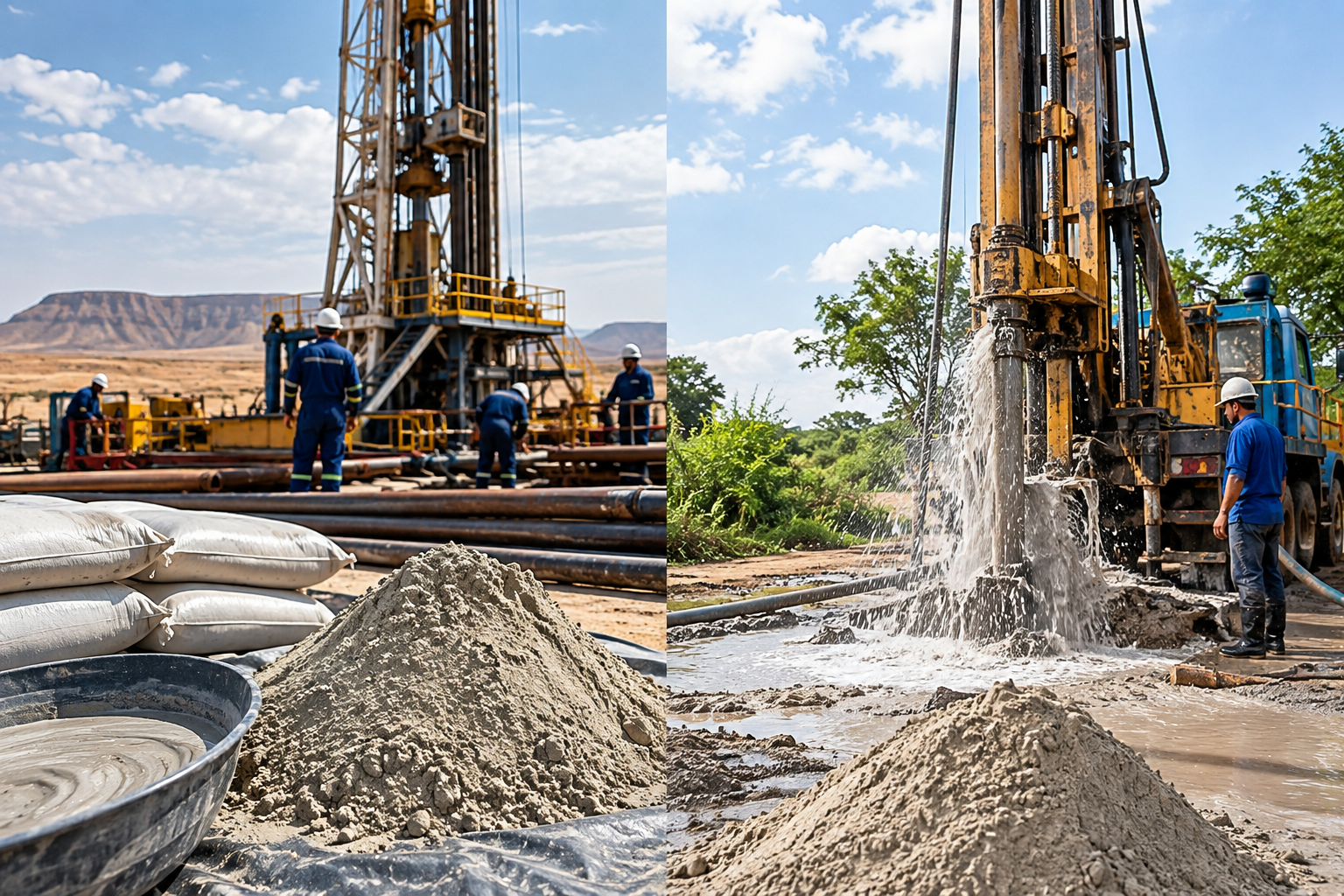
Bentonite can help control lost circulation, but it isn't a universal plug for every type of formation loss. Its main value is as a highly colloidal, water-swellable clay that increases viscosity, improves suspension, and helps build a low-permeability seal. In many treatments, it also carries other lost circulation materials (LCMs) into fractures and voids where those materials provide the actual mechanical bridge.
The right treatment depends on why the fluid is being lost, how quickly it is disappearing, the size and geometry of the loss zone, the drilling-fluid system already in the hole, and the pressure available to place the treatment. A simple bentonite sweep may be appropriate for seepage losses. A large naturally fractured or cavernous zone usually needs a designed LCM treatment, with bentonite serving as the carrier and rheology builder rather than the sole sealing material.
This guide explains how bentonite works in lost-circulation control, how to prepare and mix it, when to use a concentrated pill, how bentonite interacts with other LCMs, and which mistakes can undermine an otherwise sound treatment.
Lost circulation occurs when drilling fluid leaves the wellbore and enters the surrounding formation instead of returning to the surface through the annulus. The loss can range from a small seepage rate to a complete loss of returns.
The underlying cause is usually a pressure and formation problem. If the pressure exerted by the circulating fluid exceeds the formation's ability to contain that pressure, fluid can enter natural fractures, induced fractures, vugs, cavernous intervals, or highly permeable zones. Excessive equivalent circulating density, excessive surge pressure, weak formations, and naturally open fractures can all contribute.
Lost circulation matters because drilling fluid performs several jobs at once. It carries cuttings, cools and lubricates the drillstring, helps maintain wellbore pressure, and contributes to formation stability. Losing too much of that fluid can make each of those functions harder to maintain.
There isn't one universal set of numerical boundaries for loss severity. Operators and drilling-fluid programs often classify losses according to local practice, well conditions, and the rate of fluid disappearance. A practical classification is:
These categories describe the operational effect rather than a fixed geological diagnosis. The same loss rate can have different consequences depending on hole size, pump rate, fluid properties, formation pressure, and available surface equipment.
Sodium bentonite is valued in drilling because of its high affinity for water and its ability to form a stable colloidal suspension. When properly hydrated in suitable water, bentonite platelets disperse and interact to produce viscosity and gel structure.
That behavior gives bentonite several useful roles in a loss-control treatment.
The important distinction is that bentonite doesn't automatically seal every fracture. Its effectiveness depends heavily on the size of the opening and the ability of the treatment to reach and bridge that opening.
Sodium bentonite is dominated by smectite minerals, particularly montmorillonite. Its layered structure allows water to enter between clay layers, producing substantial hydration and dispersion when the chemistry and mixing conditions are favorable.
That hydration is the foundation of its drilling performance. A good sodium bentonite can develop useful rheology at relatively modest concentrations compared with less swelling clays, making it suitable for drilling-fluid formulations and specialized treatments.
| Bentonite characteristic | Why it matters in drilling |
|---|---|
| High hydration capacity | Helps develop viscosity and suspension after proper mixing |
| Colloidal behavior | Supports stable water-based drilling-fluid systems |
| Gel development | Helps suspend cuttings and LCMs when circulation slows or stops |
| Filtration control | Contributes to formation of a low-permeability filter cake |
| Rheology modification | Helps engineers adjust flow behavior for hole cleaning and treatment placement |
| Cation exchange behavior | Makes water chemistry and ionic contamination important during hydration |
Bentonite performance isn't determined by the mineral name alone. Particle-size distribution, mineral composition, moisture, processing, hydration characteristics, and product specifications all affect field performance. That's why drilling operations should work from the supplier's technical data and the actual mud-test results rather than assuming that every bentonite product will behave identically.
A useful way to understand a bentonite-based treatment is to separate the job into two functions: rheology and bridging.
Bentonite primarily provides the rheological framework. It thickens the carrier fluid, improves suspension, and can help the treatment remain concentrated at the loss interval.
LCMs provide much of the physical bridging. Granular materials can bridge openings, fibers can form a reinforcing network, and flakes can overlap across irregular surfaces. A properly designed particle-size distribution gives the treatment a better chance of establishing a seal across a range of aperture sizes.
In a moderate loss zone, bentonite alone may provide useful control when the openings are small and the treatment can form a stable filter cake. As the openings become larger, relying on clay alone becomes less dependable. The treatment needs material capable of physically spanning the opening.
This is why a bentonite slurry is often best viewed as a carrier and sealing matrix, not simply as a bulk plugging material.
The quality of the final treatment starts with mixing. Poor hydration can make a high-quality bentonite perform like a much weaker product.
Water chemistry has a direct effect on clay hydration. Calcium and magnesium can interfere with the dispersion and swelling behavior of bentonite, while high salinity can reduce the hydration of many freshwater bentonite products.
Before mixing a concentrated treatment, check the available water and compare it with the bentonite supplier's recommended mixing conditions. If the water is hard, an appropriate treatment such as soda ash may be used in some water-based systems to reduce the effect of calcium. The amount should be based on water testing and the drilling-fluid program rather than a fixed recipe.
Bentonite should be introduced through suitable mixing equipment at a controlled rate. Dumping large quantities directly into a tank can produce hydrated outer layers around dry interiors. These partially hydrated lumps are often called fish eyes and may take much longer to disperse.
A properly operated jet hopper or other high-shear mixing system exposes more clay surface area to water and promotes faster, more uniform hydration.
There is no single mixing time that applies to every bentonite product or field system. Product type, particle size, water chemistry, shear energy, temperature, and concentration all influence hydration.
A field program may use a defined hydration period, but the better practice is to verify performance through rheology and filtration testing. If the slurry is still developing viscosity after the planned mixing period, it shouldn't be treated as fully hydrated simply because a particular number of minutes has passed.
Useful field measurements can include Marsh funnel viscosity, rheometer readings, gel strengths, density, and filtration properties. The appropriate tests depend on the drilling application and the fluid system.
The goal isn't to achieve the highest possible viscosity. Excessive viscosity can increase circulating pressure, raise equivalent circulating density, impair pumping, and make placement harder. A treatment should have enough structure to perform its intended job without creating a new pressure problem.
A lost-circulation pill is a concentrated treatment volume designed to be placed at or near the loss interval. The exact formulation should be based on the loss mechanism, hole geometry, fluid compatibility, temperature, pressure, and the LCM materials available at the rig.
A basic design process looks like this:
A pill should be designed around the formation rather than around a generic bentonite concentration. Two wells with the same nominal loss rate may require very different treatments if one is losing fluid through small permeable pores and the other through large natural fractures.
For many serious losses, the most effective approach is a blend of bentonite and LCMs. The materials perform different jobs within the treatment.
| LCM type | Typical role in a treatment |
|---|---|
| Granular LCM | Provides physical bridging across openings |
| Flake LCM | Creates overlapping coverage across irregular surfaces |
| Fibrous LCM | Forms a reinforcing network and helps interlock other particles |
| Sized calcium carbonate | Provides acid-soluble bridging in applications where that property is required |
| Cellulosic materials | Can contribute fibers or particles to a sealing structure |
| Bentonite | Builds viscosity, suspends LCMs, and contributes to the sealing matrix |
A mixture containing different particle sizes can be more useful than relying on one size alone. Larger particles begin the bridge, medium particles fill the developing structure, and finer material helps reduce remaining voids.
The exact combination depends on the loss zone and the operating environment. The treatment also needs to remain pumpable through the planned flow path. A formulation that looks excellent on paper but cannot be placed without excessive pressure isn't a practical treatment.
Bentonite can be useful on its own when losses are relatively small and the formation accepts a fine, colloidal material. Examples can include seepage into permeable formations or small pathways where a filter cake and increased fluid structure can reduce invasion.
A bentonite-only treatment may also make sense when the primary objective is to improve the carrying capacity and rheology of the drilling fluid rather than to bridge a large fracture.
The limitation is straightforward: clay particles are very small. They aren't a substitute for coarse bridging material when the loss pathway is large enough for the treatment to flow through before a stable seal develops.
A more aggressive treatment is usually warranted when losses are substantial, circulation is difficult to maintain, or the formation contains fractures, vugs, or other large flow channels.
In those cases, bentonite can be used to create a viscous carrier that transports a carefully selected blend of LCMs. The coarse material helps establish the bridge, while the finer particles and clay help fill the remaining spaces.
For very large voids or cavernous formations, even a well-designed LCM pill may not provide a permanent solution. The formation may require a specialized cement, resin, gunk, or other remedial treatment, depending on the well design and operational requirements. Bentonite should therefore be selected as part of the overall loss-control strategy, not treated as a universal remedy.
A treatment only works if it reaches the loss zone in usable condition. Placement planning is therefore just as important as the recipe.
The crew needs to account for the internal volume of the drillstring, annular volume, pump rate, fluid rheology, and estimated location of the loss interval. The treatment should be displaced carefully so that its leading edge reaches the target without unnecessarily exposing weak formations to high pressure.
Once the pill is positioned, the appropriate static period depends on the treatment chemistry and the design objective. Some pills rely on rapid bridging, while others need time to develop gel structure or interact with the formation. A blanket thirty- or sixty-minute rule isn't appropriate for every formulation.
Restarting circulation also requires care. Applying full pump rate immediately can disturb a developing seal or create a pressure surge. A controlled restart, followed by observation of returns and pressure response, provides a better indication of whether the treatment has held.
Mud weight is closely connected to lost circulation. Increasing density raises hydrostatic pressure, which can help maintain well control but can also push a weak formation beyond its fracture pressure.
When losses begin, adding more and more weight without understanding the pressure window can make the problem worse. Engineers should consider the relationship between mud density, annular pressure losses, surge and swab effects, and the formation's pressure and fracture characteristics.
Bentonite itself should not be viewed as a method for solving an excessive mud-weight problem. Its role is to modify fluid behavior and support sealing. If the root cause is an overbalanced or hydraulically aggressive drilling program, the treatment should be accompanied by a review of the operating parameters.
Polymers can be used with bentonite in some water-based drilling-fluid systems to modify filtration, rheology, encapsulation, or shale interaction. However, compatibility matters.
For example, an anionic polymer isn't automatically the right choice simply because it increases viscosity or reduces filtration in a laboratory test. The polymer type, concentration, water chemistry, temperature, salinity, solids content, and existing additives all influence performance.
The same principle applies to caustic soda and other mud chemicals. Adjusting pH can affect clay dispersion, but more chemical isn't necessarily better. Over-treatment can create undesirable rheology or compatibility problems.
For field use, additive selection should follow the drilling-fluid program and supplier guidance, with laboratory or pilot testing when the treatment is unfamiliar or unusually concentrated.
A generic pill may work in one formation and fail completely in another. Losses through fine pores, induced fractures, natural fractures, and caverns require different approaches.
Start with the loss mechanism and available formation information. Then select the material and concentration.
Bentonite that hydrates well in fresh water may behave differently in hard or saline water. Calcium and magnesium can reduce dispersion, while salts can suppress hydration depending on the clay and concentration.
Test the water before preparing a large treatment whenever conditions allow.
A very thick pill can be difficult to pump and may generate excessive pressure during placement. That can create additional fractures or prevent the treatment from reaching the target.
The objective is controlled rheology, not maximum rheology.
If the loss zone contains large fractures or voids, fine clay may simply enter the formation without establishing a durable bridge. In such cases, the formulation needs appropriately sized LCMs.
Excess drilled solids can increase plastic viscosity and alter the performance of a bentonite-based fluid. They can also increase circulating pressure and equivalent circulating density.
Good solids-control practices remain important even during a loss-control event.
A newly formed seal can be disturbed by a sudden increase in flow rate or pressure. Restart procedures should be planned with the expected formation strength and treatment design in mind.
Values such as mixing time, bentonite concentration, pill volume, and static time should not be treated as universal specifications. Product data and field conditions vary.
Use laboratory data, supplier recommendations, and actual mud checks to establish the working range.
Choosing a bentonite product should start with the application rather than the lowest purchase price. Important characteristics include hydration behavior, viscosity development, filtration performance, particle-size distribution, moisture, mineral composition, and consistency between batches.
For freshwater drilling fluids, an appropriate API-grade sodium bentonite may provide the required viscosity and filtration characteristics. High-yield products can be useful where the operation needs greater rheological performance from a lower solids concentration. In more challenging environments, treated bentonites or bentonite-polymer systems may offer advantages, although their suitability should be confirmed under the actual water and temperature conditions.
Before purchasing material for a drilling program, ask for:
A supplier that can provide consistent technical documentation is easier to work with when a mud program needs to be reproduced across multiple wells or locations.
For buyers evaluating bentonite for drilling and loss-control applications, Axewelledge can be considered as a mineral supplier. Product selection should still be based on the required specification, test data, and compatibility with the drilling-fluid program rather than on supplier claims alone.
Bentonite is used in both oil and gas drilling and water-well applications, but the fluid requirements can differ substantially.
In water-well drilling, bentonite may be used for drilling-fluid viscosity, cuttings transport, borehole stabilization, filtration control, and other well-construction functions. The formulation often needs to support the particular drilling method and formation being penetrated.
Oil and gas wells can involve much more demanding pressure, temperature, salinity, solids, and completion considerations. A bentonite treatment suitable for a shallow freshwater application shouldn't automatically be transferred to a high-temperature or high-salinity well.
The common principle is simple: select the bentonite and treatment based on the fluid system and downhole environment.
Before mixing a bentonite-based lost-circulation treatment, confirm the following:
This checklist helps keep the response focused on the actual loss problem instead of turning every event into a generic high-viscosity treatment.
Success shouldn't be judged solely by whether returns appear immediately after the treatment. Monitor the response over the next drilling and circulation stages.
Useful indicators include a reduction in fluid-loss rate, recovery of surface returns, more stable pit volume, improved pump-pressure behavior, and the ability to resume drilling without the loss rate returning to its previous level.
If losses return as soon as normal circulation resumes, the first treatment may have bridged only part of the zone. Another treatment, a different LCM blend, or a more permanent remedial method may be required.
The pressure response is also important. A treatment that reduces losses but creates an unacceptably narrow operating window may not be a practical long-term solution. The best result is a stable seal that allows the drilling program to continue within safe hydraulic limits.
Bentonite is a valuable component of lost-circulation control because it hydrates, develops colloidal viscosity, provides gel structure, improves suspension, and contributes to filtration control. Those properties make it particularly useful as a carrier and matrix for LCM treatments.
The most important point is that bentonite isn't a one-size-fits-all lost-circulation solution. Small seepage losses may respond to a properly hydrated bentonite system, while larger fractures and cavernous zones generally call for a combination of bentonite and appropriately sized LCMs.
Good results depend on matching the treatment to the loss mechanism, controlling water chemistry, mixing the clay properly, managing rheology and pressure, placing the pill accurately, and evaluating the seal before returning to normal drilling.
For commercial drilling operations, consistent bentonite quality matters as much as the formulation itself. A product with reliable hydration and rheological performance makes treatment design more predictable and helps reduce variation between batches. The final selection should always be verified against the drilling-fluid specification, supplier test data, and the conditions of the well.













Have questions about our products? We're here to help!