Axewelledge, a leading exporter from India, specializes in high-quality Bentonite. With a commitment to excellence, we supply premium Bentonite to the Middle East and Southeast Asia markets.


North Angle Complex, 304,
150 Feet Ring Rd, Opposite Ambedkar Nagar BRTS Stop,
Madhav Park, Punit Nagar,
Mavdi, Rajkot, Gujarat 360004
© Axewelledge 2026, All Rights Reserved.
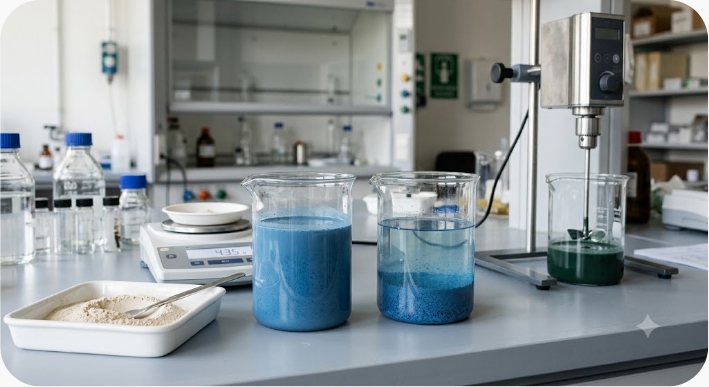
A coating can contain the right pigment, binder, solvent balance, and color and still develop a serious storage problem if the pigment settles too quickly. Bentonite improves pigment suspension in industrial coatings by building controlled low-shear structure in the liquid phase. That structure increases resistance to particle movement and can slow the downward migration of dense pigment particles.
The important point is that adding more clay doesn't automatically produce a better coating. Bentonite grade, activation, dispersion method, dosage, pigment loading, binder chemistry, and application shear all influence the result. A formulation that looks stable in a laboratory beaker may behave differently after storage, pumping, tinting, or spray application.
This guide explains what bentonite does inside a coating, how to select and incorporate it, which dosage levels are useful for initial screening, how to test pigment settling, and which formulation mistakes commonly lead to poor flow, excessive viscosity, or hard sediment.
Pigments are solid particles dispersed through a liquid formulation. Many industrial pigments are substantially denser than the surrounding liquid, so gravity naturally drives them toward the bottom of the container.
If the formulation doesn't provide enough resistance to particle movement, pigments gradually settle. The result may be a concentrated layer at the bottom of a drum, color variation between portions of the same batch, changes in film properties, or extra mixing before application.
Suspension isn't just a storage concern. It affects how consistently the coating performs from the first use to the last.
A well-designed coating has to balance several properties:
These requirements can conflict. Increasing viscosity may improve settling resistance, but excessive viscosity can make pumping and spraying difficult. A strong thixotropic structure can improve storage stability while hurting leveling if it doesn't break down appropriately under shear.
That's where bentonite can be useful.
Bentonite is a naturally occurring clay dominated by smectite minerals, particularly montmorillonite. Its fine plate-like particles can interact with one another when they are properly dispersed in a compatible liquid system.
In suitable formulations, those particles form a weak internal network. The network increases resistance to movement under low-shear conditions, which is particularly useful while a coating sits undisturbed in a container.
The practical mechanism can be understood through four related effects.
A coating at rest needs enough internal structure to slow the downward movement of pigment particles. Depending on the grade and formulation, bentonite can increase low-shear viscosity and contribute to yield-like behavior.
This matters because pigment settling is primarily a low-shear problem. A coating may need to be structured while sitting on a warehouse shelf but considerably less viscous while it is being pumped or sprayed.
Some bentonite-containing systems become more structured at rest and less structured when shear is applied. After the shear is removed, part of that structure can rebuild over time.
That behavior suits many industrial coatings because storage and application place very different demands on the formulation. During storage, the coating needs to hold particles in place. During application, it needs to move.
The goal isn't maximum viscosity. It's a controlled rheology profile that changes appropriately with shear.
Sedimentation is influenced by particle size, the density difference between the solid and liquid phases, and the resistance of the continuous phase to particle movement. Increasing that resistance can slow settling.
Bentonite doesn't have to stop every particle from moving to be useful. In many formulations, reducing the rate of sedimentation and maintaining a soft, easily redispersed structure is more practical than creating an extremely rigid system.
The same rheological structure that helps suspend pigments can also help a wet coating resist sag on vertical surfaces. This is relevant to industrial primers, protective coatings, maintenance paints, and other products applied at useful wet-film thicknesses.
Suspension and sag control are often related formulation objectives. Improving one can influence the other, although the desired balance depends on the application method and film requirements.
The exact mechanism depends on the clay chemistry and liquid phase, but the way the clay is introduced into the formulation is important.
When bentonite is added to a compatible liquid and properly dispersed, the clay particles interact with the surrounding medium and with one another. In aqueous systems, hydration is particularly important because water interacts strongly with suitable hydrophilic bentonite grades.
Under low shear, these interactions can create a structured network throughout the liquid. Pigment particles moving through that network encounter more resistance than they would in an unstructured, low-viscosity medium.
Under higher shear, the structure can partially break down. Apparent viscosity falls, making the coating easier to pump, mix, brush, roll, or spray. Once the coating returns to a low-shear state, some of the structure can rebuild.
This is why one viscosity measurement at one spindle speed doesn't tell you everything about a coating.
A formulation can show an acceptable viscosity at a single test condition and still settle during storage. Conversely, a coating with relatively high low-shear viscosity may spray well if its structure breaks down appropriately under application shear.
For formulation work, rheology needs to be viewed as a profile rather than a single number.
Not every bentonite grade is interchangeable.
The first consideration is the chemistry of the coating. Water-based systems, solventborne systems, and formulations containing specialized solvents or resins can require different rheology technologies.
For water-based coatings, a suitably selected hydrophilic bentonite can provide suspension and rheology modification after proper dispersion and hydration. Sodium-rich bentonites are often considered because of their swelling and water-interaction characteristics, but actual performance depends on mineral composition, processing, particle size, purity, and the rest of the formulation.
For solventborne systems, ordinary hydrophilic bentonite isn't automatically the correct choice. Organophilic clays, commonly called organoclays, are often used when compatibility with non-aqueous media is required.
The distinction matters. Saying that a material is bentonite doesn't tell a formulator how it will behave in a particular coating. The clay needs to be compatible with the continuous phase and the desired rheological profile.
Bentonite is one of several technologies used to control suspension and rheology. The appropriate choice depends on coating chemistry, processing conditions, application method, and performance targets.
| Rheology approach | Main strength | Typical consideration |
|---|---|---|
| Bentonite | Suspension, low-shear structure, thixotropy | Requires an appropriate grade and effective dispersion |
| Organoclay | Rheology control in many solventborne systems | Often requires specific activation and processing |
| Associative thickener | Flow and viscosity modification in suitable systems | Performance depends strongly on resin and surfactant chemistry |
| Cellulosic thickener | Useful viscosity control in many water-based systems | Can influence flow, leveling, and water sensitivity |
| Fumed silica | Strong rheological and anti-settling effects in selected systems | Dispersion and dust handling require attention |
| Polymeric rheology modifier | Tunable rheology profiles | Compatibility and formulation interactions must be evaluated |
These technologies aren't interchangeable recipes. Some coatings use a single rheology modifier, while others combine materials to achieve the required profile.
Bentonite can be useful when a formulator wants mineral-based low-shear structure and suspension support without relying entirely on a conventional soluble thickener.
There is no universal bentonite dosage for industrial coatings. The required level depends on the clay grade and the complete formulation.
For initial laboratory screening in a water-based industrial coating, a practical study might examine approximately 0.5%, 1.0%, 1.5%, 2.0%, and 3.0% bentonite by weight. The final level should then be adjusted based on rheology, settling, application behavior, and film properties.
These are formulation starting points, not specifications for every coating. Some systems may reach the desired structure at lower levels, while others may need a different technology altogether.
The mistake to avoid is choosing dosage from container viscosity alone.
Suppose 1% gives acceptable viscosity but visible pigment settling remains after storage. Moving to 2% might improve suspension, but it could also create excessive low-shear structure or change application behavior. The better solution could instead be improved pigment dispersion, a different bentonite grade, a co-thickener, or a revised addition sequence.
Treat dosage as an optimization variable, not a fixed recipe.
If you're developing or troubleshooting an industrial coating, a controlled laboratory workflow is a better starting point than adding clay by trial and error.
Before changing the formulation, identify what is actually happening.
Ask:
A hard sediment may indicate a broader dispersion or formulation problem rather than simply a lack of viscosity.
Bentonite can improve suspension, but it isn't a substitute for proper pigment wetting and dispersion.
Poorly dispersed pigment agglomerates behave differently from well-dispersed individual particles. Large agglomerates can settle faster, create color variation, and contribute to surface defects.
Check dispersion quality before increasing the clay level. If pigment aggregates are already present, thickening the continuous phase may hide the underlying problem without correcting it.
Match the clay to the continuous phase and the rheological profile you need.
For water-based coatings, evaluate a grade intended to disperse and develop structure in aqueous systems. For solventborne formulations, investigate a suitable organophilic clay or another rheology modifier designed for the selected medium.
Supplier technical data should also be reviewed. Depending on the application, useful characteristics can include moisture, fineness, mineral composition, swelling behavior, viscosity characteristics, and other quality parameters that may influence batch-to-batch performance.
Dispersion quality matters as much as nominal dosage.
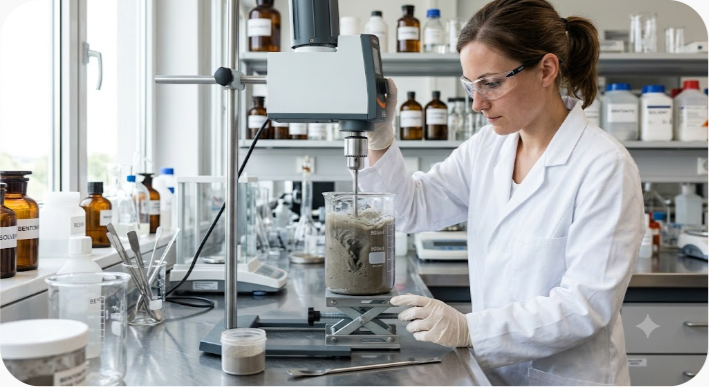
A common approach is to introduce bentonite into a portion of the appropriate liquid phase under controlled agitation. Avoid dumping a large quantity into stagnant liquid, where the material can hydrate around the outside of dry clay and form persistent lumps.
Mixing energy and hydration time depend on the grade and formulation. Some systems need a dedicated pre-dispersion stage, while others can incorporate the clay during the main batch process.
Watch the dispersion as it develops and measure its rheology rather than relying only on a predetermined mixing time.
Prepare several laboratory samples instead of committing to one concentration.
For example, compare 0.5%, 1%, 1.5%, 2%, and 3% bentonite while holding pigment, binder, solvent or water, dispersant, and other ingredients constant.
Record:
This gives a much clearer picture of what the clay is contributing than a single visual observation.
A bentonite dispersion can look excellent by itself and behave differently after resin, pigment, additives, and other ingredients are introduced.
The final coating is what matters.
Test the complete formulation under realistic storage and application conditions. If the product will be pumped, sprayed, rolled, or applied through a particular industrial process, reproduce enough of that process to expose rheology problems before scale-up.
A useful coating shouldn't simply become thinner under shear. You also need to understand how quickly its structure returns afterward.
If laboratory equipment permits, measure viscosity or rheological recovery after a controlled high-shear period. Slow or incomplete recovery can contribute to settling or sagging after application. Very rapid rebuilding, on the other hand, can sometimes interfere with leveling.
The desired recovery profile depends on the coating and application method.
Ingredient sequence is easy to overlook during formulation development, yet it can change how bentonite performs.
Bentonite needs access to the liquid phase in which it is expected to develop its structure. If it is introduced after substantial amounts of resin, pigment, salts, surfactants, or other additives have changed the liquid environment, its hydration and rheological response may differ from what was observed in the initial clay dispersion.
A useful development strategy is to create and evaluate the bentonite dispersion first, then build the rest of the formulation around it where the chemistry allows.
That isn't a universal rule. Some coating systems are deliberately designed around particular resin and additive packages, and changing the order can affect pigment wetting, foam, viscosity, or color acceptance.
The right addition sequence is the one that performs consistently in the complete formulation.
Not all pigments settle at the same rate.
Particle size and density matter, as does the tendency of a pigment to agglomerate. A dense inorganic pigment can create a different suspension challenge from a lower-density organic pigment.
Pigment loading matters as well. Increasing solids can make a coating more structured, but high solids can also make dispersion and processing more difficult.
For that reason, don't transfer a successful bentonite dosage from one color or pigment package directly to another without testing.
A white industrial coating with a high loading of titanium dioxide, for example, can have very different rheological requirements from a lightly pigmented primer or colored maintenance coating. The same bentonite percentage may not produce the same suspension, flow, or application behavior.
Water-based systems can be sensitive to electrolyte concentration, pH, dispersants, surfactants, and resin chemistry.
Bentonite interacts with water and dissolved species, so the water phase isn't simply an inert carrier. Changes in water quality or additive concentration can influence clay swelling, dispersion, and final rheology.
When developing a water-based coating, monitor at least these variables:
This is also why a formulation developed with laboratory water can behave differently in a production plant using another water source.
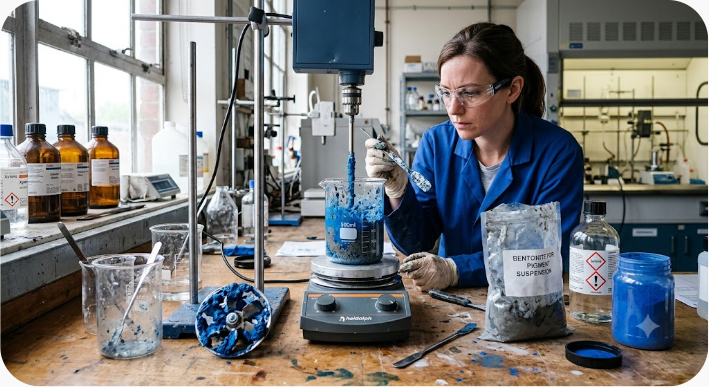
Solventborne coatings require a different approach because conventional hydrophilic bentonite doesn't necessarily disperse or structure an organic liquid phase effectively.
Organophilic bentonites are modified to interact with non-aqueous systems. Their performance can depend on solvent polarity, resin type, activation chemistry, shear, and the presence of other additives.
For these systems, follow the technical supplier's recommended activation and incorporation procedure rather than treating the material like a water-dispersible clay.
The formulation principle remains similar: develop enough low-shear structure to support pigment suspension and sag control while allowing the coating to flow under application shear.
A quick overnight observation can be useful, but it isn't enough for a serious formulation decision.
A practical laboratory program can combine several tests.
Fill transparent containers with the coating and observe the material over time. Look for a clear liquid layer, concentrated pigment zone, hard sediment, or other changes in appearance.
After storage, apply a defined mixing procedure and record how easily the sediment returns to a uniform state.
A coating that develops a small amount of soft sediment may be more practical than one that appears stable initially but eventually forms a compact layer requiring aggressive mixing.
Measure viscosity under more than one shear condition where possible. A single viscosity number doesn't describe a complete thixotropic coating.
Elevated-temperature storage can help expose stability problems sooner, although accelerated results shouldn't automatically be treated as a direct prediction of real-world shelf life.
Apply the coating using a representative method and inspect flow, leveling, sag, spray behavior, and film appearance.
The strongest formulation is the one that performs consistently across the test program, not simply the one that produces the highest viscosity or the least visible settling in one laboratory measurement.
If pigment is settling because of poor wetting, agglomeration, incompatibility, or an unsuitable dispersant package, additional clay may only increase viscosity.
Find the cause first.
Two products both described as bentonite can behave differently. Mineral composition, processing, particle size, exchangeable cations, purity, and intended application can all influence performance.
Evaluate the actual grade rather than relying on the generic material name.
Poorly dispersed clay can form lumps and deliver less effective structure than the same nominal quantity when properly incorporated.
Mixing conditions deserve as much attention as dosage.
A coating can look fine under application conditions while still settling badly in storage. Low-shear behavior is critical when evaluating suspension.
Absolute visual stability isn't necessarily the right target. If achieving it makes the coating too thick to pump, spray, level, or process, the formulation isn't balanced.
A small amount of soft sediment that easily returns to suspension can be manageable. Compact, hard sediment can become a production and customer-use problem.
Mixing geometry changes with batch size. Impeller type, tip speed, vessel dimensions, addition location, and mixing time can all influence clay dispersion.
A formulation that works in a 1-liter beaker needs controlled scale-up before it becomes a production recipe.
The most useful way to think about bentonite is as part of a rheology profile rather than as a simple thickener.
At rest, you generally want enough structure to slow pigment movement. Under application stress, the coating needs controlled flow. At higher shear, it should become easier to move. After application, some structure recovery can help reduce sag while still allowing the film to level.
Three formulation questions help keep these requirements separate:
A successful bentonite system addresses all three rather than maximizing one measurement.
Suppose an industrial water-based coating contains a relatively high pigment loading and develops visible settling during storage. The coating also needs to be sprayable and form a smooth film.
A sensible development program could begin with a control sample containing no bentonite. Then prepare several samples with increasing bentonite levels while keeping the other ingredients constant.
The control might show significant settling but excellent spray flow. A middle concentration could reduce settling while retaining acceptable spray behavior. A higher concentration might nearly eliminate visible settling but create excessive low-shear viscosity and slower leveling.
The middle formulation could therefore be the more useful starting point for further development, even though the higher-clay sample appears more stable in the container.
The next step would be to refine that formulation by checking dispersion conditions, pigment dispersant level, pH, and interactions between bentonite and the binder system.
That approach is more reliable than simply adding clay until the sediment disappears.
Bentonite is useful, but it isn't a universal answer to pigment instability.
Consider another approach if:
A polymeric rheology modifier, associative thickener, organoclay, fumed silica, dispersant adjustment, or combination approach may be more appropriate depending on the system.
Good formulation work isn't about forcing one ingredient to solve every problem. It's about building a coating in which each component has a clear job.
If bentonite becomes part of a production coating, consistency matters as much as initial laboratory performance.
Ask the supplier for technical information covering the specific grade under evaluation. Depending on the application, useful data may include:
For industrial buyers, supply continuity matters too. A formulation can be carefully optimized around one mineral grade, so unexpected changes in raw-material characteristics can introduce avoidable production variation.
Axewelledge supplies industrial Bentonite from India for applications where consistent mineral quality and dependable supply are important. For a coating developer, the practical next step is to match the Bentonite grade to the coating chemistry and validate it through a controlled laboratory trial rather than selecting a material based on the word Bentonite alone.
If pigment settling is causing problems, keep the troubleshooting process focused.
Bentonite improves pigment suspension in industrial coatings primarily by providing controlled low-shear structure and thixotropic behavior. Used correctly, it can slow pigment settling, support redispersibility, improve sag resistance, and help maintain a useful balance between storage stability and application flow.
The important word is correctly. Bentonite grade, liquid chemistry, pigment type, dosage, dispersion, and shear history all influence the result. A strong formulation usually comes from a controlled series of trials rather than simply increasing clay until the coating becomes thick.
For manufacturers evaluating Bentonite for industrial coatings, Axewelledge can help identify a suitable mineral grade for laboratory testing and supply requirements. Start with the chemistry of the coating, define the rheology you need, and let performance data determine the final dosage.













Have questions about our products? We're here to help!