Axewelledge, a leading exporter from India, specializes in high-quality Bentonite. With a commitment to excellence, we supply premium Bentonite to the Middle East and Southeast Asia markets.


North Angle Complex, 304,
150 Feet Ring Rd, Opposite Ambedkar Nagar BRTS Stop,
Madhav Park, Punit Nagar,
Mavdi, Rajkot, Gujarat 360004
© Axewelledge 2026, All Rights Reserved.
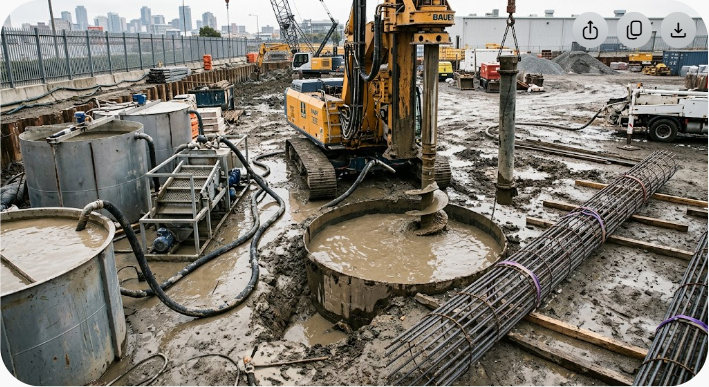
A bored pile can fail long before concrete reaches the bottom if the excavation walls aren't properly supported. Bentonite slurry helps keep an open pile bore stable by forming a low-permeability filter cake and providing fluid pressure against the surrounding ground.
That makes bentonite particularly useful for deep foundation work where groundwater, loose sands, silts, or unstable soils make dry excavation impractical. But simply adding bentonite to water isn't enough. The slurry has to be mixed, hydrated, tested, maintained, and cleaned to suit the ground conditions and the project's specifications.
This guide explains how bentonite slurry works in pile foundation construction, its main benefits, the properties engineers monitor, common mistakes, and practical steps for getting a reliable slurry system.
Bentonite slurry is a suspension of finely divided bentonite clay in water. In bored pile construction, it is placed in an excavated borehole to help support the surrounding soil while drilling continues and before concrete is placed.
Bentonite is particularly effective because sodium-rich montmorillonite particles hydrate and swell in water. The hydrated clay creates a viscous suspension that can form a thin filter cake against permeable soil. At the same time, the fluid column provides hydrostatic support to the borehole walls.
The U.S. Federal Highway Administration describes mineral slurry for drilled shafts as a mixture of clay mineral and potable water and notes that bentonite is the most commonly used mineral slurry material. It also stresses that the slurry should be designed and tested for borehole stability rather than treated as a one-size-fits-all mixture. Federal Highway Administration +1
In practical terms, the slurry performs two related jobs:
The exact formulation depends on the soil, groundwater chemistry, pile depth, excavation method, equipment, and project specification.
The main reason is simple: a deep, uncased borehole may not remain open long enough for reinforcement and concrete placement.
A dry hole can be relatively straightforward in competent cohesive ground, but conditions change quickly in loose sand, gravel, fractured formations, or soil below the groundwater table. Water can enter the excavation, pore pressure can destabilize the walls, and loose particles can fall into the bottom.
Bentonite slurry gives the contractor another way to maintain the excavation while work progresses.
The most important benefits are:
These benefits are connected. A slurry that is too thin may not provide adequate support or cuttings suspension. A slurry that is excessively viscous can create problems during cleaning and concrete placement.
The target isn't maximum viscosity. It's the right slurry condition for the actual borehole.
Two mechanisms matter most: hydrostatic pressure and filter-cake formation.
The slurry column inside the borehole creates pressure that increases with depth. This pressure helps resist the tendency of surrounding groundwater and soil to move into the excavation.
For this mechanism to work, the slurry level needs to be maintained at an appropriate elevation. If the level drops substantially, the pressure acting against the borehole wall also drops.
This is one reason slurry management isn't just a preparation activity. It continues throughout excavation.
When bentonite slurry contacts a permeable formation, some water can move into the surrounding soil while hydrated clay particles accumulate at the borehole interface. This creates a thin layer commonly called a filter cake or mud cake.
The layer reduces fluid loss into the formation and helps maintain the hydraulic pressure needed to support the excavation.
The quality of this filter cake depends on slurry chemistry, bentonite quality, concentration, hydration, soil permeability, and other site conditions. A slurry that looks thick in a mixing tank isn't automatically a good slurry for foundation work.
Sodium bentonite is commonly selected for slurry applications because of its strong swelling and water-retention characteristics. Its montmorillonite content and exchangeable cation chemistry strongly influence hydration, viscosity, filtration, and yield.
However, the phrase 'high-swelling bentonite' isn't enough to specify a construction-grade product. Two materials sold under the same general name can behave very differently in water.
For pile work, procurement should consider properties such as:
The final selection should follow the project specification and laboratory or field trials rather than relying only on a product label.
A successful pile slurry is a controlled construction material. Several properties deserve regular attention.
Density indicates how much mineral solids and other material are present in the slurry. It also affects the pressure generated by the fluid column.
Too little density may indicate insufficient solids or excessive dilution. Excessively high density can signal accumulated drilled fines or an over-concentrated slurry, which may interfere with cleaning and concrete placement.
FHWA guidance for mineral slurry in drilled shafts gives a typical density range of about 64.3 to 72 lb/ft³, equivalent to approximately 1.03 to 1.15 g/cm³, together with project-specific controls. These figures should be treated as specification guidance, not a universal recipe for every pile project. Federal Highway Administration
Viscosity affects how the slurry flows and how effectively it suspends fine particles.
A common field measurement is the Marsh funnel test. It provides a quick indication of slurry flow behaviour and is useful for monitoring changes during construction.
FHWA's drilled shaft guidance lists 28 to 50 seconds per quart as a mineral-slurry viscosity range for the cited specification. The appropriate project target may differ based on the slurry formulation and site requirements. Federal Highway Administration
Sand content is especially important near the end of drilling.
Excavated sand and other solids can accumulate in the slurry. If they aren't removed, the fluid may become heavier and less effective, while excess sediment can remain in the pile base or contaminate the concrete placement zone.
FHWA guidance identifies a maximum mineral-slurry sand content of 4 percent immediately before concrete placement in the cited drilled-shaft specification. Some projects may require tighter limits, so the project specification should control. Federal Highway Administration
Bentonite performance is affected by water chemistry. Monitoring pH can help identify abnormal slurry conditions and changes caused by groundwater or other contaminants.
The same FHWA mineral-slurry guidance gives a pH range of 8 to 11 for the referenced specification. Again, this is a useful engineering reference rather than a universal acceptance range for every formulation. Federal Highway Administration
Fluid-loss behaviour becomes particularly important in permeable formations. A suitable bentonite slurry should limit excessive water loss while maintaining a stable filter cake.
Laboratory testing can help determine whether a selected bentonite performs adequately before full-scale use.
Bentonite isn't the only option. Synthetic polymer slurries are also used in drilled shaft construction, and some projects use polymers because of their particular rheological or cleanup characteristics.
The choice should be based on soil conditions, groundwater chemistry, equipment, environmental requirements, disposal arrangements, and the project specification.
| Factor | Bentonite slurry | Polymer slurry |
|---|---|---|
| Primary material | Mineral clay, commonly sodium bentonite | Synthetic polymer system |
| Borehole support | Provides hydrostatic support and filter-cake formation | Provides fluid support with polymer-dependent behaviour |
| Solids content | Contains mineral solids | Can operate with relatively low solids |
| Cuttings management | Requires control of accumulated solids | Often easier to separate in suitable systems |
| Hydration | Requires adequate mixing and hydration | Depends on polymer chemistry and manufacturer guidance |
| Reuse | Commonly conditioned and reused | Can also be managed and reused depending on system |
| Groundwater sensitivity | Water chemistry can strongly affect performance | Chemistry can also affect polymer performance |
| Selection | Common mineral-slurry choice | Alternative where project conditions favour it |
FHWA guidance treats polymer slurry as a separate system with its own acceptance limits and manufacturer recommendations, rather than assuming that polymer and bentonite slurries can be managed identically. Federal Highway Administration
Good slurry performance starts before drilling begins.
Start with the water source, not the clay bag.

Water chemistry can influence bentonite hydration and rheology. Salinity and dissolved minerals may reduce the performance of some bentonite systems. If site groundwater is chemically aggressive, conduct compatibility testing before committing to the full slurry mix.
Choose a bentonite designed for slurry performance and verify its technical data. Don't select solely on price per tonne.
A slightly cheaper clay that requires substantially higher dosage or produces inconsistent slurry can cost more through slower drilling, additional cleaning, disposal, or rejected batches.
Bentonite should normally be dispersed into water outside the borehole using suitable mixing equipment. The objective is to distribute the clay particles uniformly rather than create partially hydrated lumps.
FHWA guidance notes that bentonite and water should be mixed outside the borehole and allowed to hydrate for several hours before use. Federal Highway Administration
The actual hydration period depends on the product, mixing energy, water chemistry, temperature, and project procedure. Follow the supplier's technical data and the approved mix design.
Freshly mixed bentonite doesn't necessarily have its final slurry properties immediately.
Give the clay enough time to hydrate and develop the required rheological behaviour. Premature use can produce a slurry that tests differently from the intended design.
Before putting the slurry into production, measure the properties required by the project specification. Typical checks include density, Marsh funnel viscosity, pH, sand content, and, where specified, fluid loss or filtration characteristics.
ASTM D4380 is one recognized U.S. test method for density of bentonitic slurries, while API slurry testing methods are also commonly referenced for field measurements. FHWA specifications for drilled shafts reference API 13B-1 procedures for density, Marsh funnel viscosity, and sand content. Federal Highway Administration +1
If the slurry misses the target, correct it before the problem moves into the borehole.
Depending on the result, adjustments might involve changing bentonite concentration, adding water, conditioning the slurry, removing accumulated solids, or addressing water chemistry.
Avoid making large undocumented changes. The slurry design should remain traceable so that a good batch can be reproduced.
Fresh slurry rarely stays fresh.
As drilling progresses, the slurry encounters soil, groundwater, cuttings, organic material, and sometimes cementitious or other contaminants from previous operations. Its density and viscosity can change as solids accumulate.
This is why a slurry that passed testing at the start of the shift may not meet the required limits later.
A practical control routine is to monitor slurry at several stages:
FHWA notes that mineral-slurry properties change during excavation and therefore require testing and maintenance during excavation and until concrete placement. It also describes conditioning and reuse as common practices, with decanting used to remove sand. Federal Highway Administration
Concrete placement is one of the most critical stages of a slurry-supported pile.
The concrete generally needs to displace the supporting fluid without allowing significant slurry contamination or interruption. For this reason, final bore cleaning and slurry quality matter just before concrete placement.
Tremie placement is commonly used for underwater or slurry-supported concrete. The tremie pipe must remain properly positioned and embedded in fresh concrete according to the project's placement procedure so that the concrete rises through the bore and displaces the slurry.
If the slurry contains excessive sand or drilled solids, the risk of poor pile cleanliness increases. The pile base also needs to be checked according to the project's inspection and acceptance requirements.
The important lesson is that bentonite slurry is temporary support, not part of the finished concrete pile. Its job is to keep the excavation stable until the structural material can safely occupy the bore.
Before starting a large piling operation, make sure the team has answers to these questions:
Answering these questions early prevents many field problems.
Swelling alone doesn't define slurry performance. A pile-support slurry needs predictable rheology, filtration behaviour, and stability.
Better approach: qualify the material through laboratory and field testing against the project requirements.
It may seem logical that more clay means more stability. In reality, excessive solids can increase viscosity and make circulation, separation, cleaning, and concrete placement more difficult.
Better approach: establish the required concentration through testing instead of guessing.
Freshly dispersed clay may not have developed its intended properties.
Better approach: follow a defined hydration procedure and verify the resulting slurry rather than relying on elapsed time alone.
A slurry designed with clean laboratory water may behave differently in saline or chemically unusual groundwater.
Better approach: test representative site water where groundwater conditions could affect performance.
Slurry properties can change as drilling continues.
Better approach: establish testing points throughout the excavation and immediately before concrete placement.
The slurry may become progressively contaminated with formation solids. This can increase density and affect the condition of the pile base.
Better approach: use desanding, settling, circulation, or other approved conditioning methods as required.
Density is useful, but it doesn't tell the whole story. Two slurries with similar density can behave differently in viscosity, filtration, and solids distribution.
Better approach: control the full set of specified properties.
Field teams sometimes add water or dry bentonite to solve an immediate problem without recording the change. That makes it difficult to reproduce successful batches or explain inconsistent results.
Better approach: document every significant adjustment and retest the slurry.
Consider a deep bored pile passing through a relatively clean sand layer and then a silty formation.
The initial bentonite slurry may meet the target density and viscosity. As drilling proceeds through the sand, the borehole remains stable, but fine sand enters the slurry. Unless those solids are removed, density and sand content gradually increase.
The next formation may introduce more silt, changing the slurry's flow behaviour again.
At this point, simply adding fresh water can reduce density but may not solve the underlying solids problem. The better response may be to circulate the slurry through a desanding or separation system, then retest it.
This is a common principle in slurry-supported excavation: condition the fluid based on what the borehole is putting into it.
There is no single dosage that works for every pile foundation.
Bentonite concentration depends on the selected product, water quality, soil permeability, borehole depth, required rheology, groundwater conditions, and the project's performance criteria. A practical mix design may begin with laboratory trials at several concentrations rather than jumping directly to one field dosage.
For example, a contractor might test progressively higher clay concentrations and compare density, viscosity, filtration, and stability. The selected concentration should provide the required performance without creating unnecessary solids or excessive viscosity.
This approach is more reliable than copying a dosage from another project. A mix that performs well in a clean sand formation may need modification in highly permeable gravel or chemically different groundwater.
Yes. Bentonite slurry is commonly circulated, conditioned, and reused when its properties remain within the approved limits.
Recycling can reduce fresh bentonite consumption and the volume of waste slurry requiring handling. However, reuse doesn't mean using the same fluid indefinitely.
Accumulated sand and drilled solids must be removed, and the slurry needs to be tested before it returns to critical construction stages. If its properties cannot be restored economically or reliably, it should be replaced according to the project's waste-management procedure.
FHWA's field materials guidance specifically notes that mineral slurries are typically circulated, conditioned, and reused, with decanting used to remove sand. Federal Highway Administration
Bentonite is a naturally occurring clay mineral, but that doesn't make slurry disposal automatic or unrestricted.
Used slurry can contain soil particles, organic material, groundwater contaminants, or other materials picked up during excavation. Disposal and discharge requirements therefore depend on the project location and the composition of the used fluid.
Contractors should plan for containment, settling, separation, transport, reuse, and final disposal before excavation starts.
The environmental advantage of a mineral-based slurry system is strongest when the material is managed responsibly and unnecessary waste is avoided through effective conditioning and reuse.
Price per bag or tonne is only one part of the purchasing decision.
For a foundation project, consistency is often more important than a low initial material price. Ask potential suppliers for technical documentation covering the properties relevant to your slurry design.
Useful questions include:
Axewelledge supplies sodium bentonite for industrial applications and can support project-specific material evaluation where slurry performance, consistency, and supply reliability are important considerations.
If you remember only a few points from this guide, make them these:
Bentonite slurry does far more than simply make water thicker. Properly designed and maintained, it creates a controlled fluid environment that helps keep a bored pile excavation stable while drilling, reinforcement installation, and concrete placement take place.
The real performance comes from the entire system: suitable bentonite, compatible water, correct mixing, adequate hydration, continuous monitoring, effective solids removal, and disciplined concrete placement.
For piling contractors and foundation engineers, that means the right question isn't simply 'Which bentonite should we buy?' It's 'Which bentonite slurry system will reliably meet the requirements of this ground, this water, and this construction method?'
That distinction can make the difference between a slurry that merely looks workable and one that performs reliably in the borehole. For project-specific bentonite requirements, contact Axewelledge to discuss material specifications, quality requirements, and supply needs.













Have questions about our products? We're here to help!