Axewelledge, a leading exporter from India, specializes in high-quality Bentonite. With a commitment to excellence, we supply premium Bentonite to the Middle East and Southeast Asia markets.


North Angle Complex, 304,
150 Feet Ring Rd, Opposite Ambedkar Nagar BRTS Stop,
Madhav Park, Punit Nagar,
Mavdi, Rajkot, Gujarat 360004
© Axewelledge 2026, All Rights Reserved.
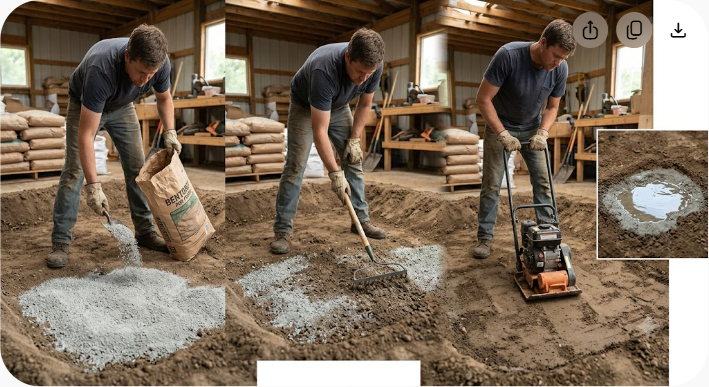
A leaking pond doesn't automatically require a synthetic liner or a complete rebuild. In suitable soil conditions, high-swelling sodium bentonite can be mixed into the soil and compacted to create a low-permeability sealing layer that limits water movement.
The difficult part is choosing the right material and using it correctly. Pond sealing depends on more than the name on the bag. Soil texture, permeability, bentonite quality, application rate, moisture, mixing, compaction, and the location of the seepage path all affect the result.
For a conventional soil-bentonite pond repair, high-swelling sodium bentonite is generally the starting material to evaluate. The right quantity, however, cannot be determined from pond size alone. A sandy basin may require a substantially different treatment from a finer-grained soil, and a localized seepage path may call for a different repair method altogether.
The practical approach is straightforward: diagnose the leak, examine the native soil, select a bentonite with suitable swelling and physical characteristics, establish the application rate through soil evaluation or testing, and construct a continuous compacted sealing layer. That process is far more reliable than choosing a generic application rate and hoping it works.
Bentonite is a naturally occurring clay containing a high proportion of smectite minerals, particularly montmorillonite. Its usefulness in pond sealing comes largely from the way suitable bentonite interacts with water.
When sodium bentonite becomes hydrated, its clay particles can absorb water and swell. The expanded particles can occupy pore spaces between soil grains and reduce the size and continuity of pathways available for water flow. When the treated soil is properly mixed and compacted, this can produce a dense layer with substantially lower permeability than the untreated soil.
That process is simple in principle but sensitive to installation conditions. Bentonite isn't a magic powder that seals every leaking pond simply because it gets wet. It needs to be present in sufficient quantity, distributed consistently, and incorporated into soil that can be compacted into a continuous barrier.
Consider the difference between two pond basins. One may sit on clean, coarse sand with large interconnected pores. Another may contain silty clay that already has relatively low permeability but has developed cracks after drying. Both ponds can leak, but the cause and repair strategy may be completely different.
The same principle applies to the location of the leak. A pond losing water across most of its floor may need a full sealing layer. A pond with a clearly identified seepage zone may need a localized treatment, cutoff, or structural repair instead.
This is why choosing bentonite for pond leak repair should begin with the site and soil, not the product catalogue.
For conventional soil-bentonite pond sealing, high-swelling sodium bentonite is generally the first type to evaluate. Sodium bentonite typically develops greater swelling in water than calcium bentonite and is widely used where hydrated clay is needed to restrict fluid movement.
The important word is "evaluate." Not every sodium bentonite product performs identically. Bentonite deposits differ in mineral composition, and processing can change particle-size distribution and other physical characteristics. A product that works well in one application may not be the most suitable choice for another.
When comparing bentonite for pond sealing, review measurable product characteristics rather than relying on the word "bentonite" alone. Depending on the project, useful information can include:
A drilling-grade bentonite, for example, may have excellent filtration performance but still require evaluation for a particular pond-sealing design. Likewise, a product sold simply as bentonite may not provide the swelling or physical consistency needed for a soil-bentonite barrier.
For a small repair, a supplier's technical data may be enough to narrow the options. For a larger pond, irrigation reservoir, water-retention basin, or commercial project, testing the actual bentonite with representative site soil can provide much more useful information before material is ordered in bulk.
The sodium-calcium distinction is one of the first technical considerations when selecting bentonite for a leaking pond.
| Feature | Sodium bentonite | Calcium bentonite |
|---|---|---|
| Water swelling | Generally high | Generally lower |
| Sealing potential | Commonly suited to soil-sealing applications | Usually requires more careful evaluation for conventional pond sealing |
| Hydration behavior | Strong expansion when hydrated | More limited expansion |
| Common applications | Drilling fluids, sealing, containment, foundry and other uses | Absorbents, foundry and other mineral applications |
| Conventional pond-sealing suitability | Common starting choice | Usually not the first choice |
| Selection priority | Swelling performance, consistency, and soil compatibility | Actual tested performance for the intended soil and method |
Sodium bentonite isn't automatically the correct choice simply because it generally swells more. Product quality and site conditions still matter. A highly swelling material that is poorly distributed through the soil can produce a less reliable result than a properly designed and compacted mixture.
Calcium bentonite generally has lower swelling capacity, so it isn't normally the first material considered for conventional soil-bentonite pond sealing. If a calcium-based product is being considered for a particular project, its actual performance should be evaluated rather than assumed from its mineral name.
The useful procurement question is therefore not just, "Is this bentonite?" Ask instead, "Does this material provide the swelling and sealing behavior required by this soil and installation method?"
A sensible selection process starts with diagnosing the leak and ends with matching the material to the construction method. The following steps can help prevent unnecessary material use and failed repairs.
Before buying bentonite, establish whether the water loss is actually caused by seepage through the pond floor or embankment.
Ponds can lose water through evaporation, leaking pipes, damaged drains, overflow structures, cracks, animal burrows, poor drainage, or other defects. Applying clay to the pond floor won't fix a damaged pipe or an embankment problem.
Look for persistent wet areas outside the pond, damp zones downstream of the embankment, sinkholes, visible cracks, muddy seepage, unusual groundwater movement, or water-level changes that cannot be explained by evaporation and normal inflow or outflow.
The visible wet spot isn't necessarily the point where water leaves the pond. Water can travel through permeable soil layers before emerging somewhere else. That matters when deciding whether a localized repair is appropriate.
For a major pond, irrigation reservoir, wastewater facility, or other important water-retention structure, a qualified geotechnical or civil engineering professional should assess significant leakage before repair work begins.
Soil is one of the strongest variables in any bentonite pond-sealing project.
Clean sand and gravel contain relatively large, interconnected voids that can provide efficient pathways for water. Bentonite can reduce permeability when properly incorporated and compacted, but the mixture needs to be designed around the actual soil.
A silty or clayey soil may already have relatively low permeability. If such a pond leaks, the cause could be shrinkage cracks, poor compaction, desiccation, a permeable underlying layer, roots, animal disturbance, or a preferential seepage path.
A basic site investigation should consider:
For a substantial repair, collect representative samples from more than one location. Surface soil alone may not represent the material through which the pond is actually losing water.
Once the soil has been characterized, compare products using technical specifications rather than price alone.
A useful supplier discussion should cover swelling performance, particle size, moisture, purity, intended application, packaging, and consistency. For large projects, ask whether the supplier can provide representative samples for testing.
Price per tonne is only one part of the cost. A lower-priced product can become more expensive if it requires a higher application rate, creates handling problems, or produces inconsistent sealing performance.
For a larger project, this is one of the most valuable steps in the selection process.
Collect representative soil from the proposed sealing area and prepare trial mixtures using the selected bentonite at several rates. Compact the samples under controlled conditions and compare their permeability or hydraulic performance.
The goal isn't to use as much bentonite as possible. It is to establish a practical mixture that meets the project's sealing requirement while remaining workable and economical.
Testing also helps reveal whether the proposed field process is realistic. A laboratory mixture may perform well under controlled conditions but fail to translate to the site if the material can't be mixed uniformly or compacted to the required density.
The same bentonite can be used in different ways depending on the soil, leak mechanism, and extent of the repair.
Common approaches include:
For many new pond construction and major rehabilitation projects, a controlled soil-bentonite mixture provides better distribution and construction control than simply spreading loose bentonite across the surface.
There isn't one universal bentonite application rate for every pond. The required amount depends on soil texture, permeability, sealing-layer thickness, compaction, bentonite properties, and the installation method.
Bentonite requirements are commonly expressed in one of two ways. A blanket treatment may be specified as a mass of bentonite per unit area. A mixed soil-bentonite layer may be designed as a percentage of the dry soil mass.
This distinction matters when someone searches for a simple answer to "how much bentonite per acre pond." Pond area alone doesn't tell you the quantity needed. The soil volume and treatment thickness also matter for a mixed layer, while the required application rate per unit area must still be established for a blanket design.
Published project guidance can provide preliminary ranges, but a value taken from another pond shouldn't be treated as a guaranteed rate for your site. Clean sand, gravelly soil, silty soil, and clay-rich soil can behave very differently.
For a soil-mixed treatment, the basic calculation is:
For an area-based blanket treatment:
Keep the units consistent throughout the calculation. A U.S. project may use pounds, square feet, acres, and cubic feet, while an international project may use kilograms, square metres, tonnes, and cubic metres.
Suppose soil testing leads a project team to evaluate a trial mixture containing 8% bentonite by dry soil mass.
If the prepared sealing layer contains 100,000 kg of dry soil, the bentonite quantity for that trial mixture would be:
That equals 8 metric tonnes.
This example demonstrates the calculation method. It is not a universal recommendation of 8% for pond sealing. The appropriate percentage must come from the soil characteristics, selected construction method, and required sealing performance.
For an actual project, estimate the full treatment volume or area, sealing-layer thickness, expected field density, transitions, and reasonable handling losses before placing an order. Where the design is important, the material quantity should be based on the project specification rather than a generic online calculator.
Bentonite generally performs most predictably when it is incorporated into a soil that can be mixed uniformly and compacted into a dense, continuous layer.
Very coarse, clean sand and gravel require particular attention because water can move quickly through their large interconnected voids. Increasing bentonite dosage indefinitely isn't necessarily the best answer. Depending on the site, importing a suitable soil, designing a controlled soil-bentonite mixture, or using a composite lining system may be more practical.
Fine-grained soils can also present challenges. A soil with significant clay content may have low permeability but still leak because of shrinkage cracks, desiccation, poor compaction, or a permeable layer beneath the surface.
Organic soils such as peat can be difficult because they may be compressible, variable, and difficult to compact into a stable sealing layer. Roots and decaying organic matter can also create preferential pathways for water movement.
The key question is simple: Can the available soil be prepared and compacted into a continuous, stable barrier? If it can't, changing the bentonite product alone won't solve the underlying construction problem.
The blanket method involves placing bentonite over a prepared pond surface and covering it with a protective soil layer. The materials are then compacted to create the intended sealing system.
This approach can be useful where the pond basin has reasonably consistent soil conditions and the treatment area can be prepared uniformly.
The bentonite must be protected from displacement during construction. Loose material exposed to wind, runoff, or moving water is not equivalent to bentonite incorporated into a properly constructed sealing layer.
The cover material also matters. It should be suitable for the construction method and thick enough to protect the treated layer from erosion and disturbance.
In the mixed method, bentonite is distributed throughout a specified thickness of soil. The mixture is then placed and compacted in controlled lifts.
This method provides direct control over bentonite distribution because the clay becomes part of the soil matrix rather than remaining as a separate loose layer.
Uniform mixing is essential. Concentrated pockets of bentonite next to untreated soil can produce inconsistent hydraulic performance. Field equipment should therefore be selected according to the soil type, treatment depth, and scale of the project.
A localized treatment may be appropriate when the leakage mechanism and affected zone have been identified with reasonable confidence.
However, the point where seepage appears outside the pond isn't necessarily the point where water crosses the pond boundary. Water can move sideways through permeable strata, so a surface-level repair can miss the actual pathway.
Localized bentonite treatment works best when it forms part of a broader investigation rather than being used simply because one wet spot is visible.
A successful pond seal depends heavily on construction quality. Even a suitable bentonite can perform poorly when the soil is poorly prepared or the final layer isn't compacted correctly.
Lower the pond to a workable level and investigate the suspected leakage zone. Remove vegetation, roots, loose sediment, debris, and unsuitable organic material from the area that will receive treatment.
If the entire basin needs sealing, prepare the complete treatment footprint rather than concentrating only on areas where water happens to be visible outside the pond.
The sealing surface should be reasonably uniform and free from large stones, roots, voids, loose material, and unstable zones.
Soft or disturbed areas may need to be excavated and replaced with suitable soil. The objective is to create a consistent foundation for the sealing layer.
Use the soil characteristics and project requirements to establish the initial bentonite dosage. For important projects, laboratory or field trials can help confirm the selected rate.
Avoid copying an application rate from another pond without checking whether the soil, layer thickness, compaction conditions, and bentonite product are comparable.
Mechanical spreading equipment can help achieve consistent coverage over large areas. The equipment should be appropriate for the site and capable of maintaining the required application rate.
Avoid creating piles of bentonite and relying on minimal mixing to distribute them. The objective is a uniform concentration throughout the designed treatment zone.
Blend the bentonite through the specified soil depth so that the material is distributed consistently throughout the sealing zone.
Depending on the project, a rotary tiller, disc, mixer, or other suitable equipment may be used. The number of passes and mixing depth should be sufficient to produce a reasonably uniform mixture rather than simply disturbing the surface.
Moisture has a direct effect on soil handling and compaction. Material that is too dry may be difficult to compact properly, while excessively wet soil can become unstable or difficult to work.
The target moisture condition should be established through appropriate soil testing where the project requires controlled compaction. Field appearance alone isn't a reliable substitute for a defined moisture range.
Compaction is one of the most important parts of the installation. Bentonite must be integrated into a dense, continuous soil structure if the treatment is intended to reduce permeability.
Place and compact the material in controlled lifts using equipment suitable for the soil. Pay close attention to edges, slopes, transitions, penetrations, and areas around structures because these locations can become weak points in the completed seal.
The completed sealing layer should be protected from erosion, drying, excavation, animal activity, roots, and unnecessary construction traffic.
A suitable cover layer can protect the treated zone from mechanical disturbance and environmental exposure. The finished pond should also be managed so that later maintenance work doesn't unintentionally damage the sealing layer.
More bentonite isn't automatically better.
An excessive dosage can increase material costs without producing a proportional improvement in sealing performance. High clay content can also change the workability, moisture requirements, and compaction behavior of the treated soil.
The objective is to achieve the required hydraulic performance with a mixture that can be placed and compacted consistently. It isn't to maximize the amount of clay in the basin.
This becomes especially significant on large ponds. When a treatment covers thousands of square metres or several acres, a relatively small increase in application rate can add several tonnes of material to the order quantity.
Controlled testing can help identify a practical dosage range instead of relying on the assumption that more material will always compensate for poor soil conditions or inadequate construction.
Too little bentonite can leave enough interconnected pore space for water to continue moving through the treated layer.
The risk can be greater in coarse soils, where the treatment needs to restrict relatively large and connected flow paths. If the clay content is insufficient or the distribution is uneven, some portions of the sealing layer may remain substantially more permeable than others.
If a pond continues to leak after treatment, don't immediately conclude that the bentonite itself failed. Check the application rate, mixing uniformity, soil preparation, moisture condition, compaction, layer thickness, and actual location of the seepage path.
A leak that originates in a pipe, embankment, structural feature, or deeper geological layer will also require a different solution.
Particle size affects both handling and how the material can be incorporated into soil.
Fine bentonite powder can hydrate quickly and disperse effectively when mixed properly, but it can also generate dust during handling. Granular or pelletized products can be easier to handle in some placement situations and may be appropriate where the material needs to be distributed in a particular way.
For a broad soil-bentonite treatment, the most important consideration is whether the selected product can be distributed uniformly throughout the designed sealing zone. Convenience alone shouldn't determine particle form.
Ask the supplier for the particle-size specification, moisture information, packaging options, and recommended handling method for the intended pond-sealing application.
Bentonite isn't the right solution for every leaking pond. Comparing a soil-bentonite seal with a synthetic liner helps clarify where each approach may fit.
| Factor | Soil-bentonite seal | Synthetic liner |
|---|---|---|
| Material | Natural clay blended with soil | Manufactured membrane |
| Installation | Requires soil preparation, mixing, moisture control, and compaction | Requires suitable subgrade preparation and controlled membrane installation |
| Typical application | Suitable soil conditions and engineered sealing layers | Sites requiring a defined membrane barrier |
| Puncture concern | No membrane to puncture | Requires protection from sharp stones and mechanical damage |
| Dependence on soil | Relatively high | Lower after suitable subgrade preparation |
| Critical workmanship | Mixing, moisture control, lift placement, and compaction | Subgrade preparation, placement, seams, penetrations, and protection |
| Repair approach | May involve reworking the treated soil | May require locating and repairing membrane damage |
Depending on the site, other systems may also be appropriate. These can include compacted clay liners, geosynthetic clay liners, geomembranes, or combinations of materials.
The selection should follow the site's geology, soil availability, construction conditions, expected service requirements, and required level of seepage control. No single lining material is appropriate for every pond.
The term "bentonite" covers materials with different mineral compositions and physical properties. Ask for technical specifications before purchasing, particularly for a large project.
A wet area downstream can show that water is moving, but it doesn't necessarily reveal the exact location of the seepage path. Investigate the site before deciding that a blanket or localized bentonite treatment is appropriate.
Application requirements vary with soil texture, permeability, treatment thickness, and construction method. A rate that performs adequately in one pond may be unsuitable for another.
Uneven distribution can leave weak areas within the sealing layer. Where a soil-bentonite mixture is specified, the bentonite should be incorporated consistently through the designed depth.
Bentonite can't compensate for a poorly constructed sealing layer. Density, uniformity, lift thickness, and moisture condition all influence the final permeability of the treated soil.
Soil that is too dry may be difficult to compact, while soil that is too wet can become unstable and difficult to handle. Establish suitable moisture conditions before full-scale placement.
Erosion, drying, roots, burrowing animals, and construction traffic can damage the treatment. Protect the completed layer with a suitable cover and control subsequent disturbance.
Some leaks are caused by damaged pipes, structural defects, animal burrows, drainage problems, or subsurface conditions that require another repair method. Diagnose the problem first.
For a small, straightforward repair, supplier documentation and a review of the site soil may be enough to narrow the product options. For a commercial pond, irrigation reservoir, wastewater pond, or other high-value installation, testing provides a stronger basis for the material selection.
A practical evaluation can follow these steps:
The final step is easy to overlook. Laboratory performance doesn't automatically translate into field performance. The construction team must be able to achieve comparable mixing, moisture, lift thickness, and compaction conditions across the full treatment area.
For a significant project, testing can also reduce the risk of ordering too little material, buying substantially more than necessary, or discovering after installation that the selected mixture is difficult to construct.
Before placing an order, confirm the following:
This checklist helps avoid a common procurement mistake: choosing a product first and trying to make the site fit the material afterward. The site conditions should drive the specification.
When sourcing bentonite for pond sealing, the useful conversation is about more than tonnes and price. The supplier should be able to explain the product's relevant physical characteristics, intended applications, packaging, and supply consistency so the material can be evaluated against the project requirements.
Axewelledge supplies sodium bentonite for industrial and sealing applications. For a pond project, provide the supplier with practical information such as the soil type, treatment method, estimated area, proposed sealing-layer thickness, required quantity, and any available test results. Those details make it easier to determine whether a particular bentonite specification fits the intended application.
For larger international orders, supply consistency becomes particularly important. Confirm particle size, moisture, packaging, transport requirements, and batch consistency before shipment. If the project depends on a tested mixture, retaining a representative product sample from the approved batch can also help with quality control during procurement and installation.
A supplier's role is to provide a consistent material that matches the specification. The pond's final performance still depends on site investigation, design, preparation, mixing, moisture control, and compaction.
Choosing bentonite for pond leak repair is less about finding a product with "bentonite" printed on the label and more about matching the material to the soil and construction method.
For conventional soil-bentonite pond sealing, high-swelling sodium bentonite is often the first material to evaluate. But the correct quantity depends on soil characteristics, permeability, treatment thickness, compaction, and the selected installation method. A fixed rate that worked on another pond isn't automatically the right rate for yours.
The most reliable process starts with diagnosis. Identify the actual leak mechanism, examine the soil, select a bentonite with suitable swelling and physical characteristics, test the soil-bentonite mixture where the project warrants it, and construct the sealing layer under controlled conditions.
If you're planning a pond repair, begin with three practical pieces of information: the soil type, the treatment area, and the intended sealing method. Add the required layer thickness and any available seepage data, and you have a much stronger basis for calculating material needs and discussing specifications with a supplier.
That approach does more than reduce guesswork. It gives you a defensible reason for the selected bentonite, application rate, and construction method before material reaches the site.













Have questions about our products? We're here to help!