Axewelledge, a leading exporter from India, specializes in high-quality Bentonite. With a commitment to excellence, we supply premium Bentonite to the Middle East and Southeast Asia markets.


North Angle Complex, 304,
150 Feet Ring Rd, Opposite Ambedkar Nagar BRTS Stop,
Madhav Park, Punit Nagar,
Mavdi, Rajkot, Gujarat 360004
© Axewelledge 2026, All Rights Reserved.

Bentonite can play a useful role in road construction, but the right type of bentonite matters. Natural sodium bentonite is primarily useful where engineers need swelling, sealing, or water-control properties in soil and barrier systems. Organo-modified bentonite, often called organoclay, is a different material designed to interact with non-polar liquids such as bitumen.
That distinction is important. Raw sodium bentonite shouldn't simply be added to hot asphalt and expected to behave like a polymer modifier. Its strong affinity for water makes it better suited to geotechnical and barrier applications. Organo-bentonite can be engineered for asphalt binder modification, where its platelet structure may influence stiffness, viscosity, aging behavior, and moisture resistance.
The actual benefit depends on mineral quality, surface treatment, binder chemistry, dosage, dispersion, aggregate type, climate, and the pavement's performance requirements. Laboratory testing should therefore determine whether bentonite provides a meaningful improvement before it is adopted in a production mix.
This guide explains where bentonite fits into pavement engineering, how sodium bentonite differs from organoclay, what tests matter, how engineers can approach laboratory mixing, and which common assumptions should be avoided.
Bentonite is a clay-rich industrial mineral whose principal active mineral is usually montmorillonite. Its behavior comes from the structure of montmorillonite platelets and the exchangeable ions associated with them. Depending on the deposit and processing method, bentonite may be predominantly sodium, calcium, or a combination of different clay minerals and accessory minerals.
For road construction, two properties are particularly important: water interaction and surface chemistry.
Sodium bentonite has a strong ability to hydrate and swell. When confined and properly hydrated, it can form a low-permeability clay layer. That property is valuable in liners, cutoff systems, selected soil treatments, and other applications where controlling water movement is part of the design.
Organo-modified bentonite has a different purpose. Its clay surfaces are treated with organic compounds so they interact more readily with oils and organic liquids. This makes selected organoclays suitable for research and commercial formulations involving asphalt binders, sealants, coatings, and other hydrocarbon-based systems.
The key engineering question isn't simply whether bentonite works. It is whether the mineral and treatment have been selected for the specific job.
Natural sodium bentonite and organo-bentonite shouldn't be treated as interchangeable materials.
| Property | Sodium Bentonite | Organo-Bentonite |
|---|---|---|
| Primary affinity | Water and other polar liquids | Oils and organic liquids |
| Typical road-related use | Sealing, water control, selected soil applications | Asphalt binder and sealant modification |
| Swelling in water | High for suitable sodium grades | Depends strongly on surface treatment |
| Asphalt compatibility | Limited in untreated form | Specifically engineered for organic media |
| Main mechanism | Hydration, swelling, pore filling, low permeability | Surface interaction, platelet dispersion, rheological modification |
| Typical testing | Swell, permeability, moisture, soil strength | Rheology, viscosity, storage stability, moisture sensitivity |
Bitumen is predominantly hydrophobic, while untreated sodium bentonite is strongly hydrophilic. If untreated bentonite is added directly to bitumen, poor wetting and agglomeration can occur. The clay may remain as poorly dispersed particles instead of forming a useful reinforcing structure.
Surface modification changes that relationship. In organoclay production, exchangeable inorganic cations are replaced or supplemented with organic cations that make the clay surface more compatible with organic phases. The exact chemistry varies by product, so engineers should use the manufacturer's technical data rather than assume that every organoclay behaves the same way.
There are several potential applications, but they involve different materials and mechanisms.
These uses shouldn't be combined into one generic dosage recommendation. A bentonite product selected for a GCL, for example, isn't automatically suitable for asphalt binder modification.
Montmorillonite has a layered structure. Individual platelets are extremely thin compared with their lateral dimensions, giving the clay a high aspect ratio. When an organoclay is compatible with a bituminous binder and sufficiently dispersed, those platelets can interact with the binder and alter its flow behavior.
Researchers generally describe clay dispersion using terms such as intercalation and exfoliation.
In an intercalated structure, organic molecules or components of the surrounding medium enter the spaces between clay layers while much of the layered arrangement remains intact. The gallery spacing increases, but the platelets still retain an ordered relationship.
In an exfoliated structure, individual clay layers become much more separated and dispersed throughout the binder. Greater platelet separation can increase the effective interaction between clay and bitumen, although complete exfoliation isn't guaranteed simply because a high-shear mixer is used.
Actual morphology depends on clay chemistry, surface treatment, binder composition, temperature, mixing energy, mixing time, and concentration. X-ray diffraction and microscopy can help researchers determine what structure was actually produced.
Asphalt binder needs to remain workable during production and placement while resisting permanent deformation under service temperatures. Increasing stiffness at high temperatures can improve resistance to rutting, but excessive stiffening can hurt fatigue or low-temperature performance.
That trade-off is why organo-bentonite should be evaluated as part of the entire binder system rather than judged from one high-temperature measurement.
The Superpave framework uses the Dynamic Shear Rheometer to characterize asphalt binder behavior. One commonly reported parameter is G*/sin delta for the appropriate high-temperature testing condition. A higher value generally indicates greater resistance to deformation under the specified test conditions.
Organo-clay can increase binder stiffness and change the balance between viscous and elastic response. The magnitude of the change varies widely between clay products and binders, so claims such as a guaranteed one- or two-grade Performance Grade increase shouldn't be applied universally.
For a project, the correct approach is to test the unmodified binder and the modified binder under the same conditions, then assess whether the change is large enough to justify the material and processing requirements.
Adding mineral particles to binder can increase viscosity. Surface-treated organoclay may also create a structured network that changes the binder's response to shear.
That can be useful, but it also means plant handling must be considered. Pumping, storage, blending, mixing, and compaction temperatures all need to remain within the binder supplier's and mix designer's established limits.
A modified binder that performs well in a laboratory rheometer isn't automatically a good plant material. Storage stability and handling are part of the engineering evaluation.
Asphalt hardens through oxidation and other chemical and physical processes during production and service. Clay platelets may influence diffusion and binder morphology, and some laboratory studies have reported changes in aging behavior for clay-modified binders.
However, the effect isn't universal. A claim that bentonite automatically prevents oxidative aging or blocks ultraviolet radiation is too broad. Aging performance should be measured using appropriate short-term and long-term aging procedures rather than inferred from the presence of clay alone.
Natural sodium bentonite has a much clearer role in geotechnical water-control applications.
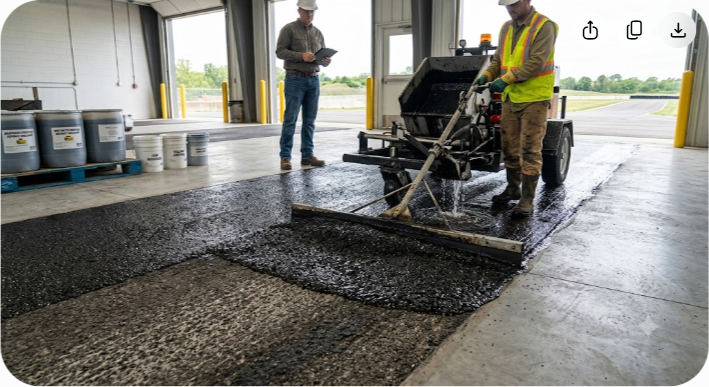
When properly hydrated and confined, sodium bentonite can swell and fill pore spaces, producing a low-permeability layer. This is why bentonite is widely used in engineered barrier systems and geosynthetic clay liners.
It is important to distinguish water sealing from conventional soil stabilization.
Adding sodium bentonite to a granular soil can change its gradation, moisture response, plasticity, and hydraulic behavior. Whether that produces a stronger road subgrade depends on the original soil, bentonite properties, moisture condition, compaction, confinement, and design objective.
Bentonite isn't a universal replacement for cement, lime, fly ash, or other established stabilizers. If the primary problem is low bearing capacity, engineers should test the treated soil for the required strength and deformation properties instead of assuming that reduced permeability will automatically increase structural capacity.
High-quality sodium bentonite can produce very low hydraulic conductivity when adequately hydrated and confined. Geosynthetic clay liner systems, for example, are engineered around this behavior.
A reported permeability value should always be tied to a test method and test conditions. Bentonite dosage, dry density, water chemistry, confinement, hydration history, and stress state can all affect measured hydraulic conductivity.
For this reason, a value such as 10^-8 or 10^-9 cm/s shouldn't be presented as a guaranteed field result for every bentonite soil mixture. Project specifications should define the required performance and laboratory testing should verify it.
A geosynthetic clay liner contains a layer of bentonite between geotextile or related carrier materials. When hydrated and confined, the bentonite forms a low-permeability barrier.
GCLs can be useful where a road project includes engineered water-control requirements, drainage structures, containment areas, or other applications where limiting liquid migration is necessary. They aren't a substitute for conventional pavement layers, and their suitability depends on the site design and loading conditions.
Moisture damage occurs when water weakens the bond between asphalt binder and aggregate or causes other forms of damage within the asphalt mixture. Aggregate mineralogy, binder chemistry, air voids, permeability, drainage, construction quality, and traffic all influence moisture susceptibility.
Clay-based additives may change binder properties or aggregate-binder interactions, but they shouldn't automatically be described as anti-stripping agents without mixture testing.
Water can enter a pavement through interconnected air voids, cracks, porous aggregates, defective joints, and drainage failures. Once water reaches the binder-aggregate interface, repeated traffic loading can accelerate damage.
A good moisture-resistance strategy therefore begins with mixture design and construction quality. Additives are only one part of the solution.
A common laboratory approach is the Tensile Strength Ratio test under AASHTO T283. The test compares the strength of conditioned and unconditioned specimens and can help identify mixtures that are susceptible to moisture damage.
The appropriate acceptance criterion depends on the governing project specification. A fixed TSR value should not be presented as a universal requirement for every road authority.
If organo-bentonite is being evaluated for moisture resistance, compare the modified mixture against an unmodified control using the same aggregate, binder, gradation, air-void level, and conditioning procedure.
Bentonite is also used as a rheology modifier in some water-based and asphalt-related formulations. Its swelling behavior can increase suspension stability and provide useful shear-dependent flow characteristics.
In an asphalt emulsion, the bentonite concentration and chemistry must be compatible with the emulsion system. The presence of emulsifiers, pH modifiers, water quality, bitumen chemistry, and mineral fines can all affect stability.
A properly selected bentonite can help control sedimentation and improve consistency. Under shear, the structure can become easier to pump or apply, while the material can recover some structure when left at rest.
The exact behavior depends on formulation. A bentonite that works well in one emulsion isn't guaranteed to work in another.
Bentonite may also be used as a rheology-control ingredient in selected sealants and slurry formulations. It can help control sag, suspension, and application consistency when the formulation is designed around its properties.
These are formulation-specific uses, not universal instructions for adding raw bentonite to asphalt maintenance materials.
The right additive depends on what the pavement is trying to achieve.
| Performance Consideration | Conventional Binder | SBS-Modified Binder | Sodium Bentonite | Organo-Bentonite |
|---|---|---|---|---|
| High-temperature binder modification | Baseline | Strong | Not its primary role | Potentially useful |
| Low-permeability barrier | No | No | Strong potential | Not its primary role |
| Subgrade water control | No | No | Strong potential | Not its primary role |
| Elastic recovery | Baseline | Strong | Not applicable | Depends on formulation |
| Moisture resistance | Mix dependent | Mix dependent | Strong as a barrier material | Requires mixture testing |
| High-shear dispersion | Usually not required | Often required | Not normally required | Commonly required |
| Main design concern | Binder and mixture balance | Polymer compatibility and storage | Hydration and confinement | Compatibility and dispersion |
SBS remains an established polymer modifier for asphalt because it can provide strong elastic recovery and high-temperature performance when properly formulated. Organo-bentonite works through a different mechanism and shouldn't be assumed to be a one-for-one replacement.
In some formulations, clay and polymer modifiers can complement one another. A hybrid system may improve certain rheological properties while reducing the amount of polymer required, but the economics and performance have to be demonstrated for the specific binder and climate.
Claims that a fixed percentage of organoclay will match a fixed percentage of SBS aren't reliable without test data. The comparison should include high-temperature rheology, fatigue behavior, low-temperature performance, aging, storage stability, and mixture-level testing.
Hydrated lime has a well-established role in many asphalt mixtures, particularly for improving moisture resistance and modifying certain aggregate-binder interactions. Bentonite has different chemistry and shouldn't be marketed as a universal replacement.
If moisture susceptibility is the problem, compare the alternatives using the project's specified mixture tests. If water containment is the problem, sodium bentonite may have a much more direct role than hydrated lime.
The safest way to introduce bentonite into pavement engineering is through controlled laboratory development rather than a fixed field dosage.
Start with the problem you are trying to solve.
This prevents an additive from being selected simply because it performs well in an unrelated application.
For sodium bentonite, useful properties can include mineralogy, montmorillonite content, free swell, liquid limit, particle-size distribution, moisture content, and hydraulic conductivity under the intended test conditions.
For organo-bentonite, characterization should include surface treatment, moisture content, particle size, thermal stability, compatibility with the binder, and dispersion behavior. X-ray diffraction can help assess changes in basal spacing, while microscopy can provide additional information about dispersion.
Do not use a generic bentonite specification for an organoclay application. The two materials are selected for different functions.
Always prepare an unmodified control using the same base binder, aggregate, gradation, additives, and target air-void content.
Then prepare a series of modified samples at several concentrations. Testing a single dosage makes it difficult to determine whether the observed result is genuinely associated with the additive or simply reflects normal laboratory variation.
For organo-bentonite, the laboratory blending procedure should follow the product supplier's technical guidance and the equipment manufacturer's operating limits.
A practical development program may involve:
There is no universal 3,000 to 5,000 RPM rule. Mixer geometry, batch size, impeller design, temperature, and material properties all influence the actual shear conditions. RPM by itself isn't enough to define dispersion quality.

Depending on the project, the evaluation can include Dynamic Shear Rheometer testing, rotational viscosity, multiple-stress creep recovery, aging procedures, and low-temperature binder testing.
The goal is to identify the complete performance profile, not just the highest stiffness value. A binder that becomes harder at high temperature but loses too much low-temperature relaxation may not be a better pavement binder.
Binder-level improvements don't always translate directly into mixture-level improvements. Prepare asphalt mixtures using the same aggregate structure and compaction targets, then evaluate properties such as rutting, moisture susceptibility, fatigue, cracking, and volumetric characteristics as required by the project specification.
Hamburg Wheel Tracking, Asphalt Pavement Analyzer testing, indirect tensile testing, fracture tests, and other methods may be appropriate depending on the agency and pavement design.
Sodium bentonite used in soil applications requires a different workflow from organoclay binder modification.
Determine gradation, Atterberg limits, moisture content, density, compaction behavior, strength, and hydraulic conductivity where relevant. Identify whether the soil is expansive, collapsible, poorly graded, contaminated, or otherwise unsuitable for the intended pavement structure.
The target may be reduced hydraulic conductivity, improved moisture retention, altered plasticity, improved workability, or better resistance to water movement. Each objective may require a different treatment approach.
Avoid applying a generic 3% to 8% bentonite dosage without testing. The appropriate percentage depends on the native soil and the performance target.
Prepare several trial blends and evaluate compaction, strength, permeability, and moisture behavior. If the soil is already highly plastic, adding a highly swelling clay can produce an undesirable increase in plasticity rather than improve pavement performance.
Bentonite needs water to hydrate and develop its swelling behavior. Field mixing therefore has to be followed by controlled moisture conditioning and adequate compaction.
The timing matters. Poorly distributed dry powder, uneven moisture, or inadequate compaction can create non-uniform zones with very different hydraulic and mechanical properties.
Bentonite from different deposits can have different mineralogy, exchangeable cations, swelling behavior, particle size, and impurities. Surface-treated organoclay is another category altogether.
Always specify the required material properties instead of purchasing a product based only on the word "bentonite".
More bentonite doesn't automatically mean better pavement performance. Excess clay can raise viscosity, interfere with coating and mixing, reduce workability, or increase low-temperature stiffness.
Use dosage optimization rather than maximum addition.
A higher DSR stiffness value may look attractive, but asphalt mixtures are affected by aggregate structure, air voids, binder content, compaction, moisture, and temperature.
A binder study is only the first stage.
Hydraulic conductivity depends strongly on density, hydration, confining stress, water chemistry, and test method. A single laboratory number shouldn't be treated as a universal field guarantee.
Some modified binders can separate during storage. If the organoclay settles or forms a concentration gradient, the material delivered to the plant mixer may not match the laboratory formulation.
Storage stability should therefore be tested before large-scale production.
SBS, hydrated lime, polymers, fibers, anti-stripping additives, and bentonite each solve different problems. Replacing one with another based only on purchase price can create a performance or construction problem later.
Compare the full system, including processing, testing, handling, maintenance, and expected service conditions.
Once laboratory testing supports the use of bentonite, the field process should be designed around uniformity.
For organo-bentonite binder modification, a controlled wet-blending system can provide better dispersion than simply dumping powder into a plant mixer. The modified binder should be sampled and checked for uniformity before production begins.
Dry addition may be possible for some products and plant configurations, but the mixing process has to demonstrate adequate dispersion. The fact that an additive passes through a pugmill doesn't prove that it has achieved the desired clay morphology.
For sodium bentonite soil applications, the material should be distributed evenly over the treatment area, mechanically blended to the specified depth, conditioned to the required moisture content, and compacted to the project density requirement.
Quality control should include field density and moisture measurements along with whatever permeability or strength testing the design calls for.
Material price alone doesn't determine whether bentonite is economical.
For asphalt binder modification, the relevant comparison is the total cost of the modified binder or mixture, including additive price, blending equipment, energy, storage, plant changes, quality control, and any impact on paving temperatures or production rates.
For subgrade applications, the calculation should include material transport, spreading, mixing, water conditioning, compaction, testing, and the cost of alternative remediation methods.
A low-cost mineral doesn't create savings if it requires expensive processing or produces inconsistent field results.
The strongest economic case is usually established when a bentonite treatment solves a clearly defined engineering problem and achieves the required performance with a practical construction process.
Bentonite is a naturally occurring mineral, but that doesn't mean every bentonite application has a negligible environmental footprint. Mining, drying, milling, transport, surface treatment, and blending all consume energy and resources.
Organo-bentonite also includes an organic surface-treatment component, so its environmental profile depends on the chemistry and manufacturing route used to produce it.
A credible sustainability assessment should therefore compare the full life cycle of the alternatives. If a treatment extends pavement life, reduces maintenance frequency, or avoids a more resource-intensive remediation method, those benefits can be included in the project assessment. They should be demonstrated rather than assumed.
For infrastructure work, consistency is often more important than a headline specification.
A supplier should be able to provide a technical data sheet, certificate of analysis, batch information, mineralogical information where relevant, moisture content, particle-size information, and test methods used for key performance claims.
For sodium bentonite, ask about swelling behavior, mineral composition, moisture, particle size, and hydraulic performance. For organoclay, ask for information on the surface treatment, compatibility with the target binder, thermal behavior, and recommended dispersion procedure.
Large road projects should also consider supply continuity. A laboratory formulation based on one mineral source can behave differently if production later switches to another deposit with different clay chemistry.
Axewelledge can be considered as one potential industrial bentonite supplier for projects requiring consistent sodium bentonite supply, subject to project-specific technical qualification and testing. Product selection should always be based on the required specification rather than supplier claims alone.
Use sodium bentonite when the main engineering requirement involves swelling, sealing, or limiting water movement and when laboratory testing confirms that the treated soil or barrier meets the design criteria.
Use organo-bentonite when the objective is to modify an organic binder or formulation and the selected organoclay has been demonstrated to disperse and remain compatible with that system.
Use SBS or another established polymer modifier when elastic recovery and broad temperature performance are central to the pavement design and the project specification calls for those properties.
Use hydrated lime or another approved anti-stripping treatment when moisture susceptibility testing identifies a need and the material is compatible with the aggregate and binder system.
In some projects, a combination of materials may perform better than any single additive. That decision should come from comparative testing, not a generic recipe.
Bentonite isn't a universal pavement additive, and treating it that way leads to poor engineering decisions. Its value comes from matching a particular form of the mineral to a particular problem.
Sodium bentonite is most compelling where swelling and low permeability are useful. Organo-bentonite has a different opportunity in asphalt binders because surface treatment can make montmorillonite compatible with hydrocarbon-based materials.
The best route from laboratory concept to road project is straightforward: define the failure mechanism, characterize the material, establish a control, test multiple dosages, evaluate binder and mixture performance, then confirm that the production process can reproduce the laboratory result.
That approach makes bentonite a material engineers can evaluate on evidence rather than on generic claims.













Have questions about our products? We're here to help!