Axewelledge, a leading exporter from India, specializes in high-quality Bentonite. With a commitment to excellence, we supply premium Bentonite to the Middle East and Southeast Asia markets.


North Angle Complex, 304,
150 Feet Ring Rd, Opposite Ambedkar Nagar BRTS Stop,
Madhav Park, Punit Nagar,
Mavdi, Rajkot, Gujarat 360004
© Axewelledge 2026, All Rights Reserved.
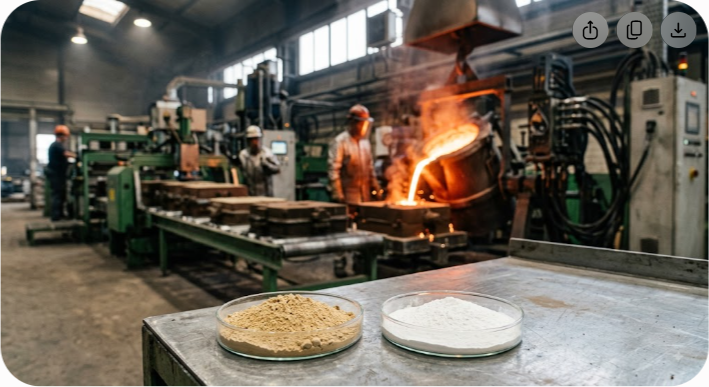
For conventional green sand molding, sodium bentonite is generally the better primary clay binder than kaolin. Its ability to hydrate, swell, coat sand grains, and build strong bonds makes it well suited to automated molding lines and continuously reclaimed sand systems. Kaolin has a different job: it is valued mainly for its refractory character and can be useful in refractory coatings, selected molding applications, cores, and other high-temperature uses where swelling and green strength aren't the main requirements.
That distinction matters. Bentonite and kaolin are both aluminosilicate clays, but they behave very differently when water is added and when the mold is exposed to molten metal. Bentonite is selected largely for bonding performance in the moist mold. Kaolin is selected more often for refractory stability after firing or intense heating.
For a foundry choosing a clay for green sand, the practical question isn't simply which mineral tolerates the highest temperature. The better question is: which clay gives the required mold strength, permeability, compactability, thermal behavior, and shakeout performance at the lowest overall system cost?
In most production green sand systems, that answer points toward a foundry-grade sodium bentonite, sometimes used with other clays or additives depending on the alloy, molding process, sand system, and casting geometry.
The simplest way to understand the comparison is to look at what happens when each clay meets water.
Bentonite used in foundry sand is rich in smectite, particularly montmorillonite. Its layered structure can accommodate water and exchangeable cations between mineral layers. Sodium-rich bentonite develops substantial swelling and forms a highly effective bonding film around sand grains. That combination gives green sand the plasticity and cohesion needed to make and handle molds.
Kaolin is dominated by kaolinite, a 1:1 clay mineral with a much less expandable structure. It doesn't develop the same colloidal gel or swelling behavior when mixed with water. As a result, simply replacing bentonite with kaolin usually changes the sand's compactability, moisture requirement, permeability, and strength profile rather than producing an equivalent binder system.
This is why the two materials shouldn't be compared solely by refractory temperature. A clay can remain chemically stable at high temperature and still be a poor choice as the primary binder in a high-speed green sand molding line.
| Property | Sodium Bentonite | Kaolin | Practical Meaning |
|---|---|---|---|
| Main clay mineral | Smectite, mainly montmorillonite | Kaolinite | Different bonding mechanisms |
| Water response | Strong swelling and hydration | Limited swelling | Bentonite develops stronger wet bonding |
| Green strength | High when properly conditioned | Generally lower as a primary green-sand binder | Bentonite is better for mold handling |
| Plasticity | High | Lower | Bentonite supports molding and compaction |
| Refractory character | Good, but loses binding function after sufficient thermal exposure | High after dehydroxylation and firing | Kaolin is useful in refractory applications |
| Typical green sand role | Primary binder | Specialty additive or refractory component | Application determines the better choice |
| Permeability impact | Efficient bonding at relatively low additions | Higher additions can reduce permeability | Binder dosage matters |
| Reclamation | Widely used in reclaimed green sand systems | Less commonly the principal binder | System design matters more than clay name alone |
The difference starts at the mineral level.
Bentonite is a commercial clay material rather than a single pure mineral. Its most important component for foundry bonding is usually montmorillonite, a smectite mineral with a 2:1 layered structure. A sheet of octahedrally coordinated aluminum or magnesium is positioned between two tetrahedral silica sheets.
Substitution within the crystal structure creates a net negative layer charge. Exchangeable cations such as sodium or calcium balance that charge. When water enters the system, these ions and the clay surfaces interact with water, allowing the layers to separate and the particles to hydrate.
Sodium-rich bentonite generally develops greater swelling than calcium-rich bentonite. That swelling creates a large hydrated surface area, which is one reason relatively modest quantities of high-quality bentonite can produce strong bonds around silica sand grains.
In a foundry muller, however, swelling alone isn't enough. The clay needs to be properly dispersed and activated through moisture addition and mulling. Poor conditioning can leave a high-quality bentonite performing below its potential.
Kaolin is composed mainly of kaolinite, a 1:1 aluminosilicate clay mineral. Its layers are held together more tightly than those of smectite, so water doesn't produce the same interlayer expansion.
That makes kaolin fundamentally different from bentonite as a wet binder. It can contribute to plasticity and strength in some formulations, but it doesn't create the same swelling gel that makes bentonite particularly effective in green sand.
Kaolin's advantage appears under a different set of conditions. After dehydroxylation, kaolinite transforms into metakaolin, and further heating can produce refractory phases. The material therefore retains useful refractory mass at temperatures where its original clay structure and plasticity have already been lost.
The distinction is important: refractory stability and green-sand bonding are not the same property.
Green strength is the strength of a moist, compacted sand mold before the metal is poured. A molding line depends on it to keep the mold intact during pattern withdrawal, handling, closing, transport, and pouring.
A well-conditioned sodium bentonite system can produce strong bonds at relatively modest clay levels. The hydrated clay coats the sand grains and forms a network that holds the compacted sand together.
Kaolin generally doesn't provide the same combination of swelling, plasticity, and green strength. Trying to compensate simply by adding more kaolin can create a new problem: excessive clay and moisture can reduce permeability and alter the way the sand compacts.
The exact strength numbers shouldn't be treated as universal specifications. Green compression strength depends on clay quality, active clay content, moisture, sand grain distribution, mulling intensity, compactability, specimen preparation, and the testing method. A value from one foundry cannot automatically be applied to another.
For that reason, foundries should specify a target range for their own process rather than buying clay against a generic strength number alone.
Insufficient green strength can show up as:
If the molding machine is operating at high speed, these problems can quickly become production problems rather than isolated sand-quality issues.
Once molten metal enters the mold, the sand near the mold face loses moisture and experiences a sharp thermal load. The strength characteristics of the sand therefore change as the mold heats.
Bentonite can provide substantial dry and hot strength when the sand system is correctly balanced. That helps resist erosion and mold-wall movement while metal is flowing through the cavity.
Kaolin can contribute refractory stability and dry strength, but that doesn't make it a direct substitute for bentonite in a green molding system. The useful property depends on when the strength is needed. A green sand mold must first survive handling while moist, then retain sufficient integrity as it heats.
This is one reason foundries often use different materials for different parts of the mold system. A bentonite-rich green sand provides the wet bonding performance, while a refractory coating can protect selected surfaces from intense metal contact.
Bentonite and kaolin behave differently when heated, but temperature claims need to be handled carefully.
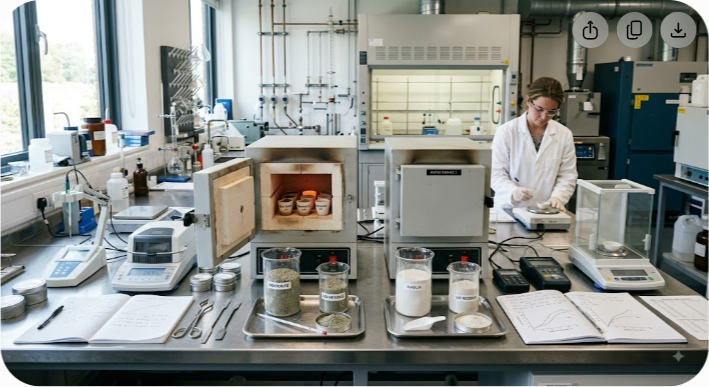
Bentonite contains both adsorbed water and water associated with its mineral structure. As temperature rises, water is removed in stages. At sufficiently high temperatures, the montmorillonite structure is altered and the clay loses the swelling and bonding properties that made it useful in the first place.
In reclaimed green sand, this thermally altered material is often referred to as dead clay. It remains in the sand system as a fine mineral fraction, but it no longer contributes the same active bonding capacity.
The exact temperature at which a particular bentonite loses useful activity isn't a single universal number. It depends on mineralogy, heating rate, exposure time, atmosphere, and the way the clay is being tested. A statement such as "bentonite stops working at exactly 1,100 degrees F" is therefore too simplistic for production engineering.
Kaolinite also loses hydroxyl groups when heated and transforms to metakaolin. Its clay plasticity is lost, but the resulting material can remain refractory at temperatures relevant to many foundry applications.
This explains an apparent contradiction: kaolin can be more refractory than bentonite while still being a poorer primary binder for wet green sand.
The properties are being measured at different stages of the process. Bentonite's strength comes largely from its hydrated clay structure. Kaolin's value in high-temperature applications comes largely from what remains after that hydrated clay structure has been transformed.
Permeability is the ability of gases to move through the compacted mold. During pouring, water vapor and gases generated by the mold materials need a path out of the mold. Poor permeability can contribute to blows, pinholes, and other gas-related defects.
Bentonite is efficient because it can provide strong bonding without requiring the very high clay additions that would be needed from a less-swelling clay. But bentonite isn't automatically synonymous with high permeability. Excessive active clay, dead clay, moisture, or overly fine sand can all reduce permeability.
Kaolin can create a similar issue if a foundry increases its addition rate to compensate for weaker green bonding. More fine material fills spaces between sand grains, while additional water may be needed to obtain acceptable workability.
The right target is therefore not simply "minimum clay" or "maximum permeability." The foundry needs enough active binder for mold strength while preserving a pore structure that can vent gases effectively.
A green sand laboratory should normally look at several properties together, including:
Looking at only one number can hide the actual cause of a casting defect.
| Property | Sodium Bentonite | Calcium Bentonite | Kaolin | Foundry Implication |
|---|---|---|---|---|
| Primary mineral | Smectite, mainly montmorillonite | Smectite, mainly montmorillonite | Kaolinite | Mineralogy drives water response |
| Swelling | High | Lower than sodium bentonite | Low | Swelling supports efficient green bonding |
| Green plasticity | High | Moderate to high | Generally lower | Important for molding and handling |
| Green strength | Generally high | Can be high depending on grade and system | Generally lower as a sole binder | Supports pattern withdrawal and mold handling |
| Dry strength | High in suitable systems | Moderate to high | Can be useful after drying | Helps resist erosion and mold movement |
| Thermal behavior | Loses active swelling after sufficient heating | Similar loss, generally with different system performance | Strong refractory character after transformation | Selection depends on process stage |
| Moisture efficiency | Generally good | Good, depending on grade | Usually less efficient as primary green binder | Affects gas generation and compactability |
| Green sand suitability | Excellent | Useful in selected systems | Limited as primary binder | Bentonite is normally preferred |
| Refractory use | Secondary or supporting role | Secondary or supporting role | Strong | Kaolin is valuable in refractory formulations |
| Continuous reclamation | Widely used | Widely used in suitable systems | Not normally the principal binder | System testing is essential |
| Typical role | Primary green-sand binder | Binder or blend component | Refractory additive, coating, or specialty material | Application determines value |
The table is a practical comparison, not a substitute for laboratory testing. Foundry clays vary considerably by deposit, processing method, mineral purity, particle-size distribution, exchangeable cations, and activation treatment.
The answer changes with the alloy and molding process, but the general pattern is consistent: green sand molding favors bentonite, while high-temperature refractory protection can favor kaolin-based materials.
For automated green sand molding of grey iron and ductile iron, sodium bentonite is commonly the primary clay binder. These systems need strong green properties during molding and handling, followed by sufficient dry and hot strength during pouring.
The clay selection should be made alongside the sand's grain-size distribution, compactability, moisture, pouring temperature, casting geometry, and reclamation conditions. A foundry casting heavy ductile iron sections may need a different sand balance from a plant producing small, thin-wall grey iron parts.
The important point is that the clay shouldn't be selected by alloy name alone. The complete molding system matters.
Steel places a much higher thermal load on the mold. Green sand can still contain bentonite as the binder, but the mold surface may require a refractory coating to reduce metal penetration, burn-on, and other high-temperature reactions.
Kaolin can be part of refractory formulations, although foundries also use other refractory materials such as zircon, alumina, chromite, and specialized coating systems depending on the casting and process.
For large steel castings, the right solution is often not "replace bentonite with kaolin." It is to keep an effective binder system and protect the mold surface with an appropriate refractory coating.
Aluminum green sand systems still need a dependable binder. Sodium bentonite, calcium bentonite, or blended systems can be used depending on the foundry's process and sand characteristics.
It would be misleading to say that calcium bentonite is automatically better because aluminum pours at a lower temperature. Shakeout performance depends on the entire sand system, including binder level, mold density, casting geometry, core materials, and mechanical shakeout conditions.
For aluminum foundries, the best clay is the one that reaches the required strength and surface quality without creating unnecessary moisture, permeability, or shakeout problems.
Copper alloys generally require more thermal resistance than aluminum but less than steel. Bentonite-based green sand systems can be used, while refractory coatings or specialty additives may be selected for areas exposed to particularly severe thermal conditions.
Again, the correct specification comes from the actual process rather than a simple metal-to-clay chart.
Not every bentonite performs the same way. Natural sodium bentonite generally has higher swelling capacity than calcium bentonite, while calcium bentonite can have useful green strength and handling characteristics in properly designed systems.
Natural sodium bentonite contains sodium as an important exchangeable cation and is commonly associated with deposits in regions such as Wyoming in the United States. High-quality natural sodium grades are valued in green sand because they can produce strong bonds with relatively efficient clay additions.
Calcium bentonite contains calcium as a major exchangeable cation and generally swells less than sodium bentonite. It can still be useful in foundry sand, particularly when the formulation is designed around its specific behavior.
Neither label tells the entire story. A calcium bentonite from one deposit can behave differently from another, just as two sodium bentonites can have different performance because of mineral purity, processing, particle size, and exchange chemistry.
Calcium bentonite can be treated with sodium carbonate to increase its sodium character. This process is commonly known as sodium activation.
Activated calcium bentonite can perform very well when properly processed, but its behavior in a continuously reclaimed foundry system depends on the quality of the activation, the sand chemistry, thermal history, and system management. It shouldn't automatically be described as either equivalent to or inferior to every natural sodium bentonite.
The practical approach is to compare actual foundry test results: swelling, active clay, compactability, green strength, wet tensile strength, permeability, moisture demand, and performance after thermal cycling.
Choosing the right clay is only half the job. Even premium bentonite can perform poorly if moisture and mulling are out of control.
Total clay includes active binder as well as thermally altered and other fine clay-sized material. A sand system can therefore contain a high total clay percentage while having a much lower level of useful active bentonite.
Methylene blue testing is widely used to estimate active clay in foundry systems, although the test method and calibration should match the foundry's laboratory practice.
Instead of copying a universal active-clay target, establish the operating range that gives your molding line the required compactability, strength, permeability, and casting quality. The right number depends on the sand system and process.
Water activates bentonite, but more water isn't better. Too little moisture can leave the clay incompletely developed and reduce bonding. Too much can increase gas generation, alter compactability, and contribute to defects.
A useful production control strategy is to correlate moisture with compactability rather than relying on moisture alone. The same moisture percentage can produce different results as sand temperature, active clay, fines, and bentonite quality change.
Bentonite needs effective dispersion around the sand grains. Adding clay and water without adequate mulling can leave the system with poor bonding despite apparently correct chemical percentages.
Review muller loading, mixing sequence, water addition, clay addition, cycle time, and temperature. The goal is a uniform conditioned sand, not simply a mixture that has reached a target moisture reading.
Thermal cycling changes the clay population. Active bentonite is gradually converted into less active material, while fines and other contaminants accumulate or are removed through reclamation.
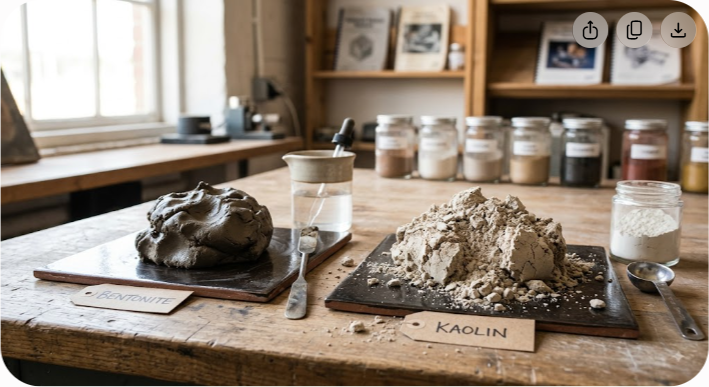
Track active clay and total clay separately. If the gap between them grows, the system may need stronger reclamation or a revised addition strategy rather than simply adding more binder.
Fresh bentonite consumption should reflect actual system losses and thermal loading. Pour weight, metal-to-sand ratio, casting geometry, reclamation efficiency, sand temperature, and dust extraction all affect consumption.
Avoid using a fixed percentage as a universal rule. A production foundry should establish its addition rate from regular sand testing and material balance data.
Clay isn't responsible for every casting defect, but an unstable binder system can make several problems worse.
These defects are associated with thermal expansion and mold-surface movement. Quartz sand undergoes a significant phase transformation near 573 degrees C, causing a rapid change in volume. If the mold surface cannot accommodate the resulting stress, expansion-related defects can develop.
A better response than simply adding more clay is to examine wet tensile strength, compactability, moisture, sand grain distribution, active clay, additives, and mold hardness. Sodium bentonite can provide strong wet bonding, but the entire sand formulation must be balanced.
If metal flow removes sand from the mold face, the problem may appear as rough surfaces or sand inclusions.
Possible causes include insufficient mold strength, poor compaction, weak sand conditioning, excessive metal velocity, poor gating, or an inappropriate binder level. Improving active bentonite and mulling can help when the binder is the limiting factor, but changing the clay alone won't fix poor gating or inadequate mold hardness.
Gas defects can result from excessive moisture, poor venting, excessive volatile material, insufficient permeability, or interactions among several of these factors.
High clay content can contribute indirectly by increasing moisture demand and reducing permeability. The better solution is to control active clay, moisture, compactability, permeability, sand temperature, and venting together.
Burn-on occurs when mold material adheres strongly to the casting surface. Metal penetration, chemical reactions, high mold temperature, sand characteristics, and refractory protection can all play a role.
For severe applications, an appropriate refractory coating can provide more protection than simply increasing the clay content. Kaolin can be used in some coating formulations, but many foundries use specialized refractory materials selected for the alloy and casting conditions.
The cheapest clay per ton isn't necessarily the cheapest clay to run.
A useful comparison should include:
For example, suppose a foundry processes 50,000 tons of circulating sand per year. A hypothetical 7% active-clay addition would represent 3,500 tons of clay if the percentage is calculated on the same stated mass basis. A 14% addition would represent 7,000 tons. Those figures illustrate why addition efficiency matters, but they should not be presented as a universal bentonite-versus-kaolin dosage rule.
In real production, the correct addition rate must come from the strength and permeability requirements of the particular sand system. If a clay requires substantially higher additions to reach the same molding performance, the extra material also changes moisture demand, fines content, reclamation load, storage requirements, and waste generation.
The most useful purchasing metric is therefore cost per ton of acceptable castings produced, not simply cost per ton of clay delivered.
A clay's ability to tolerate heat doesn't tell you whether it will provide sufficient green strength. Green sand needs a binder that works before pouring, not just a mineral that survives afterward.
Natural sodium bentonite, calcium bentonite, and sodium-activated products can have very different swelling and bonding characteristics. Mineral purity and processing also matter.
If mulling is poor, adding more clay can increase costs without solving the underlying problem. Check moisture addition, mixing energy, sand temperature, and active clay first.
A large total-clay number can hide a low active-clay level. Thermal history and reclamation can leave substantial dead fines in the system.
A thin-wall aluminum casting and a heavy ductile iron casting don't necessarily need the same sand properties. Production targets should reflect the mold, alloy, molding equipment, and casting geometry.
Casting defects are often multi-factor problems. Gating, venting, pouring temperature, mold hardness, sand temperature, moisture, grain size, and metal chemistry can be just as important as the binder.
Sodium bentonite is usually the first material to evaluate when you operate a green sand molding system and need strong wet bonding, good compactability, efficient clay usage, and reliable mold handling.
It is particularly relevant to automated production of grey iron and ductile iron castings, although the final specification should be based on actual sand testing. It can also be part of green sand systems used for other alloys.
Calcium bentonite can be appropriate when its specific green strength, swelling behavior, and system characteristics match the foundry's requirements. It can be used alone or as part of a blended clay system.
Don't select it simply because the casting alloy is non-ferrous. Run comparative trials under the actual production conditions.
Kaolin is worth considering when refractory behavior is more important than high swelling and wet bonding. Typical uses include refractory coatings and selected high-temperature formulations. It can also have a role in certain core and molding materials, but it should not be assumed to be a one-for-one replacement for bentonite in conventional green sand.
If you're evaluating two suppliers or two clay grades, don't compare only laboratory swelling values. Run a controlled plant trial.
Record the existing sand system's active clay, total clay, moisture, compactability, permeability, green strength, sand temperature, and casting defect rate.
Keep the sand, moisture-control method, mulling conditions, and molding parameters as consistent as practical. If multiple variables change at once, it becomes difficult to identify why performance moved.
Fresh sand test results don't always predict reclaimed-system behavior. Monitor active clay and system fines after the sand has experienced normal production heat cycles.
Track fresh clay consumption, water additions, reclamation losses, sand disposal, scrap, finishing labor, and downtime. A clay that costs more per ton may still reduce total cost if it delivers stable molding performance with lower consumption.
The final specification should state the properties that matter to the foundry, not just the product name. Useful purchase requirements may include moisture, swelling, active clay performance, particle-size distribution, residue, and other agreed laboratory characteristics.
Consistent clay quality matters because green sand systems respond to changes in swelling, mineral purity, moisture demand, and thermal history. A supplier should be able to provide a stable product specification and support quality control from shipment through production trials.
Axewelledge supplies bentonite from India for industrial applications and offers grades intended for demanding mineral-processing and foundry requirements. For a foundry evaluating a new bentonite source, the most useful starting point is a technical comparison based on the plant's existing sand data.
Rather than selecting a product from a generic strength claim, ask the supplier for representative test data, recommended conditioning parameters, packaging and shipment specifications, and samples for plant or laboratory evaluation.
For green sand applications, the right bentonite should help the foundry maintain stable molding properties without forcing unnecessary increases in clay, water, or reclamation load. A controlled trial is the best way to determine whether a grade is a genuine fit for the system.
Bentonite and kaolin are not interchangeable foundry clays. Sodium bentonite is generally the stronger choice when the primary requirement is wet green-sand bonding, mold handling, and stable production on a reclaimed green sand system. Kaolin earns its place where refractory behavior is the priority, particularly in selected coatings and high-temperature applications.
The best clay decision comes from the whole process: mineral quality, active clay, moisture, compactability, permeability, mulling, thermal exposure, reclamation, alloy, mold design, and casting quality all matter.
If you're comparing suppliers, don't stop at the price per ton. Test the clay in your own sand system and measure the properties that affect the cost of good castings. That's where the real difference between two binder materials shows up.













Have questions about our products? We're here to help!