Axewelledge, a leading exporter from India, specializes in high-quality Bentonite. With a commitment to excellence, we supply premium Bentonite to the Middle East and Southeast Asia markets.


North Angle Complex, 304,
150 Feet Ring Rd, Opposite Ambedkar Nagar BRTS Stop,
Madhav Park, Punit Nagar,
Mavdi, Rajkot, Gujarat 360004
© Axewelledge 2026, All Rights Reserved.
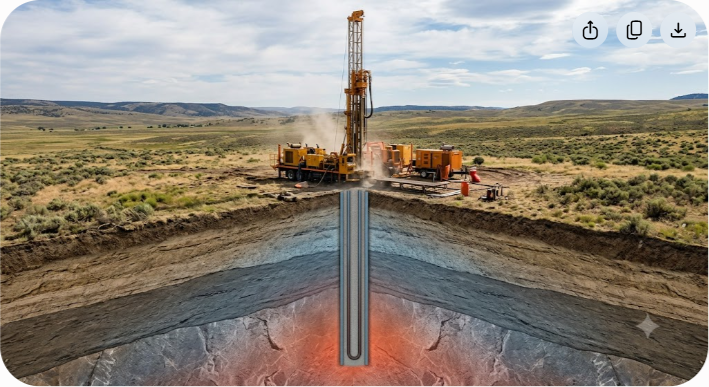
Bentonite is used in geothermal drilling for more than one reason. In the drilling fluid, it helps control filtration, suspend cuttings, and support weak formations. In closed-loop ground-source heat pump systems, bentonite-based grout can seal the borehole annulus around the heat-exchange pipe. The right formulation can also help balance hydraulic sealing with thermal performance.
The important point is that bentonite isn't a universal recipe. Its performance depends on mineral quality, water chemistry, concentration, mixing, temperature, formation conditions, and the job's specific requirements. A formulation that works well in a shallow closed-loop borehole may be unsuitable for a deep, high-temperature geothermal well.
This guide covers seven practical uses of bentonite in geothermal drilling, explains where it fits in the drilling and grouting process, compares it with other materials, and outlines the specifications and field practices worth checking before a project starts.
A stable borehole is the foundation of a successful drilling operation. Geothermal wells can pass through loose sand, gravel, weathered rock, clay-rich overburden, fractured formations, and competent bedrock within the same hole. The weaker intervals can slough, cave, or wash out when they aren't adequately supported.
A properly prepared bentonite drilling fluid helps reduce that risk. Hydrated bentonite forms a low-permeability filter cake against permeable sections of the borehole wall. The cake limits fluid invasion into the formation while the fluid column provides hydrostatic support. Together, these effects can help maintain the integrity of the hole while drilling continues.
Bentonite works particularly well because its plate-like clay particles interact with water and develop a structured suspension. Under circulation, the fluid can be pumped through the system. When circulation slows or stops, the structure of the suspension increases and helps keep solids from settling rapidly.
The filter cake matters just as much as the bulk mud properties. An unnecessarily thick or poorly formed cake can increase drag and complicate downhole operations, while excessive fluid loss can weaken the formation or cause the drilling fluid level to fall. The goal is controlled filtration, not simply the highest possible viscosity.
Several measurements provide a better picture of borehole stability than bentonite concentration alone:
The required properties should be set from the formation, drilling method, hole size, circulation system, and operating temperature rather than copied from a generic bentonite recipe.
Drilling fluid has to do more than cool the bit. It must transport the rock fragments created at the bottom of the borehole to the surface. If cuttings settle, they can accumulate around the bottom-hole assembly, increase torque and drag, restrict circulation, and contribute to stuck-pipe problems.
Bentonite provides the rheological structure needed for this job. Hydrated bentonite suspensions are non-Newtonian and can exhibit useful thixotropic behavior. In practical terms, the fluid can flow under pumping conditions while developing enough structure during periods of low or zero circulation to slow the settling of solids.
That behavior is particularly useful when drilling is interrupted for a connection, tool change, survey, or other operation. The exact gel strength required depends on the hole geometry and cuttings characteristics. Excessive gel strength isn't automatically better; a fluid that becomes too structured can require more pressure to restart circulation and can complicate solids control.
A good geothermal drilling fluid has to balance several competing requirements. It needs enough carrying capacity to remove cuttings, but excessive viscosity can increase circulating pressure and energy demand. It needs sufficient low-shear structure to limit settling, but excessive gels can make pump startup difficult.
For that reason, field personnel commonly monitor properties such as plastic viscosity, yield point, gel strengths, density, and filtration. The appropriate target range should come from the drilling program and the bentonite manufacturer's tested performance rather than from a single universal number.
| Fluid property | Why it matters | What poor control can cause |
|---|---|---|
| Plastic viscosity | Reflects resistance associated with the liquid and suspended solids | Excessive pressure losses and inefficient circulation when too high |
| Yield point | Indicates the fluid's ability to develop carrying capacity under low shear | Poor cuttings transport when too low |
| Gel strength | Shows how the fluid develops structure when static | Cuttings settling when too low; difficult restart when too high |
| Fluid loss | Indicates how much filtrate enters permeable formations | Formation instability and excessive fluid consumption |
| Density | Determines hydrostatic pressure and affects solids transport | Formation influx or excessive formation pressure when poorly matched |
Bentonite is therefore best viewed as a rheology-building material, not simply a thickener. The finished fluid has to behave appropriately throughout the drilling cycle.
In a vertical closed-loop ground-source heat pump system, the borehole is usually completed with a U-shaped high-density polyethylene pipe. The space between that pipe and the surrounding formation is the annulus. Leaving that space poorly sealed can create both hydraulic and thermal problems.
Bentonite-based geothermal grouts are used to fill and seal the annulus. The grout helps limit groundwater movement along the borehole and creates a continuous medium around the heat-exchange pipe. Depending on the formulation, it can also provide the thermal properties needed for the system design.
This is different from using bentonite drilling mud. Drilling fluid is formulated to circulate and perform during excavation; geothermal grout is formulated for permanent placement after the loop pipe is installed. The two applications may use related raw materials, but their specifications and performance requirements are not interchangeable.
A properly designed grout can help:
The grout formulation should be selected according to local groundwater requirements, formation conditions, installation method, pipe material, and the thermal design of the system. In many jurisdictions, geothermal borehole grouting is subject to specific construction and environmental requirements, so project specifications and local codes should take precedence over a generic material recommendation.
Bentonite has excellent sealing characteristics, but neat bentonite grout isn't necessarily the best choice when thermal conductivity is the main design objective. Thermal resistance between the heat-exchange pipe and surrounding ground affects the size and performance of a ground-source heat pump borefield.
For that reason, geothermal grouts can be engineered with thermally conductive mineral fillers. Silica sand and other conductive additives may be incorporated into a bentonite-based system to increase thermal conductivity while retaining the sealing characteristics needed for the borehole.
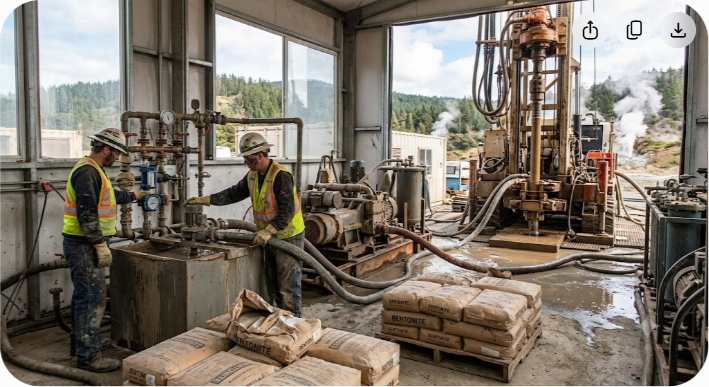
The formulation is a balancing exercise. Adding more conductive aggregate can raise thermal conductivity, but it can also change density, viscosity, pumpability, settlement behavior, and water demand. A grout that looks excellent on a laboratory thermal-conductivity test may still be unsuitable if it segregates during pumping or cannot be placed continuously at the required depth.
A higher laboratory thermal-conductivity value doesn't automatically produce a better geothermal installation. Engineers also need to consider borehole diameter, pipe configuration, ground thermal properties, grout placement, loop-fluid temperature, and long-term system loading.
For a commercial or large residential field, the grout should be selected as part of the overall borefield design rather than treated as an isolated material purchase.
Lost circulation occurs when drilling fluid enters fractures, cavities, coarse gravel, or other high-permeability zones faster than the circulation system can replace it. The problem is especially relevant in fractured rock, which is common in many geothermal settings.
Bentonite can help control some forms of fluid loss by building a filter cake and reducing filtration into permeable formations. In more severe losses, bentonite may also be used as part of a lost-circulation treatment, often alongside other materials selected for the size and character of the loss zone.
The distinction is important. Bentonite isn't a cure for every lost-circulation event. Large open fractures and cavernous zones may require bridging materials, granular products, fibrous materials, cementitious treatments, mechanical isolation, or a combination of approaches.
A concentrated bentonite treatment can be placed where fluid losses are occurring. As the clay hydrates and develops structure, it can reduce permeability through smaller flow paths and help establish a seal. Coarser bentonite products may be used when the treatment needs to bridge larger voids.
The treatment should be designed around the actual loss mechanism. Before increasing clay concentration indefinitely, the drilling team should consider formation pressure, fracture size, fluid density, pump pressure, and whether continued circulation is desirable at that stage of the operation.
This approach avoids a common mistake: treating every loss with a thicker mud. A higher-viscosity fluid can increase pressure and, in some formations, make losses worse. The right response depends on why the fluid is disappearing.
Bentonite drilling fluids can contribute to the general lubrication and cooling functions of a water-based drilling system. Circulating fluid carries heat away from the bit and transports it toward the surface, while the fluid film can reduce friction between moving components and the borehole environment.
That said, bentonite shouldn't be presented as a specialized high-performance lubricant. Its primary drilling-fluid roles are filtration control, suspension, rheology, and formation support. Where a geothermal drilling program has unusually high torque, difficult formations, or demanding downhole equipment, purpose-designed lubricants or other additives may still be required.
These benefits depend on maintaining the fluid correctly. Contamination with drilled solids, cement, salts, or incompatible additives can change rheology and reduce the performance expected from the original bentonite formulation.
In high-temperature geothermal drilling, temperature limits for the complete fluid system should be established from laboratory testing and supplier data. Clay behavior, polymer stability, filtration, and chemical compatibility can all change as temperature increases.
Geothermal boreholes can intersect more than one groundwater zone. If the completed well is not properly sealed, the borehole itself can become a preferential pathway for water to move between formations that were previously separated.
Bentonite is widely used in sealing applications because hydrated clay can form a low-permeability barrier. Bentonite pellets, chips, plugs, or engineered slurries can be selected according to the borehole geometry and sealing objective.
The same principle applies when a borehole is abandoned. The sealing design should prevent unwanted fluid movement through the well and should comply with the applicable regulatory requirements. A material choice alone doesn't guarantee a successful abandonment. Placement technique, borehole condition, hydration, seal length, and verification are all important.
Different bentonite forms are suited to different jobs:
| Bentonite form | Typical application | Main consideration |
|---|---|---|
| Fine powder | Drilling fluids and prepared slurries | Requires controlled mixing and hydration |
| Pellets | Targeted sealing intervals | Placement and hydration behavior must be controlled |
| Granules or chips | Sealing larger intervals or irregular spaces | Particle size and hydration time affect placement |
| Engineered grout | Closed-loop geothermal annular sealing | Must balance hydraulic sealing, thermal performance, and pumpability |
Bentonite should also be treated as a mineral material, not automatically as a guarantee of environmental compliance. The finished system must meet the requirements of the project and the relevant authority, including any restrictions on additives or placement methods.
Sodium bentonite is widely used because it offers a useful combination of swelling, filtration control, suspension, and availability. But it isn't automatically the best material for every geothermal application.
Calcium bentonite generally has lower swelling and lower yield in freshwater systems. It can still be useful in applications where its properties are appropriate, but it usually requires different formulation and treatment than sodium bentonite.
Polymer-based fluids can provide strong rheological control at relatively low concentrations and may be selected for specific drilling conditions. Their temperature stability and chemical compatibility must be evaluated for the actual geothermal environment. Polymer and clay systems can also be combined when the drilling program calls for it.
| Performance factor | Sodium bentonite | Calcium bentonite | Polymer-based system |
|---|---|---|---|
| Freshwater swelling | Generally high | Generally lower | Not applicable in the same way |
| Filtration control | Strong when properly formulated | Generally weaker in untreated freshwater | Can be very effective depending on polymer type |
| Suspension | Strong, with useful gel structure | Moderate to lower | Highly formulation-dependent |
| Temperature response | Depends on grade, chemistry, and exposure time | Depends on grade and chemistry | Strongly dependent on polymer chemistry |
| Thermal grout use | Common as a sealing matrix | Possible in selected systems | Possible in engineered systems |
| Water chemistry sensitivity | Significant | Significant | Depends on polymer chemistry |
There is no single material that wins every category. The drilling fluid or grout should be selected against measurable project requirements rather than a generic claim that one clay is universally superior.
The best bentonite product is the one whose tested properties match the drilling method, water chemistry, formation, temperature, and application. Product price per tonne tells only part of the story.
High-yield bentonite can produce the required drilling-fluid properties with less dry material than a lower-yield clay. Suppliers may report yield using standardized test methods, so make sure products are compared on the same basis.
A high yield does not mean that the material should automatically be used at a lower concentration. The required concentration still depends on filtration, cuttings transport, hole size, formation permeability, and other operating conditions.
For drilling-fluid applications, API Specification 13A provides standardized requirements for several drilling-fluid materials, including bentonite. If a project calls for API-compliant material, check the specific section and the supplier's current test documentation rather than relying on the phrase "API grade" alone.
API compliance also doesn't mean that a product is automatically optimized for every geothermal application. The project may require additional testing for temperature, water chemistry, filtration, or grout performance.
Bentonite performance is closely related to its montmorillonite content, exchangeable cations, particle size, processing, and hydration environment. Sodium-dominant bentonites generally show strong swelling and suspension behavior in freshwater.
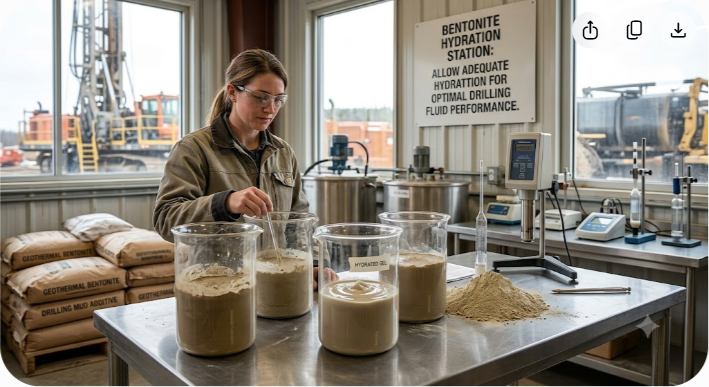
Don't judge mineral quality from montmorillonite percentage alone. A complete product specification and application-specific test data provide a more useful basis for selection.
Fine bentonite powder is typically used when rapid dispersion and controlled mixing are required for drilling fluids or prepared slurries. Granular products, pellets, and chips are more suitable for some sealing and lost-circulation applications because their physical form allows controlled placement before full hydration.
Particle size also affects mixing equipment, hydration time, dust control, and the risk of clumping. The product should match the equipment available at the site.
Water chemistry can make a good bentonite perform poorly. Calcium, magnesium, salinity, alkalinity, and other dissolved ions can influence hydration and rheology. Before a major drilling program, testing the actual makeup water is far more reliable than assuming that the product will behave like it does in laboratory freshwater.
Many bentonite problems that appear to be product failures actually begin in the mixing system. Poor dispersion, contaminated water, inadequate hydration, and excessive drilled solids can all change the final fluid.
Test the makeup water before preparing the drilling fluid. If hardness is high, treatment with soda ash may improve bentonite hydration, but the dosage should be based on water analysis and established field practice. A fixed dose should not be applied blindly because hardness varies from one water source to another.
Saltwater or highly mineralized water may require a different bentonite grade or a specially formulated fluid. If the geothermal formation introduces saline water into the active system, monitor the fluid rather than assuming the original formulation will remain unchanged.
A venturi hopper, jet mixer, or other suitable high-shear mixing system generally disperses bentonite more consistently than adding powder directly to a stagnant tank. The objective is to wet and disperse the clay quickly while avoiding lumps that hydrate on the outside and remain dry internally.
Mixing order also matters when polymers, deflocculants, lost-circulation materials, or other additives are used. Follow the product supplier's recommended sequence and test compatibility before introducing several additives into the active system.
Bentonite doesn't always reach its final rheology immediately after it enters the water. Hydration time varies with clay quality, particle size, water chemistry, temperature, and mixing energy. Some high-yield products hydrate relatively quickly, while others benefit from additional aging.
If the drilling schedule allows, prepare and condition the mud before it is needed downhole. Field testing should confirm when the slurry has reached the intended properties.
A well-formulated bentonite system can still become difficult to manage when large amounts of drilled solids accumulate. Solids-control equipment and regular property checks help prevent the fluid from becoming unnecessarily dense or viscous.
The drilling team should routinely monitor density, viscosity, filtration, gel behavior, and other properties specified by the drilling program. Adjustments should be based on those measurements rather than on visual appearance alone.
Several recurring mistakes can undermine an otherwise sound drilling-fluid program.
Formation permeability, temperature, hole diameter, and groundwater conditions can change substantially during a single well. A mud system that works in shallow overburden may not be suitable for a deeper fractured-rock interval.
More viscosity can improve suspension, but it can also increase circulating pressure and reduce drilling efficiency. If formation losses are already occurring, raising viscosity without understanding the loss mechanism may make the problem worse.
Drilling fluid is designed for circulation and removal from the hole. Grout is designed for permanent placement. Using a drilling-fluid formulation as a substitute for engineered geothermal grout can produce poor sealing or inadequate thermal performance.
A premium sodium bentonite can lose much of its expected performance when mixed with unsuitable water. Water testing should be part of the initial formulation process, not an afterthought when the mud starts behaving unexpectedly.
A cheaper clay that produces less usable mud may require more material, more storage, and more handling. Compare products by standardized yield, rheology, filtration, and actual consumption rather than purchase price alone.
Geothermal environments vary widely. The temperature tolerance of the complete fluid system depends on clay grade, water chemistry, additives, exposure time, and operating conditions. Use supplier data and application-specific testing when high-temperature performance matters.
The word "geothermal" covers very different drilling environments. A residential ground-source heat pump borehole and a deep geothermal production well can require completely different fluid and completion strategies.
| Application | Primary bentonite role | Main design concern |
|---|---|---|
| Vertical closed-loop borehole | Annular sealing and, in some cases, thermal grout formulation | Groundwater protection and thermal resistance |
| Shallow water-well-style drilling | Borehole support, suspension, and filtration control | Formation stability and clean hole development |
| Deep exploratory geothermal well | Drilling-fluid rheology and filtration control where compatible | High temperature, pressure, fractured formations, and fluid losses |
| Lost-circulation treatment | Seal or support a treatment system | Matching the material to fracture or void size |
| Borehole abandonment | Permanent sealing of selected intervals | Regulatory compliance and reliable placement |
This distinction helps explain why there is no universal "best bentonite concentration" for geothermal drilling. The right formulation starts with the job, not the product label.
Before ordering material, ask the supplier for documentation that allows the product to be evaluated against the actual application. Depending on the job, useful information can include:
For geothermal grout, add thermal conductivity, density, bleed or settlement behavior, permeability, pumpability, and curing or hydration characteristics where relevant to the project specification.
The more demanding the installation, the more valuable application-specific testing becomes. A laboratory comparison using the actual water source and proposed solids ratio can reveal problems before the drilling crew is working several hundred metres below the surface.
Consistent field performance starts with consistent raw material and processing. For geothermal drilling, buyers should evaluate suppliers on documented product quality, batch consistency, technical support, logistics, and the ability to provide material suited to the intended application.
Axewelledge supplies bentonite for drilling, civil engineering, and other mineral-processing applications. When evaluating any supplier, including Axewelledge, project teams should request current technical data and confirm that the selected grade meets the specification for the particular drilling fluid or geothermal grout.
For a closed-loop ground-source project, that may mean comparing grout thermal conductivity and sealing performance. For a deep exploratory well, it may mean evaluating yield, filtration, rheology, water compatibility, and high-temperature behavior. The procurement decision should follow the engineering requirement rather than the other way around.
Bentonite remains an important material in geothermal drilling because its hydration and rheological behavior can solve several different problems. Its most useful roles include borehole support, cuttings suspension, filtration control, annular sealing, thermal grout formulation, selected lost-circulation treatments, and borehole abandonment.
The material performs best when the formulation is matched to the application. Sodium bentonite is often a strong choice for freshwater drilling fluids and geothermal sealing systems, but product grade, water chemistry, concentration, mixing, temperature, and placement method all affect the result.
For drilling contractors and geothermal engineers, the practical approach is straightforward: define the required fluid or grout properties, test the available water, compare products using standardized data, and verify the finished mixture under representative conditions. That process is much more reliable than selecting bentonite on swelling claims or price alone.













Have questions about our products? We're here to help!