Axewelledge, a leading exporter from India, specializes in high-quality Bentonite. With a commitment to excellence, we supply premium Bentonite to the Middle East and Southeast Asia markets.


North Angle Complex, 304,
150 Feet Ring Rd, Opposite Ambedkar Nagar BRTS Stop,
Madhav Park, Punit Nagar,
Mavdi, Rajkot, Gujarat 360004
© Axewelledge 2026, All Rights Reserved.
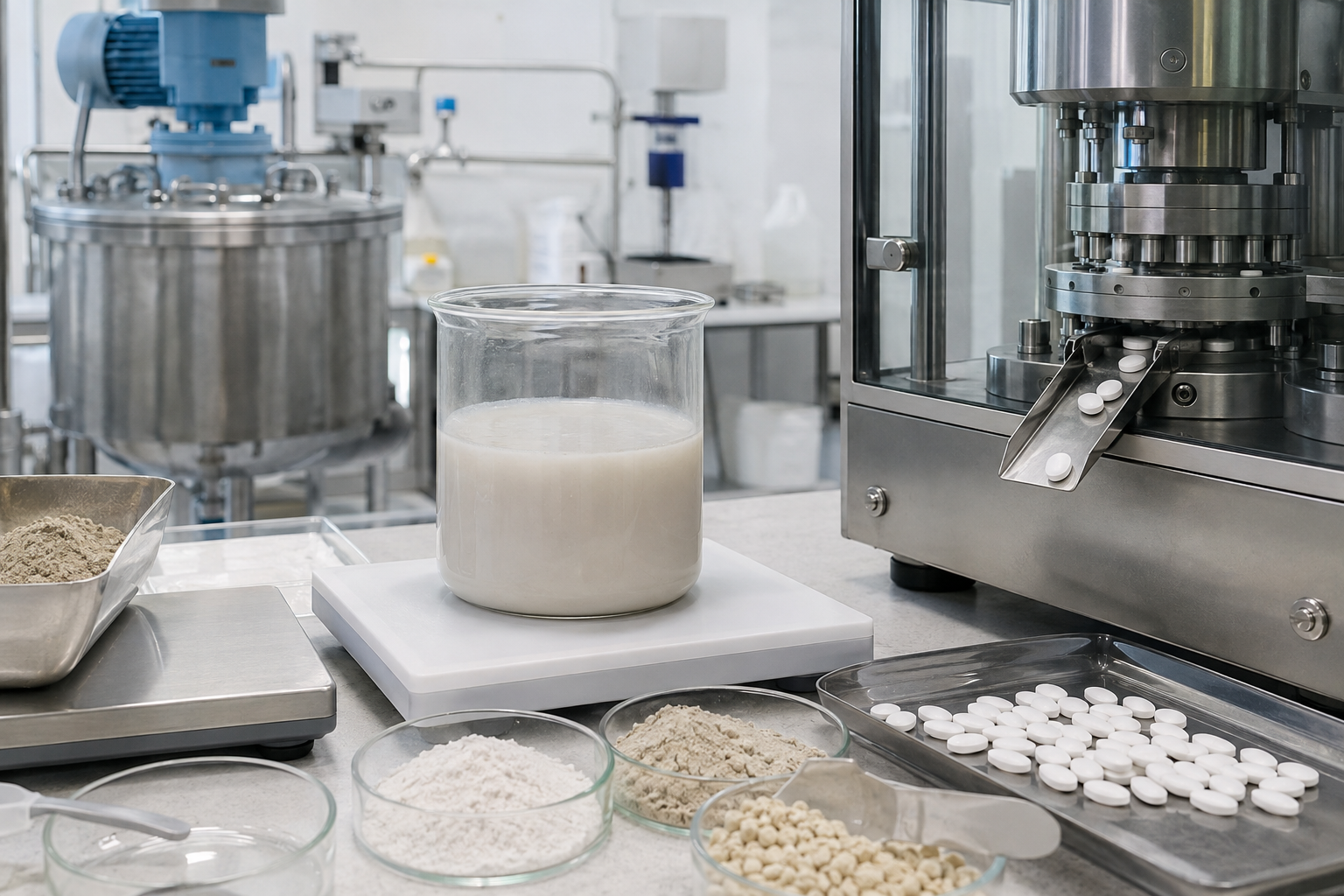
Bentonite in pharmaceutical formulations is used mainly for what it does physically: it can build viscosity, keep particles suspended, bind selected substances, and modify the structure of a dosage form. Purified bentonite and other pharmaceutical smectites are therefore considered for oral suspensions, topical preparations, tablets, and some research-stage drug delivery systems.
The important qualification is that bentonite is not a universal pharmaceutical excipient. Its performance depends on mineral composition, particle size, purification, exchangeable ions, processing history, formulation pH, electrolyte concentration, and the properties of the active pharmaceutical ingredient (API). A clay that performs well in one formulation can reduce drug availability or destabilize another.
For that reason, formulators need to evaluate bentonite as a functional material rather than simply as an inert filler. The same surface chemistry that gives montmorillonite its useful adsorption and hydration properties can also create compatibility problems with certain APIs.
This guide explains what pharmaceutical-grade bentonite is, how it behaves in different dosage forms, how it compares with common synthetic and cellulose-based excipients, and what developers should check before using it in a pharmaceutical product.
Bentonite is a naturally occurring clay whose principal mineral component is usually a smectite, most commonly montmorillonite. It forms when volcanic ash and related materials undergo geological alteration. Commercial bentonite deposits can differ substantially in mineralogy and composition, so material described simply as bentonite is not automatically suitable for pharmaceutical use.
Pharmaceutical-grade material must meet the applicable quality requirements for its intended use. Depending on the product, market, and regulatory pathway, manufacturers may need to demonstrate compliance with a relevant pharmacopoeial monograph, internal specifications, or other applicable quality standards. Identity, purity, microbial quality, elemental impurities, particle characteristics, and functional performance may all matter.
Industrial bentonite used for drilling, construction, foundry work, or civil engineering should not be treated as a pharmaceutical raw material. Geological clays can contain accessory minerals and trace elements that require careful control before a material is considered appropriate for medicinal applications.
Natural mineral deposits vary from one geological source to another. Even material taken from different parts of the same deposit can show differences in mineral composition, swelling behavior, particle-size distribution, and trace-element content.
Pharmaceutical processing therefore focuses on producing a controlled material rather than simply grinding mined clay into a fine powder. Depending on the source and specification, processing may include washing, separation of coarse particles, drying, milling, blending, and other purification or treatment steps.
The final material should be supported by appropriate analytical data and a documented quality system. Testing for elemental impurities is particularly important because clay minerals can naturally contain elements that must be controlled in medicinal products.
The exchangeable ions associated with montmorillonite influence how the clay behaves in water. Sodium-rich and calcium-rich bentonites can therefore show noticeably different swelling and rheological properties.
| Characteristic | Sodium-rich bentonite | Calcium-rich bentonite |
|---|---|---|
| Hydration behavior | Generally greater swelling and dispersion in water | Generally lower swelling |
| Rheology | Can produce stronger, more structured aqueous dispersions | Often produces lower viscosity at comparable concentrations |
| Common formulation interest | Suspending systems and viscosity modification | Adsorption and selected dry or low-viscosity applications |
| Main formulation consideration | Sensitive to electrolyte conditions and dispersion method | Functional performance depends strongly on mineral composition and processing |
These categories should not be treated as interchangeable specifications. The actual performance of a pharmaceutical clay depends on more than the name sodium or calcium bentonite. Developers should qualify the specific grade they intend to use.
Montmorillonite has a layered 2:1 structure. Each platelet contains an octahedral sheet between two tetrahedral sheets. Substitution of ions within the crystal lattice can create a net negative charge on the clay surface. Exchangeable cations occupy spaces between the layers and help balance that charge.
This structure explains much of bentonite's pharmaceutical behavior. Water can enter between and around the clay layers, while charged molecules can interact with the mineral surface or exchange with interlayer cations. The result is a material whose physical behavior changes substantially when it is hydrated, sheared, or exposed to electrolytes.
Finely dispersed smectite can present a very large effective surface area. Reported values vary considerably with the analytical method, particle size, degree of delamination, moisture content, and material grade, so a single surface-area figure should not be treated as a universal specification for pharmaceutical bentonite.
The practical significance is more important than the headline number. More accessible surface provides more opportunity for adsorption, ion exchange, and interaction with water and dissolved substances.
Cation exchange capacity, commonly abbreviated as CEC, describes the ability of a clay to exchange positively charged ions. Montmorillonite generally has a relatively high CEC compared with many other clay minerals.
In a pharmaceutical formulation, this property can be useful, but it also creates a compatibility concern. A positively charged API may interact with the clay strongly enough to change its apparent solubility, dissolution profile, or bioavailability. CEC should therefore be considered alongside API charge, pH, ionic strength, and binding data rather than treated as a benefit on its own.
When certain bentonites are dispersed in water, hydrated clay platelets can form a structured network. The network increases apparent viscosity and can help prevent suspended particles from settling rapidly.
Some bentonite dispersions are thixotropic. They become less viscous when subjected to shear, such as shaking or pumping, and rebuild part of their structure when the shear is removed. That behavior can be useful in liquid medicines and topical products because the formulation can remain structured during storage while still being practical to pour or spread.
The exact rheological profile depends on clay grade, concentration, dispersion conditions, pH, temperature, electrolyte content, and other formulation ingredients. It should be measured experimentally rather than inferred from the raw material name.
Bentonite can serve several formulation functions, but those functions should be distinguished from approved therapeutic claims. A material can be technically capable of adsorbing a substance without being appropriate for treating poisoning, infection, diarrhea, or another disease.
| Function | How it works | Formulation examples | Main development concern |
|---|---|---|---|
| Suspending agent | Builds a structured aqueous network | Oral suspensions and dispersed liquids | Sedimentation, redispersion, viscosity |
| Viscosity modifier | Hydrates and increases continuous-phase structure | Topical gels and creams | Spreadability and electrolyte sensitivity |
| Adsorbent | Provides charged and high-area surfaces | Selected gastrointestinal or research applications | API binding and impurity control |
| Tablet excipient | Contributes to powder and granule behavior | Selected compressed dosage forms | Compression, disintegration, and dissolution |
| Release-modifying material | Can interact with drugs and create a diffusion barrier | Research and specialized formulations | Reproducibility and drug release |
| Stabilizing aid | Can contribute to physical structure in dispersed systems | Selected emulsions and suspensions | Compatibility with the complete formula |
A suspension contains solid particles dispersed through a liquid. Without sufficient physical structure, those particles settle under gravity. If the sediment becomes difficult to redisperse, the concentration of API can vary from one dose to the next.
Hydrated bentonite can increase the yield stress and viscosity of the continuous phase, reducing the rate at which particles settle. The clay does not necessarily need to eliminate sedimentation entirely. In many formulations, the more realistic objective is to produce a sediment that remains readily redispersible after normal storage.
The formulation must also remain practical for the patient. Excessive viscosity can make a suspension difficult to pour, measure, or swallow. Developers therefore need to balance sedimentation control with pourability and dose uniformity.

Bentonite can provide body and structure to creams, gels, and other topical systems. Its mineral platelets interact with water and other formulation components to create a more structured product.
That structure can affect spreadability, suspension of insoluble ingredients, sensory properties, and physical stability. Bentonite may be useful when a formulator wants mineral-based rheological modification, but it does not automatically replace a polymeric thickener.
Compatibility testing is essential because salts, surfactants, preservatives, active ingredients, and changes in pH can alter the clay network. A formulation that looks stable immediately after manufacture may change during storage.
Bentonite has been investigated and used in certain solid dosage formulations as a functional mineral excipient. Its fine particles can influence powder flow, compaction, granule structure, and water uptake.
However, the simple claim that bentonite always acts as both a strong binder and a rapid disintegrant is misleading. Binding and disintegration are competing formulation requirements, and their balance depends on the complete tablet composition and manufacturing process.
If clay is incorporated into a tablet, developers should evaluate hardness, friability, disintegration time, dissolution, compression behavior, and API compatibility. The effect can vary with concentration and with whether the material is added during direct compression, wet granulation, or another process.
Smectite clays can adsorb selected substances in the gastrointestinal tract because of their surface area, charge characteristics, and ion-exchange capacity. This property has made certain smectite materials relevant to gastrointestinal products and has also attracted research interest in toxin and pathogen binding.
The mechanism should not be described as universal neutralization of toxins. Adsorption depends on the chemical properties of the target substance and the surrounding environment. pH, ionic strength, competing molecules, and residence time can all affect binding.
There is another important consideration: the clay can potentially bind useful molecules as well as unwanted ones. A formulation intended for oral administration therefore needs evidence that the material does not interfere with the intended API or other important components.
Montmorillonite has attracted considerable research interest as a component of drug-delivery systems. Its layered structure can interact with selected drug molecules, particularly charged compounds, and researchers have investigated clay-based composites, intercalation systems, and hybrid matrices for modified release.
The release mechanism is more complicated than simply placing a drug between clay layers and expecting a fixed release period. Diffusion, ion exchange, swelling, desorption, dissolution of the API, particle size, and the surrounding medium can all influence release behavior.
For that reason, claims such as a universal 12- or 24-hour release period should not be made without product-specific evidence. Controlled release must be demonstrated through appropriate in vitro release testing and, where required, additional pharmaceutical development and clinical evidence.
Bentonite can contribute to the consistency and physical stability of topical preparations. Its hydrated mineral structure can increase viscosity and help keep dispersed ingredients suspended.
In barrier products, the clay may also contribute to the physical properties of the film left on the skin. However, whether a particular formulation protects against a specific irritant or improves a dermatological condition is a product-specific claim that requires supporting evidence.
The practical formulation question is usually straightforward: does the chosen clay produce the desired rheology and stability without compromising the API, preservative system, skin feel, or manufacturing process?
Bentonite should not simply be dumped into a vessel of water and expected to hydrate uniformly. Poor powder wetting can produce agglomerates that hydrate slowly and leave the batch with uneven viscosity.
A robust manufacturing process should be established through development work rather than copied from a generic recipe. The following sequence illustrates the principles involved.
Start with a qualified bentonite grade and the specified pharmaceutical-quality water. Review the supplier's certificate of analysis and confirm that the material meets the internal specification for the product.
Water temperature, hardness, ionic content, and other characteristics can affect clay hydration. The process should therefore use controlled water quality rather than relying on assumptions about local water.
Add bentonite gradually under suitable agitation. Controlled powder addition gives individual particles a better opportunity to wet before they form large agglomerates.
High-shear mixing can help with dispersion, but the appropriate shear rate and duration depend on equipment, batch size, concentration, and clay grade. Excessive shear is not automatically better.
After dispersion, give the clay sufficient time to hydrate and reach the intended rheological state. Some grades develop their final structure relatively quickly, while others benefit from a longer equilibration period.
Rather than using a universal 30- to 45-minute mixing time, manufacturers should establish the required endpoint through viscosity, particle dispersion, and other process controls.
An aging period can improve reproducibility in some bentonite systems because the hydrated structure continues to develop after initial mixing. The required period should be determined during formulation development.
Monitor temperature and avoid assuming that a dispersion has reached its final viscosity immediately after mixing. A batch that appears acceptable at the mixer may behave differently after standing overnight.
APIs, electrolytes, preservatives, surfactants, and other ingredients should be added according to the validated manufacturing sequence. Some materials can interfere with clay hydration or alter the final rheology.
For an ionic API, in particular, the developer should understand whether the ingredient changes the clay network or becomes adsorbed onto the mineral surface. Addition order can therefore be a critical process parameter rather than a minor manufacturing detail.
Bentonite's strengths come with trade-offs. Its surface chemistry can improve physical stability in one product and interfere with drug release in another. The main development risks deserve attention early in pre-formulation work.
Montmorillonite commonly carries a net negative charge on its platelet surfaces. Positively charged drug molecules can therefore interact with the clay through adsorption or ion exchange.
That interaction may be useful when adsorption is the intended function. It can be a problem when the API needs to dissolve and become available for absorption.
The solution is not simply to avoid all cationic APIs. Instead, characterize the interaction using appropriate analytical and dissolution methods. Compare drug recovery, dissolution profiles, and relevant stability data with and without the clay.
Dissolved salts can substantially change the behavior of smectite dispersions. Electrolytes affect the electrical double layer around clay particles and can promote changes in aggregation, viscosity, or gel structure.
This matters in formulations containing sodium chloride, potassium salts, calcium salts, buffers, or other ionic ingredients. The effect should be evaluated at the actual concentration used in the finished product.
If bentonite loses too much viscosity in the presence of electrolytes, the formulation may require a different clay grade, a revised concentration, a different addition sequence, or a complementary rheology modifier. Any such change should be verified experimentally.
A mineral raw material is not automatically free of microorganisms or elemental impurities. Pharmaceutical-grade clay therefore requires appropriate controls for the intended dosage form.

Elemental impurity assessment should follow the applicable regulatory framework and risk-based approach. Microbial specifications should also reflect the dosage form and applicable pharmacopoeial requirements.
The supplier should be able to provide meaningful quality documentation, traceability, specifications, test methods, and batch data. Buying a material solely because it is described as high purity is not sufficient.
Natural minerals vary by deposit and processing conditions. Two products carrying similar descriptions can perform differently in the same formulation.
For this reason, pharmaceutical development should qualify the exact grade and supplier rather than relying only on a generic material description. Critical functional attributes might include viscosity development, swelling behavior, particle-size distribution, mineral identity, elemental impurities, microbial quality, and moisture.
An excipient can change more than the physical appearance of a dosage form. If bentonite adsorbs an API or changes the microenvironment around drug particles, it can alter dissolution and potentially affect exposure.
This is especially important for poorly soluble or ionizable drugs. A formulation that remains physically stable during storage is not successful if the API is released too slowly or binds irreversibly to the excipient.
The best excipient depends on the job. Bentonite should not be presented as universally superior to polymers such as carbomers, hypromellose, or cellulose-based materials.
| Attribute | Bentonite | Carbomer | HPMC | Microcrystalline cellulose |
|---|---|---|---|---|
| Origin | Natural mineral | Synthetic polymer | Cellulose derivative | Purified cellulose |
| Main strength | Mineral surface activity and structured dispersion | Efficient thickening at low concentration | Broad pharmaceutical utility and viscosity control | Tablet processing and solid dosage applications |
| Thixotropy | Can be strong in suitable grades | Can provide strong structured rheology | Depends on grade and concentration | Generally limited as a standalone rheology modifier |
| Adsorption | Potentially significant | Generally limited compared with smectite | Generally limited compared with smectite | Usually lower than smectite |
| Electrolyte response | Can be significant | Depends on pH and formulation conditions | Generally manageable across many systems | Usually less useful for building aqueous gels |
| API interaction risk | Can be important for charged molecules | Usually lower as a direct ion-exchange interaction | Usually lower as a direct ion-exchange interaction | Generally lower, but product-specific interactions remain possible |
| Typical development focus | Hydration, rheology, adsorption, mineral purity | Neutralization, viscosity, pH | Grade selection, viscosity, temperature, release | Compression, flow, disintegration |
Bentonite can be attractive when a formulation needs mineral-based structure, suspension control, or adsorption. Carbomers can be more appropriate when a clear, highly efficient polymeric gel is required. HPMC is widely used when controlled viscosity or modified release is needed, while microcrystalline cellulose is particularly valuable in solid dosage development.
The right comparison is therefore not which material is best overall, but which excipient delivers the required performance with the fewest compatibility and manufacturing problems.
The regulatory status of bentonite depends on the specific material, intended use, dosage form, jurisdiction, and applicable compendial or regulatory requirements. A supplier should not describe a mineral as pharmaceutical grade without supporting documentation.
Important quality considerations can include:
A pharmacopoeial reference should also be checked against the current edition and the market in which the product will be manufactured or sold. Requirements can change, and not every bentonite product is covered by the same monograph.
A purchasing decision should begin with the finished product's technical requirements rather than a generic request for bentonite.
Ask the supplier for the material specification, certificate of analysis, mineralogical information, elemental impurity data, microbiological controls, particle-size information, manufacturing controls, and regulatory documentation relevant to the intended use.
For formulation-critical materials, it is also useful to request representative samples from multiple batches. A material that meets a numerical specification on paper still needs to demonstrate consistent performance in the actual formulation.
Smectite clays continue to attract attention in pharmaceutical research because their layered structure and surface chemistry provide several ways to interact with active molecules.
Researchers have studied montmorillonite and related clays as carriers for selected drugs. Depending on the drug and clay surface, molecules can adsorb onto the external surface or interact with interlayer regions.
The research question is usually not whether the clay can hold the drug. It is whether loading, release, stability, reproducibility, and safety can be controlled well enough for a practical dosage form.
Montmorillonite can also be combined with polymers and other biomaterials to create composite delivery systems. These materials may alter mechanical strength, swelling, diffusion, and release behavior.
Such systems remain an area of active research. Results from laboratory studies should not be presented as evidence that a particular clay-based delivery system is already an established clinical technology.
Clay-polymer composites have been investigated for wound-care materials, where adsorption, fluid handling, rheology, and surface interactions may be useful. Chitosan, alginate, cellulose derivatives, and other polymers have been studied alongside clay minerals.
Again, the distinction between research potential and approved medical use matters. A promising laboratory material still requires appropriate safety, quality, manufacturing, and clinical evaluation before it can support a therapeutic claim.
Several recurring mistakes can make bentonite perform poorly even when the raw material itself is suitable.
Industrial bentonite may be designed for drilling fluids, construction, casting, or other non-pharmaceutical applications. Its impurity profile and manufacturing controls may not meet pharmaceutical requirements.
Use a material that has been qualified for the intended pharmaceutical application and supported by appropriate documentation.
Increasing clay concentration can raise viscosity, but it can also make a product difficult to pour, spread, manufacture, or administer. Higher levels may also increase API binding or affect dissolution.
The useful concentration is the lowest level that meets the required performance after the complete formulation has been evaluated.
Adding electrolytes or charged APIs before the clay has fully dispersed can produce a very different structure from one obtained through controlled hydration. Manufacturing sequence should therefore be treated as part of formulation design.
A single viscosity measurement does not describe a suspension's long-term performance. Developers should consider viscosity recovery, sedimentation, redispersibility, temperature effects, storage stability, and the behavior after repeated shaking or dosing.
Bentonite is a mineral, but that does not make it chemically irrelevant. Its surface charge, ion-exchange capacity, and adsorption behavior can affect active ingredients and other excipients.
Natural origin is not a substitute for compatibility testing.
A disciplined development process reduces the chance of discovering a clay-related problem late in development.
This approach keeps the focus on measurable product performance rather than assumptions about what bentonite should do.
Bentonite can be a useful pharmaceutical excipient when its mineral properties match a defined formulation requirement. Its hydration behavior can support suspension stability and viscosity control, while its surface chemistry can provide adsorption and ion-exchange functionality.
The same properties can also create risks. Charged APIs may bind to the clay, electrolytes can change rheology, and natural mineral variation can affect batch consistency. Pharmaceutical-grade status must therefore be established through appropriate specifications and quality controls rather than inferred from the word bentonite alone.
For formulation scientists, the most important step is early experimental screening. Evaluate the actual clay grade with the actual API and the intended manufacturing process. If the material improves the required quality attributes without compromising drug release, stability, safety, or manufacturability, it may have a valuable place in the formulation.
For pharmaceutical buyers, supplier qualification is equally important. Consistent mineral identity, impurity control, microbiological quality, functional performance, traceability, and change management matter just as much as nominal purity.
Bentonite is neither a miracle ingredient nor simply an inert mineral. Used with appropriate controls, it is a versatile excipient whose distinctive surface and hydration properties can solve specific formulation problems.













Have questions about our products? We're here to help!