Axewelledge, a leading exporter from India, specializes in high-quality Bentonite. With a commitment to excellence, we supply premium Bentonite to the Middle East and Southeast Asia markets.


North Angle Complex, 304,
150 Feet Ring Rd, Opposite Ambedkar Nagar BRTS Stop,
Madhav Park, Punit Nagar,
Mavdi, Rajkot, Gujarat 360004
© Axewelledge 2026, All Rights Reserved.
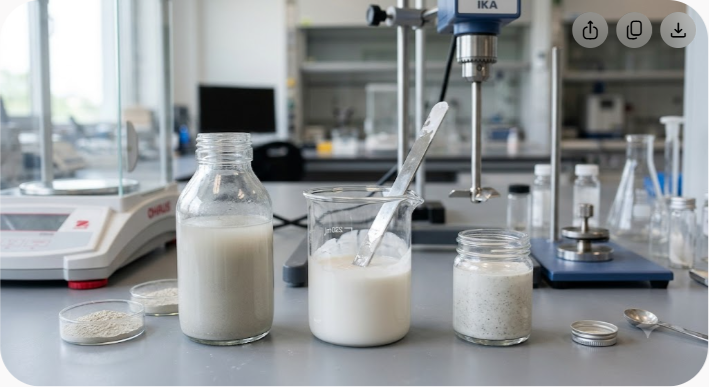
A water-based adhesive can leave the production line with the right viscosity and still become difficult to use after storage. Settling, syneresis, viscosity drift, poor spread, and sag can turn a sound formulation into a costly quality problem. Bentonite can help improve water-based adhesive stability, but the result depends on the clay grade, dosage, dispersion method, water chemistry, and adhesive system.
The main role of bentonite is rheological rather than simply thickening the adhesive. When a suitable grade is properly hydrated and dispersed, its fine clay particles can build structure within the aqueous phase. That structure can increase low-shear viscosity, slow the movement of suspended solids, improve sag resistance, and allow the adhesive to flow more readily when shear is applied. Once the shear is removed, the structure can rebuild.
That distinction matters. Bentonite isn't just a powder that makes glue thicker. Used well, it can help control how an adhesive behaves in the container, through the pump or coating equipment, during application, and while the applied film is settling. Used poorly, it can create agglomerates, excessive viscosity, poor wetting, inconsistent flow, or unwanted changes in the dried adhesive film.
For formulators, the practical question is therefore not simply whether bentonite increases viscosity. The better question is whether it can produce the particular rheology and storage stability the adhesive needs without compromising bonding performance.
Bentonite is a naturally occurring clay whose principal mineral component is generally montmorillonite. Its layered structure gives it a strong interaction with water, particularly in sodium-rich grades. When a suitable bentonite is dispersed correctly, the hydrated particles can form a structured suspension.
For an adhesive formulator, that structure can provide several useful effects:
The important word is rheology. Viscosity is only one part of the picture. Rheology describes how a material flows and deforms when force is applied. An adhesive that is too thin at rest may allow mineral fillers or pigments to settle. An adhesive that is too thick under every condition may be difficult to pump, coat, brush, or spread.
A useful formulation therefore needs a balance: enough structure to remain stable in storage, but enough flow under application shear to move through the intended process.
Adhesive stability isn't one single property. A formulation may resist settling but still suffer from viscosity drift, or it may hold its viscosity while developing syneresis. Bentonite can address several of these problems when its rheological contribution matches the formulation.
If an adhesive contains fillers, pigments, mineral extenders, or other suspended solids, gravity will gradually pull those particles downward unless the continuous phase provides enough resistance.
Simply increasing viscosity isn't always the answer. What matters is the adhesive's behavior at low shear and under the small stresses that occur while a container sits undisturbed. A structured clay network can increase resistance to particle movement, helping suspended materials remain distributed.
This is especially relevant to adhesives that sit in drums, pails, cartridges, or other containers for extended periods. The objective isn't necessarily to stop every particle from moving forever. The practical goal is to prevent hard-packed sediment and maintain a product that remains reasonably uniform and can be remixed when required.
Sag becomes a problem when a wet adhesive film or bead moves downward under gravity before it has developed enough strength to hold its position. The result can be an uneven coating, inconsistent bead geometry, or material collecting at the bottom of a vertical surface.
A suitable clay-based rheology modifier can increase low-shear resistance while still allowing the adhesive to flow when sufficient application force is applied. This balance can be useful in brush, roller, bead, and other application methods where the material needs to move during application but should resist movement afterward.
The target isn't maximum viscosity. It's controlled flow with useful recovery after shear.
Some bentonite systems show shear-thinning and time-dependent structure recovery. In practical terms, the adhesive can become easier to move during mixing, pumping, brushing, or spreading and regain some of its structure after it is left undisturbed.
That behavior can be valuable in products that must combine easy application with good storage stability. A container may need a relatively structured adhesive while sitting on a warehouse shelf, but the same material must become easier to pump or spread during use.
Not every bentonite grade produces the same rheological profile. Mineral composition, particle size, exchangeable cations, surface treatment, electrolyte concentration, pH, and processing conditions can all change the result.
Syneresis occurs when a structured material releases liquid from its internal network. In an adhesive, it may appear as a watery layer on the surface or around the container walls.
A properly selected clay rheology modifier can help maintain a more uniform internal structure and reduce the tendency toward liquid separation in some formulations. However, bentonite isn't a universal cure for syneresis.
Polymer chemistry, surfactants, salts, pH, storage temperature, freeze-thaw exposure, and water loss can all contribute to phase separation. If syneresis appears after bentonite is added, the right response isn't automatically to increase the clay level. The entire formulation needs to be examined.
The mechanism starts with hydration and particle interaction.
When a suitable bentonite comes into contact with water, water interacts with the clay layers and causes the particles to hydrate and disperse. Depending on the clay chemistry and concentration, the particles can interact to form a three-dimensional structure within the aqueous phase. That structure can contribute yield stress, low-shear viscosity, and shear-dependent flow.
Sodium-rich bentonite generally has greater swelling capacity than calcium bentonite and can produce relatively viscous aqueous dispersions. But the label alone doesn't tell you how a particular grade will behave in an adhesive. Two products sold as bentonite can differ substantially in mineral composition, particle size, moisture, swelling behavior, and rheological response.
The adhesive environment matters just as much. Electrolytes, dissolved salts, pH, polymers, surfactants, fillers, and processing conditions can all change particle interactions. That's why formulation trials should use the actual production-grade bentonite and the complete adhesive system rather than relying only on a generic clay-water test.
If the objective is to modify the rheology of a water-based adhesive, sodium bentonite is often a logical starting point because it generally swells and disperses strongly in water. That doesn't make it universally superior.
| Property | Sodium bentonite | Calcium bentonite |
|---|---|---|
| Water swelling | Generally high | Generally lower |
| Aqueous viscosity | Often higher at comparable loading | Often lower at comparable loading |
| Hydration response | Typically strong | Generally more moderate |
| Typical rheology role | Thickening and suspension control | Selected rheology and absorption applications |
| Sensitivity to formulation chemistry | Can be significant | Can be significant |
| Starting point for water-based adhesive trials | Often worth evaluating | Requires grade-specific testing |
The final choice should come from adhesive performance, not mineral classification alone.
For industrial formulation work, ask the supplier for information relevant to the actual grade, such as moisture, particle-size distribution, swelling behavior, viscosity or rheology data where applicable, typical analysis, and batch consistency. A clay that performs predictably from batch to batch can be more useful than a nominally stronger grade whose properties vary significantly.
Bentonite can be considered in several water-based adhesive families, although compatibility needs to be demonstrated experimentally.
Waterborne acrylic, vinyl acetate, vinyl acetate-ethylene, and other emulsion-based adhesives commonly require rheology control for application and storage. Bentonite can sometimes complement a polymeric thickener by adding low-shear structure and suspension support.
The main challenge is compatibility. Clay particles can interact with surfactants, salts, polymer particles, and other ingredients. A grade that works well with one emulsion can produce unwanted flocculation or viscosity changes in another.
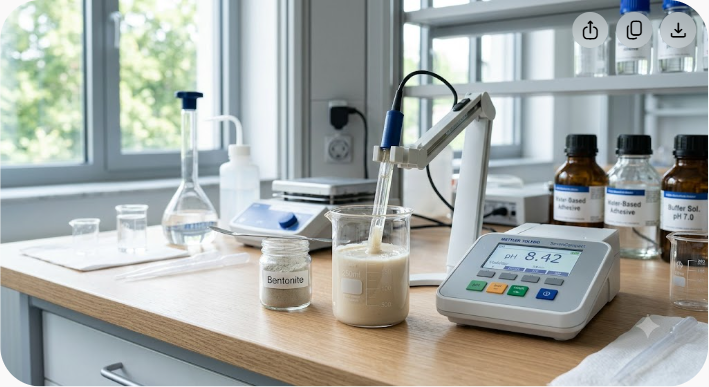
For latex and emulsion systems, evaluate not only initial viscosity but also particle stability, appearance, application behavior, drying, and final bond performance.
Packaging adhesives often need a careful balance between pumpability, coating behavior, wet tack, and storage stability. Clay-based rheology control may be useful where the formulation contains suspended solids or needs additional resistance to settling.
The application equipment should guide the target rheology. An adhesive used in a high-speed coating line may need a different flow profile from one dispensed manually from a cartridge or bottle.
Paper and board adhesive systems depend heavily on controlled viscosity because application equipment needs to deliver a consistent amount of adhesive at production speed. Excessive viscosity can interfere with pumping and coating, while insufficient low-shear structure can contribute to flow and settling.
Bentonite can be useful as part of a broader rheology package rather than as the sole thickener. The required level should be established through application trials and bond testing.
Construction adhesives can require higher body, sag resistance, and storage stability, particularly when mineral fillers are present. A clay-based rheology modifier may provide useful structure in these systems.
The formulation target still depends on how the adhesive is used. A wall adhesive, paper adhesive, and high-speed packaging adhesive may all be water-based but have very different rheological requirements.
There is no universal bentonite dosage for water-based adhesives.
Commercial specialty smectite rheology modifiers may be recommended at fractions of a percent, while natural bentonite systems can require different concentrations depending on clay activity, formulation solids, particle loading, and the desired rheology.
For a new formulation, a practical laboratory screening range could include 0.25%, 0.5%, 1.0%, 1.5%, and 2.0%, provided those levels are appropriate for the selected grade and adhesive. The purpose isn't to find the highest possible viscosity. It's to identify where stability improves without creating unacceptable application or bonding problems.
Consider a simple example. An adhesive containing 0.25% bentonite may still develop visible sediment after storage. At 0.5%, settling may be substantially reduced while pumping remains easy. At 1.0%, the adhesive may become noticeably harder to pump or spread. In that case, the lower concentration may be more useful even though it produces less viscosity.
The practical rule is simple: use the lowest concentration that solves the stability problem while preserving the required adhesive properties.
Dosage should also be calculated consistently. Decide whether the percentage is based on total formulation weight, the water phase, or another defined basis, and use the same basis throughout development and production records.
Poor dispersion is one of the easiest ways to make a good clay look like a poor additive.
When bentonite powder is added too quickly to a viscous polymer system, the outside of each agglomerate can hydrate before water reaches the dry material inside. The result can be fisheyes, soft lumps, incomplete hydration, and uneven viscosity.
A controlled dispersion procedure is usually more reliable:
The exact procedure should be established for the selected clay and production equipment. A dispersion method that works in a small laboratory beaker may not reproduce the same result in a large tank because the mixing geometry and local shear conditions are different.
For many formulation trials, it's useful to establish a well-dispersed clay phase before introducing ingredients that could interfere with hydration. However, there is no single addition order that applies to every adhesive chemistry.
A straightforward laboratory approach is to prepare a bentonite dispersion separately, allow it to hydrate, and then blend it into the adhesive under controlled mixing. This gives the formulator a cleaner way to compare different clay concentrations.
After identifying a promising formulation, the next step is to test whether the same result can be reproduced using the intended manufacturing sequence. This is important because addition time, impeller design, tank geometry, batch size, and local shear can all change dispersion quality.
If the laboratory method requires a separate pre-hydration step but the plant process doesn't allow one, the formulation and process need to be developed together. A technically sound formulation that cannot be manufactured consistently isn't a finished solution.
Bentonite responds strongly to its surrounding chemical environment. That's part of what makes it useful as a rheology modifier, but it also creates formulation challenges.
Electrolytes can change the interactions between clay particles and reduce the viscosity of some bentonite dispersions. This matters when the adhesive contains salts, hard water, neutralizing agents, or other ionic ingredients.
If production water comes from different sources, test those water qualities during formulation development. A clay that behaves well in low-salt laboratory water may respond differently in plant water.
The pH of the system can influence clay particle interactions and the behavior of other adhesive ingredients. A viscosity measurement taken before the full formulation is assembled may therefore tell only part of the story.
Measure pH and viscosity after the complete adhesive has been prepared. If the formulation is expected to experience pH drift during storage, include that possibility in the stability program.
More clay doesn't automatically mean more stability.
At excessive loading, an adhesive may become difficult to pump, spread, filter, or coat. The product may develop an undesirable texture, and the additional mineral solids can alter the dried film.
A formulation can therefore reach a point where settling continues to improve but application and bond performance begin to suffer. That trade-off needs to be measured rather than judged from viscosity alone.
An under-hydrated clay can produce inconsistent results. A freshly manufactured batch may look acceptable, then become significantly thicker during storage as the clay continues to hydrate or the internal structure develops.
Pair immediate post-production measurements with defined aging measurements. If viscosity changes substantially over time, investigate hydration and formulation interactions before changing the dosage.
It's more useful to compare the roles of the two materials than to ask which one is universally better. Bentonite and polymeric thickeners work through different mechanisms and can sometimes complement one another.
| Characteristic | Bentonite | Polymeric thickener |
|---|---|---|
| Primary role | Mineral-based rheology and suspension control | Rheology and viscosity control |
| Low-shear structure | Often strong | Depends on polymer chemistry |
| Suspension support | Often useful | Depends on rheology profile |
| Water sensitivity | Generally significant | Varies by chemistry |
| Electrolyte sensitivity | Can be significant | Varies widely |
| Hydration or process requirements | Important | Depends on product and chemistry |
| Contribution to mineral solids | Adds mineral solids | Usually adds little or no mineral solid |
| Effect on dried film | Must be evaluated | Must be evaluated |
| Combination use | Often possible | Often possible |
A hybrid approach can sometimes produce a useful application profile. Bentonite may provide low-shear structure and suspension control while a polymeric thickener fine-tunes viscosity and flow under application conditions.
The combination still needs testing. Clay-polymer interactions can produce unexpected changes in viscosity, especially when salts, surfactants, or sensitive emulsions are present.
A useful stability program should measure more than one property. A sample that looks stable can still have unacceptable viscosity drift or weakened bond performance.
Prepare the adhesive without bentonite. Record viscosity, pH, appearance, solids content where relevant, and application behavior. This control becomes the reference for every clay-containing sample.
Use a small but meaningful concentration series. For example, compare 0.25%, 0.5%, 1.0%, 1.5%, and 2.0% where those levels are appropriate for the selected material.
Keep equipment, mixing speed, mixing time, temperature, addition order, and sample size consistent. Otherwise, process variation can mask the effect of the clay.
Record viscosity under conditions relevant to the application. Where possible, measure several shear rates rather than relying on a single spindle-and-speed reading. A single viscosity value can hide important differences in flow behavior.
Store samples under controlled conditions. Comparing room-temperature storage with an elevated-temperature condition can help identify formulations that are sensitive to heat, but the exact test should reflect the expected storage environment and product requirements.
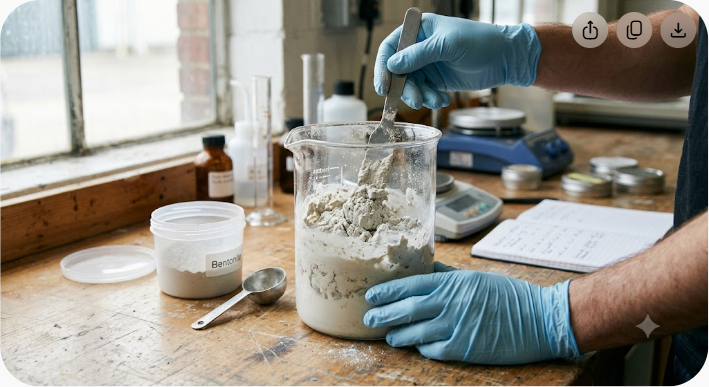
Look for a clear liquid layer, compact sediment, phase separation, color changes, or changes in texture. Photographing samples at defined intervals can make visual comparisons more objective.
Compare viscosity before and after storage. A formulation that maintains its appearance but experiences a large viscosity shift may still be unsuitable for production.
Use the intended application method. Depending on the product, this could mean brushing, coating, pumping, spraying, dispensing, or spreading. Check wetting, open time, sag, bead stability, tack, drying, and final bond performance as appropriate.
If sediment forms, determine whether normal agitation restores a uniform product. Soft, easily redispersed sediment is generally easier to manage than a compact layer that requires high shear or extensive mixing.
For a water-based adhesive, the following test panel provides a practical starting point:
| Test | What it tells you |
|---|---|
| Brookfield or comparable viscosity | Basic viscosity and batch-to-batch comparison |
| Multi-shear rheology | Flow behavior during storage and application |
| Yield stress | Resistance to movement under low stress |
| pH | Chemical consistency and compatibility |
| Visual sedimentation | Physical storage stability |
| Syneresis observation | Tendency toward liquid separation |
| Heat-aging stability | Sensitivity to elevated storage temperature |
| Freeze-thaw testing | Robustness where cold exposure is expected |
| Bond strength | Whether formulation changes affect adhesive performance |
| Application trial | Real-world spreading, pumping, coating, or dispensing behavior |
For international production, keep test conditions and units clearly documented. Viscosity may be reported in mPa·s or cP, while temperature should be stated in degrees Celsius or Fahrenheit according to the relevant specification and audience. More important than the unit itself is consistency: use the same method and conditions when comparing batches.
A low-cost clay can become expensive if it requires a higher dosage, produces inconsistent viscosity, or creates manufacturing problems.
Evaluate performance per unit of finished adhesive, not just purchase price per kilogram. A higher-priced grade can sometimes require less material or produce a more consistent process, but that needs to be demonstrated through testing.
Mineralogy, exchangeable cations, particle size, purity, moisture, processing, and activation can affect performance. Qualify the actual grade you intend to purchase rather than relying on the generic word "bentonite."
Rapid powder addition encourages agglomeration. Controlled addition gives water more opportunity to wet the particles and generally makes hydration more reproducible.
An adhesive can look perfect immediately after production and change substantially after 24 hours, one week, or longer. Aging data is essential when the clay is still developing its structure after initial mixing.
Hard water and dissolved salts can affect clay hydration and rheology. If production water differs between plants or changes seasonally, confirm that the same bentonite grade produces the required result under actual conditions.
The thickest sample isn't necessarily the most useful sample. Wetting, bond strength, application behavior, drying, film properties, pumpability, and storage stability all need to meet the product specification.
Clay and polymeric rheology modifiers have different mechanisms and performance profiles. In some formulations, a combination can provide a better balance than either material used alone.
If you're evaluating bentonite for the first time, keep the development program controlled. Changing five ingredients at once makes it difficult to identify what actually improved the formulation.
Start with a representative adhesive base and one consistent bentonite grade. Prepare a control sample and several increasing clay concentrations. Standardize the dispersion procedure, then measure initial viscosity, low-shear behavior, pH, appearance, and application performance. Age the samples and repeat the measurements at defined intervals.
Suppose the best-performing sample has excellent settling resistance but becomes too viscous during application. Don't immediately reject bentonite. Test a lower concentration first. If that doesn't solve the problem, investigate whether a complementary polymeric rheology modifier can provide the desired application profile at a lower clay loading.
If the adhesive becomes unstable after bentonite is added, investigate the chemistry before increasing the dose. Check pH, electrolyte concentration, water hardness, mixing sequence, hydration time, and interactions with the emulsion or polymer.
This controlled approach is usually more informative than repeatedly changing several ingredients and trying to judge the result from appearance alone.
Yes. That's why storage stability cannot be evaluated separately from adhesive performance.
Bentonite is a mineral solid. Increasing its concentration changes the composition of the adhesive and can influence water release, polymer concentration in the drying film, flexibility, cohesion, substrate wetting, and the structure of the final film.
The effect depends heavily on adhesive chemistry and clay loading. A formulation may become more stable in the container while developing a weaker or less flexible bond after drying. The opposite can also occur if the original system lacked sufficient structure or had poor application control.
For that reason, don't define success as "highest viscosity" or "no settling." Define success as a formulation that remains stable and meets the required application and bond specifications.
Bentonite may not be the right choice when an adhesive requires an extremely clear film, very low mineral content, unusually high transparency, or a rheological profile that clay cannot provide.
It may also be unsuitable when the formulation contains ingredients that strongly interfere with clay hydration or particle interactions.
Depending on the application, a polymeric thickener, associative thickener, cellulose derivative, specialty smectite, or another rheology modifier may be more appropriate. The choice depends on the resin, solids level, pH, electrolyte concentration, application method, transparency requirements, and final film properties.
The useful question isn't simply, "Can bentonite thicken this adhesive?" A better question is, "Can this bentonite create the rheology profile I need without compromising the adhesive?"
That shift in thinking prevents over-formulation. The objective is a controlled material, not a high viscosity number for its own sake.
Once a laboratory formulation moves into commercial production, consistency becomes just as important as peak performance.
If clay moisture, particle-size distribution, mineral composition, or swelling behavior changes significantly between batches, an adhesive manufacturer may see viscosity drift even though the formulation recipe hasn't changed.
A dependable mineral supplier should therefore support formulation work with appropriate technical information and consistent material quality. For industrial buyers, useful documentation can include product specifications, typical analysis, moisture information, packaging details, and batch or quality-control data relevant to the selected grade.
Axewelledge supplies Bentonite for industrial applications and focuses on processed mineral products for consistent industrial use. For adhesive development, the important step isn't simply choosing a supplier. It's matching the specific Bentonite grade to the resin system and validating that grade through controlled laboratory and production trials.
Sometimes, but it shouldn't be assumed. Bentonite and synthetic or polymeric thickeners create viscosity through different mechanisms. Bentonite can provide useful low-shear structure and suspension control, while polymeric thickeners may offer more precise application rheology. A partial replacement or combination can be more practical than complete substitution.
Sodium bentonite is often a useful starting point because it generally swells and disperses strongly in water. However, suitability depends on the complete adhesive system. Calcium bentonite, modified smectites, and specialty rheology clays can behave differently. Test the actual grade for viscosity, settling, application behavior, and bond performance.
Continued hydration, development of the clay network, water loss, pH changes, or interactions with other ingredients can increase viscosity during storage. Concentration, temperature, mixing conditions, and electrolyte content also matter. Measure viscosity at defined aging intervals and compare the results with the initial sample before changing the bentonite dosage.
Bentonite can reduce sedimentation when it creates enough low-shear structure to slow the downward movement of suspended particles. Performance depends on clay concentration, particle characteristics, electrolyte level, pH, and the density and size of suspended solids. Test bentonite in the complete adhesive because a clay-water suspension alone cannot predict every formulation effect.
There is no universal dosage because natural bentonite grades and adhesive systems behave differently. A useful laboratory screen can test several concentrations around the expected working range, such as 0.25% to 2.0% where appropriate. Select the lowest loading that provides acceptable stability without causing excessive viscosity, poor application, or reduced bond performance.
Bentonite can improve physical storage stability by reducing settling, controlling low-shear flow, and helping maintain a more uniform suspension. It doesn't automatically extend the adhesive's total shelf life. Preservative performance, polymer stability, microbial control, packaging, temperature, pH, and freeze-thaw exposure still require separate evaluation during shelf-life testing.
Yes. Clay-based and polymeric rheology modifiers can sometimes complement each other. Bentonite may provide low-shear structure and suspension control while a polymeric thickener adjusts application viscosity. Compatibility must be tested because the combination can produce unexpected viscosity changes, particularly in formulations containing salts, surfactants, or sensitive polymer emulsions.
Yes, bentonite can improve the physical stability of many water-based adhesive formulations, particularly by controlling low-shear viscosity, suspension, sag, and sedimentation. The result depends on the clay grade, dosage, hydration method, water chemistry, pH, electrolytes, polymer system, and processing conditions.
A reliable development path is straightforward: choose a consistent bentonite grade, disperse it properly, test several concentrations, measure rheology before and after aging, and verify that improved storage stability doesn't come at the expense of application or bond performance.
For manufacturers evaluating Bentonite for a new water-based adhesive, the goal isn't simply to make the product thicker. It's to build the right flow profile for the entire product life cycle, from mixing and filling to storage, application, drying, and final bonding.













Have questions about our products? We're here to help!