Axewelledge, a leading exporter from India, specializes in high-quality Bentonite. With a commitment to excellence, we supply premium Bentonite to the Middle East and Southeast Asia markets.


North Angle Complex, 304,
150 Feet Ring Rd, Opposite Ambedkar Nagar BRTS Stop,
Madhav Park, Punit Nagar,
Mavdi, Rajkot, Gujarat 360004
© Axewelledge 2026, All Rights Reserved.
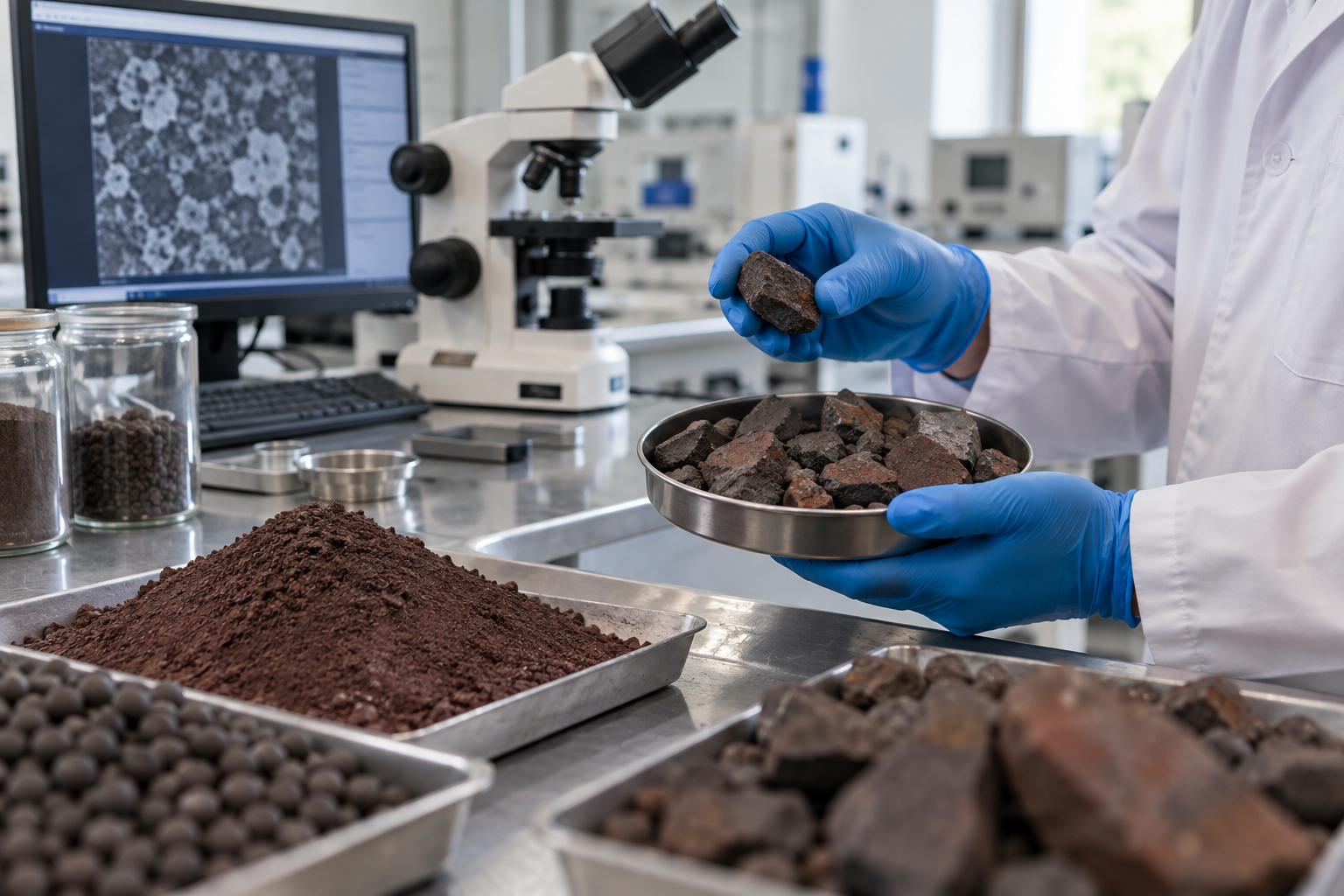
Iron ore pellet strength depends on more than the quality of the ore concentrate. The binder, moisture level, particle size, mixing conditions, and firing schedule all influence whether pellets remain intact from balling through handling and induration. Bentonite is widely used as a binder because its swelling and water-retention properties help fine iron ore particles form stable green pellets and develop sufficient strength during drying and firing.
The key point is simple: bentonite helps iron ore fines hold together during pellet formation and handling, but the right grade and dosage matter just as much as the binder itself. Too little binder can produce fragile green balls, while too much adds unnecessary gangue minerals to the pellet.
This guide explains how bentonite works in iron ore pelletizing, what affects its performance, how sodium bentonite compares with calcium bentonite, which operating variables matter most, and how plants can approach binder optimization in a controlled way.
Bentonite is a clay-rich industrial mineral whose principal swelling component is generally montmorillonite. Its behavior depends on mineralogy, exchangeable cations, moisture, particle size, and processing history. These properties make bentonite useful as a binder in several mineral-processing applications, including iron ore pelletizing.
Iron ore concentrates contain very fine particles. After grinding and beneficiation, these particles have a high surface area but don't naturally form durable, spherical pellets when simply rolled with water. Pelletizing adds controlled moisture and mechanical action so the concentrate can form green balls. A binder helps those balls retain their shape and resist handling damage.
When bentonite is properly dispersed in the moist feed, water interacts with the clay particles and promotes swelling and hydration. The hydrated clay contributes to cohesion between the ore particles. During subsequent drying, the water is removed and the particles become more firmly connected. During induration, the iron ore itself undergoes high-temperature reactions that ultimately provide much of the fired pellet's strength.
That distinction is important. Bentonite is primarily a green-pellet and pre-induration binder. It contributes to the early mechanical integrity of the pellet, while fired strength depends heavily on mineral reactions, porosity, pellet chemistry, firing temperature, residence time, and the resulting microstructure.
Bentonite improves pellet strength through several related mechanisms rather than through one simple chemical reaction.
When bentonite contacts water, its clay minerals can absorb water between their layers. Sodium-rich bentonite generally has greater swelling potential than calcium-rich bentonite. This allows the clay to disperse more effectively when the feed is mixed correctly.
The hydrated clay increases cohesion within the moist pellet. Instead of behaving like a loose collection of fine mineral grains, the feed develops a more continuous network that helps the particles stay together while the pellet rolls and moves through the plant.
Iron ore particles have irregular surfaces and different particle-size distributions. Bentonite occupies some of the spaces between particles and contributes to the forces holding the moist structure together.
The result is a green pellet that is less likely to crack, flatten, or shed fines during normal handling. The exact improvement depends on the ore, bentonite quality, moisture content, mixing conditions, and balling parameters.
Bentonite also affects how water is retained and distributed in the feed. Uniform water distribution is essential because pellet formation depends on a controlled balance between capillary forces, particle movement, and plasticity.
A poorly mixed feed can contain wet and dry zones. Some pellets may become overly sticky while others remain weak and dusty. Good bentonite dispersion helps create more consistent pellet formation across the batch.
Green pellets contain substantial moisture. As they enter the drying section, that water must be removed without creating excessive internal stress.
A well-formed pellet with adequate green strength can tolerate this transition better than a fragile pellet. Bentonite contributes to the cohesion of the green structure, although the drying profile itself remains critical. Excessively rapid heating or uneven drying can damage pellets regardless of binder quality.
Pellet quality is often discussed as though strength were one measurement. In practice, different stages of the process require different mechanical properties.
Green pellets are formed before induration and still contain moisture. They must withstand transfer from the balling equipment to conveyors, screens, chutes, and the induration system.
Useful green-pellet measurements can include compressive strength, drop resistance, and resistance to abrasion or degradation. The appropriate test method depends on the plant and its quality-control program.
If green strength is too low, pellets can break during handling and create additional fines. If pellets are too soft or plastic, they may deform during transfer or screening. Both conditions can affect bed permeability and the consistency of the feed entering the induration furnace.
After drying, much of the free moisture has been removed. The pellet must retain its shape and withstand further movement into the preheating and firing zones.
Dry strength is affected by the original pellet structure, drying conditions, binder distribution, ore characteristics, and the development of bonding during later thermal treatment. Bentonite helps maintain cohesion before firing, but it should not be treated as the only factor controlling fired pellet strength.
Once pellets have been indurated, their strength comes primarily from high-temperature bonding and mineral transformations within the pellet. Depending on the pellet chemistry and process, bonding phases can include hematite recrystallization and other mineral phases formed during firing.
This is why a plant should not judge bentonite performance only by a single green-strength result. The binder has to work within the complete pelletizing process without creating unacceptable effects on pellet chemistry or fired properties.
Not all bentonite performs the same way. Mineral composition is one of the first factors to examine when comparing potential suppliers or grades.
Montmorillonite content, exchangeable cations, swelling behavior, moisture content, particle-size distribution, and impurities can all affect performance. A supplier's product specification should therefore be evaluated alongside plant trials rather than relying on the product name alone.
Sodium-rich bentonite generally has high swelling capacity and strong water absorption characteristics. When properly dispersed, it can provide effective binding at relatively low addition levels compared with less swelling clay materials.
For iron ore pelletizing, this can be useful because the binder itself contributes mineral matter to the pellet. If a plant can meet its strength requirements with a lower binder addition, it may reduce the amount of unwanted gangue introduced through the binder.
Calcium-rich bentonite generally swells less than sodium-rich bentonite. Some calcium bentonites can be modified or activated for specific applications, so a simple sodium-versus-calcium label isn't enough to predict plant performance.
If a different bentonite grade is introduced, the plant should verify its performance through controlled testing. Binder dosage, moisture requirements, mixing behavior, and pellet strength may all change.
| Property | Sodium-Rich Bentonite | Calcium-Rich Bentonite | Why It Matters |
|---|---|---|---|
| Swelling potential | Generally higher | Generally lower | Affects hydration and dispersion |
| Water interaction | Strong | More limited | Influences pellet formation |
| Binder efficiency | Can be high | Depends strongly on grade | Affects required addition rate |
| Green pellet support | Generally effective | Depends on mineralogy and activation | Influences handling resistance |
| Gangue contribution | Depends on dosage and chemistry | Depends on dosage and chemistry | Affects final pellet chemistry |
The table describes general tendencies, not universal specifications. Actual performance should be confirmed with laboratory and plant testing because bentonite quality varies significantly between deposits and processing grades.
Binder selection is only one part of the equation. A good pelletizing operation controls the entire feed and balling system.
Moisture is essential for pellet formation and bentonite hydration, but more water doesn't automatically mean stronger pellets.
If the mix is too dry, bentonite may not hydrate properly and the feed can remain dusty or difficult to ball. If the mix is too wet, pellets can become sticky, oversized, or prone to deformation.
The correct moisture level depends on the ore concentrate, bentonite, particle-size distribution, balling equipment, and operating conditions. Rather than applying one universal moisture target, plants should establish an operating window through controlled trials and routine monitoring.
Moisture should also be measured consistently. Sampling location, sampling frequency, and measurement method can influence the numbers operators see on the control system or laboratory report.
The physical characteristics of the iron ore concentrate strongly influence pellet formation. Fine particles provide surface area for bonding, while the overall particle-size distribution affects packing, porosity, water demand, and balling behavior.
Bentonite cannot completely correct a feed that is poorly prepared. If the concentrate has changed because of a different ore source, grinding condition, or beneficiation circuit, the required binder and moisture conditions may change as well.
For this reason, binder optimization should be carried out together with feed characterization rather than in isolation.
Bentonite has to be distributed throughout the feed. A high-quality binder can perform poorly if it remains concentrated in small pockets or isn't adequately wetted.
Dry mixing and wet mixing conditions both matter. The plant should consider mixer type, residence time, feed rate, water addition point, and the sequence in which bentonite and water enter the system.
Consistent mixing reduces the chance of producing a batch containing both weak and overly wet pellets.
Pellet diameter, disc or drum speed, residence time, feed rate, and bed conditions influence the growth and shape of green balls.
A binder adjustment won't necessarily solve a problem caused by poor balling conditions. Operators should look at pellet size distribution, shape, moisture, strength, and recycle behavior together before changing the bentonite dosage.
A strong green pellet can still fail if the drying and firing profile is poorly controlled.
Drying removes water gradually. If the pellet is exposed to conditions that cause rapid evaporation before sufficient permeability develops, internal pressure can contribute to cracking. Preheating and firing must also be controlled so that the desired mineral bonds form without excessive thermal stress or unwanted pellet degradation.
There is no single bentonite dosage that works for every iron ore pelletizing plant. A practical starting point is to use the supplier's specification and then establish the plant's optimum through testing.
A useful optimization program can follow these steps.
Check the supplier's technical specification and verify relevant properties through laboratory testing. Depending on the application, these may include montmorillonite content, swelling behavior, moisture, particle-size distribution, and chemical composition.
Don't judge a shipment only by appearance. Two materials can look similar while behaving differently during hydration and mixing.
Record the concentrate's particle-size distribution, moisture, chemistry, and relevant surface-area measurements. Note any changes in ore source or beneficiation conditions.
A binder trial is much easier to interpret when the feed remains consistent.
Test several addition levels rather than changing the dosage randomly. Keep other major process variables as stable as practical.
Measure green pellet strength, drop resistance, pellet size distribution, moisture, and other plant-specific quality indicators. If possible, continue the assessment through drying and firing so that the effect on fired pellet properties can also be evaluated.
Bentonite adds mineral matter to the pellet. Its silica and alumina contribution should therefore be included in the overall pellet chemistry calculation.
A binder that produces strong pellets at a very high addition rate may not be desirable if the additional gangue affects the product specification or downstream ironmaking performance.
Laboratory testing is useful for screening materials, but plant conditions can produce different results. Once a promising dosage and grade are identified, confirm them under normal operating conditions.
Monitor the process over enough production time to account for normal variation in ore feed, moisture, temperature, and equipment operation.
Consider a plant that notices an increase in broken green pellets after a change in iron ore concentrate.
The first response shouldn't automatically be to add more bentonite. The increase in breakage could come from a change in feed fineness, moisture, mixing, balling conditions, or the bentonite itself.
A structured investigation could look like this:
This approach helps separate a binder problem from a process problem. It also reduces the risk of increasing clay addition when the real issue is elsewhere in the circuit.
Different concentrates have different surface characteristics, particle-size distributions, and moisture requirements. A dosage that works for one feed may be unnecessary or insufficient for another.
Binder dosage should therefore be based on measured pellet performance rather than copied directly from another plant.
The lowest purchase price per tonne isn't necessarily the lowest cost per tonne of finished pellets. A cheaper binder may require a higher addition rate or produce less consistent pellet quality.
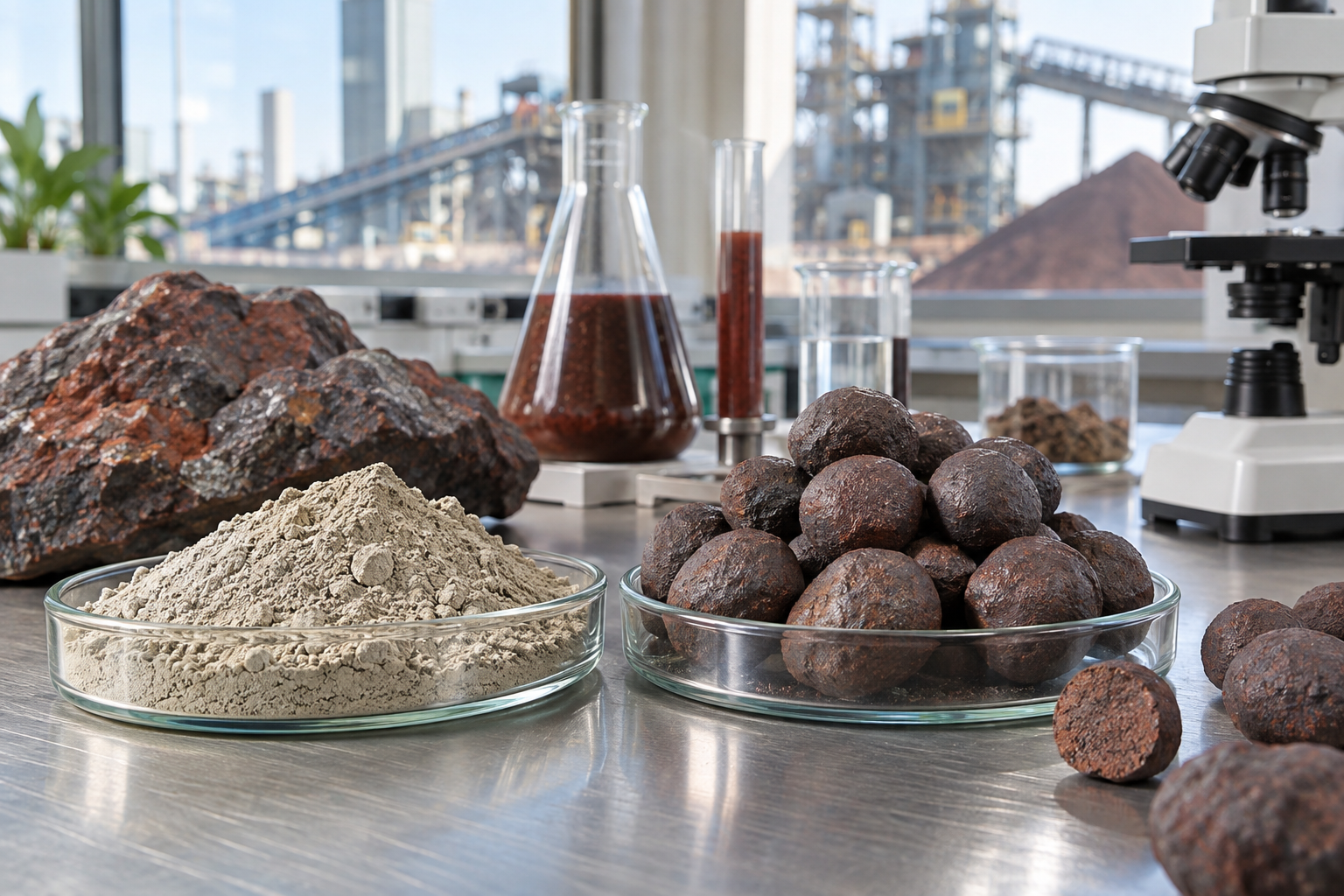
A better comparison considers binder cost, required dosage, pellet performance, chemistry, handling losses, and supply consistency.
Adding more bentonite can improve green strength up to a point, but the relationship isn't unlimited. Excess binder increases the amount of clay-derived mineral matter entering the pellet and can affect iron grade and slag-forming components.
Before increasing dosage, check moisture, mixing, feed characteristics, and balling conditions.
Bentonite is a moisture-sensitive material. Changes in its moisture content can affect the amount of dry active material delivered when dosing is based on wet weight.
Plants should account for product moisture when calculating actual dry-basis addition rates.
Even when a supplier is consistent, incoming material should be checked according to the plant's quality-control procedure. Changes in mineralogy, moisture, particle size, or contamination can affect pelletizing behavior.
Routine testing provides an early warning before a material change becomes a production problem.
Strong green pellets aren't automatically strong fired pellets. Pellet quality has to be evaluated across the process.
A sensible quality program considers green properties, dry behavior, fired strength, reducibility or reduction behavior where relevant, porosity, chemistry, and fines generation according to the final application.
A useful test program combines binder characterization with pellet performance testing.
Depending on the plant's specifications, testing may include:
The exact methods should follow recognized standards or the plant's validated internal procedures.
Pellet quality testing can include:
The purpose of testing isn't simply to produce a higher strength number. The goal is to identify a combination of binder grade and operating conditions that produces the required pellet quality without unnecessary binder consumption or adverse chemistry.
Binder optimization can affect plant performance indirectly through pellet consistency.
When green pellets are mechanically stable, fewer may break during handling and screening. A more uniform feed can also support stable movement through the induration system. However, the relationship between binder addition and overall plant efficiency isn't automatic.
For example, excessive bentonite can add unwanted gangue and may offset some of the benefits of stronger green pellets. Similarly, a binder reduction that saves material cost isn't useful if it causes enough pellet degradation to increase fines or disrupt operation.
The right target is therefore minimum effective binder addition, not simply minimum binder addition.
Bentonite is a clay mineral, so it introduces components other than iron into the pellet. Silica and alumina are particularly important when calculating the final chemistry of the product.
This matters because ironmaking operations have defined requirements for feed chemistry. Additional gangue can influence slag volume, flux requirements, and the overall iron content of the burden.
The impact depends on the binder's composition and the amount used. High-quality bentonite with suitable swelling and binding performance may allow the plant to meet strength requirements at a lower addition rate, but the actual effect should always be calculated from the material's chemical analysis.
The choice between sodium-rich and calcium-rich bentonite should be based on measured performance rather than a simple assumption that one type will always work better.
Important comparison points include:
| Factor | What to Check |
|---|---|
| Swelling | Does the material hydrate and disperse consistently? |
| Binder efficiency | What addition rate produces the required pellet strength? |
| Moisture response | How does the material behave across the plant's normal moisture range? |
| Chemistry | How much silica, alumina, and other gangue does it contribute? |
| Particle size | Is the material suitable for rapid and uniform mixing? |
| Supply consistency | Can the supplier maintain the same specification between shipments? |
| Cost per finished tonne | What is the actual binder cost at the required dosage? |
A plant should compare these factors using its own ore and operating conditions. Supplier data is useful for screening, but plant trials provide the most relevant evidence for final selection.
Before changing bentonite grade or dosage, review the following:
This checklist helps operators avoid making a binder change based on one isolated measurement.
A reliable supplier should provide more than a product name and a price. For metallurgical applications, the technical specification matters.
Ask for information covering mineral composition, moisture, swelling behavior, particle size, chemical analysis, packaging, storage requirements, and batch consistency where applicable. The supplier should also be able to discuss the intended application and support sample evaluation.
For exporters such as Axewelledge, customers can use product specifications and sample testing as part of their supplier-qualification process. Any supplier's material should still be evaluated against the buyer's own pelletizing requirements before full-scale adoption.
Consistent supply is particularly important for plants that depend on narrow operating windows. A change in binder properties can alter moisture demand, balling behavior, and pellet strength even when the nominal dosage remains unchanged.
Bentonite acts mainly as a binder during green pellet formation. When hydrated, its clay minerals swell and help create cohesion between fine iron ore particles. This improves the pellet's ability to retain its shape during balling, screening, transfer, and drying. Its effect must be considered alongside ore characteristics, moisture, mixing, and induration conditions.
Sodium-rich bentonite generally has higher swelling and water-absorption capacity than untreated calcium-rich bentonite. That can provide effective binding at relatively low addition rates. However, actual performance depends on mineralogy, ore type, moisture, mixing, and the specific bentonite grade. Plants should confirm the required dosage through laboratory and plant-scale testing.
Bentonite improves green pellet strength by interacting with water and contributing to cohesion between moist iron ore particles. The hydrated clay helps the freshly formed pellet resist deformation, cracking, and breakage during handling. The improvement depends on proper dispersion and suitable moisture; adding more binder cannot compensate for every problem in the balling circuit.
Bentonite dosage varies with ore mineralogy, particle size, moisture, binder quality, and the required pellet properties. Many operations use a relatively small percentage of bentonite compared with the total dry feed, but there is no universal dosage. Plants should establish the optimum rate through controlled trials and monitor both pellet performance and chemistry.
Moisture allows bentonite to hydrate and helps the iron ore concentrate form stable green balls. Too little water can limit hydration and produce weak, dusty pellets, while too much can create sticky or poorly shaped balls. The optimum moisture range is plant-specific, so operators should establish it through testing rather than relying on one fixed value.
Yes. Bentonite contains mineral components such as silica and alumina, so increasing the binder addition can increase gangue content and influence pellet chemistry. A binder with suitable swelling and binding efficiency can help reduce the amount required to achieve the target strength. The final impact should be calculated from the actual chemical analysis and dosage.
Bentonite plays an important supporting role in iron ore pelletizing because it helps fine concentrate particles form stable green pellets and withstand handling before induration.
The most important lessons are straightforward:
The most effective approach is to treat bentonite as one part of a controlled pelletizing system. Characterize the ore and binder, establish a suitable moisture window, ensure thorough mixing, test several addition levels, and evaluate the resulting pellets from balling through firing. That process gives manufacturers a more reliable basis for controlling pellet quality while keeping binder consumption and chemistry within specification.













Have questions about our products? We're here to help!