Axewelledge, a leading exporter from India, specializes in high-quality Bentonite. With a commitment to excellence, we supply premium Bentonite to the Middle East and Southeast Asia markets.


North Angle Complex, 304,
150 Feet Ring Rd, Opposite Ambedkar Nagar BRTS Stop,
Madhav Park, Punit Nagar,
Mavdi, Rajkot, Gujarat 360004
© Axewelledge 2026, All Rights Reserved.
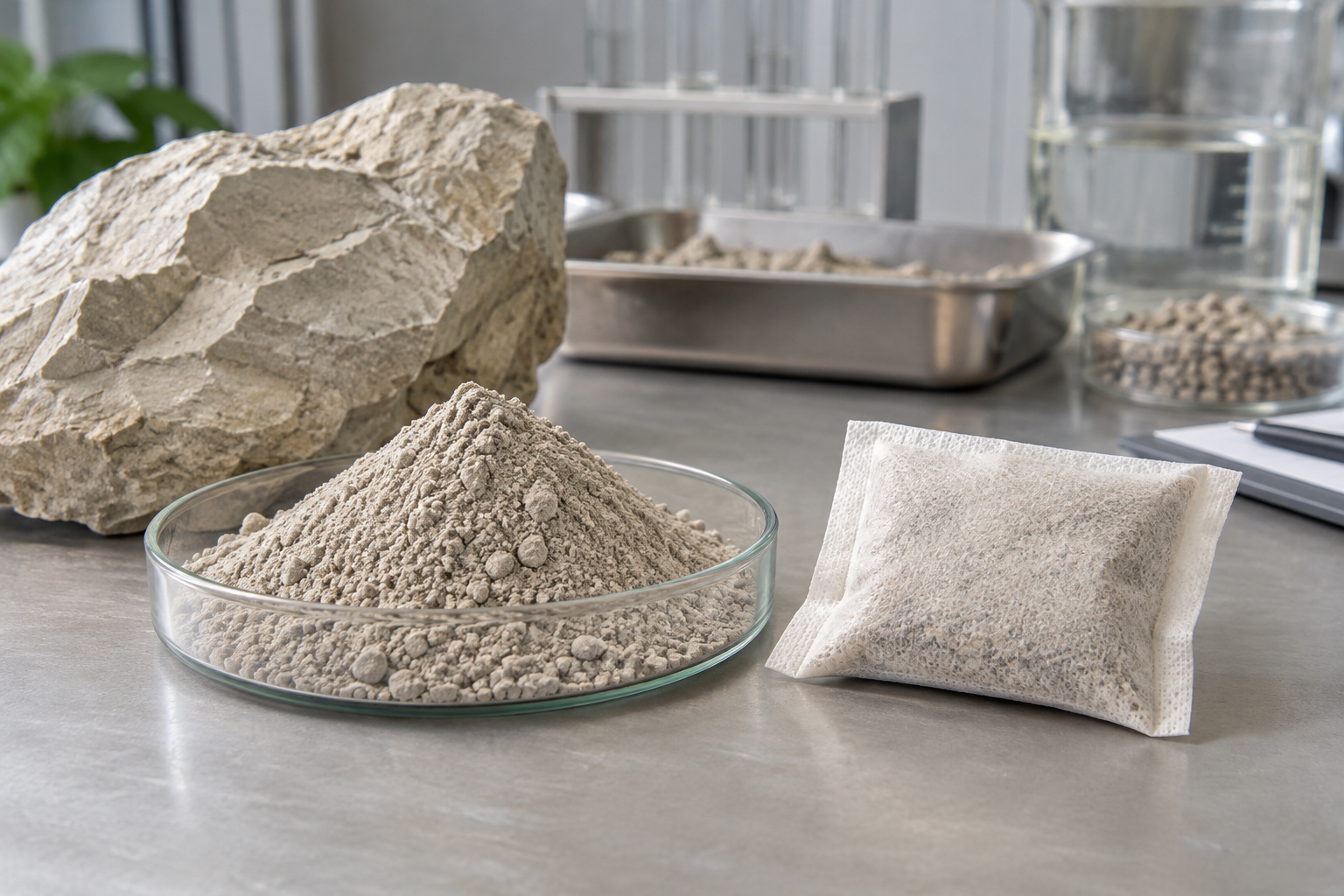
Bentonite is highly effective at taking up and retaining water because its main clay minerals have a layered structure that can hydrate and expand. But there is an important distinction: bentonite is not simply a sponge-like material, and not every bentonite product performs well as a packaged desiccant. Mineral composition, exchangeable cations, particle size, moisture content, activation, and the way the material is packaged all affect performance.
For industrial moisture control, that distinction matters. A clay desiccant used inside a shipping package has a different job from sodium bentonite used to seal a pond, landfill liner, or borehole. Both applications depend on bentonite's interaction with water, but they rely on different physical properties.
This guide explains how bentonite absorbs and retains water, why sodium bentonite generally swells more than calcium bentonite, how clay desiccants compare with silica gel, and where bentonite makes practical sense for moisture management.
A bentonite moisture absorber is a moisture-control material made from bentonite clay, usually processed into granules, powder, pellets, or a formulated clay desiccant. Its ability to interact with water comes mainly from smectite minerals, particularly montmorillonite, which have very fine particles and expandable layers.
When water vapor or liquid water reaches the clay, water molecules can enter spaces between the mineral layers. The clay hydrates, its layers separate to varying degrees, and the material expands. Depending on the grade and application, the hydrated clay can retain substantial amounts of water within its structure and pore system.
That behavior is useful in several different ways. A packaged clay desiccant can help reduce humidity inside an enclosed space. A sodium bentonite liner can swell after contact with water and reduce the movement of liquid through soil or a constructed barrier. A drilling fluid can use bentonite's hydration and rheological properties to control fluid loss and maintain the borehole wall.
The same mineral is involved, but the performance target is different in each case.
The phrase "absorbs water" is convenient, but the underlying process is more complicated than simple absorption into a porous sponge. Bentonite interacts with water through a combination of surface adsorption, interlayer hydration, capillary effects, and swelling.
Bentonite particles have a very large effective surface area because the particles are extremely small and consist of thin mineral layers. Water vapor can interact with these surfaces, while liquid water can penetrate the spaces between particles.
The exact amount of moisture taken up depends strongly on the surrounding relative humidity, temperature, particle size, mineral composition, and the initial moisture content of the clay.
Montmorillonite has a layered crystal structure. A simplified description is a three-sheet arrangement in which an octahedral sheet sits between two tetrahedral silica sheets.
The layers carry a net negative charge that is balanced by exchangeable cations located around and between the layers. Common exchangeable cations include sodium, calcium, and magnesium.
When water becomes available, these ions become hydrated. Water molecules can enter the interlayer region, increasing the separation between clay layers.
As hydration continues, the distance between mineral layers increases. Sodium-rich bentonite can develop particularly strong swelling because sodium ions promote extensive hydration and, under suitable conditions, osmotic swelling.
This is why sodium bentonite can expand dramatically when fully hydrated. However, swelling figures should always be treated as grade-specific rather than as a universal property of all sodium bentonite. Laboratory methods, mineral purity, exchangeable cation composition, particle size, and test conditions can produce different results.
Once hydrated, bentonite can hold water within its expanded clay structure and between particles. In compacted systems, the swelling can also reduce the size and connectivity of pore spaces.
This property is particularly important in sealing applications. The goal isn't necessarily to remove moisture from the environment. Instead, the hydrated clay forms a low-permeability barrier that restricts water movement.
That distinction is easy to miss. A bentonite liner and a clay desiccant both interact strongly with water, but one is primarily used to restrict liquid flow while the other is formulated to reduce humidity in an enclosed space.
Bentonite is a clay material formed largely from volcanic ash that has undergone alteration. Its performance depends on the minerals present, with montmorillonite being particularly important for swelling behavior.
The structure of montmorillonite consists of extremely thin silicate layers. These layers have permanent charge differences created by substitutions within the crystal lattice. The resulting negative charge is balanced by exchangeable cations.
This layered arrangement is central to bentonite's interaction with water. Instead of behaving like a solid block of non-expandable mineral, the individual layers can separate as they hydrate.
The small particle size also contributes to a large surface area. More surface area means more opportunity for water molecules to interact with the mineral.
Cation exchange capacity, often abbreviated as CEC, describes the ability of a clay to hold and exchange positively charged ions. Bentonite can have a relatively high CEC because of its smectite content.
CEC itself is not a direct measurement of water absorption. A high CEC does not automatically mean that a particular bentonite product will absorb a specific amount of moisture. Instead, it is one indicator of the clay's mineral characteristics and its ability to interact with exchangeable ions.
For moisture-control applications, buyers should look at the complete technical specification rather than relying on a single number.
The dominant exchangeable cation has a major influence on how bentonite behaves in water. Sodium-dominated bentonite generally develops much greater swelling than calcium-dominated bentonite under comparable conditions.
Calcium bentonite can still interact strongly with water and has useful adsorption and rheological properties, but it typically does not produce the same degree of free swelling associated with sodium bentonite.
Choosing between sodium and calcium bentonite depends on the application. It isn't accurate to describe one grade as universally better because the required performance changes from one industrial process to another.
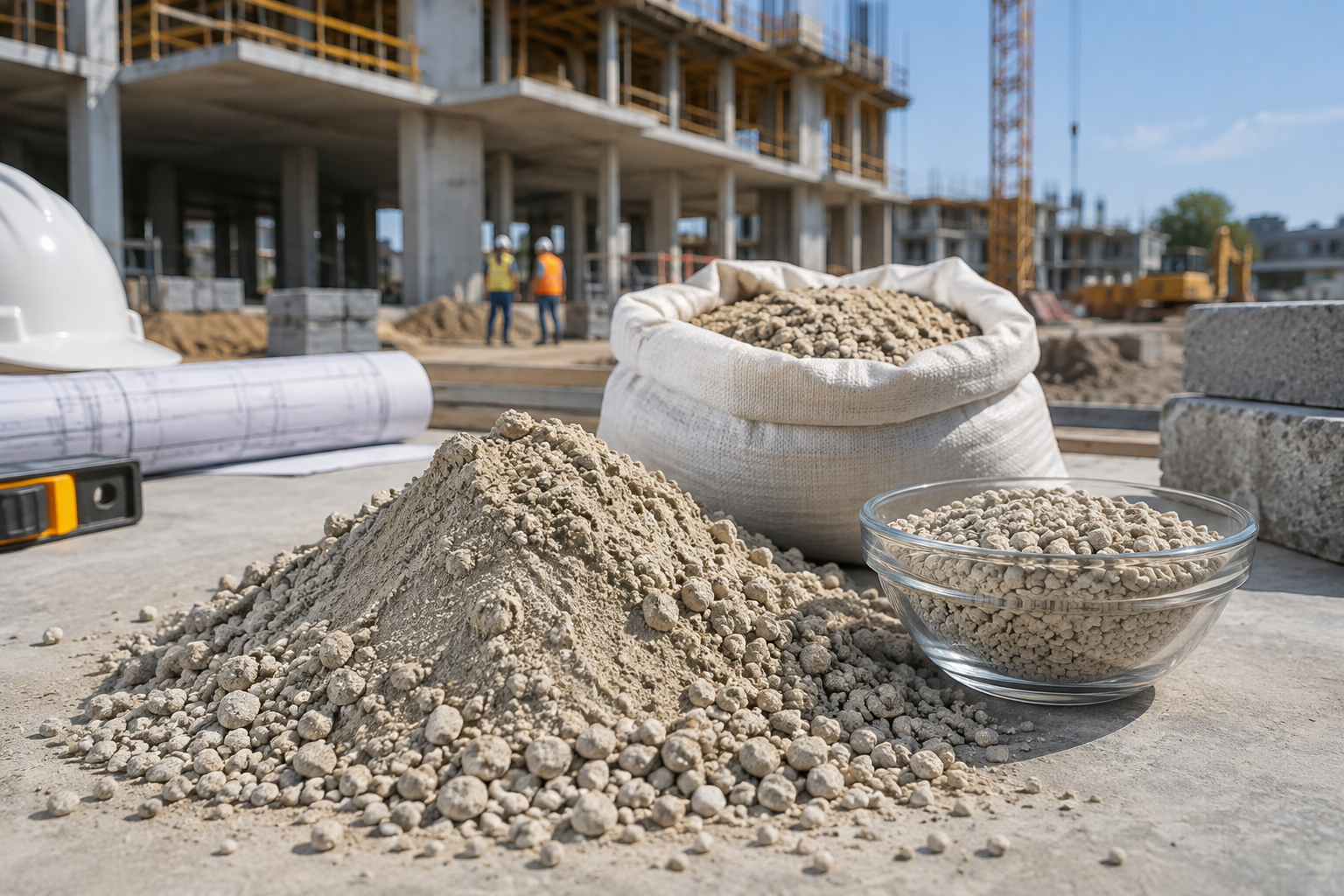
| Property | Sodium Bentonite | Calcium Bentonite |
|---|---|---|
| Typical swelling behavior | High, depending on grade and test method | Lower than sodium bentonite under comparable conditions |
| Water interaction | Strong hydration and swelling | Hydrates but generally swells less |
| Permeability after hydration | Can become very low in properly compacted systems | Generally higher than sodium bentonite in comparable systems |
| Common applications | Sealing, drilling fluids, geosynthetic clay liners, some clay desiccants | Foundry, absorbent products, filtration and other mineral applications |
| Main performance consideration | Swelling, water retention, permeability, rheology | Adsorption, processing behavior and application-specific performance |
For a moisture-control product, the label "sodium bentonite" alone isn't enough. A buyer should also check moisture content, particle size distribution, smectite content, swelling or absorption test results, packaging format, and any relevant quality specification.
Yes, bentonite-based clay can be used as a desiccant, but the wording needs some care. A commercial clay desiccant is normally processed and packaged specifically for moisture control. Raw bentonite taken directly from a mine shouldn't automatically be treated as equivalent to a finished desiccant product.
Clay desiccants are often supplied in sachets, bags, canisters, or other breathable packaging. The packaging lets water vapor reach the clay while keeping the mineral contained.
The effectiveness of a clay desiccant depends on the moisture adsorption characteristics of the formulation and the conditions inside the package. Relative humidity is particularly important. A material that performs well at one humidity level may behave differently at another.
For this reason, technical data should be evaluated under test conditions that resemble the intended application.
Relative humidity has a major influence on how a desiccant interacts with water vapor. Moisture adsorption is not a fixed number that remains constant regardless of the surrounding environment.
A clay desiccant can take up water vapor from a sealed environment even when the air doesn't feel humid. However, the amount and rate of moisture uptake depend on the clay formulation and its adsorption isotherm.
For sensitive products, the important question isn't simply how many grams of water the clay can hold. Engineers also need to consider how quickly it can capture moisture, the target relative humidity, the free volume inside the package, the initial moisture load, and the expected storage or shipping duration.
As humidity rises, more water vapor is available for adsorption. The clay may take up additional moisture until it approaches its capacity under those conditions.
If liquid water enters the package, the situation changes. A desiccant sachet isn't designed to replace waterproof packaging or handle large amounts of free water. Bentonite can swell substantially when exposed to liquid water, but a clay desiccant should be selected and packaged for the moisture load it is expected to encounter.
This is one reason good moisture-control design uses the desiccant and the package together rather than treating the desiccant as a complete substitute for a moisture barrier.
Bentonite clay and silica gel are both used in moisture-control products, but their chemistry and moisture-adsorption behavior are different.
Silica gel is a highly porous form of silicon dioxide with a large internal surface area. It is widely used in packaging because it can adsorb significant amounts of water vapor and is available in many standardized grades and packet formats.
Bentonite-based desiccants rely on the properties of clay minerals, particularly smectite. They can offer a practical mineral-based alternative where cost, material preference, availability, or application requirements make clay attractive.
| Factor | Bentonite Clay Desiccant | Silica Gel |
|---|---|---|
| Main material | Smectite-rich clay | Porous silicon dioxide |
| Moisture mechanism | Surface adsorption and hydration of clay layers | Adsorption on a highly porous surface |
| Physical response to liquid water | Can hydrate and swell strongly | Does not swell in the same way |
| Typical packaging | Sachets, bags and formulated packs | Sachets, canisters and formulated packs |
| Common use | General moisture control and industrial packaging | Packaging, electronics, pharmaceuticals and other controlled applications |
| Selection priority | Grade, mineral composition, moisture capacity and formulation | Pore structure, grade, capacity and humidity performance |
There is no universal rule that one material should replace the other. The right choice depends on the required humidity range, packaging design, moisture load, cost, regulatory requirements, and product sensitivity.
Bentonite-based moisture-control materials can serve several industrial and commercial purposes. The form of the material matters just as much as the mineral itself.
Humidity inside shipping containers can fluctuate significantly as cargo moves through different climates. Temperature changes can also cause condensation on container surfaces or on the cargo itself.
A properly specified clay desiccant can help control water vapor inside sealed packaging. This is particularly useful for metal components, machinery parts, textiles, leather goods, tools, electrical components, and other products vulnerable to humidity-related damage.
The desiccant should be sized according to the packaging volume, product moisture load, barrier properties of the packaging, expected transit duration, and environmental conditions. Simply adding an arbitrary number of packets doesn't guarantee adequate protection.
Corrosion can begin when metal surfaces are exposed to moisture under favorable conditions. Moisture-control packs can reduce the relative humidity inside a sealed package and therefore reduce the conditions that support corrosion.
However, desiccants work best as part of a complete corrosion-control strategy. Packaging seals, vapor barriers, corrosion inhibitors, product cleanliness, and temperature management can all affect the final result.
Electronic components and precision instruments can be sensitive to humidity during storage and transportation. A clay desiccant can help reduce moisture in a suitably sealed package.
The desiccant should not be placed directly against a product unless the packaging system is designed for that arrangement. Sachet material, dust generation, chemical compatibility, and product cleanliness should all be considered.
Bentonite is also widely used for water-control applications in construction, but this is different from using a bentonite desiccant.
In geosynthetic clay liners, slurry walls, cutoff systems, and certain waterproofing products, sodium bentonite hydrates and swells to create a low-permeability layer. The objective is to restrict the movement of liquid water rather than remove humidity from an enclosed space.
Bentonite plays an important role in drilling fluids because hydrated clay can provide viscosity, suspension, and fluid-loss control. These properties help maintain drilling-fluid performance and support borehole stability.
The objective here is again different from desiccant packaging. The value of bentonite comes from its interaction with water and its resulting rheological behavior, not simply from removing atmospheric humidity.
Buying based only on the phrase "high absorption" can lead to inconsistent results. A better approach is to define the application first and then compare technical data.
Determine whether the problem is water vapor, condensation, direct liquid water, or water movement through soil. These are different problems and require different products.
A sachet may be suitable for humidity inside a sealed carton. A waterproof membrane may be necessary where liquid water can enter. Compacted sodium bentonite may be appropriate for a sealing application.
For desiccant packaging, establish the relative humidity you need to control. The target should reflect the sensitivity of the product being protected.
A technical data sheet that provides moisture-uptake values at defined relative humidities is more useful than a general claim about absorption capacity.
Ask for information about smectite or montmorillonite content and the dominant exchangeable cations. These characteristics help explain how the material is likely to behave when hydrated.
Powder, granules, pellets, and processed sachet material can behave differently. Particle size affects handling, surface exposure, dust, packing density, and the rate at which moisture can reach the material.
The best form depends on how the material will be used. A loose powder may have useful laboratory characteristics but be impractical inside commercial packaging.
A desiccant cannot provide its full moisture-uptake potential if it has already absorbed a significant amount of water before use. Packaging and storage conditions therefore matter.
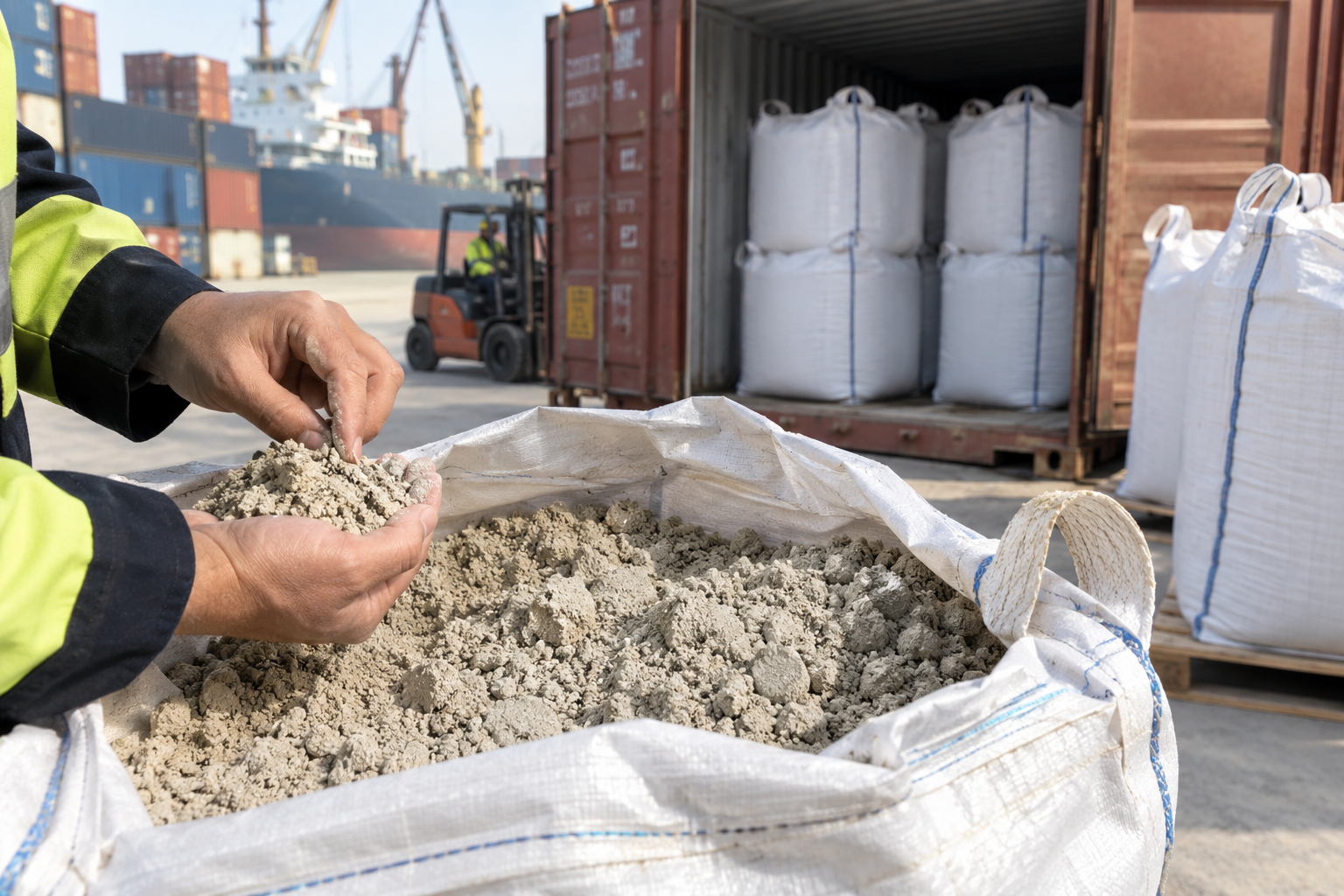
Bulk clay should be stored in a way that limits unwanted moisture exposure, especially when it will later be processed into a moisture-control product.
Useful documentation may include moisture capacity at defined relative humidities, free swelling or swell index, particle-size distribution, moisture content, pH, bulk density, and chemical or mineralogical analysis.
The exact tests should match the intended application. A swelling test designed for a sealing material does not automatically predict performance as a packaged desiccant.
Bentonite is a broad commercial term covering materials with different mineral compositions and performance characteristics. Two products can both be called bentonite while behaving quite differently.
Always compare the technical specification, not just the product name.
A large swelling ratio does not directly tell you how much water vapor a desiccant can capture at a particular relative humidity.
Swelling and moisture adsorption are related to the clay's interaction with water, but they are different performance measurements. Use the test that matches the application.
Mining and processing quality are not the same thing as finished desiccant performance. Raw material may contain moisture, variable mineral content, or particles that aren't suitable for a sachet or controlled packaging product.
Commercial desiccants are formulated, dried, sized, and packaged for a specific purpose.
A desiccant works inside a moisture-control system. If the package allows large amounts of outside humidity to enter continuously, the desiccant may become saturated faster than expected.
A suitable moisture barrier and a properly sized desiccant should be designed together.
Adding more material can increase moisture capacity, but it doesn't fix every packaging problem. Poor seals, wet products, direct water leakage, and unsuitable packaging materials can overwhelm a desiccant system.
Start by identifying the source and expected quantity of moisture.
Bentonite's water-retention behavior becomes especially useful when the goal is to restrict liquid movement rather than capture humidity.
When sodium bentonite hydrates in a confined space, the clay can expand and fill available pores. Under suitable conditions, the hydrated material forms a very low-permeability mass.
This principle is used in several engineered containment and waterproofing systems. Geosynthetic clay liners, for example, incorporate bentonite between geotextile or related layers so that the clay can hydrate and form a barrier when exposed to water.
The performance of such systems depends on confinement, hydration conditions, clay quality, ionic composition of the water, density, and installation quality. High salinity or certain dissolved ions can change swelling and hydraulic behavior, so laboratory testing may be necessary for demanding applications.
The words absorption and adsorption are often used interchangeably in product descriptions, but they describe different physical processes.
Absorption generally refers to a substance entering into the bulk of another material. Adsorption refers to molecules accumulating on a surface.
Bentonite's interaction with water involves both surface effects and hydration within its layered structure. That is why describing it simply as a sponge is misleading.
For a commercial desiccant, the useful measurement is usually the amount of moisture the product can take up under defined temperature and relative-humidity conditions. For a sealing material, permeability and swelling behavior may be more important than total moisture uptake.
Bentonite is hygroscopic enough to interact with atmospheric moisture, so storage conditions can affect the starting condition of the material.
Bulk bentonite should generally be protected from rain, condensation, and prolonged exposure to humid air. Packaging should remain intact until the material is ready for processing or use.
For finished clay desiccants, moisture-barrier packaging is particularly important. A desiccant that has already picked up substantial moisture during storage has less available capacity when it reaches the end user.
Storage recommendations should follow the supplier's technical documentation because the appropriate conditions vary with product form and packaging.
For industrial procurement, a clear specification makes supplier comparisons much easier. Depending on the application, buyers may request:
Not every specification is necessary for every application. The important point is to connect the test to the job the bentonite needs to perform.
Bentonite contains expandable clay minerals, especially montmorillonite, with layered structures that interact strongly with water. Water can hydrate the clay layers and occupy spaces between them, while the fine particles provide substantial surface area. Performance varies by mineral composition, cation type, processing, particle size, and humidity, so product-specific test data matters.
Sodium bentonite can show substantial free swelling when fully hydrated, but there is no single swelling value that applies to every deposit or commercial grade. Results depend on mineral composition, particle size, exchangeable cations, water chemistry, and the test method. Technical specifications should therefore state the test procedure and conditions behind any swelling figure.
Sodium bentonite generally develops greater swelling and lower hydraulic permeability than calcium bentonite under comparable conditions. That makes sodium-rich grades particularly useful for sealing and some moisture-control applications. However, "better" depends on the job. A desiccant requires humidity-adsorption data, while a liner requires swelling and permeability performance under its expected conditions.
No. Bentonite does not dissolve in water like a soluble salt. Its expandable clay minerals hydrate and swell, producing a gel-like or cohesive hydrated mass. Some fine particles can disperse in water, especially under suitable chemical conditions, but the clay mineral itself remains present. The degree of dispersion and swelling depends on the bentonite grade and water chemistry.
Bentonite is used across packaging, construction, civil engineering, drilling, foundry, and industrial processing. Clay-based desiccants can help control humidity in sealed packages, while sodium bentonite is widely used in drilling fluids and low-permeability barriers. The formulation and grade should be selected for the specific task rather than assuming one bentonite product fits every application.
Bentonite-based desiccants can adsorb water vapor at relatively low humidity, but their capacity and adsorption rate depend on the formulation and environmental conditions. They shouldn't be described as equally effective at every humidity level. For sensitive packaging, compare moisture-uptake data at the actual temperature and relative humidity expected during storage and transportation.
A properly formulated clay desiccant can be an alternative to silica gel for some packaging applications, but the materials have different moisture-adsorption characteristics. The choice should be based on the required humidity range, capacity, package volume, product sensitivity, cost, and applicable quality requirements. Test the selected desiccant in the actual packaging system before large-scale deployment.
Raw bentonite should not automatically be treated as a finished desiccant. Commercial clay desiccants are selected and processed for moisture capacity, particle size, moisture content, handling, and packaging compatibility. If raw mineral is being converted into a desiccant, the material should be dried, processed, tested, and packaged according to the requirements of the intended application.
Bentonite's moisture-control performance starts with its mineral structure. Smectite-rich clay contains expandable layers that can hydrate when exposed to water, and sodium-rich bentonite generally develops much greater swelling than calcium-rich material.
For desiccant applications, however, swelling alone isn't enough to judge performance. Moisture capacity at defined relative humidities, particle size, initial moisture content, packaging, and storage conditions all matter.
For sealing applications, the priorities change. Swelling, permeability, confinement, water chemistry, and installation conditions become central to the design.
The most reliable approach is to match the bentonite grade and product form to the moisture problem. If the objective is humidity control inside a sealed package, evaluate a purpose-made clay desiccant. If the objective is to restrict liquid water movement, evaluate an engineered bentonite sealing system.
For bulk procurement, work from a written specification and request batch-level quality documentation where consistency is important. A supplier should be able to explain the mineral grade, processing method, relevant test results, packaging, and recommended storage conditions.
Bentonite is valuable because it does more than simply hold water. Its layered mineral structure allows it to hydrate, swell, retain moisture, and, under suitable conditions, create a low-permeability barrier. Understanding which of those properties your application actually needs is the key to selecting the right material.













Have questions about our products? We're here to help!