Axewelledge, a leading exporter from India, specializes in high-quality Bentonite. With a commitment to excellence, we supply premium Bentonite to the Middle East and Southeast Asia markets.


North Angle Complex, 304,
150 Feet Ring Rd, Opposite Ambedkar Nagar BRTS Stop,
Madhav Park, Punit Nagar,
Mavdi, Rajkot, Gujarat 360004
© Axewelledge 2026, All Rights Reserved.

If you buy bentonite by the metric ton, moisture is part of what you are paying for. A shipment at 14% moisture contains less dry mineral than the same-weight shipment at 9%, and that difference can affect freight cost, storage, feeding, and downstream formulation.
That doesn't mean the driest bentonite is automatically the best bentonite. Moisture is only one quality parameter, and its importance depends on the grade, particle size, packaging, transport conditions, and application. The useful question for a buyer isn't simply, "How dry is it?" It is, "What moisture level gives us reliable handling and performance at the lowest delivered cost?"
For most processed industrial bentonite, free moisture is commonly controlled within a defined range rather than driven toward zero. The exact specification should come from the product standard and application. Drilling-grade bentonite, foundry bentonite, pelletizing grades, granular absorbents, and civil-engineering products don't necessarily share the same target.
In commercial bentonite purchasing, moisture content generally refers to the water that can be removed from a representative sample under the conditions specified by the agreed test method. It is usually reported as a percentage of the original wet sample mass.
Bentonite is primarily composed of smectite minerals, especially montmorillonite, along with varying amounts of quartz, feldspar, calcite, mica, and other minerals depending on the deposit and processing route. The clay's layered structure can interact strongly with water, particularly when sodium is the dominant exchangeable cation.
It helps to distinguish free moisture from water that is part of the mineral structure. Free or removable moisture occupies pores, particle surfaces, and spaces between particles. Structural hydroxyl groups are chemically associated with the clay lattice and behave very differently during heating.
| Moisture type | Where it occurs | What happens during routine drying | Why buyers care |
|---|---|---|---|
| Free or removable moisture | Particle surfaces, pores, and interparticle spaces | Removed under the conditions of the agreed moisture test | Affects shipping weight, flow, caking, and effective dry-solids content |
| Adsorbed/interlayer water | Associated with clay surfaces and expandable interlayers | Removal depends on temperature, humidity, mineralogy, and test conditions | Influences hydration and measured mass loss |
| Structural hydroxyls | Part of the mineral structure | Not normally removed by routine moisture testing | Loss at high temperature changes the mineral structure |
A routine moisture test should not be interpreted as a direct measurement of every form of water in the mineral. Test temperature and duration matter. If a buyer, supplier, and independent laboratory use different methods, their reported values may not be directly comparable.
For that reason, a purchase specification should identify the test method, sample basis, sampling point, and acceptance limit, not just state a number such as "moisture below 12%."
Moisture affects bentonite in three main ways: how much dry material you receive, how easily you handle it, and how consistently it behaves in your process.
The financial effect is straightforward. If a shipment weighs 10,000 metric tons at 14% moisture on a wet basis, about 1,400 metric tons of that shipment's measured mass is water under that calculation. At 9% moisture, the corresponding figure is about 900 metric tons. The difference is 500 metric tons of water by wet-basis calculation.
The operational effect is less obvious. Excess moisture can make a fine powder cohesive, increase caking, interfere with feeders, and change how material enters a mixer. But reducing moisture too aggressively can increase dust and may change handling characteristics. It doesn't automatically improve hydration or swelling performance.
Most importantly, moisture should never be used as a substitute for performance testing. A low-moisture bentonite isn't necessarily a high-swelling bentonite, a high-yield drilling grade, or a strong foundry binder.
No. That's one of the most important distinctions for procurement teams.
Bentonite is not a simple dry powder in which every reduction in water represents an improvement. Commercial bentonite needs a moisture specification that balances processing, storage, transport, dust control, and application requirements.
A very dry powder can be dusty and difficult to handle. A high-moisture product can cake or bridge during storage and may deliver less dry mineral per shipped ton. Between those extremes is the range that works for the particular product and process.
Very low moisture can create several practical problems, especially with finely milled material.
Dust generation: Fine bentonite can become increasingly dusty as moisture falls. That can increase material loss and create a need for stronger dust-control measures around unloading, conveying, and bag emptying.
Poor feeding behavior: Extremely dry, fine powders can behave unpredictably in hoppers and pneumatic systems. Static and poor flow may become more noticeable depending on particle size, equipment, humidity, and conveying conditions.
Hydration can become less forgiving: Dry bentonite still has to hydrate when added to water. If powder is added too quickly or without sufficient dispersion, the outer surface of individual agglomerates can hydrate before the interior does. The resulting partially hydrated lumps are often called "fish eyes." This is primarily a mixing and dispersion problem, although powder condition can influence how severe it becomes.
The answer isn't simply to add moisture to the product. Proper powder quality, particle-size distribution, mixing energy, addition rate, and hydration time all matter.
Excess moisture creates a different set of problems.
Caking: Moisture can cause fine particles to adhere and form hard or soft agglomerates during storage and transport.
Bridging and rat-holing: Cohesive material may stop flowing properly through hoppers and silos, particularly when combined with pressure from overlying material.
Feeder problems: Wet or sticky bentonite can adhere to screws, valves, conveyor surfaces, and pneumatic conveying equipment.
Lower dry-solids yield per shipment: A high-moisture shipment contains less dry mineral for every metric ton purchased on a wet basis.
Higher delivered cost per dry ton: Freight and other weight-based costs apply to the total shipped mass, including water.
There is no universal moisture threshold at which every bentonite becomes unusable. The right upper limit should come from actual handling trials and the relevant product specification.
The same moisture value can have different consequences in different industries. Buyers should therefore avoid copying a moisture limit from one grade into another application without testing.
Sodium bentonite is widely used in water-based drilling fluids because hydrated smectite can build viscosity, suspension, and filtration-control properties. In drilling applications, however, the finished mud's performance depends on much more than the powder's incoming moisture.
When dry bentonite is added to freshwater, it hydrates and disperses. If the incoming powder contains more free moisture, each metric ton contains less dry bentonite. That can change the amount of active solids delivered per unit of purchased weight.
Powder condition also affects feeding. Material that has picked up moisture during storage may form lumps and feed less consistently. For high-volume drilling-fluid operations, that can make mud properties harder to control.
For API-grade material, buyers should use the applicable API product specification and agreed test methods rather than relying on a generic moisture target. Moisture should be evaluated alongside yield, rheology, filtration behavior, particle-size requirements, and other contractual properties.
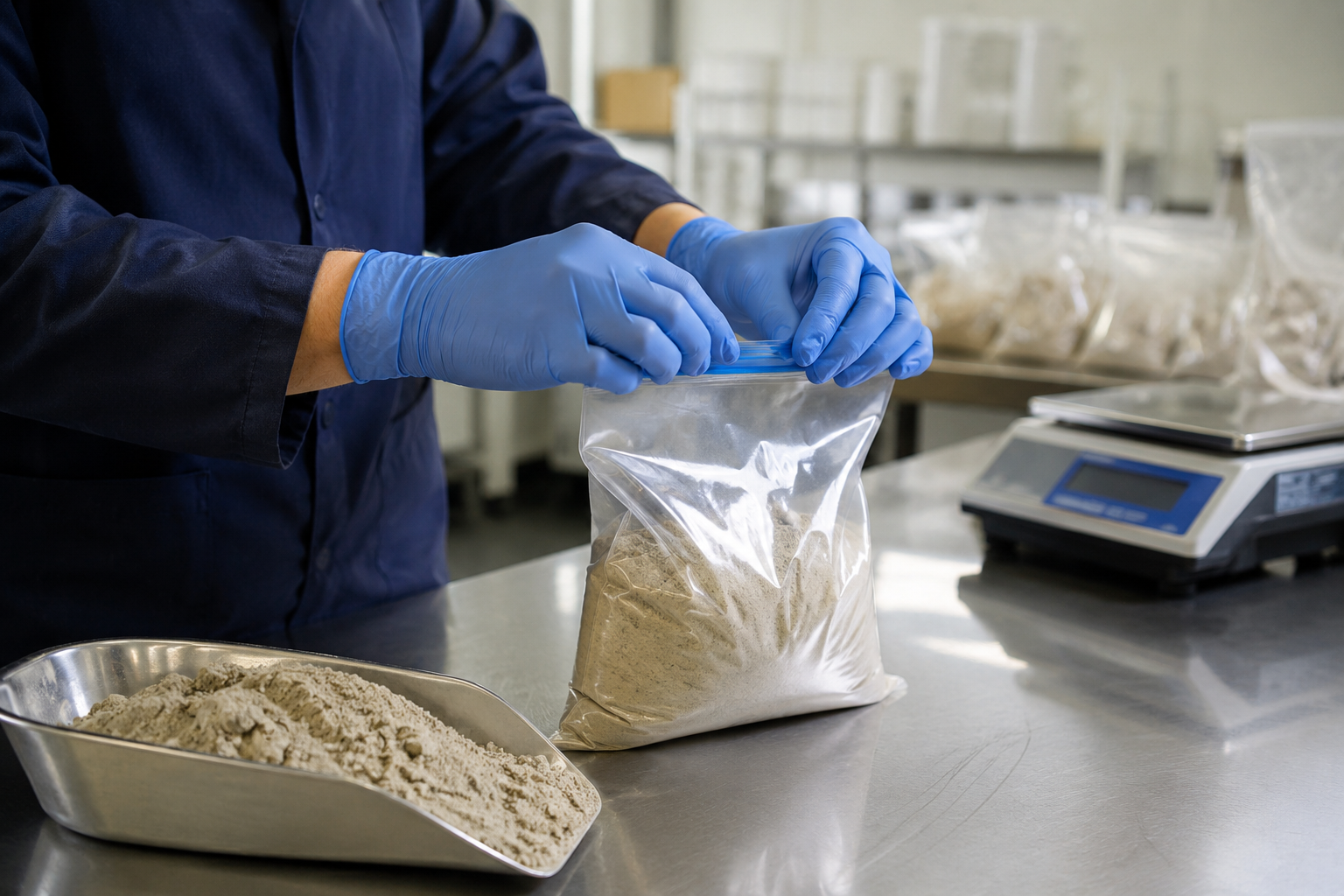
Foundries use bentonite as part of the binder system in green molding sand. Sodium bentonite, calcium bentonite, and blended systems can behave differently, so the incoming moisture specification needs to be considered alongside the foundry's sand-control system.
The key issue is consistency. If the bentonite feed changes significantly in moisture, the amount of dry binder entering the muller changes even when the feeder says the same mass is being added. The foundry may then need to compensate with water or binder additions.
Moisture in the finished molding sand is also critical, but that is a separate measurement from the moisture content of the incoming bentonite. A buyer should not assume that controlling the clay powder alone guarantees the correct sand moisture.
Bentonite slurries are used in diaphragm-wall construction, trench support, tunneling, horizontal directional drilling, and other applications where the clay's ability to disperse and form a low-permeability filter cake is important.
Incoming powder moisture affects how much dry bentonite is actually added when material is dosed by mass. It can also affect storage and feeding. Once the bentonite is mixed with water, however, slurry properties must be checked directly.
Useful field and laboratory controls can include slurry density, viscosity, filtrate loss, sand content, pH, and gel behavior, depending on the engineering specification. A supplier's powder-moisture result cannot replace those checks.
Bentonite is used as a binder in iron ore pelletizing, where small quantities can influence green-ball formation and subsequent pellet quality. The important moisture balance exists across the entire pelletizing process, not just in the bentonite.
Incoming bentonite moisture changes the amount of dry binder delivered per unit of feed. If that moisture varies from shipment to shipment, operators may see changes in binder dosage on a dry-solids basis and may need to adjust process water.
For pelletizing, buyers should therefore specify bentonite moisture alongside binder performance, mineralogy, particle size, swelling or rheological characteristics where relevant, and the plant's own green-ball and fired-pellet tests.
Granular sodium bentonite used for clumping cat litter is processed differently from many fine industrial grades. Here, granule strength, particle-size distribution, absorbency, clumping behavior, dust, and final moisture all matter.
Too much moisture can encourage premature agglomeration during processing or storage. Too little can increase dust and alter the way granules behave during packaging and use.
The correct specification should therefore be based on the finished granule's performance rather than an arbitrary moisture number copied from powdered bentonite.
Geosynthetic clay liners, or GCLs, contain bentonite between geotextile layers and are used as hydraulic barriers in engineered containment systems. Moisture management is important during manufacturing, storage, and installation because premature hydration can change handling characteristics.
The relevant requirements are product- and project-specific. Buyers should follow the manufacturer's declared properties and the applicable project specification instead of assuming that a general industrial bentonite moisture range applies to a GCL.
The following table is a practical procurement framework, not a universal industry standard. Actual limits should be taken from the applicable product specification, customer requirement, or validated plant process.
| Industry / Application | Practical moisture consideration | Main reason to control it | What to verify alongside moisture |
|---|---|---|---|
| API drilling bentonite | Often controlled in a defined low-to-moderate range | Feeding consistency and dry-solids yield | API compliance, rheology, yield, filtration properties |
| Foundry green sand | Typically controlled for consistent binder addition | Stable mulling and molding behavior | Binder performance, sand moisture, strength, permeability |
| Civil engineering slurry | Controlled to keep dosing and handling consistent | Predictable slurry preparation | Density, viscosity, filtrate loss, sand content |
| Iron ore pelletizing | Controlled to maintain consistent dry binder addition | Stable green-ball formation | Binder efficiency, particle size, pellet strength |
| Granular cat litter | Controlled to preserve granule quality and handling | Prevent caking and excess dust | Absorbency, clump strength, particle-size distribution |
| GCL production | Controlled according to product and manufacturing specification | Prevent unwanted hydration and handling problems | Swell index, fluid loss, mass per unit area, product specification |
The important takeaway is that a table of generic percentages can help frame a purchase discussion, but it should not replace a product-specific specification.
Moisture becomes especially important when bentonite is bought in large quantities and transported over long distances.
Suppose a buyer purchases 10,000 metric tons of wet bentonite at $150 per metric ton delivered. For a simple comparison, assume Supplier A delivers at 9% moisture and Supplier B at 14% moisture.
Using the common wet-basis moisture calculation:
At the same $150 delivered price, Supplier A's nominal cost per calculated dry ton is about $164.84, while Supplier B's is about $174.42.
The difference is roughly $9.58 per calculated dry ton.
There is another way to view the same transaction. The 5-percentage-point moisture difference represents approximately 500 additional metric tons of water in the 10,000-MT shipment. At $150 per shipped ton, that portion corresponds to $75,000 of shipment value under the simplified assumption that the entire delivered price scales directly with shipped mass.
This is useful for procurement analysis, but it shouldn't be treated as a final contract adjustment without checking the actual commercial terms. Ocean freight may be quoted by container, vessel lot, or other basis, and some suppliers sell against dry weight or include moisture allowances in their contracts.
A buyer comparing two bentonite suppliers should avoid comparing wet tonnes alone when moisture differs materially.
The basic dry-solids calculation is:
For example, 1,000 MT of bentonite at 12% moisture contains approximately 880 MT of dry solids on this simplified basis:
That makes it much easier to compare delivered cost per dry metric ton.
For contractual work, always use the moisture basis specified in the purchase agreement. A reported moisture percentage can be misleading if one party reports wet basis and another uses a different basis.
Moisture testing is only as good as the sample. Bentonite can vary within a shipment, and the material near a container wall or exposed to humid air may not represent the entire lot.
A sound quality-control program therefore has two parts: representative sampling and a defined analytical method.
Gravimetric drying is the most straightforward approach for measuring mass loss associated with moisture under specified conditions.
A typical procedure is:
The basic wet-basis calculation is:
Where:
Do not automatically describe ASTM D2216 as the universal bentonite moisture standard. ASTM D2216 is a standard method for laboratory determination of water content of soil and rock by mass, while bentonite suppliers may use product-specific, customer-specific, or industry-specific methods. The purchase contract should identify the exact method used for acceptance.
Halogen moisture analyzers combine a balance with controlled heating and can produce results much faster than a conventional laboratory oven.
They're useful for incoming inspection and process control when the method has been validated against the reference laboratory procedure. The instrument's temperature program, sample mass, endpoint, and sample preparation can all affect the result.
For a commercial dispute, the contract should specify which method takes precedence. A rapid analyzer shouldn't automatically override the agreed reference method simply because it produces a number more quickly.

Karl Fischer titration is designed for precise water determination and is valuable when trace water measurement is genuinely required. It isn't normally the first choice for routine bulk bentonite moisture control.
For most industrial bentonite procurement, a validated gravimetric method is more practical. Karl Fischer becomes relevant when the formulation or analytical requirement calls for specific water determination at much lower concentrations or when other volatile components could interfere with a simple loss-on-drying measurement.
A highly accurate instrument can't fix a bad sample.
Consider a bulk shipment in which several bags near the container door have absorbed moisture while the material in the center remains relatively dry. Testing only the exposed bags could produce a result that doesn't represent the lot.
For meaningful acceptance testing, define:
For high-value bulk purchases, a written sampling plan is often more valuable than simply asking for a tighter moisture number.
Bentonite can exchange moisture with humid air. The rate and extent depend on mineralogy, particle size, packaging, temperature, relative humidity, and exposure time.
A product that leaves the processing plant at the agreed moisture level can therefore arrive with a different moisture profile if packaging or storage conditions allow significant moisture transfer.
Container condensation, often called container sweat, can occur when temperature changes cause moisture-laden air inside a closed container to reach its dew point. Water can then condense on cooler metal surfaces and potentially wet cargo.
This is different from bentonite simply absorbing moisture from humid air. Both mechanisms can matter during international transport.
Useful controls include:
Desiccants aren't a substitute for sound packaging. Their effectiveness depends on container volume, cargo moisture, packaging permeability, temperature, and the amount of moisture entering the system.
For packaged bentonite, basic warehouse discipline goes a long way.
Keep bags off the floor. Use pallets or another suitable barrier, particularly where concrete floors can be damp.
Protect the product from rain and condensation. Covered storage is essential for paper bags and other moisture-sensitive packaging.
Control humidity where practical. There is no universal requirement that every bentonite warehouse remain below exactly 60% relative humidity. The appropriate condition depends on packaging, product specification, local climate, and storage duration. The objective is to prevent meaningful moisture pickup and caking.
Use sensible stock rotation. FIFO can reduce unnecessary storage time, although properly packaged bentonite doesn't automatically have a short shelf life. Storage conditions are the bigger concern.
Inspect older lots before use. Look for hard caking, damaged packaging, visible moisture exposure, and changes in flowability.
A specification such as "moisture below 15%" may be technically acceptable but commercially weak. A shipment at 14.8% can pass while performing very differently from material at 9% if the application is sensitive to dry-solids dosage or powder handling.
Better approach: Define a target range, an acceptance limit, the test method, and the commercial consequence of exceeding the limit.
Low moisture doesn't prove high montmorillonite content, high swelling capacity, good rheology, or strong binding performance.
Two bentonites can have similar moisture values and very different performance because of differences in mineralogy, exchangeable cations, particle size, processing, and impurities.
Better approach: Pair moisture with application-specific performance tests.
These are different properties.
Swelling capacity describes how a bentonite behaves when hydrated under a defined test procedure. Moisture content describes the water present in the material at the time of testing. A moist bentonite isn't necessarily a high-swelling bentonite.
For example, a sodium-rich bentonite may have strong swelling characteristics even when supplied at a relatively low moisture level, while a calcium-rich material may behave very differently at a similar moisture content.
Better approach: Specify swelling, rheology, yield, or absorbency separately when those properties matter.
A CoA is useful, but it doesn't eliminate the need for receiving inspection when moisture has a meaningful commercial or operational impact.
Better approach: Agree on a sampling and retesting procedure before the shipment arrives. For important cargoes, an independent inspection company can provide an additional chain-of-custody record.
A supplier offering the lowest price per wet metric ton may not offer the lowest price per dry metric ton.
Better approach: Normalize supplier quotes to dry solids, then compare freight, packaging, losses, and application performance.
A moisture specification copied from another product may create problems. A powder that works well at 9% in one process may not require the same target in another.
Better approach: Test the actual grade under production conditions before locking the commercial specification.
A strong bentonite specification should contain more than one line for moisture.
At minimum, consider including:
This approach prevents moisture from becoming an isolated purchasing metric.
Supplier qualification should focus on process control rather than marketing claims alone.
Ask potential suppliers how they monitor moisture after drying, how often they calibrate their moisture instruments, how they sample production lots, and how they protect finished material from moisture pickup before shipment.
It is also useful to request representative CoAs from several production lots rather than reviewing a single ideal result. Consistency is often more valuable than a one-time number.
For a supplier such as Axewelledge, buyers should evaluate the same fundamentals: documented specifications, representative test reports, application-specific performance data, packaging controls, and a clear inspection procedure. Product claims about reserves, production capacity, or export volume should be independently verified as part of normal supplier due diligence rather than accepted solely as marketing statements.
A good supplier relationship should make it easy to answer a practical question: If the shipment arrives outside the agreed moisture range, what happens next? The contract, sampling plan, and commercial terms should already provide the answer.
Before placing a bulk bentonite purchase order, check the following:
Bentonite moisture content matters because it changes more than the number printed on a Certificate of Analysis. It affects the amount of dry mineral delivered, the way powder flows and stores, the cost of transporting each usable tonne, and the consistency of downstream processing.
But the goal isn't to buy the driest possible bentonite. The goal is to buy consistent bentonite at a moisture level that suits the grade and application.
For procurement teams, the most useful approach is straightforward:
Once those controls are in place, moisture stops being a vague quality number and becomes what it should be: a measurable part of product quality, logistics, and total cost.













Have questions about our products? We're here to help!