Axewelledge, a leading exporter from India, specializes in high-quality Bentonite. With a commitment to excellence, we supply premium Bentonite to the Middle East and Southeast Asia markets.


North Angle Complex, 304,
150 Feet Ring Rd, Opposite Ambedkar Nagar BRTS Stop,
Madhav Park, Punit Nagar,
Mavdi, Rajkot, Gujarat 360004
© Axewelledge 2026, All Rights Reserved.
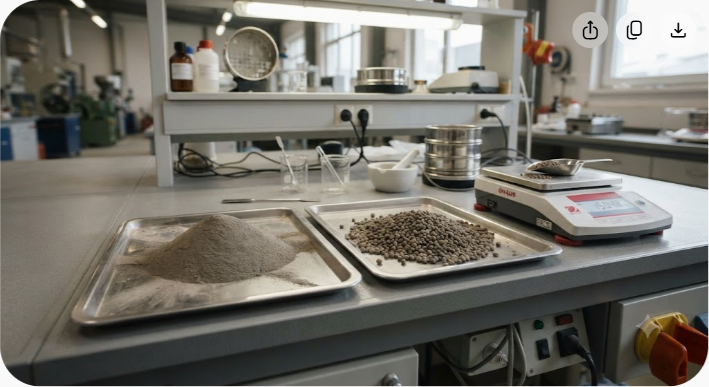
Bentonite powder and bentonite granules can come from the same mineral, but they don't behave the same way in storage, mixing, hydration, dosing, or field application. The better form depends less on the product name and more on what you need the bentonite to do.
For fast dispersion and controlled mixing into liquids, fine bentonite powder is usually the practical choice. For applications that require localized placement, easier handling, or gradual hydration, granular bentonite can be more suitable. The grade, mineral composition, moisture content, particle-size distribution, and swelling performance still matter more than physical form alone.
That distinction is easy to miss. A buyer may compare powder and granules as if they were two completely different minerals, yet the real difference is often particle size and the way particle size changes handling and hydration.
The simplest difference is particle size. Bentonite powder is milled into fine particles, while bentonite granules consist of larger particles or agglomerated material. Both may be produced from the same sodium or calcium bentonite source, but their physical behaviour during use can be quite different.
Powder exposes much more surface area to water immediately. That makes it useful when you need bentonite to disperse through a slurry, suspension, coating, or formulation. Granules are easier to place in a defined area and can hydrate progressively as water reaches the particles.
The distinction becomes especially important in industrial purchasing because the word bentonite by itself doesn't tell you enough. You also need to know the bentonite type, intended application, swelling characteristics, moisture, particle-size specification, purity requirements, and test method.
A high-swelling sodium bentonite in powder form and the same mineral supplied as granules may have similar underlying chemistry, but they can produce very different results in a process.
| Feature | Bentonite Powder | Bentonite Granules |
|---|---|---|
| Physical form | Fine particles | Larger particles or granules |
| Water contact | Rapid and extensive | More gradual, depending on size |
| Mixing into liquids | Usually easier | Usually requires more time or agitation |
| Dust potential | Higher during handling | Generally lower |
| Localized placement | Less convenient | Often easier |
| Dosing | Well suited to controlled powder dosing | Convenient for bulk placement or granular dosing |
| Drilling-fluid preparation | Commonly preferred | Less convenient for rapid dispersion |
| Sealing applications | Useful when dispersed or incorporated into a system | Useful for direct placement and swelling in confined spaces |
| Storage considerations | Protect from moisture and dust loss | Protect from moisture and premature hydration |
| Best selection factor | Dispersion and mixing requirements | Placement and hydration requirements |
This table gives you the practical distinction, but there is an important qualification: granular does not automatically mean slow-swelling, and powder does not automatically mean high-swelling. Those characteristics depend on the mineral and processing, not simply the physical form.
Bentonite powder is bentonite that has been dried and milled to a specified fine particle size. The exact specification varies according to the application. Industrial products may be supplied in different mesh or micron ranges rather than one universal powder size.
The fine particle structure makes powder useful wherever the bentonite needs to become part of a uniform mixture.
Common applications include:
The main operational advantage is dispersion. When properly added to water, fine particles can hydrate and develop the viscosity, suspension behaviour, or swelling needed for the application.
That doesn't mean you can simply add any bentonite powder to water and expect the same result. Addition rate, water chemistry, mixing energy, temperature, particle size, hydration time, and bentonite quality all influence performance.
Drilling fluids often need bentonite to disperse through water and form a stable suspension with the desired rheological properties. Fine powder is therefore convenient because it can be metered into a mixing system and hydrated before the fluid reaches the active circulation system.
In drilling applications, buyers commonly evaluate properties such as viscosity, filtration behaviour, yield characteristics, gel strength, moisture, and relevant API specifications rather than choosing a product simply because it is labelled powder.
For an industrial buyer, this is a crucial point. A powder that looks fine and uniform may still be unsuitable if its swelling, rheological behaviour, or test performance does not meet the process requirement.
Bentonite granules are larger particles of bentonite supplied in a granular form. Depending on the manufacturing process, they may be produced by granulation, controlled agglomeration, or other particle-sizing methods.
Granules are often selected where the material needs to be placed rather than rapidly dispersed.
Examples include certain sealing, soil, construction, agricultural, and environmental applications. Granular sodium bentonite is widely associated with sealing because the particles can absorb water, swell, and form a low-permeability mass when conditions are suitable.
The actual performance still depends on the product specification. Granule size, swelling capacity, moisture, mineral composition, density, and placement conditions can all affect the final seal.
Consider dry granular bentonite placed in a defined gap or soil zone. Water enters the material, the clay particles hydrate and swell, and the material can expand into available voids.
That behaviour is useful because the bentonite doesn't necessarily need to be dispersed through a large volume of water before it starts performing its sealing function.
This is one reason granular products can be attractive for applications such as:
However, a granular product shouldn't be chosen solely because it's easier to pour. The installation method and water conditions need to be compatible with the specified bentonite.
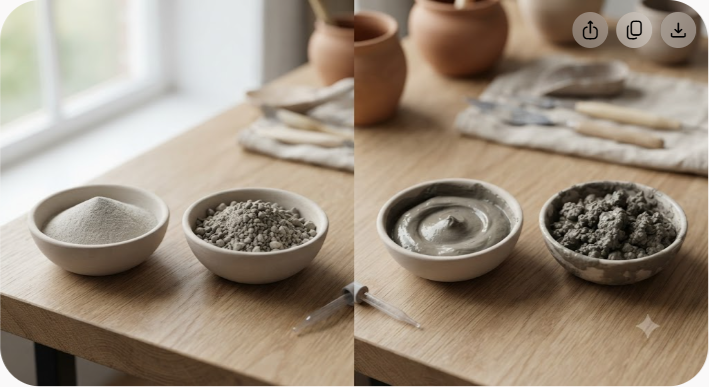
This is one of the most common misunderstandings about bentonite.
Particle form alone does not determine how much bentonite will ultimately swell. Swelling is strongly influenced by the type of bentonite, especially its montmorillonite content and exchangeable cations, as well as particle size, water chemistry, concentration, and test conditions.
Sodium bentonite generally has greater swelling capacity than calcium bentonite because sodium-dominant montmorillonite can take up substantially more water between its clay layers under suitable conditions.
But comparing a sodium bentonite powder with a calcium bentonite granule only by physical form would give you the wrong answer. You are comparing two variables at once.
For procurement, separate the questions:
This approach prevents particle size from becoming a substitute for a proper product specification.
Water is where the difference becomes particularly visible.
Fine powder has a large surface area relative to its particle mass. If it is added correctly to water and mixed adequately, water can contact a large amount of clay quickly. That makes powder appropriate for processes where rapid dispersion and hydration are required.
Granules present less exposed surface area at the beginning. Water must penetrate or break down the larger particles before the bentonite is fully hydrated. The process can therefore be slower and more dependent on granule size and water availability.
This isn't necessarily a disadvantage.
For a sealing application, slower hydration can be useful because the material needs time to absorb water and expand into surrounding voids. For a drilling-fluid mixing tank, the same behaviour may be inconvenient because the operator usually wants consistent dispersion before the fluid is pumped into the active system.
Bentonite does not hydrate in isolation. Dissolved salts and other ions in water can influence clay behaviour. High ionic strength can reduce apparent swelling and alter rheology compared with fresh, low-salinity water.
That's why a bentonite product that performs well in a laboratory test using specified water may behave differently in field conditions.
If your process uses saline water, hard water, recycled process water, or wastewater, test the actual water rather than assuming a freshwater result will transfer directly to production.
For many operators, handling is as important as technical performance.
Powder can be easy to meter into a controlled mixing system, but fine material can also create dust during bag opening, transfer, conveying, and manual charging. Good industrial housekeeping, suitable ventilation, enclosed transfer where appropriate, and proper personal protective equipment are important.
Granules generally create less fine dust during routine pouring and can be convenient for bulk placement. They're also easier to see and distribute manually across a defined area.
But granules have their own handling requirements. If they're exposed to moisture during storage, the particles can begin to hydrate or form lumps. A product that was free-flowing when packed may become difficult to feed if moisture enters the packaging.
For either form, packaging should protect the material from moisture contamination and excessive exposure during storage and transport.
Particle size isn't just a packaging detail. It can influence the rate at which water reaches the clay and the speed at which the material becomes active.
For powder, finer particles generally offer more immediate contact with water. However, extremely fine material can also present handling challenges and may require careful addition to prevent floating, dusting, or formation of surface lumps.
Granules behave differently. Larger particles may remain physically intact for longer before absorbing enough water to swell and break down. This can be desirable for controlled placement but undesirable when immediate dispersion is required.
For that reason, buyers should ask suppliers for the actual particle-size specification, not just a description such as fine powder or large granules.
The best form becomes clearer when you start with the application instead of the product catalogue.
Powder is generally the more practical form for preparing water-based drilling fluids because the bentonite needs to disperse and hydrate through the mixing system.
The important specifications can include swelling behaviour, rheology, fluid-loss performance, moisture, particle size, and compliance with the relevant drilling-fluid standard.
Granules can be difficult to use efficiently where rapid, uniform dispersion is required.
Granules can be useful for applications where dry bentonite is placed into a joint, trench, borehole, or defined soil zone and allowed to hydrate in place.
Powder can also be valuable where bentonite needs to be incorporated into a formulated material or dispersed through a slurry or composite system.
The right choice depends on the installation design rather than the word waterproofing alone.
In green-sand casting, bentonite acts as a binder within the molding sand system. Fine bentonite is typically advantageous because it needs to distribute throughout the sand and respond to controlled moisture and mulling conditions.
Particle size, active clay content, moisture, compactability, permeability, mold hardness, and reclaimed-sand condition all influence performance. Adding more bentonite simply because the mold feels weak can create other problems if the system isn't tested.
Granular bentonite can be convenient for spreading or localized soil application because it is easier to handle over a defined area and generally produces less airborne dust than a fine powder.
Powder may be preferred when bentonite must be incorporated into a formulated agricultural product or mixed uniformly with another material.
Application rate should always follow the requirements of the particular soil, crop system, product specification, and local regulations.
Powder is often more practical where bentonite is added to water or wastewater as part of a treatment formulation. Fine particles can hydrate and interact with suspended solids or other components of the treatment process.
But bentonite isn't a universal water-treatment medium. Its suitability depends on the contaminant, treatment objective, water chemistry, dose, contact conditions, and downstream solids handling.

If you're buying bentonite for an industrial process, use this sequence before selecting the physical form.
This process sounds simple, but it prevents a common purchasing mistake: choosing the cheapest form first and discovering later that the material is inconvenient or unsuitable for the actual process.
Powder may hydrate faster, but faster hydration isn't the same thing as higher swelling capacity.
A granular high-swelling sodium bentonite can be more appropriate for a sealing application than a fine powder with unsuitable mineral characteristics. Compare performance specifications, not appearance.
Lower dust can be a useful handling advantage, but it doesn't make granules appropriate for every application.
If the bentonite must rapidly disperse through a liquid, the slower wetting and breakdown of larger particles may work against the process.
A bentonite product may perform differently in freshwater and saline or high-hardness water. If your process uses unusual water chemistry, include it in product qualification.
Two suppliers may quote swelling values, moisture levels, or particle-size figures obtained using different procedures. Numbers are only useful when you know how they were measured.
Ask for the test method, specification range, and certificate of analysis rather than comparing isolated numbers from different documents.
A statement such as 200 mesh bentonite tells you something about physical sizing, but it doesn't tell you everything about mineralogy, swelling, rheology, moisture, purity, or application performance.
A proper technical specification should cover the properties relevant to your process.
Dry bentonite needs protection from uncontrolled moisture. Powder can cake, while granules can begin to hydrate and lose their intended flow characteristics.
Keep bags or bulk containers protected from rain, leaks, condensation, and unnecessary humidity exposure. Follow the supplier's storage recommendations for the specific product.
Suppose Supplier A offers a fine sodium bentonite powder and Supplier B offers granular sodium bentonite. Don't compare the product names alone.
Request the following information from both suppliers:
Then ask a more useful question: Which product meets the process requirement with the least operational complication?
That question often changes the buying decision.
Not always.
They may originate from the same bentonite deposit and share similar chemical characteristics, but their physical behaviour can be different enough to affect the process.
If a formulation calls for powder because it needs rapid dispersion, replacing it with granules may increase mixing time or leave partially hydrated particles. Conversely, replacing a granular sealing product with a fine powder can change placement behaviour, dust generation, hydration rate, and the way the material occupies a confined space.
A substitution should therefore be treated as a process change, not simply a packaging change.
Run a controlled trial before making a permanent substitution, especially in applications where bentonite performance affects sealing, drilling-fluid properties, casting quality, or regulatory compliance.
A strong purchase specification removes ambiguity before the material leaves the supplier's facility.
Instead of ordering simply bentonite granules or bentonite powder, describe the required product in terms of the application and measurable characteristics.
For example, a specification might identify:
The exact limits should come from the application and qualification testing. There is no single set of values that is correct for every bentonite use.
This matters particularly for international procurement. Material may travel long distances by road, container, or bulk shipment before reaching the end user. Packaging, moisture protection, loading conditions, and warehouse storage can all influence the condition of the product on arrival.
The answer comes down to the job.
Choose bentonite powder when you need fine material to disperse, mix, bind, suspend, or hydrate efficiently within a formulated system. This is why powder is common in drilling fluids, foundry systems, treatment formulations, and other applications where uniform mixing matters.
Choose bentonite granules when controlled placement, easier field handling, and in-place hydration are more important. This makes granular material useful in selected sealing, soil, environmental, and agricultural applications.
But don't stop at the physical form. A good decision also considers sodium versus calcium bentonite, swelling behaviour, particle-size distribution, moisture, water chemistry, application conditions, and the relevant quality standard.
The most useful rule is simple: select the mineral for its required performance, then select the physical form that makes that performance practical to deliver.
Bentonite is a natural mineral, so properties can vary between deposits and even between processed batches if quality control is weak. Processing can improve consistency, but the finished product still needs to be matched to the application.
For industrial buyers, a dependable supply program should include clear specifications, batch testing, appropriate packaging, traceability, and technical communication.
Axewelledge supplies bentonite for multiple industrial applications and can help buyers evaluate the appropriate product form based on the intended use, required specifications, and delivery requirements. For recurring supply, discussing the application before selecting powder or granules can prevent costly trial-and-error later.
Bentonite powder and granules aren't competing minerals. They're different physical forms that can make the same underlying clay behave differently during handling, hydration, mixing, and placement.
Powder is generally the practical choice for rapid dispersion and uniform mixing. Granules are often better suited to controlled placement and in-place swelling. Neither form is universally superior.
If you're sourcing bentonite, start with the performance your process requires. Then match the mineral type, particle size, moisture, testing method, packaging, and supply specification to that requirement. That approach gives you a product that works in the process, not just one that looks right on a datasheet.













Have questions about our products? We're here to help!