Axewelledge, a leading exporter from India, specializes in high-quality Bentonite. With a commitment to excellence, we supply premium Bentonite to the Middle East and Southeast Asia markets.


North Angle Complex, 304,
150 Feet Ring Rd, Opposite Ambedkar Nagar BRTS Stop,
Madhav Park, Punit Nagar,
Mavdi, Rajkot, Gujarat 360004
© Axewelledge 2026, All Rights Reserved.
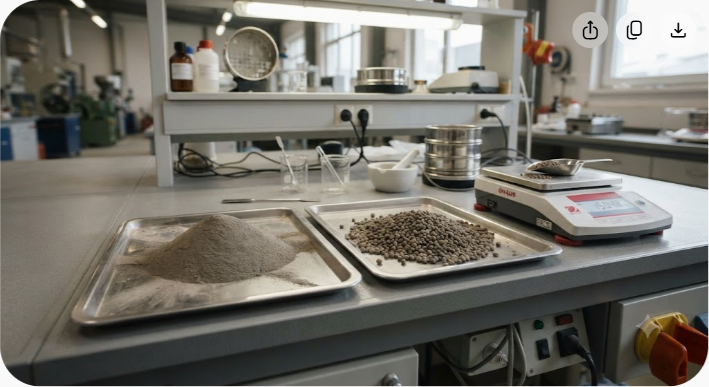
The choice between bentonite powder and bentonite granules is mainly a question of particle size, hydration behavior, handling, and the way the material needs to reach its working location. The two forms can come from the same sodium or calcium bentonite deposit, but they behave very differently once water, mixing energy, transport, or soil conditions enter the picture.
For drilling fluids, foundry binders, and other applications that need rapid dispersion and rheology, fine bentonite powder is generally the better fit. For active pond sealing, borehole sealing, and dry agricultural spreading, larger granules or pellets are usually easier to place because they generate less dust and can reach the target area before fully hydrating.
The important point is that particle size doesn't create a new mineral. Processing changes how quickly the clay interacts with water and how easily it can be handled. The grade, montmorillonite content, exchangeable cations, moisture content, and other quality parameters still determine the underlying performance.
| Application | Typical Preferred Form | Main Reason |
|---|---|---|
| Drilling mud and HDD | Fine powder | Disperses in water and develops viscosity efficiently under suitable mixing conditions. |
| Active pond sealing | Granules or pellets | Sinks through standing water and hydrates at the target surface. |
| Dry soil sealing | Powder or fine granules | Can be distributed and incorporated into soil before compaction. |
| Agricultural soil amendment | Granules | Easier to spread with conventional dry-application equipment and produces less dust. |
| Foundry sand binding | Fine powder | Disperses through the sand system and coats grains during mulling. |
| Borehole and well sealing | Pellets, chips, or granules | Can be placed at depth before substantial hydration occurs. |
| Iron ore pelletizing | Fine powder | Provides uniform binder distribution in the feed material. |
Bentonite is a clay dominated by the mineral montmorillonite, a member of the smectite group. Its layered structure allows water and exchangeable ions to interact with the clay surfaces. Sodium-rich bentonite generally has greater swelling potential than calcium-rich bentonite, although actual performance depends on mineralogy, grade, water chemistry, and processing.
That distinction matters when comparing powder with granules. Grinding or screening changes particle size, but it doesn't automatically change the mineral chemistry of the clay. A high-swelling sodium bentonite can be sold as powder, granules, or pellets, with each form intended for different handling and application conditions.
After mining, bentonite may be crushed, dried, milled, screened, classified, or agglomerated. The exact process depends on the intended end use. Milling creates finer particles for applications that require rapid dispersion. Screening produces controlled granular fractions. Compaction or extrusion can produce pellets with a defined size and shape for applications such as well sealing.
Particle size affects several practical characteristics:
There is no universal rule that one form is higher quality than the other. The right product is the one whose grade and physical form match the application.
Bentonite powder is produced by drying and grinding bentonite to a controlled particle-size distribution. Commercial grades may be supplied at different mesh sizes, depending on the industry and specification. A 200-mesh product, for example, is substantially finer than an 80-mesh product, while a 325-mesh material is finer still.
The mesh number should not be treated as a complete description of product quality. Two powders with similar particle sizes can perform differently because their montmorillonite content, mineral composition, exchangeable cations, moisture, and processing history differ. For technical applications, the supplier's certificate of analysis and the relevant industry specification are more useful than mesh size alone.
Fine bentonite exposes a large amount of clay surface to water. With appropriate mixing, water can contact the particles rapidly, allowing the clay to disperse and develop viscosity. In drilling fluids, this behavior is valuable because the clay needs to become part of the circulating fluid rather than remain as coarse sediment at the bottom of a mixing tank.
Hydration is not simply a matter of dumping powder into water. Water quality, temperature, mixing energy, addition rate, residence time, and the presence of other chemicals can all affect performance. Some bentonite grades also benefit from a hydration period before the fluid reaches its target rheology.
Adding dry powder too quickly can create a hydrated outer layer around partially wetted particles. This phenomenon is commonly called fish-eye formation. Once the outside becomes gelled, water has difficulty reaching the dry material trapped inside. Controlled addition and adequate shear help prevent the problem.
Drilling fluids and HDD: Sodium bentonite powder is widely used in water-based drilling fluids because properly prepared bentonite suspensions can provide viscosity, suspension capacity, and filtration control. The exact grade should be selected according to the drilling-fluid specification and formation conditions.
Foundry sand: Bentonite powder is used as a binder in green sand molding. During mulling, the clay interacts with water and sand to produce the bonding characteristics required to maintain mold shape. Foundry performance depends on more than mesh size; foundry-specific bentonite grades are formulated and tested for the required molding properties.
Iron ore pelletizing: Fine bentonite can act as a binder in the production of green iron ore pellets. Uniform dispersion is important because the binder must interact consistently with the concentrate during pellet formation.
Civil engineering slurries: Bentonite powder is used in applications such as slurry trenching, diaphragm wall construction, and certain tunneling operations. The selected grade must provide the required rheology and filtration characteristics under the project's soil and water conditions.
Selected industrial and environmental applications: Fine bentonite may also be used as an adsorbent, binder, rheology modifier, or sealing component. The appropriate grade depends on the contaminant, process chemistry, solids concentration, and required performance.
Granular bentonite consists of larger particles produced through screening, crushing, or agglomeration. Depending on the application, suppliers may offer different size ranges, including products described by mesh ranges such as 8 to 20 mesh or 12 to 40 mesh. Pellets and chips are also used when a particular placement behavior is required.
Granules are not simply powder with less surface area. Their larger size changes how water reaches the clay and how the material behaves during placement. A dry granule can travel through a water column before absorbing enough water to swell significantly. That property is useful when the material must reach the bottom of a pond or a specified depth in a borehole.
When a granular particle contacts water, the outer surface begins to hydrate first. The rate at which the interior hydrates depends on particle size, clay properties, water chemistry, temperature, and exposure conditions.
This slower response can be an advantage. In a water-filled pond or borehole, the goal isn't to create a thick slurry at the surface. The goal is to deliver the bentonite to the intended location first. Once the material reaches that location, hydration and swelling can create the sealing mass.
Granules are therefore useful when placement comes before hydration. Powder is generally preferable when dispersion and hydration need to happen quickly.
Pond and reservoir sealing: Granular sodium bentonite is commonly considered for applications where bentonite must be distributed over the bottom of a water-filled pond. Particle size, application rate, water depth, soil type, and leak conditions all matter, so the product should be selected according to the manufacturer's application guidance.
Agricultural soil conditioning: Granular bentonite can be mechanically spread and incorporated into soil. It is particularly useful where the objective is to increase the clay fraction and improve water-holding behavior in suitable sandy soils. Results depend strongly on soil texture, application rate, incorporation depth, irrigation, and rainfall.
Borehole and well sealing: Bentonite pellets, chips, and granular products are used for sealing wells and boreholes because they can be placed below the water level before substantial swelling occurs. Product selection should follow applicable well-construction or environmental requirements.
Geosynthetic clay liners: Bentonite granules are used in the manufacture of some geosynthetic clay liners. The bentonite is contained between geotextile layers and forms a low-permeability barrier when hydrated.
Absorbent products: Certain granular bentonite grades are used in absorbent products, including some cat litter formulations. These products are formulated for absorption and clumping rather than for industrial rheology or sealing, so they shouldn't be treated as interchangeable grades.
The simplest way to compare the two forms is to ask what the material needs to do before it hydrates.
| Performance Factor | Bentonite Powder | Bentonite Granules |
|---|---|---|
| Particle size | Fine, often specified by mesh | Coarse, often specified by mesh or pellet size |
| Initial water contact | Rapid | Gradual |
| Dispersion in a properly mixed fluid | Excellent for suitable grades | Limited without additional processing |
| Fluid viscosity development | Well suited | Generally poor compared with powder |
| Settling through standing water | Poor | Good |
| Dust potential | Higher | Lower |
| Dry broadcast application | Less convenient | More convenient |
| High-shear mixing requirement | Often required for efficient dispersion | Usually unnecessary for dry placement |
| Pond sealing in standing water | Generally unsuitable | Commonly preferred |
| Drilling mud preparation | Standard form for suitable grades | Generally unsuitable |
| Borehole sealing | Can hydrate too early | Pellets or granules are commonly preferred |
| Foundry binder applications | Commonly used | Generally unsuitable for direct binder use |
| Storage requirement | Keep dry and sealed | Keep dry and sealed |
Hydration rate is one of the biggest practical differences between powder and granules, but it should not be confused with total swelling capacity.
A fine particle can interact with water quickly because water has much greater access to its surface. A larger particle exposes less surface area relative to its mass, so water takes longer to penetrate toward the center. As a result, a granular product may eventually develop substantial swelling while still being slow to hydrate during the first stage of application.
That difference is useful in different situations.
For a drilling-fluid mixer, rapid hydration is normally desirable because the bentonite needs to become part of the circulating fluid. For a pond containing several feet of water, rapid hydration at the surface can be a disadvantage if the material never reaches the leaking soil. In that case, a properly sized granular product can be more practical.
Water chemistry also matters. Hard water, dissolved salts, and other ions can change the swelling and rheological behavior of bentonite. A product should therefore be evaluated using the actual process water whenever the application is sensitive to fluid performance.
Mesh size describes particle size, but it isn't a quality grade by itself. The higher the mesh number, the finer the material generally is. However, mesh specifications are based on particle-size distribution, and suppliers may report the percentage passing a particular sieve rather than describing every particle as exactly one size.
For example, a product marketed as 200 mesh doesn't mean every particle has a diameter of exactly 75 microns. It indicates that the material meets a specified screening or particle-size requirement. The precise test method and acceptance limit should be confirmed on the product specification sheet.
For buyers, the practical questions are:
Don't choose a product based on mesh size alone. Two products with similar particle sizes can behave differently in the field.
Agricultural applications usually favor granular products when the material needs to be broadcast across a field. Granules are easier to feed through spreaders and are less susceptible to wind loss than very fine powder.
The objective is usually to improve the physical behavior of soil rather than to create an immediate liquid slurry. Bentonite can increase the clay fraction of suitable sandy soils and improve water-holding characteristics, but it isn't a universal soil amendment. Heavy application to already clay-rich or poorly drained soil can create different problems from those encountered in sandy soil.
Application rates should therefore be based on soil testing, texture, the intended crop, irrigation conditions, and the product specification. A blanket rate such as a fixed number of tons per acre should not be treated as appropriate for every field.
A practical agricultural workflow is:
Pond sealing is one of the clearest examples of why powder and granules cannot simply be substituted for one another.
When the basin is empty, bentonite can be applied to prepared soil and incorporated before compaction. Depending on the sealing method, the material may be mixed into the soil or applied as part of a compacted bentonite-soil layer.
Fine powder can distribute effectively through soil when properly mixed, while granular material can also work when the application system provides sufficient distribution and incorporation. The correct rate depends on soil permeability, soil type, basin preparation, moisture content, and the chosen sealing method.
The important step is thorough mixing and compaction. Simply scattering bentonite over a dry basin without incorporating it into the specified soil layer is unlikely to provide the intended barrier.
A different approach is needed when water is already present. Fine powder can remain at or near the surface, disperse with wind and currents, or hydrate before reaching the pond bottom. A properly sized granular product is better suited to this type of placement because the particles can sink through the water column before swelling substantially.
The goal is not to make the bentonite disappear into the water. The goal is to place enough material across the leaking area so that hydration creates a continuous low-permeability layer at the soil-water interface.
Before buying, confirm the pond depth, approximate surface area, soil condition, water chemistry, suspected leak location, and recommended application method. These factors determine whether granular bentonite is appropriate and how much material may be required.
Drilling-fluid systems generally need a bentonite grade that can disperse in water and provide the required rheology and filtration properties. Fine powder is therefore the standard physical form for many water-based drilling applications.
The exact concentration shouldn't be copied from a generic guide. Different formations, water qualities, drilling methods, temperatures, and fluid programs require different treatments. In HDD, for example, the fluid program may need to balance viscosity, filtration control, cuttings transport, pumpability, and formation compatibility.
When purchasing drilling-grade bentonite, look beyond the words "high swelling." Ask for the applicable specification, rheological data, filtration performance, moisture content, particle-size distribution, and test method. If the material is intended to meet API requirements, confirm that the supplier provides the relevant documentation for the grade being offered.
Granules are generally a poor substitute for drilling powder because their larger particles don't disperse into the fluid as efficiently. Simply increasing the mixing time isn't always an adequate solution. If a process requires fine bentonite, the correct approach is to purchase the appropriate grade rather than trying to turn a granular sealing product into a drilling-fluid product on site.
Foundry systems require a bentonite grade that can develop the required bonding properties during mulling. Fine powder is commonly used because it can be distributed through the sand-water system and interact with individual sand grains.
The correct formulation depends on the foundry process, sand system, casting metal, equipment, moisture control, and required mold properties. Bentonite percentage should therefore be established through the foundry's process controls and testing rather than by copying a generic recipe.
Granular bentonite is not normally a direct substitute for a foundry-grade powder. Large particles are harder to distribute uniformly and can change the conditioning behavior of the sand system. Buyers should specify foundry-grade bentonite and review the supplier's technical data rather than choosing a product solely by mesh size.
Borehole sealing creates the opposite requirement from drilling-fluid preparation. The material often needs to travel down a narrow space before it hydrates significantly.
For this reason, bentonite pellets, chips, or appropriately sized granules are commonly used for well sealing and abandonment work. Their size allows controlled placement at depth, where they can hydrate and swell to form a seal.
Fine powder can hydrate prematurely when it contacts water near the top of a borehole. That can cause bridging, leaving voids below the swollen material. In a properly designed sealing procedure, the product size and placement method are chosen to reduce this risk.
Well construction and abandonment requirements can vary by jurisdiction and project type. Always follow the applicable regulatory and engineering requirements rather than relying on a generic product recommendation.
Fine bentonite powder isn't automatically the best choice just because it has a high swelling potential. If the material must cross a water column, its tendency to disperse and hydrate near the surface can work against the project.
Better approach: For active pond or reservoir applications, evaluate properly sized granules or pellets designed for wet placement. Confirm the application rate and method before spreading the product.
Granular bentonite and drilling-grade powder are manufactured for different physical behaviors. Larger particles don't provide the same rapid dispersion required in many drilling-fluid systems.
Better approach: Specify the drilling-fluid grade and relevant performance requirements before ordering. If the application calls for a fine powder, don't substitute a granular sealing product simply because the chemical name on the bag is the same.
A strong bentonite grade can behave differently in fresh, hard, or saline water. Calcium and magnesium ions can reduce the swelling and rheological response of sodium bentonite through ion exchange and changes in clay dispersion.
Better approach: Test the actual process water when water chemistry is likely to affect performance. Use the fluid-treatment program recommended for the specific bentonite grade rather than applying a universal chemical dosage without testing.
Fine powder can generate dust during bag opening, conveying, silo loading, and manual transfer. A site that isn't prepared for powder handling can end up with both a housekeeping problem and an occupational exposure concern.
Better approach: Use appropriate engineering controls such as enclosed transfer, local exhaust ventilation, dust collection, and controlled feeding. Follow the applicable workplace exposure requirements and the product's safety data sheet.
Bentonite is a mineral product, so it doesn't spoil in the same way as an organic material. Moisture is the bigger concern. Once dry bentonite begins to hydrate inside a bag or bulk container, it can cake and become difficult to feed or disperse.
A certificate of analysis should match the product specification and the intended application. Depending on the grade, buyers may need information such as:
A single swelling number doesn't tell the whole story. Ask the supplier to provide the test method, specification limits, and representative batch data for the grade you are buying.
Use bentonite powder when the material needs to disperse quickly and perform as part of a liquid or fine-solid mixture. Typical examples include drilling fluids, foundry sand systems, and iron ore pelletizing.
Use bentonite granules or pellets when the material needs to reach a location before it hydrates. Typical examples include wet pond sealing and borehole sealing. Granular products are also convenient for many dry agricultural applications because they can be spread with standard equipment and generate less dust than fine powder.
The decision can be reduced to five questions:
Bentonite powder and bentonite granules are not competing versions of the same product. They are physical forms designed to behave differently during handling and application.
Choose bentonite powder when you need rapid dispersion, fluid viscosity, fine-particle distribution, or efficient binding in a controlled mixing process.
Choose bentonite granules or pellets when you need lower dust, easy dry application, controlled hydration, or reliable placement through standing water or into a borehole.
The best purchase decision starts with the application, not the product name. Before placing a bulk order, define the required particle size, bentonite type, swelling or rheological target, water chemistry, packaging, and relevant testing standard. A reputable industrial bentonite supplier should be able to provide a technical data sheet, certificate of analysis, sample material, and guidance on the appropriate grade.
Axewelledge supplies bentonite in powder and granular forms for industrial, agricultural, civil engineering, and other applications. Buyers can work with the supplier to identify a suitable particle-size range and product specification for their intended use, then review samples and technical documentation before committing to a larger shipment.













Have questions about our products? We're here to help!