Axewelledge, a leading exporter from India, specializes in high-quality Bentonite. With a commitment to excellence, we supply premium Bentonite to the Middle East and Southeast Asia markets.


North Angle Complex, 304,
150 Feet Ring Rd, Opposite Ambedkar Nagar BRTS Stop,
Madhav Park, Punit Nagar,
Mavdi, Rajkot, Gujarat 360004
© Axewelledge 2026, All Rights Reserved.
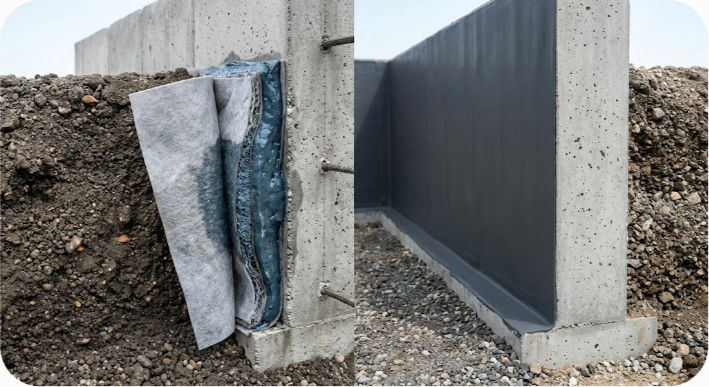
Water entering a building foundation exerts thousands of pounds of hydrostatic pressure per square foot, making below-grade waterproofing one of the most critical structural decisions in modern construction. If you are deciding between bentonite sheets and liquid coatings for a below-grade project, the quick answer comes down to site conditions: bentonite sheets excel in blindside applications, high hydrostatic pressure, and active water environments due to their self-healing nature, while liquid coatings provide a seamless, monolithic bond ideal for complex geometric footings, detailing penetrations, and positive-side installations with clear access.
Choosing the wrong membrane type leads to foundation leaks, costly structural remediation, and interior water damage. To make the right call, structural engineers, architects, and general contractors must look beyond raw material prices and evaluate soil chemistry, site geometry, water table fluctuations, and long-term durability.
Below-grade structures exist in a harsh subterranean environment. Foundations, basements, elevator pits, and utility tunnels face constant moisture migration from soil humidity, perched water tables, or heavy rain saturation. When water accumulates around a foundation, it exerts hydrostatic pressure—forcing liquid into microscopic cracks, cold joints, and porous concrete matrices.
Traditional dampproofing, such as thin asphaltic sprays, only resists vapor and capillary action. It cannot stop standing water under hydrostatic pressure. True below-grade waterproofing requires an impermeable physical barrier capable of bridging structural cracks, resisting subterranean chemical degradation, and remaining durable for the design life of the building.
Selecting a system requires assessing two key installation methodologies:
Bentonite waterproofing sheets—often referred to as Geosynthetic Clay Liners (GCLs) or bentonite geotextile composites—are engineered barriers that utilize high-swelling sodium bentonite clay. Sodium bentonite is a naturally occurring volcanic ash mineral rich in montmorillonite. When exposed to water, sodium bentonite absorbs up to 15 times its dry volume, expanding into a dense, gelatinous paste with extremely low hydraulic conductivity.
In sheet manufacturing, granular sodium bentonite clay is encapsulated between two geotextile fabric layers. Needling or stitch-bonding holds the clay in place, creating a uniform, flexible roll material that contractors unroll against soil, lagged walls, or concrete formwork.
When water encounters an installed bentonite sheet, the clay hydrates and swells. Because the sheet is confined between the solid concrete structure and the surrounding soil or retaining wall, the expanding clay cannot expand freely. Instead, it compresses into an impermeable, high-density hydraulic seal.
This swelling mechanism gives bentonite a unique technical advantage: self-healing capability. If a minor puncture or tear occurs during construction backfilling or structural settlement, adjacent hydrated bentonite expands into the void, resealing the breach automatically without manual intervention.
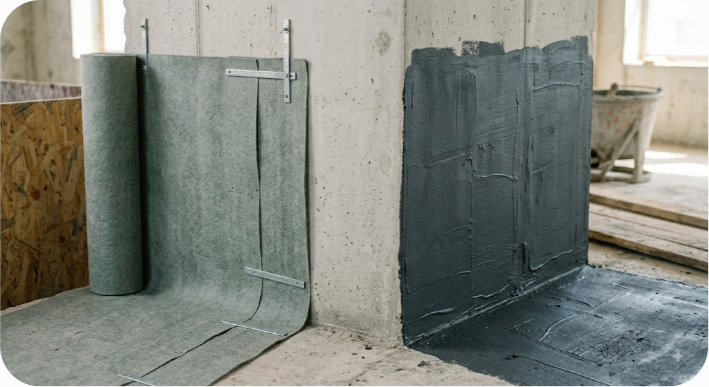
Liquid waterproofing coatings are fluid-applied materials that cure into a continuous, seamless, elastomeric rubber membrane across the foundation surface. Applied by spray, roller, squeegee, or trowel, liquid membranes adhere directly to cured concrete substrates.
Because they are applied in a liquid state, these coatings conform perfectly to irregular geometry, structural footings, tie-backs, pipe penetrations, and complex structural angles without seams or mechanical fasteners.
To help project managers and design teams select the correct technology, the table below compares core performance criteria for both systems:
| Performance Criteria | Bentonite Clay Sheets | Liquid-Applied Coatings |
|---|---|---|
| Primary Mechanism | Active swelling hydraulic seal | Passive elastomeric seamless barrier |
| Self-Healing Ability | Excellent (heals minor punctures) | None (punctures leak unless repaired) |
| Installation Conditions | Works on damp, uncured concrete | Requires dry, clean, cured concrete |
| Seamlessness | Seams require overlap & bentonite detail | 100% seamless and monolithic |
| Substrate Preparation | Minimal (tolerates rough surfaces) | Extensive (requires primer, repairs, drying) |
| Blindside Suitability | Outstanding (industry standard) | Poor to difficult |
| Complex Details & Pipes | Requires manual detailing paste | Excellent (conforms naturally) |
| Chemical Resistance | Sensitive to high salinity/solvents | High resistance to varied soil chemicals |
| Thickness Consistency | Factory-controlled uniform thickness | Variable (depends on applicator skill) |
| Weather Limitations | Must avoid pre-hydration before pour | Rain & frost interrupt curing process |
| Average Lifespan | Indefinite (natural mineral material) | 20 to 30+ years (synthetic polymer aging) |
Substrate preparation accounts for a large portion of waterproofing field labor. Liquid coatings require a clean, dry, structural surface free of dust, oil, honeycombing, or curing compounds. Concrete typically needs to cure for 7 to 28 days before liquid application to prevent moisture outgassing, which causes pinholes, blisters, and adhesion failure.
Bentonite sheets do not rely on chemical adhesion to cured concrete. They can be installed directly over freshly poured green concrete, damp surfaces, or compacted earth. On blindside applications against lagging or sheet piles, crews simply fasten the sheets mechanically, place rebar, and pour concrete directly against the fabric face. This saves weeks on tight construction schedules.
However, bentonite sheets require careful seam overlap management. Overlaps must measure at least 2 to 4 inches (50 to 100 mm) and incorporate bentonite detailing paste to prevent groundwater bypass.
Both systems can resist significant hydrostatic head pressure when installed correctly, but they perform differently under continuous water immersion.
Bentonite sheets thrive in high water tables. As hydrostatic pressure increases, it pushes the hydrated bentonite tighter against the structural concrete, reinforcing the seal. High-grade sodium bentonite membranes withstand hydrostatic heads exceeding 150 feet (45 meters) of water pressure.
Liquid coatings resist hydrostatic pressure through adhesion to the substrate. Under high positive-side water pressure, the liquid membrane is pushed into the wall, which helps performance. However, if groundwater finds an edge or a tiny pinhole, water can migrate behind an unbonded or poorly primed coating, making leak tracing difficult.
Concrete foundation walls move due to thermal expansion, ground settling, and concrete shrinkage. A reliable waterproofing system must bridge small structural cracks that develop over time.
Groundwater chemistry directly impacts bentonite performance. Standard high-yield sodium bentonite expands when exposed to fresh water. However, if groundwater contains high concentrations of calcium, salts, or industrial chemicals, cation exchange can occur. Calcium ions replace sodium ions in the clay matrix, converting sodium bentonite into calcium bentonite, which exhibits significantly lower swelling capacity.
For sites with brackish groundwater, coastal saltwater intrusion, or contaminated brownfields, engineers must select polymer-modified bentonite formulations designed to resist salt degradation.
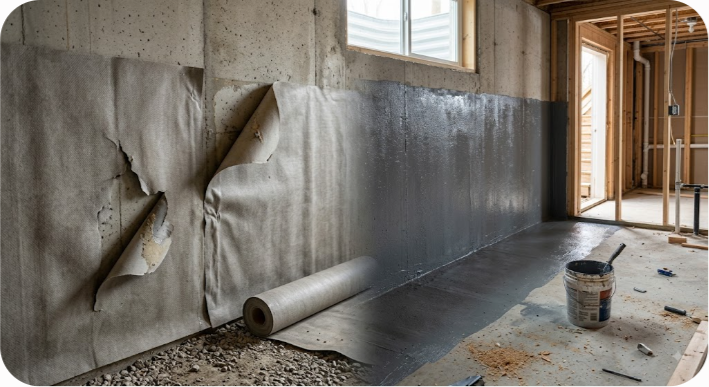
Liquid coatings, particularly high-grade polyurethane and polyurea systems, are chemically inert once cured. They resist acid-rich soils, industrial effluents, and high salinity without losing performance.
Site geometry dictates system choice:
Even high-quality waterproofing materials will fail if installed improperly. Here are frequent field errors observed with both systems:
Evaluating below-grade waterproofing solely on material cost per square foot is a costly mistake. The true cost includes surface preparation, labor rates, site scheduling impact, protection boards, and potential leak repairs.
Remediating a failed below-grade waterproofing system after a building is constructed can cost up to 10 to 20 times the original installation price due to excavation, interior injection, and business disruption. Investing in the correct system up front provides essential long-term protection.
Use this practical guide to choose the right system for your foundation project:
For projects utilizing bentonite sheet systems, performance relies heavily on the quality and purity of the raw sodium bentonite clay. High-purity sodium bentonite with a high swelling capacity and low filter loss ensures that the finished geotextile composite forms a low-permeability hydraulic barrier when hydrated.
As global mining leaders in sodium bentonite processing, suppliers like Axewelledge supply industrial-grade sodium bentonite reserves to geotextile and construction product manufacturers worldwide. High montmorillonite content and controlled particle size distribution give engineered GCL systems consistent expansion and dependable water-sealing performance under high hydrostatic pressure.
Choosing between bentonite sheets and liquid-applied coatings is not about finding a universally superior product; it is about matching material properties to site conditions. Bentonite sheets dominate blindside applications, damp substrates, and high water tables thanks to their self-healing natural clay core. Liquid coatings excel on open-cut, geometrically complex concrete surfaces where a continuous, bonded elastomeric film prevents lateral water movement.
By carefully analyzing water table levels, substrate curing schedules, installation access, and groundwater chemistry, project teams can specify a below-grade waterproofing system that keeps foundations dry and structurally sound for decades.













Have questions about our products? We're here to help!