Axewelledge, a leading exporter from India, specializes in high-quality Bentonite. With a commitment to excellence, we supply premium Bentonite to the Middle East and Southeast Asia markets.


North Angle Complex, 304,
150 Feet Ring Rd, Opposite Ambedkar Nagar BRTS Stop,
Madhav Park, Punit Nagar,
Mavdi, Rajkot, Gujarat 360004
© Axewelledge 2026, All Rights Reserved.
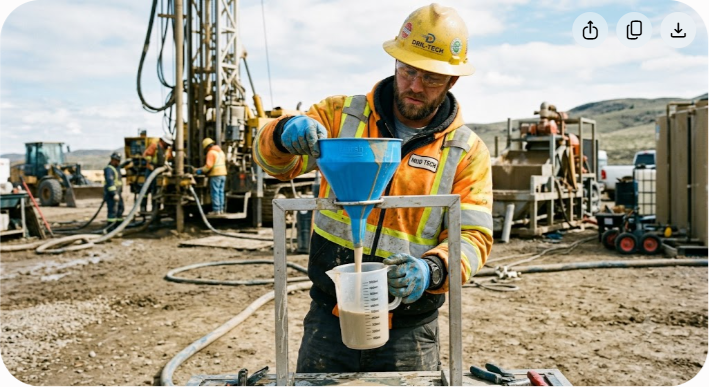
Measuring bentonite slurry viscosity with a Marsh Funnel takes exactly 26 seconds if your fluid is pure fresh water at 70 degrees Fahrenheit (21 degrees Celsius). When you run high-yield sodium bentonite through that same cone, that discharge time increases to anywhere from 35 to over 60 seconds per quart. That time difference, known as Marsh Funnel Viscosity or funnel seconds, is your first line of defense against stuck drill pipe, borehole collapse, and failed foundation shafts.
Testing bentonite fluid parameters on a job site does not require a thousand-dollar rotational viscometer. It requires a standardized plastic or metal cone, a graduated measuring cup, a stopwatch, and a disciplined technique. In this guide, you will master the exact step-by-step field protocol for testing bentonite viscosity using a Marsh Funnel, understand how to interpret the results, troubleshoot inaccurate readings, and maintain your testing kit to API standards.
Marsh Funnel Viscosity is an empirical measurement of fluid consistency. It measures the time in seconds required for a specific volume of liquid (1 quart or 946 milliliters) to flow vertically through a precision orifice at the bottom of a structured cone. Developed by H.N. Marsh in 1928, it remains the primary, industry-wide standard indicator of fluid thickness on civil construction sites, horizontal directional drilling (HDD) rigs, and oil and gas wells worldwide.
It is vital to understand what funnel viscosity is—and what it is not:
Sodium bentonite relies on montmorillonite clay platelets that swell up to 15 to 18 times their original dry volume when hydrated in clean water. These microscopic platelets align to form a complex three-dimensional house-of-cards gel structure. This structural network provides two critical operational properties: carrying capacity (lifting heavy soil cuttings out of the borehole) and fluid-loss control (building an impermeable filter cake along the borehole wall).
If your bentonite fluid viscosity drops too low, drill cuttings drop out of suspension, settling around your drill bit or reamer. This leads to stuck pipe, high rotational torque, and potential loss of the hole. Conversely, if your viscosity surges too high, fluid pumps work under extreme pressure, swabbing increases during trips, and filtration control degrades due to thick, spongy mud cakes.
To ensure consistent readings across global jobsites, the American Petroleum Institute (API RP 13B-1 for water-based fluids) strictly standardizes Marsh Funnel dimensions and receiving vessel specifications.
| Specification Component | Standard Imperial Units | Standard Metric Units | Key Operational Function |
|---|---|---|---|
| Funnel Top Opening | 6.0 inches diameter | 152 mm diameter | Provides wide entry for pouring bentonite slurry safely. |
| Funnel Total Cone Length | 12.0 inches | 305 mm | Creates consistent hydrostatic fluid head pressure. |
| Orifice Tube Length | 2.0 inches | 50.8 mm | Precision exit passage controlling laminar discharge stream. |
| Orifice Inside Diameter | 3/16 inch (0.1875 in) | 4.76 mm | Fixed aperture governing volumetric flow rate. |
| Screen Mesh Aperture | 10 mesh (0.063 in) | 1.6 mm | Catches oversized cuttings, gravel, and unhydrated clay lumps. |
| Receiving Cup Capacity | 1.0 quart (32 fl oz) | 946 mL (or 1000 mL mark) | Standard collection volume for timed viscosity test. |
Using non-standard cups or damaged funnels invalidates your field data. Always verify that your receiving cup features a clear 1-quart (946 mL) fill line.
Follow this standardized protocol to obtain repeatable, field-accurate Marsh Funnel viscosity readings on your job site.
Before pulling a fluid sample, ensure your Marsh Funnel, receiving cup, glass thermometer, and stopwatch are clean and free of dried bentonite crust or oil films. Rinse the inside cone with clean fresh water. Wetting the internal surfaces reduces surface tension drag during the test.

To confirm equipment accuracy, perform a fresh water check at least once per shift:
Never scoop mud from the surface of a quiet pit where solids have settled. Sample directly from the active mud line, discharge manifold, or return line after the shaker screens. Use a clean container to collect at least 1.5 quarts (1.5 liters) of fresh slurry. Record the sampling location and time on your daily mud report.
Insert a fluid thermometer directly into your fresh bentonite sample. Record the temperature in degrees Fahrenheit or Celsius. Viscosity varies directly with temperature—bentonite thins as temperature rises and thickens as it cools. Tracking temperature helps distinguish thermal thinning from chemical dilution.
Target funnel viscosity values vary based on geology, drilling depth, equipment type, and fluid system design. Below are standard target operational ranges used across civil and geotechnical engineering sectors.
The fluid is under-hydrated or diluted. Low viscosity reduces cutting suspension, leading to rapid solids drop-out, hole cleaning failures, and risk of severe fluid loss into porous soil formations. Action: Increase bentonite addition or add high-yield polymers to boost gel matrix structure.
Optimal working range for most mixed-soil drilling and piling operations. The bentonite slurry maintains strong cutting suspension capabilities while permitting efficient solids removal across shaker screens and desanders.
The fluid is overly thick. High viscosity causes extreme pump pressure, reduced penetration rates, sand retention inside mud tanks, and potential swabbing during pipe trips. Action: Dilute with clean fresh water or add thinners/dispersants. Check for reactive clay solids loading from the formation.
Even experienced technicians can generate invalid viscosity readings due to subtle procedural mistakes. Here are the five most frequent sources of field test errors and how to eliminate them.
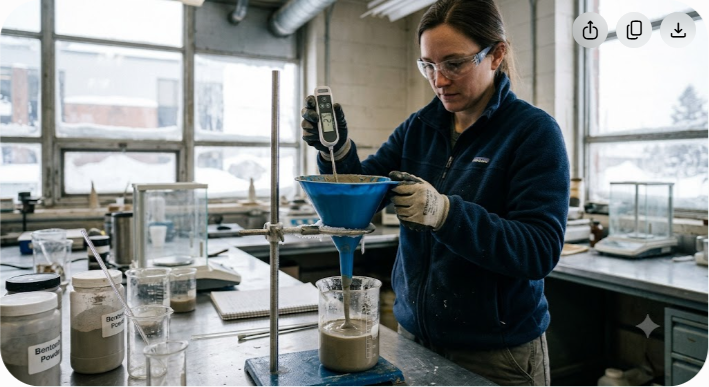
If tiny shale fragments or unhydrated clay balls slip past a damaged top screen, they partially obstruct the 3/16-inch exit tube. This artificially inflates discharge time, giving a false high viscosity reading. Solution: Inspect the internal screen daily for tears. If flow appears erratic or swirling stops, stop the test, clean the orifice, and re-test with a fresh sample.
Tilting the Marsh Funnel changes the fluid head pressure pushing slurry through the nozzle. Shaking the funnel introduces mechanical kinetic energy, temporarily thinning thixotropic bentonite gels and yielding artificially low times. Solution: Rest the funnel securely on a rigid stand or hold it completely stationary in a vertical plane throughout the discharge.
Using a bone-dry plastic funnel causes surface friction and fluid drag, adding 1 to 2 seconds to your total timing sequence. Solution: Pre-wet the internal surfaces of the funnel and measuring cup with clean water before every test run.
If you remove your finger from the orifice fractionally before starting your stopwatch, fluid starts flowing before timing begins, resulting in inaccurate low readings. Solution: Practice a synchronized two-hand release where your timing thumb triggers the stopwatch the exact millisecond your index finger clears the nozzle outlet.
Testing hot return mud (above 100 degrees Fahrenheit / 38 degrees Celsius) right next to cold makeup water produces wild variance in funnel seconds. Bentonite mud thins when hot and thickens when cold. Solution: Always measure and record temperature alongside funnel seconds. Normalize your readings when comparing fluid across shifts.
Field engineers frequently ask if Marsh Funnel seconds can be mathematically converted into absolute viscosity units like centipoise (cP) or millipascal-seconds (mPa·s).
Because bentonite is a non-Newtonian, shear-thinning fluid, there is no direct, single mathematical conversion between Marsh Funnel seconds and dynamic viscosity. The shear rate inside a draining Marsh Funnel continuously decreases as the fluid level drops from the top wire to the exit point.
However, for quick field estimates on standard water-based bentonite muds, empirical correlation models exist. One widely recognized approximation formula developed for low-solids bentonite systems is:
Example Calculation: If your bentonite slurry weighs 1.05 g/cm³ (8.75 lbs/gal) and yields a Marsh Funnel time of 42 seconds: Apparent Viscosity = 1.05 × (42 - 26) = 1.05 × 16 = 16.8 cP
Important Caution: Use this formula strictly for rough field context. For accurate yield point, plastic viscosity, and 10-second gel strength measurements required for complex deep drilling, always rely on a multi-speed rotational viscometer (such as a Fann Model 35).
Consistency maintains mud quality. Follow this recommended testing frequency based on project scale:
Even flawless Marsh Funnel testing technique cannot compensate for poor raw materials. Low-grade or improperly treated bentonite clay yields unstable fluid viscosity, requiring excessive chemical additives and frequent mud treatments to maintain acceptable suspension capacity.
High-yield API-grade Sodium Bentonite—sourced from rich natural montmorillonite deposits—delivers reliable, predictable viscosity performance. Top-tier bentonite swells rapidly in fresh water, producing clean filter cakes and predictable funnel times with minimal product mass per barrel of fluid.
For major infrastructure projects, deep well drilling, and foundation engineering, sourcing standardized high-swelling bentonite from established global producers like Axewelledge ensures uniform particle size, low grid sand content, and dependable rheological stability shift after shift.
Mastering Marsh Funnel testing provides rapid, reliable oversight of your bentonite fluid performance. By maintaining clean equipment, verifying calibration with a 26-second water test, and standardizing your timing methodology, you ensure your drilling fluid protects your borehole, reduces equipment wear, and keeps your project on schedule.













Have questions about our products? We're here to help!