Axewelledge, a leading exporter from India, specializes in high-quality Bentonite. With a commitment to excellence, we supply premium Bentonite to the Middle East and Southeast Asia markets.


North Angle Complex, 304,
150 Feet Ring Rd, Opposite Ambedkar Nagar BRTS Stop,
Madhav Park, Punit Nagar,
Mavdi, Rajkot, Gujarat 360004
© Axewelledge 2026, All Rights Reserved.
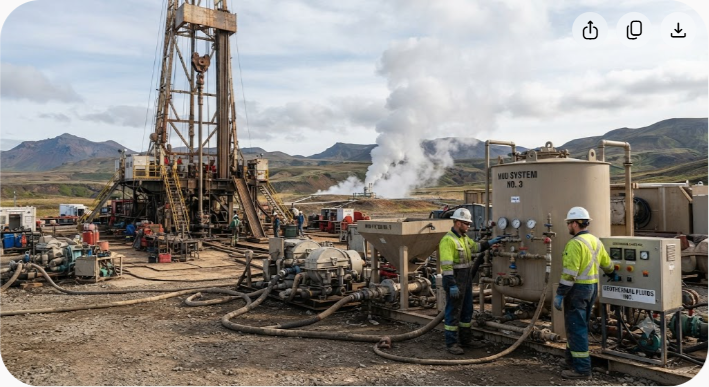
Bentonite has a useful role in geothermal projects because it can control drilling-fluid rheology, reduce fluid loss, support borehole walls, and create low-permeability seals. It is also used in selected grouting and abandonment applications, although the right formulation depends heavily on temperature, groundwater chemistry, borehole design, and the required service life.
That last point matters. Bentonite isn't a universal high-temperature material that can simply be added to every geothermal system. Standard sodium bentonite can lose desirable rheological properties as temperature rises, and bentonite-rich grout is not automatically the most thermally conductive grout. Good geothermal engineering starts with the actual downhole conditions and then selects the clay grade, concentration, additives, and placement method around them.
Bentonite is a clay-rich material dominated by smectite minerals, particularly montmorillonite. Its engineering value comes from the way those fine clay particles interact with water. Sodium-rich bentonite generally develops strong swelling, suspension, and gel-forming properties, while calcium-rich bentonite tends to swell less and behaves differently in aqueous systems.
Those properties make bentonite useful at several stages of geothermal development. During drilling, it can help transport cuttings and build a filter cake that limits fluid invasion into permeable formations. During well construction, bentonite-based materials can contribute to sealing and grouting systems. In some abandonment designs, bentonite can form part of a low-permeability plug or seal where regulations and well conditions permit its use.
Geothermal projects vary widely. A shallow closed-loop heat pump borehole has very different requirements from a deep production well drilled into a high-temperature reservoir. Enhanced geothermal systems introduce another set of challenges because drilling may encounter naturally fractured or intentionally stimulated rock. For that reason, bentonite selection should never be based on the product name alone.
The seven applications below cover the main ways bentonite is used in geothermal engineering and explain where its advantages end and other materials or additives become necessary.
Rotary drilling depends on a fluid system that can carry rock cuttings from the bottom of the borehole to the surface. Water can perform this function under some conditions, but its low viscosity makes it difficult to suspend cuttings when circulation slows or stops. Bentonite changes the fluid's rheology by creating a structured suspension.
A properly hydrated sodium bentonite slurry can provide viscosity and gel strength that help keep drilled solids suspended. That matters during connections, pump interruptions, and other periods when flow velocity falls. If cuttings settle rapidly, they can accumulate around the drill string, increase torque and drag, interfere with circulation, or contribute to stuck-pipe problems.
Bentonite drilling fluids can also provide a degree of lubrication and cooling for the drilling system. The actual performance depends on the complete mud formulation, water quality, solids loading, temperature, and additives rather than bentonite concentration alone.
The objective isn't simply to make the mud as thick as possible. Excessive viscosity can increase circulating pressure, reduce drilling efficiency, and make solids control more difficult. The drilling team has to balance viscosity, gel strength, filtration characteristics, density, pumpability, and borehole conditions.
Temperature is another important variable. Conventional bentonite systems can experience changes in viscosity and filtration behavior as downhole temperature increases. Deep geothermal wells may therefore require specially formulated drilling fluids, polymers, dispersants, or other additives alongside bentonite. In some high-temperature environments, alternative fluid systems may be more appropriate.
A practical geothermal mud program should define target properties before drilling begins and establish how those properties will be measured at the rig. Routine checks can then identify changes caused by temperature, formation water, drilled solids, or chemical contamination.
Unconsolidated sediments, weak formations, fractured rock, and reactive clays can make borehole stability difficult. The problem becomes more serious when drilling passes through several formations with different permeability and mechanical properties.
Bentonite helps by contributing both fluid pressure and filter-cake formation. When a bentonite drilling fluid contacts a permeable formation, fine clay particles can accumulate at the borehole wall and form a relatively low-permeability filter cake. This reduces filtrate invasion and helps maintain the pressure conditions established by the drilling fluid column.
The filter cake isn't a structural support wall in the conventional sense, and it shouldn't be described as one. Borehole stability comes from the interaction of hydrostatic pressure, formation strength, in-situ stresses, fluid chemistry, drilling parameters, and wellbore geometry. Bentonite supports that system rather than replacing proper geomechanical and drilling-fluid design.
A well-designed bentonite mud can be particularly useful when drilling through loose sands or other permeable intervals. The fluid's carrying capacity helps remove cuttings, while the filter cake can reduce uncontrolled filtrate invasion.
However, bentonite doesn't solve every instability mechanism. Naturally fractured rock, swelling formation clays, severe pressure differences, and mechanically weak formations may require changes to mud weight, chemistry, casing strategy, drilling rate, or circulation practices.
The useful question is therefore not whether bentonite will "keep the hole open" on its own. It is whether the selected drilling-fluid system provides the rheological and filtration properties required by the specific formation and operating conditions.
Fluid loss is one of the most important reasons bentonite is incorporated into drilling fluids. When liquid from the mud enters a permeable formation too quickly, the drilling system can lose volume and pressure while the formation receives unwanted filtrate and suspended solids.
The fine particles in hydrated bentonite can form a filter cake that restricts the movement of liquid through the formation face. This helps maintain fluid volume in the borehole and can reduce the rate at which filtrate enters permeable zones.
For geothermal wells, controlling fluid loss can also help protect formations that need to remain hydraulically accessible. Excessive invasion of solids or filtrate can complicate well cleanup and may interfere with the intended behavior of a productive interval. The severity depends on the reservoir, fluid chemistry, permeability, fracture network, and completion design.
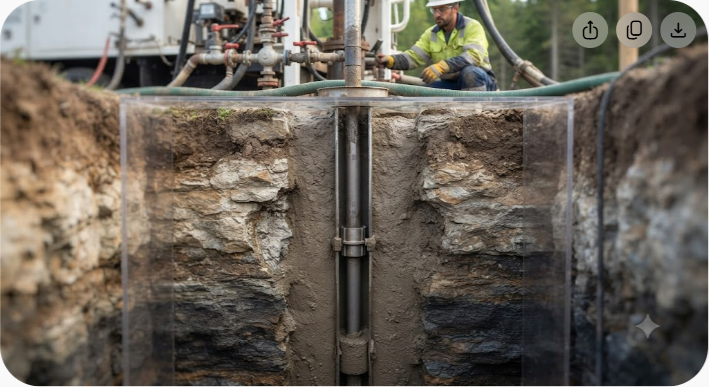
A good filtration-control system needs more than a high bentonite concentration. Operators should consider filtrate volume, filter-cake thickness and quality, low-shear rheology, solids content, temperature, and compatibility with formation water.
Water chemistry is particularly important. Calcium, magnesium, salinity, and other dissolved ions can alter clay behavior. Contaminated mixing water can therefore produce a very different mud from one prepared with suitable fresh water.
Where native bentonite performance isn't enough, drilling-fluid engineers may combine bentonite with polymers or other filtration-control additives. The formulation should be selected through laboratory testing and adjusted using field measurements rather than relying on a generic dosage.
Bentonite also appears in grout systems used around geothermal heat exchanger loops, particularly in shallow ground-source heat pump installations and some borehole heat exchanger designs. Here, however, an important distinction is often missed: bentonite itself isn't automatically a high-thermal-conductivity grout.
The purpose of the grout is to fill the annular space between the heat exchanger pipes and the borehole wall. A properly designed grout limits groundwater movement, supports the pipe assembly, and provides a continuous thermal pathway between the loop and surrounding ground.
Bentonite can contribute to low permeability and flexibility, but its thermal conductivity may be insufficient for a particular design if used without thermally conductive fillers. Formulators may therefore combine bentonite or cementitious binders with materials such as silica sand or other thermally conductive aggregates, depending on the application.
The right grout should be selected against the actual design requirements. Key considerations include thermal conductivity, hydraulic conductivity, shrinkage, setting behavior, pumpability, density, groundwater compatibility, and long-term mechanical performance.
For example, a shallow closed-loop installation may prioritize reliable annular filling and thermal performance at moderate temperatures. A deeper borehole heat exchanger may impose higher pressures and different temperature cycles. The same grout formulation shouldn't automatically be carried from one project to the other.
Bentonite can be valuable in a grout formulation, but engineers should test the complete mixture rather than assuming that adding more bentonite will improve heat transfer. Increasing clay content can increase water retention and reduce permeability while also changing the thermal properties and rheology of the grout.
Geothermal boreholes may cross groundwater-bearing formations before reaching the target interval. Proper annular sealing is therefore essential when the well design creates a pathway between formations that should remain hydraulically separated.
Sodium bentonite chips, pellets, granular bentonite, or bentonite-containing grouts can be used in suitable sealing applications. When hydrated, bentonite can swell and form a low-permeability barrier. Its ability to conform to irregular spaces makes it useful where a tight seal is required around casing or within a designated borehole interval.
The engineering objective is not simply to create an "impermeable" barrier. In practice, seal performance depends on hydration, placement, confinement, borehole geometry, material quality, temperature, groundwater chemistry, and the presence of preferential flow paths.
Pellets and chips can be useful where a dry granular seal is placed into a specified annular interval and then hydrated. Grouts may be preferred where the design calls for a pumped material that fills a more complex geometry.
Placement is critical. A high-quality bentonite product can still produce a poor seal if it segregates, hydrates prematurely, bridges above the intended interval, or fails to contact the surrounding formation adequately.
For projects that pass through protected aquifers, the sealing design should follow the applicable groundwater and well-construction requirements. Material selection, placement method, and verification should be documented as part of the well-construction plan.
Geothermal drilling can encounter fractured, cavernous, or highly permeable formations that absorb drilling fluid faster than the circulation system can replace it. This condition is known as lost circulation.
Losses can range from partial seepage to severe or total loss of circulation. The appropriate response depends on the size and nature of the loss zone, the drilling fluid, formation pressure, well depth, and the operational consequences of continuing to drill.
Bentonite can form part of a lost-circulation-material treatment because hydrated clay can contribute to plugging and sealing. In practice, however, severe losses are often addressed with blends containing different particle sizes and materials selected to bridge fractures or openings. Depending on the situation, granular materials, fibrous materials, flakes, cementitious systems, or specialist loss-control products may be used alongside or instead of bentonite.
A narrow seepage zone may respond to a relatively fine treatment, while a large fracture may require coarse bridging particles capable of forming a stable structure across the opening. Simply increasing bentonite concentration doesn't guarantee that a large loss zone will seal.
Treatment design should therefore consider the estimated fracture width, circulation-loss rate, pumping pressure, formation temperature, and compatibility with the drilling fluid. After treatment, the team should verify whether circulation has returned to an acceptable level before proceeding.
This is especially important in geothermal wells because fractured rock can be part of the intended reservoir. A treatment that stops losses during drilling may also affect the hydraulic behavior of a productive interval. The treatment objective must be defined before the material is pumped.
Geothermal wells eventually require abandonment, whether because a well has reached the end of its useful life, failed to meet its intended purpose, or is no longer economically viable. Abandonment aims to isolate formations, prevent unwanted fluid migration, and protect groundwater resources.
Bentonite can be used in some abandonment and sealing designs because hydrated bentonite provides low permeability and can accommodate limited deformation without behaving like a brittle solid. Depending on the well construction and local regulations, bentonite plugs, pellets, or bentonite-containing sealing materials may form part of the abandonment system.
The important qualification is that bentonite isn't automatically a permanent solution for every geothermal well. High temperatures, groundwater chemistry, confinement, cement interfaces, casing conditions, and regulatory requirements all influence whether it is appropriate.
A deep, high-temperature production well may require a carefully engineered combination of cement, mechanical barriers, and other sealing materials rather than a simple bentonite plug. The abandonment program should follow the governing well-construction and environmental regulations for the project location.
| Application | Main Function | What Bentonite Contributes | Key Design Consideration |
|---|---|---|---|
| Drilling fluids | Cuttings transport and rheology control | Suspension, viscosity, gel strength | Temperature, solids loading, water chemistry |
| Borehole stabilization | Filter-cake development and fluid support | Low-permeability filter cake | Formation permeability and mechanical stability |
| Fluid-loss control | Limit filtrate invasion | Fine-particle filtration barrier | Filtration rate, cake quality, formation sensitivity |
| Thermal grouting | Fill borehole annulus around loops | Low permeability and formulation flexibility | Thermal conductivity and shrinkage |
| Annular sealing | Isolate groundwater-bearing intervals | Swelling and low permeability | Hydration, confinement, placement quality |
| Lost circulation control | Reduce drilling-fluid losses | Sealing and plugging contribution | Fracture size and LCM blend design |
| Abandonment | Isolate subsurface formations | Low-permeability sealing component | Temperature, chemistry, regulations |
The right bentonite grade should be selected from the application backwards. Start with the required performance, then identify the material and formulation that can deliver it.
Record expected circulating, formation, and static temperatures rather than relying only on surface measurements. Temperature can change clay rheology, filtration behavior, polymer performance, and grout properties.
For deep geothermal drilling, laboratory testing at representative temperatures can reveal changes that aren't visible in a room-temperature mud test. A formulation that looks excellent at the mixing tank may behave differently after extended exposure downhole.
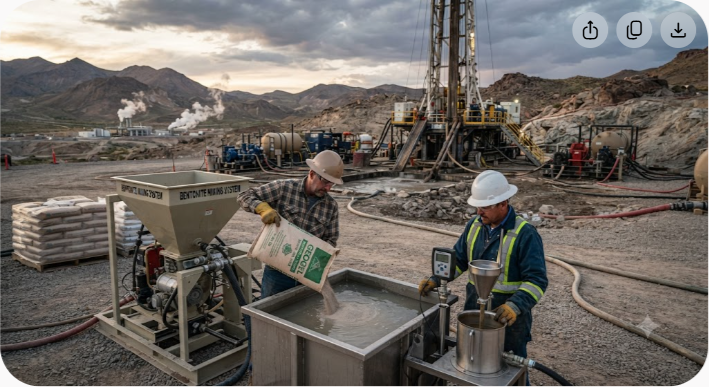
Mixing water and formation water can have a major effect on bentonite hydration. Hard water and dissolved salts can reduce swelling and alter rheological behavior. Calcium and magnesium ions are particularly relevant because they can affect the balance between dispersed and flocculated clay particles.
Test the actual water source when possible. If the project will encounter highly mineralized formation water, include that chemistry in formulation and compatibility testing.
Drilling fluid, annular seal, thermal grout, and lost-circulation treatment are different jobs. A powder designed for drilling-fluid rheology isn't necessarily the best product for a pelletized annular seal, and a high-swelling sealing bentonite isn't automatically the right ingredient for a thermally enhanced grout.
Specify material properties that can be measured and verified. Depending on the application, those may include moisture, particle-size distribution, swelling behavior, rheology, filtrate loss, gel strength, density, thermal conductivity, or hydraulic conductivity.
Geothermal systems frequently contain more than bentonite. Drilling fluids may include polymers, lubricants, weighting materials, dispersants, and filtration-control additives. Grouts may contain cement, silica sand, thermally conductive fillers, retarders, or other admixtures.
Compatibility testing helps prevent unexpected flocculation, excessive viscosity, settling, poor pumpability, or loss of thermal performance.
A specification sheet for the raw bentonite is only the starting point. For critical applications, test the finished mud, grout, or seal under conditions that resemble field operation.
For drilling fluids, useful measurements can include viscosity, gel strength, filtration behavior, density, and solids content. For thermal grout, thermal conductivity, hydraulic conductivity, shrinkage, and pumpability may be more important. For a sealing material, swelling, permeability, hydration behavior, and placement performance deserve attention.
Bentonite performance depends as much on handling as on mineral quality. Poor hydration can leave dry clusters inside an otherwise apparently mixed slurry, producing inconsistent rheology and reducing the material's effective performance.
Not every geothermal project operates at the same temperature or depth. A shallow ground-source heat pump borehole, a conventional hydrothermal well, and an enhanced geothermal system can require very different materials and operating procedures.
Start with the actual design envelope instead of selecting a product from the word "geothermal" alone.
Sodium bentonite generally offers strong swelling and suspension properties, but that doesn't mean it remains unchanged at every geothermal temperature. Heat can alter rheology, filtration behavior, and additive performance.
For demanding wells, test the complete fluid system under representative thermal conditions.
Bentonite can improve sealing and flexibility, but adding more clay doesn't necessarily improve heat transfer. In a closed-loop system, grout thermal conductivity is a central design parameter.
Measure the finished grout and compare it with the project's thermal requirements.
Large fractures and cavernous formations can require engineered bridging systems. A fine clay slurry may not provide the particle-size distribution needed to form a stable plug across a large opening.
Select lost-circulation materials based on the loss mechanism and estimated opening size.
A certificate of analysis is useful, but it doesn't reproduce the project's water chemistry, temperature, formation conditions, or additive package. Critical geothermal applications deserve application-specific testing before bulk deployment.
The same mineral can serve very different purposes depending on the geothermal technology.
| Project Type | Typical Bentonite Role | Main Performance Focus |
|---|---|---|
| Conventional hydrothermal well | Drilling-fluid component, filtration control, selected sealing applications | Rheology, filtration, temperature tolerance |
| Enhanced geothermal system | Drilling-fluid and selected loss-control or sealing applications | Formation interaction, circulation losses, temperature, chemistry |
| Shallow closed-loop system | Grout or sealing-system component | Thermal conductivity, permeability, shrinkage |
| Deep borehole heat exchanger | Drilling fluid and potentially grout or sealing material | Temperature, pumpability, thermal performance |
| Well abandonment | Plug or sealing-system component where permitted | Isolation, permeability, long-term compatibility |
This distinction helps prevent a common procurement mistake: specifying "geothermal bentonite" without identifying what the material actually needs to do.
Bentonite is valuable in geothermal engineering because its interaction with water produces properties that are useful for drilling, filtration control, sealing, and selected grouting applications. Its role is substantial, but it isn't a universal solution.
For drilling, focus on rheology, gel strength, filtration, solids control, temperature, and water chemistry. For annular seals, focus on swelling, hydration, confinement, placement, and hydraulic isolation. For thermal grout, evaluate the complete grout's thermal and hydraulic properties rather than the bentonite content alone. For lost circulation, select a treatment according to the size and character of the loss zone.
The best procurement specification is therefore performance-based. Define the application, operating temperature, water chemistry, required test properties, packaging, quantity, and quality-control requirements before choosing a mineral supplier.
Large geothermal projects also place practical demands on mineral supply. Consistent particle size, moisture, swelling behavior, packaging, batch traceability, and delivery schedules can matter just as much as the headline mineral specification.
A supplier should be able to provide a clear technical data sheet, relevant test results, consistent batch quality, and guidance on handling and storage. For demanding applications, buyers should also confirm that the supplied material matches the grade used during laboratory qualification.
Axewelledge can be considered as an industrial bentonite supply option for projects requiring sodium bentonite and related mineral products. Its suitability for a specific geothermal application should be assessed against the project's technical specification, temperature range, water chemistry, testing requirements, and applicable standards.
Bentonite supports geothermal engineering in seven main areas: drilling-fluid rheology, borehole stabilization, fluid-loss control, thermal grouting, annular sealing, lost-circulation treatment, and selected well-abandonment systems.
The material works because of its fine smectite structure and its interaction with water, but performance changes with temperature, chemistry, concentration, and formulation. That is why the right approach is not to ask whether bentonite is suitable for geothermal energy in general. The better question is which bentonite grade and formulation can meet the measured requirements of a particular geothermal application.
When those requirements are defined clearly and verified through representative testing, bentonite can be a reliable part of a well-designed geothermal drilling, sealing, grouting, or environmental protection system.













Have questions about our products? We're here to help!