Axewelledge, a leading exporter from India, specializes in high-quality Bentonite. With a commitment to excellence, we supply premium Bentonite to the Middle East and Southeast Asia markets.


North Angle Complex, 304,
150 Feet Ring Rd, Opposite Ambedkar Nagar BRTS Stop,
Madhav Park, Punit Nagar,
Mavdi, Rajkot, Gujarat 360004
© Axewelledge 2026, All Rights Reserved.
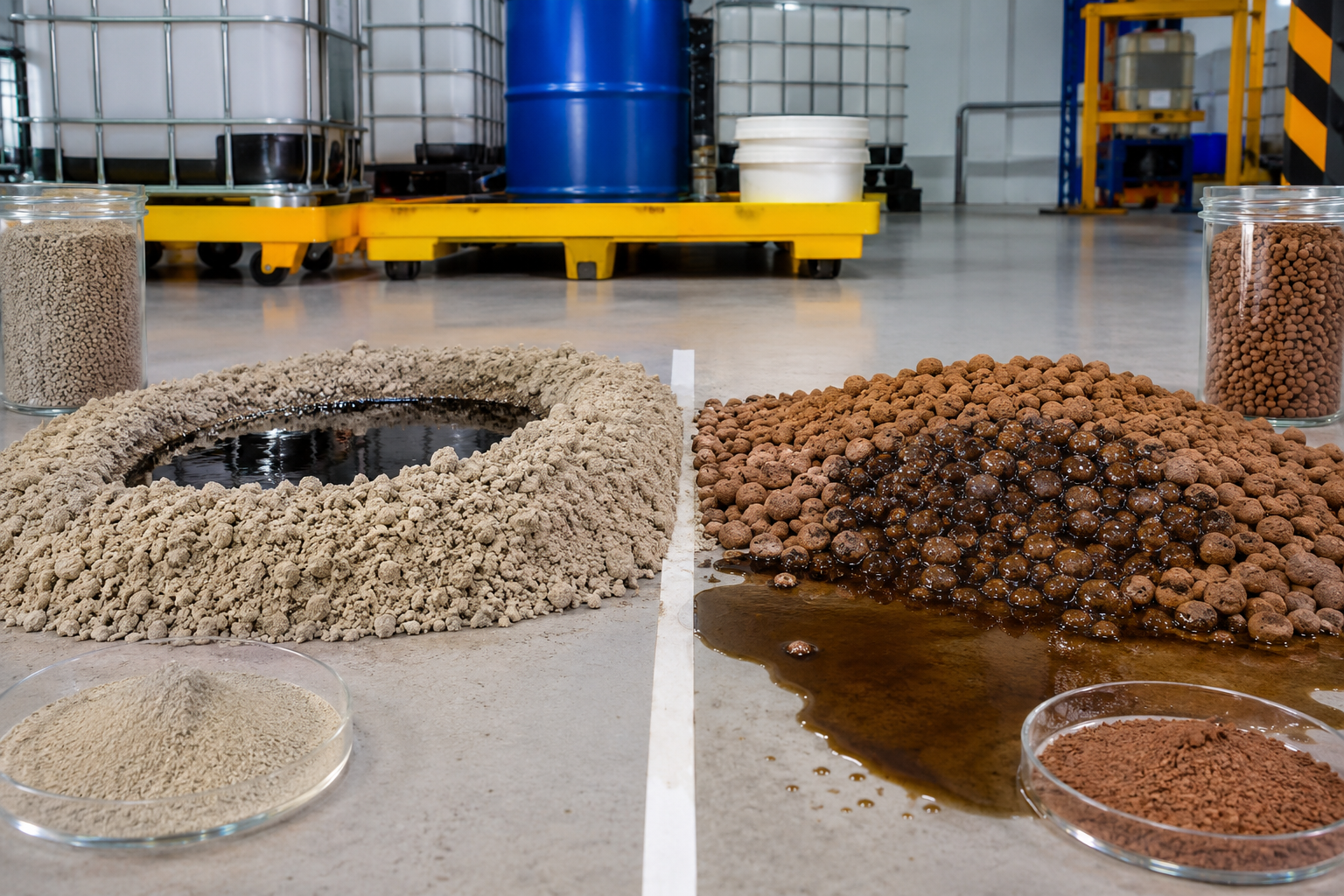
Standard attapulgite or montmorillonite floor sweep clay absorbs oil through simple capillary action, holding roughly 0.8 to 1.2 times its dry weight in liquid. Sodium bentonite expands up to 15 to 18 times its dry volume upon hydration, creating an impermeable, high-density gel barrier that seals leaks, encapsulates hazardous hydrocarbons, and prevents fluid leaching under compaction.
For basic non-hazardous workshop drips, traditional calcined clay absorbents offer a low initial purchase cost. However, for containment of hazardous oil spills, land-based pipeline ruptures, chemical holding pond leaks, and secondary containment seals, sodium bentonite provides superior structural containment, zero-leach encapsulation, and lower total disposal mass.
To choose the right absorbent for hazardous containment, environmental engineers and EHS (Environment, Health, and Safety) managers must evaluate mineral structure at the molecular level. Not all natural clay absorbents perform identically under chemical stress.
Traditional industrial floor sweeps rely on calcined clays such as attapulgite, sepiolite, or calcium-rich montmorillonite. These minerals are heat-treated (calcined) at temperatures between 400°C and 700°C to drive off bound water and harden the mineral granules.
Sodium bentonite is an aluminum silicate clay composed primarily of active sodium montmorillonite. Its crystalline structure consists of two tetrahedral silica sheets sandwiching a central aluminum octahedral sheet (a 2:1 layer structure).
Evaluating absorbents for industrial oil spill response requires looking beyond the price per bag. The table below compares the physical and chemical performance metrics of sodium bentonite against traditional calcined clay absorbents.
| Performance Parameter | Sodium Bentonite Absorbent | Calcined Clay (Attapulgite/Sepiolite) |
|---|---|---|
| Primary Mechanism | Crystalline swelling, hydration gelation, & matrix encapsulation | Capillary action into porous mineral granules |
| Swelling Capacity | 1500% – 1800% volume expansion (15x–18x dry volume) | 0% (Inert, rigid granular structure) |
| Liquid Retention Under Pressure | High; forms a flexible gel that resists mechanical squeezing | Low; liquid leaches out when compacted or compressed |
| Hydraulic Conductivity (Permeability) | Extremely low (1×10?? to 1×10?¹? cm/s) | Moderate to high (1×10?³ to 1×10?? cm/s) |
| Dusting & Friability | Low (When processed into uniform granules) | High; prone to crushing into respirable silica dust |
| Application Focus | Heavy oil seals, barrier dikes, ground migration control, hazardous waste stabilization | Light floor drips, minor surface maintenance, indoor shop spills |
Standard calcined clay absorbents require a 1:1 weight ratio for effective oil cleanup. Cleaning up a 50-gallon (approx. 190-liter) spill of light crude or hydraulic oil requires roughly 400 lbs (180 kg) of calcined clay granules.
In contrast, high-purity sodium bentonite—especially when modified with quaternary ammonium compounds into organophilic bentonite—interacts directly with non-polar hydrocarbons. Modified organophilic bentonites attract and bind organic oils, synthetic lubricants, and aromatic fuels, achieving high liquid retention with up to 40% less total sorbent mass compared to untreated porous clays.
When handling hazardous liquids (such as heavy transformer oils, PCB-contaminated fluids, or aromatic hydrocarbons), preventing liquid release during transport and landfill placement is mandatory under environmental regulations.
Under EPA Toxicity Characteristic Leaching Procedure (TCLP) testing (Method 1311) and Paint Filter Liquids Test (Method 9095B):
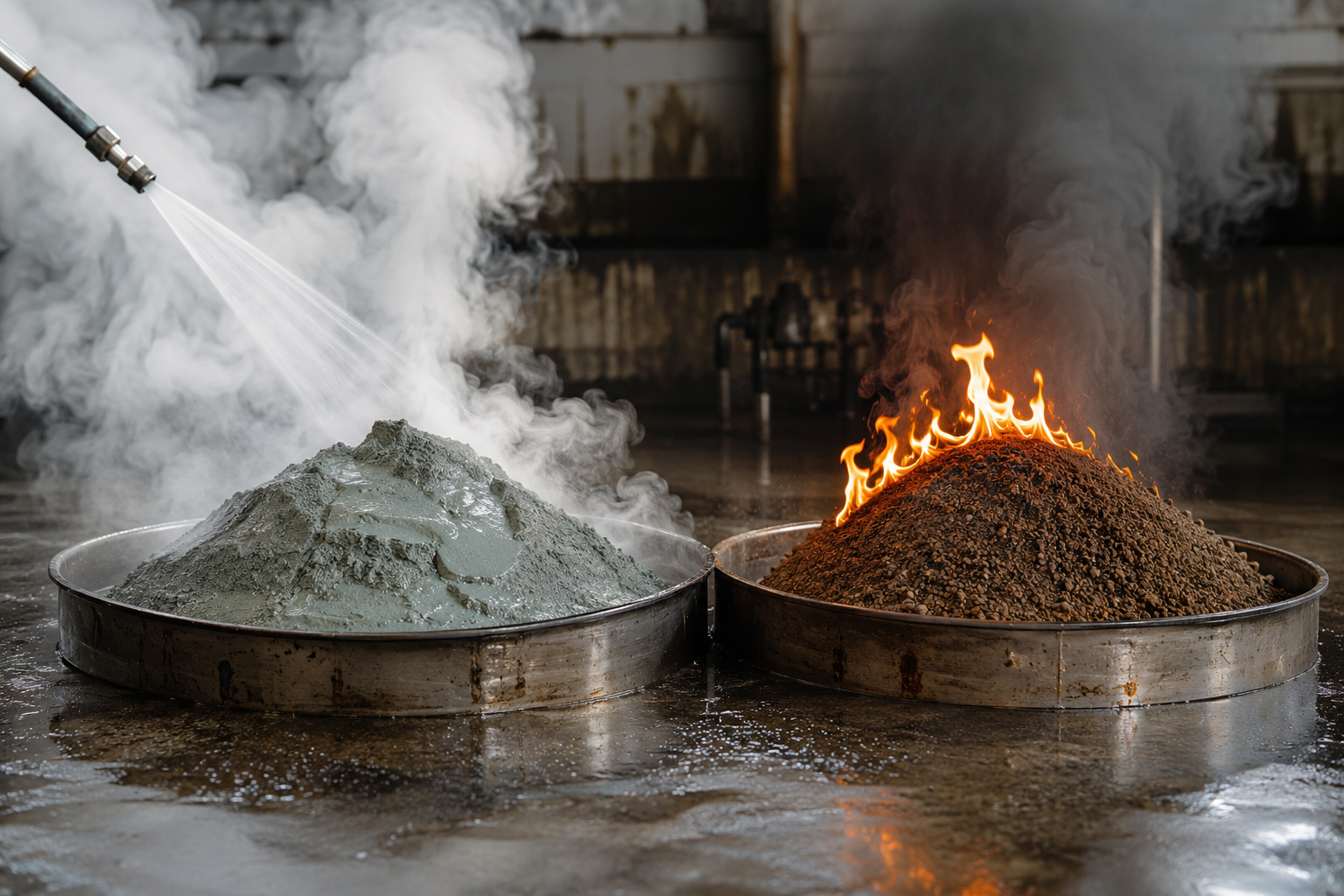
Spills of light crude, benzene, or volatile fuels present immediate vapor and fire risks to emergency response teams.
Granular calcined clay leaves substantial void space between particles, allowing volatile gases to off-gas into the surrounding air. Sodium bentonite forms a continuous, thick slurry or blanket when applied over liquid pools, sealing the liquid surface. This barrier reduces VOC evaporation rates by up to 85% compared to open air or porous granular applications, reducing flammability hazards and worker exposure levels.
When a pipeline fitting breaks on open soil or an unpaved tank farm pad, hazardous liquids sink directly toward underground aquifers.
Applying granular clay to unpaved ground absorbs surface ponding but does nothing to block downward migration. Applying sodium bentonite creates an immediate swelling seal at the soil interface. As moisture or polar liquid triggers swelling, bentonite fills soil pore channels, lowering soil hydraulic conductivity to under 1×10?? cm/sec. This halts vertical migration and contains the plume near the surface for mechanical excavation.
Calcined clay granules crush under heavy machinery, forklift tires, and boot traffic. This crushing action breaks down the granules into fine respirable crystalline silica dust, creating respiratory hazards (violating OSHA PEL limits) and returning trapped oil back onto the plant floor as a greasy sludge.
High-grade sodium bentonite processed into stable, dust-suppressed granules resists mechanical breakdown under moderate loads. Once hydrated or mixed with heavy oil fractions, it converts into a cohesive, non-abrasive paste that scoops cleanly without leaving slippery, abrasive mineral dust across concrete surfaces.
Bentonite is chemically inert, non-combustible, and retains structural stability at elevated temperatures. When applied to hot oil leaks or thermal fluids (up to 400°C / 750°F), bentonite will not ignite, melt, or release toxic combustion gases. Its natural inorganic composition acts as a thermal blanket, smothering flame ignition points on hot equipment manifolds.
Raw, untreated sodium bentonite is naturally hydrophilic (water-attracting). While raw sodium bentonite works exceptionally well for aqueous hazardous spills, water-based emulsions, and ground-sealing barriers, its swelling rate drops when exposed directly to pure, non-polar hydrocarbons like mineral spirits, diesel fuel, or refined synthetic oils.
To overcome this physical limit in dedicated hydrocarbon spill management, chemical processing plants utilize Organophilic Bentonite (organoclay).
For chemical plants, refineries, offshore platforms, and hazardous waste remediation teams, organophilic bentonite provides rapid gelation for pure organic solvent spills where standard clays fail to retain fluid.
When a hazardous oil leak occurs on an industrial site or unpaved roadway, proper deployment determines whether the spill is contained or becomes an environmental liability. Follow this step-by-step containment protocol.
Do not throw mineral absorbents directly into the middle of a moving fuel pool. First, establish a perimeter containment berm 3 to 5 feet (1 to 1.5 meters) ahead of the advancing liquid front.
Once the flow is contained, cover the main liquid pool with a continuous layer of granular absorbent.
Unlike powdery calcined clay that turns into slippery mud, hydrated or oil-saturated bentonite aggregates into a firm, manageable paste.
Prepare the collected waste for transport and landfill disposal in compliance with EPA land disposal restrictions (LDRs).
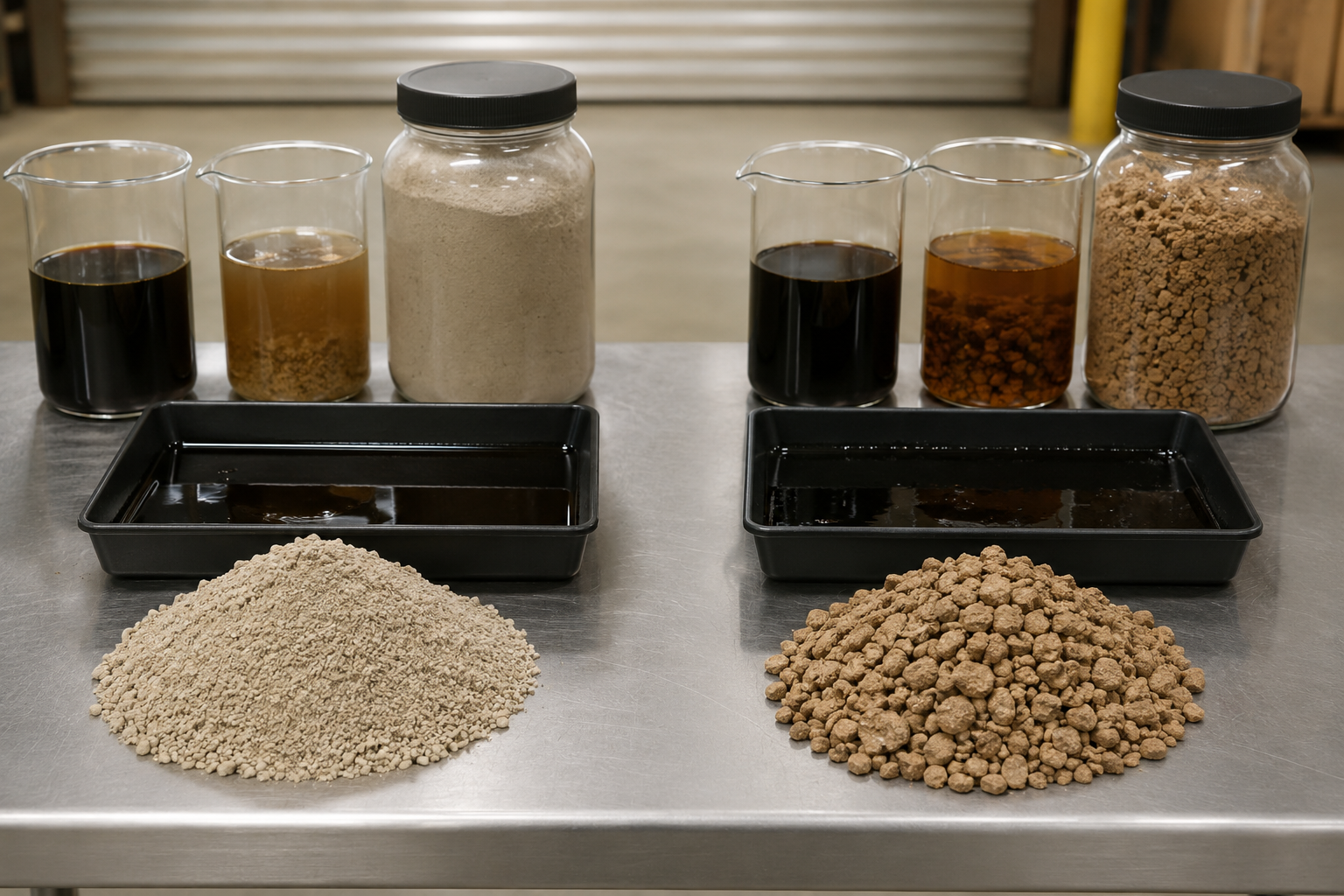
Purchasing department decision-makers often look solely at the purchase price per 50 lb bag. However, industrial environmental managers evaluate the Total Cost per Spill Cleaned, which includes procurement, freight, storage, labor, and hazardous waste disposal fees.
While calcined attapulgite clay may cost 20% to 30% less per bag upfront compared to specialized bentonite products, its lower absorption ratio and heavy mass create compounding expenses:
Consider a 100-gallon (approx. 380-liter) industrial oil spill:
Using the correct mineral absorbent is a key compliance factor during site inspections by regulatory agencies like the US EPA, OSHA, and global environmental authorities.
EPA Spill Prevention, Control, and Countermeasure (SPCC) rules require facility owners to maintain adequate containment systems that prevent oil from reaching navigable waters or soil.
Bentonite's ability to achieve hydraulic conductivity below 1×10?? cm/sec makes it an approved mineral liner and temporary dike medium for secondary containment systems around chemical storage tanks.
Calcined clays often contain high fractions of free crystalline silica. Crushing calcined granules underfoot releases airborne dust above the OSHA Permissible Exposure Limit (PEL) of 50 µg/m³ over an 8-hour time-weighted average.
High-grade, wet-processed sodium bentonite features significantly lower free quartz fractions and superior granular structural integrity, minimizing airborne particulate hazards during deployment in enclosed plant spaces.
To dispose of oil-contaminated sorbents in non-hazardous or class-specific landfills, the waste material must pass the EPA Method 9095B (Paint Filter Liquids Test). If liquid drips through a standard paint filter mesh after 5 minutes under gravity, the waste cannot be landfilled as solid waste. Bentonite gelation binds liquids tightly, ensuring consistent compliance with Paint Filter test requirements.
To optimize safety and procurement budgets across your facility, deploy each absorbent type based on the specific operational environment.
| Facility Location / Surface | Spill Type / Hazard Level | Recommended Absorbent Mineral |
|---|---|---|
| Indoor Concrete Floor | Minor maintenance drips, light oil | Calcined Clay Absorbent |
| Machinery Maintenance Bays | Small non-hazardous hydraulic leaks | Calcined Clay Absorbent |
| Chemical / Fuel Storage Pad | Hazardous fuel, crude, solvent spill | Organophilic Bentonite |
| Unpaved Roadways & Open Soil | Hydrocarbon leaks threatening soil | Sodium Bentonite / Organoclay |
| Wastewater / Leachate Ponds | Emulsified hydrocarbon runoff | Sodium Bentonite |
Selecting the right mineral absorbent requires access to consistent, high-purity reserves and precise processing technology. As a global exporter and one of the world's leading producers of premium bentonite, Axewelledge delivers high-capacity mineral absorbents tailored for rigorous industrial containment requirements.
With over 60 million tons of high-grade natural reserves and advanced processing plants, Axewelledge supplies sodium bentonite featuring exceptional swelling power, low hydraulic conductivity, and reliable grain-size distribution. Whether you require bulk sodium bentonite for soil sealing and secondary containment or refined mineral bases for chemical processing, Axewelledge ensures consistent international quality standards, dependable supply chains, and export expertise across global markets.
Before selecting your next shipment of industrial absorbents, keep these primary selection criteria in mind:













Have questions about our products? We're here to help!