Axewelledge, a leading exporter from India, specializes in high-quality Bentonite. With a commitment to excellence, we supply premium Bentonite to the Middle East and Southeast Asia markets.


North Angle Complex, 304,
150 Feet Ring Rd, Opposite Ambedkar Nagar BRTS Stop,
Madhav Park, Punit Nagar,
Mavdi, Rajkot, Gujarat 360004
© Axewelledge 2026, All Rights Reserved.
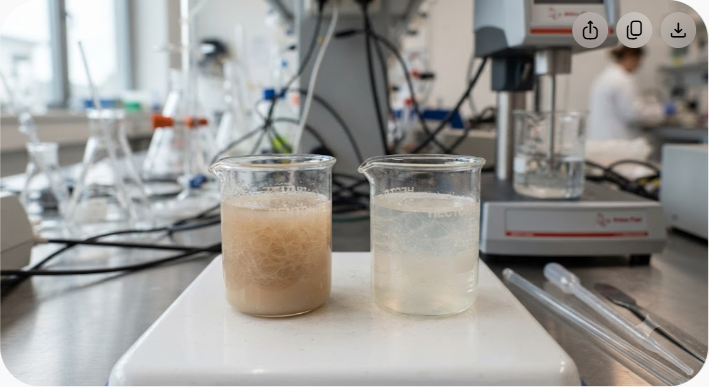
Bentonite and hectorite are both smectite clays, but they are not interchangeable rheology modifiers. The practical choice depends on the continuous phase, required viscosity profile, optical appearance, electrolyte environment, processing method, and raw-material budget.
For water-based industrial systems, sodium bentonite is often the practical starting point when strong hydration, suspension, gel strength, and economical bulk performance matter. Refined or synthetic hectorite becomes more relevant when very fine particle size, high purity, low optical haze, smooth texture, or specialty rheology is a priority. Neither clay is universally better. The grade and formulation matter as much as the mineral name.
That distinction is important because rheology isn't simply about making a liquid thicker. A useful rheology modifier must give the product the right behavior at rest and under shear. A coating may need to resist sagging on a vertical surface but flow easily under a brush or spray. A drilling fluid must suspend solids while circulating and then rebuild structure when circulation stops. A cosmetic gel may need viscosity without losing clarity or developing a gritty feel.
This guide compares bentonite and hectorite from those practical angles, including swelling, gel strength, thixotropy, clarity, electrolyte sensitivity, cost, processing, applications, testing, and common formulation mistakes.
Rheology describes how a material flows and deforms when force is applied. In industrial formulation, rheology control is about deliberately shaping that behavior so a product can be manufactured, stored, transported, and used without unwanted separation or application problems.
A rheology modifier can affect several properties at once:
Smectite clays are useful because their thin plate-like particles can form structured networks in suitable liquids. The exact mechanism depends on mineralogy, particle size, surface chemistry, concentration, electrolyte content, pH, dispersion quality, and the surrounding formulation.
The familiar description of a clay forming a "house-of-cards" structure is useful, but it should not be treated as a complete explanation of every smectite system. Platelet interactions can include electrostatic attraction and repulsion, edge-face association, face-face interactions, and changes caused by ions in the continuous phase. The resulting network determines how much structure the formulation develops at rest and how readily that structure breaks down under shear.
This is why two clays can produce similar viscosity readings at one test speed while behaving very differently during pumping, brushing, spraying, filling, or storage.
Bentonite is a clay material dominated by smectite minerals, most commonly montmorillonite. Many commercial bentonites originate from the alteration of volcanic ash or related volcanic materials. Their performance varies substantially with deposit geology, mineral composition, exchangeable cations, processing, particle size, and treatment.
The two broad commercial categories encountered most often are sodium bentonite and calcium bentonite. Sodium-dominant bentonite generally has greater water swelling and can produce stronger hydrated gels than untreated calcium-dominant material. Calcium bentonite can also be modified or activated for particular applications, so the simple labels should not be treated as a substitute for product specifications.
At the crystal level, montmorillonite is a dioctahedral 2:1 phyllosilicate. A layer containing an octahedral sheet is positioned between two tetrahedral silica sheets. Isomorphic substitution within the crystal creates a net negative layer charge, which is balanced by exchangeable cations between the layers.
When a suitable sodium bentonite is dispersed in water, hydration and interlayer expansion allow the particles to develop a colloidal suspension. Under appropriate conditions, that suspension can provide substantial viscosity, yield stress, suspension capacity, and filtration control.
Sodium bentonite is particularly useful where the formulation needs a strong water-based structure at relatively practical solids concentrations. This is one reason it is widely used in drilling fluids, civil engineering slurries, geosynthetic clay liners, foundry applications, and other systems where suspension and water interaction are central to performance.
Its main advantages for rheology-related applications include:
There is an important qualification: not every bentonite grade produces the same viscosity. A deposit with high montmorillonite content, favorable exchangeable cations, suitable particle size, and controlled processing can behave very differently from a lower-performing clay containing more non-clay minerals.
For that reason, buyers should specify measurable properties rather than relying only on the word "bentonite."
Hectorite is a trioctahedral smectite mineral in which magnesium is prominent in the octahedral sheet and lithium substitution contributes to the layer charge. Natural hectorite is comparatively uncommon, and high-purity grades are therefore typically positioned in more specialized markets than commodity bentonite.
Refined natural hectorite and synthetic hectorite products are used where a fine, clean mineral network is valuable. Synthetic hectorite is often engineered to provide consistent particle characteristics and low levels of unwanted mineral impurities. Commercial grades differ, so the properties of one hectorite product should not automatically be assigned to every natural or synthetic hectorite.
Hectorite is particularly associated with specialty personal care, pharmaceutical, coatings, and other formulations in which clarity, texture, purity, or controlled rheology can justify a higher raw-material cost.
Fine particle dimensions and controlled purity can make certain hectorite grades useful where conventional industrial bentonite would introduce too much haze, color, sediment, or texture.
Depending on the grade and formulation, useful characteristics can include:
Hectorite is not automatically transparent, electrolyte-proof, or suitable for every cosmetic or pharmaceutical system. Those outcomes depend on grade selection, concentration, dispersion, salts, surfactants, pH, and the rest of the formulation.
The most useful comparison is not simply which mineral produces the highest viscosity. It is how each material fits the complete formulation requirement.
| Performance factor | Sodium bentonite | Hectorite, natural or synthetic |
|---|---|---|
| Mineral family | Smectite, commonly montmorillonite | Trioctahedral smectite |
| Typical continuous phase | Primarily aqueous systems | Aqueous specialty systems; selected grades also support specialty non-aqueous or treated systems |
| Water swelling | Often very high for suitable sodium grades | Useful swelling and gel formation, depending on grade |
| Bulk industrial availability | Generally high | More limited, particularly for high-purity grades |
| Raw-material cost | Usually lower | Usually higher |
| Suspension capability | Strong in suitable aqueous systems | Strong in suitable specialty formulations |
| Optical clarity | Often limited by mineral impurities and particle characteristics | Often better for clear or translucent systems when using suitable refined or synthetic grades |
| Thixotropy | Strong in appropriate formulations | Strong and highly useful in specialty formulations |
| Electrolyte sensitivity | Can be significant, especially with multivalent ions | Also formulation-dependent; grade-specific testing is essential |
| Typical large-volume uses | Drilling, civil engineering, foundry, pelletizing, sealing | Specialty coatings, personal care, pharmaceutical and other high-value systems |
| Processing sensitivity | Dispersion and hydration are critical | Dispersion and activation are critical |
The table gives a starting point, not a specification sheet. A technical datasheet and application trial should determine the final choice.

Swelling is one of the most important differences between commercial clay grades, but swelling volume alone does not tell you how a formulation will perform.
For sodium bentonite, water enters the clay structure and promotes hydration and expansion. Under favorable conditions, the dispersed platelets interact to create a structured suspension. This can generate significant low-shear viscosity and yield stress, both of which are valuable when a fluid needs to keep solids suspended.
In drilling fluids, for example, the target isn't simply a thick mud. The fluid must have a balanced rheological profile. It needs to circulate through the drill string, transport cuttings to the surface, and develop appropriate gel characteristics when circulation stops. Excessive viscosity can increase pumping requirements, while inadequate structure can reduce suspension performance.
The same principle applies to civil engineering slurries. A clay suspension may need enough structure to carry solids and maintain stability, but it must still be workable during pumping and placement.
Hectorite can also build strong structured networks, particularly in fine-particle specialty grades. Its value often comes from the combination of rheology and formulation aesthetics rather than maximum bulk swelling. A cosmetic chemist may care less about achieving the largest possible gel volume and more about obtaining a smooth, stable, visually acceptable product at a controlled dosage.
A Brookfield viscosity result at one spindle and one rotational speed tells you only part of the story. Two samples can produce similar readings at a selected shear rate and still differ significantly in yield stress, shear thinning, thixotropic recovery, or sedimentation resistance.
A better development program measures rheology over a range of shear conditions. Depending on the application, useful measurements can include:
This approach gives the formulator a much clearer picture of how the clay will behave outside the laboratory beaker.
Optical appearance can quickly eliminate a conventional bentonite from consideration. Many natural bentonites contain accessory minerals and iron-bearing components that contribute color or turbidity. Their dispersed particles can also scatter light strongly enough to make a formulation visibly cloudy.
That is rarely a problem in drilling muds, foundry binders, construction slurries, or other opaque industrial products. It becomes important when the finished material is supposed to look clear, translucent, bright, or highly polished.
Suitable hectorite grades can offer an advantage because their fine particle characteristics and controlled purity can reduce visible haze. Synthetic grades are often especially useful when reproducibility and low impurity levels matter.
Still, "hectorite equals clear" is too simple. Transparency depends on particle size, concentration, refractive-index relationships, dispersion state, dissolved salts, other suspended materials, and the optical properties of the entire formulation.
A clear product should therefore be tested in the actual base rather than selected from mineral name alone.
Some refined or specially processed bentonite grades can be suitable when absolute transparency is not required. White or low-color mineral grades may work in opaque creams, pastes, coatings, and other formulations where moderate haze is acceptable.
The commercial question is straightforward: how much optical performance does the product actually require? Paying for a specialty hectorite makes more sense when clarity or fine texture is a genuine product requirement rather than simply a desirable specification on paper.
Smectite rheology can change significantly when salts and other dissolved species enter the system. This is one of the areas where formulation testing matters most.
Sodium bentonite can lose some of its dispersion and gel performance in the presence of high concentrations of electrolytes, particularly multivalent cations such as calcium and magnesium. These ions can alter the electrical environment around the clay platelets and promote aggregation or changes in swelling behavior.
This matters in drilling fluids prepared with saline or hard water, as well as in industrial formulations containing substantial electrolyte loads. Water quality should be evaluated before a clay is approved for production.
Hectorite can be useful in certain electrolyte-containing specialty formulations, but it should not be described as universally salt-resistant. Its behavior depends on the particular grade and the ionic environment. Synthetic and surface-treated products can behave differently from untreated natural minerals.
pH also matters. Extreme pH conditions, complexing agents, surfactants, preservatives, and other formulation ingredients can alter particle interactions. The correct question is therefore not simply, "Which clay tolerates salt better?" It is, "Which grade maintains the required rheological profile in this exact chemical environment?"
The continuous phase should be one of the first questions in clay selection.
Sodium bentonite is a natural candidate for many aqueous systems because its hydration and swelling characteristics are well suited to water. Typical examples include drilling fluids, construction slurries, foundry systems, and selected water-based coatings or suspensions.
Hectorite is also useful in water-based specialty formulations, particularly when a fine, controlled rheology network is needed. Personal care and specialty coating systems may place greater value on its purity and appearance characteristics than on maximum bulk swelling.
Untreated hydrophilic bentonite is not automatically suitable for organic solvents. Non-aqueous rheology control often requires an organophilic clay, commonly called an organoclay, in which the mineral surface has been modified with organic compounds to make it compatible with the chosen organic medium.
Organoclays can be based on different smectite minerals, including bentonite-derived montmorillonite, and specialty hectorite-derived materials are also used. Their performance depends strongly on the solvent polarity, resin chemistry, activator system, shear history, and processing method.
This distinction prevents a common purchasing mistake: selecting a mineral based on its name without checking whether its surface chemistry matches the continuous phase.
Bentonite has a major commercial advantage when the application consumes large quantities. It is widely mined, processed in many regions, and available in grades designed for industries such as drilling, civil engineering, foundry, construction, pelletizing, and sealing.
Hectorite is generally positioned higher in the value chain because suitable natural deposits are less common and specialty or synthetic grades can require additional processing and tighter quality control. That does not make hectorite economically unattractive in every case. A small amount of a specialty clay can be justified when it solves a problem that a cheaper mineral cannot solve adequately.
The correct cost comparison should therefore use cost per unit of required performance rather than price per kilogram alone.
For example, suppose a low-cost bentonite requires a higher loading and produces unacceptable haze, while a more expensive hectorite achieves the required rheology and appearance at a much lower concentration. The cheaper bag of mineral may not produce the cheaper finished product.
The reverse is equally important. If a formulation is opaque, water-based, and consumed by the tonne, paying a premium for a specialty clay may add cost without delivering a useful performance benefit.
A structured screening process can prevent expensive trial-and-error work.
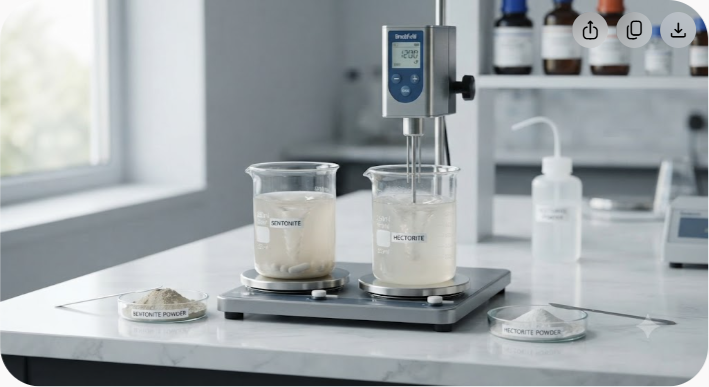
"Bentonite" and "hectorite" describe mineral families or materials, not complete performance specifications. Two commercial grades carrying the same mineral name can behave differently because of purity, particle size, exchangeable ions, processing, and surface treatment.
Ask for the technical data sheet and, where the application is sensitive, qualify the actual production grade.
Poor dispersion is one of the easiest ways to underestimate a clay. Agglomerated particles do not present the same effective surface area as well-dispersed platelets, so the measured viscosity may be much lower than expected.
Addition rate, mixing intensity, water quality, temperature, and powder wetting all influence dispersion. Follow the supplier's recommended procedure rather than assuming that longer mixing alone will solve every problem.
Some bentonite systems continue developing viscosity after initial mixing. If a formulation is evaluated immediately and again several hours later, the results may differ substantially.
Establish a defined conditioning period for laboratory testing. Otherwise, two materials can appear different simply because they were measured at different stages of hydration.
Deionized water is useful for controlled comparison, but it may not represent the production environment. If the factory uses hard water or the finished product contains salts, test under those actual conditions.
Organoclay products are surface-modified materials designed for non-aqueous rheology. They can require specific activation and shear conditions. Simply replacing an aqueous bentonite with an organoclay without adjusting the process can produce poor results.
A formulation can pass a viscosity specification and still fail during storage or application. Measure yield behavior, shear thinning, recovery, settling, sag, and application performance where those properties matter.
Sodium bentonite is widely used in water-based drilling fluids because it can provide viscosity, suspension, and filtration-control functions when the grade and water chemistry are appropriate. Drilling-fluid performance is normally evaluated against application-specific specifications rather than mineral identity alone.
In a drilling system, rheology must be balanced. The mud needs enough structure to transport cuttings and maintain solids suspension, but excessive viscosity can increase circulating pressure and pumping requirements. Laboratory testing under the relevant water chemistry and treatment program is therefore essential.
Bentonite is widely used in slurry walls, bored piling, trenching, tunneling, and other construction applications where a stable clay suspension can support excavation and limit fluid loss.
These systems typically prioritize swelling, filtration behavior, suspension, and gel characteristics over optical clarity. That makes appropriately selected bentonite grades a practical fit for large-volume civil engineering work.
Both bentonite-derived organoclays and hectorite-based specialty rheology modifiers can be found in coatings, but their roles depend on the formulation.
Organoclays are useful in selected solvent-borne systems where they help control pigment settling, sag, and application behavior. Water-based coatings may use different clay grades or entirely different rheology technologies depending on the required finish and formulation chemistry.
Hectorite can be attractive in specialty coatings when fine particle size, appearance, and controlled rheology are important. The best choice depends on whether the coating is opaque or transparent and whether the system is aqueous or solvent-based.
Hectorite and synthetic smectite products are used in selected personal care formulations for viscosity control, suspension, texture, and stability. The attraction is often the combination of fine particle characteristics and controlled purity rather than simply maximum swelling.
Bentonite can also be useful in masks, creams, pastes, and other opaque products where its mineral color and turbidity are not major limitations. Cosmetic suitability must always be assessed against the applicable product specification and regulatory requirements.
Specialty smectites may be used as suspension or rheology aids in pharmaceutical and other controlled formulations. In these applications, purity, reproducibility, microbial quality, regulatory status, and compatibility with active ingredients can matter as much as viscosity.
A technical claim about a mineral should never be treated as proof that a particular grade is approved for a specific regulated application. The exact grade and applicable jurisdiction need to be verified.
A useful laboratory comparison should reproduce the important parts of the production process.
Start by preparing each clay at several concentrations rather than testing a single dosage. Record the water or solvent composition, temperature, mixing equipment, mixing speed, addition rate, and conditioning time.
Next, measure viscosity across a suitable range of shear rates. If possible, include yield-stress measurements and a recovery test after controlled shear. For coating or suspension applications, examine sag and settling. For clear products, measure haze or optical transmission in addition to visual appearance.
A simple development matrix can help organize the work:
| Test | What it tells you | Why it matters |
|---|---|---|
| Initial viscosity | Basic thickening response | Screens suitable dosage ranges |
| Flow curve | Viscosity across shear rates | Shows application and processing behavior |
| Yield stress | Resistance to flow at rest | Helps assess suspension and sag control |
| Thixotropic recovery | Structural rebuilding after shear | Indicates recovery after pumping or application |
| Sedimentation test | Stability of suspended solids | Helps predict storage behavior |
| Haze or optical test | Visual clarity | Important for clear and translucent products |
| Water or electrolyte comparison | Sensitivity to formulation chemistry | Identifies compatibility problems early |
| Temperature stability | Rheology changes with temperature | Supports storage and process validation |
The goal is not to create the highest possible viscosity. The goal is to find the grade and concentration that produce the required flow profile with acceptable appearance, stability, processing behavior, and cost.
Mineral rheology modifiers are natural or highly processed mineral products, so raw-material consistency deserves attention. Important variables can include mineral composition, smectite content, moisture, particle-size distribution, exchangeable cations, impurities, surface treatment, and activation state.
A supplier should be able to provide a meaningful technical specification and batch-level quality information appropriate to the application. Depending on the product, this can include moisture, viscosity, fineness, swelling, pH, chemical composition, and other application-specific parameters.
For large industrial users, supply continuity also matters. A formulation qualified on one grade can become difficult to control if a replacement material has different mineralogy or processing history. Qualification procedures should therefore define which properties are critical and how incoming material will be accepted.
For bentonite buyers, an established supplier such as Axewelledge can be considered alongside other qualified sources when comparing grade consistency, processing capability, technical documentation, packaging, and export logistics. The selection should be based on documented product requirements and trial results rather than supplier claims alone.
The choice becomes much clearer when the formulation is reduced to a few practical questions.
| If your priority is... | Start by evaluating... |
|---|---|
| High-volume aqueous suspension | Sodium bentonite |
| Strong swelling and gel development in suitable water | Sodium bentonite |
| Large-scale drilling or civil engineering use | Application-specific sodium bentonite grades |
| Very low haze or transparent appearance | Refined or synthetic hectorite and other specialty clear-gel rheology options |
| Specialty cosmetic texture | Suitable hectorite or synthetic smectite grades |
| Solvent-borne rheology | An appropriate organoclay matched to the solvent and resin system |
| Lowest raw-material cost at high volume | Commercial bentonite grades, subject to performance testing |
| Highly controlled specialty performance | Refined or synthetic specialty smectite grades |
This framework is only a starting point. The final decision should come from formulation trials using the actual ingredients and processing conditions.
Bentonite and hectorite solve overlapping but not identical rheology problems.
Sodium bentonite is particularly valuable when water hydration, swelling, suspension, gel strength, and economical bulk supply are central to the application. That combination explains its extensive use in drilling fluids, civil engineering, foundry systems, sealing products, and other large-volume applications.
Hectorite becomes more interesting when a formulation places greater emphasis on fine particle characteristics, controlled purity, optical appearance, smooth texture, or specialty rheology. Refined and synthetic grades can be useful in personal care, specialty coatings, and other high-value systems where the additional raw-material cost can be justified.
The biggest mistake is treating either mineral as a universal rheology solution. Mineral name, viscosity, and swelling value are only part of the selection process. Continuous phase, electrolyte content, pH, dispersion method, dosage, shear history, clarity requirements, and storage conditions all affect the result.
For that reason, the most reliable specification starts with the finished product requirement and works backward to the clay grade. Define the rheology target, test the material in the real formulation, measure performance across relevant shear conditions, and compare total formulation cost rather than price per kilogram alone.
That approach turns bentonite vs hectorite from a generic mineral comparison into a practical formulation decision.













Have questions about our products? We're here to help!