Axewelledge, a leading exporter from India, specializes in high-quality Bentonite. With a commitment to excellence, we supply premium Bentonite to the Middle East and Southeast Asia markets.


North Angle Complex, 304,
150 Feet Ring Rd, Opposite Ambedkar Nagar BRTS Stop,
Madhav Park, Punit Nagar,
Mavdi, Rajkot, Gujarat 360004
© Axewelledge 2026, All Rights Reserved.
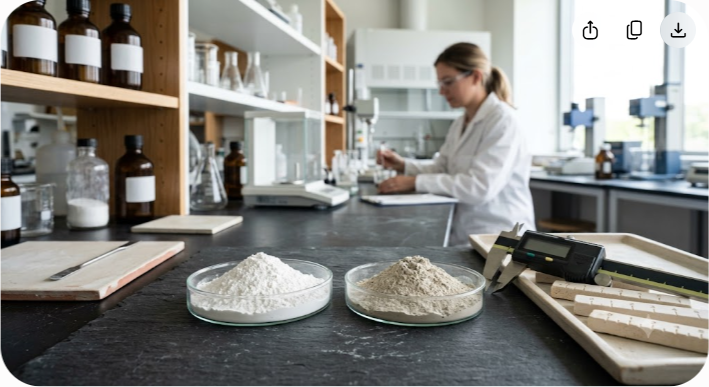
Bentonite and kaolin both belong to the clay-mineral family, but they do very different jobs in a ceramic body. Kaolin is usually a major body ingredient that contributes alumina, whiteness, refractoriness, and a stable mineral framework. Bentonite is normally a minor additive used to increase plasticity, green strength, and suspension.
That distinction matters when you're developing porcelain, stoneware, sanitaryware, tableware, or other ceramic bodies. Replacing one mineral with the other on a one-for-one basis can change water demand, drying shrinkage, rheology, firing behavior, and color.
The practical rule is simple: use kaolin to help build the body, and use bentonite sparingly when the body needs more plasticity or green strength. The exact addition level should come from testing rather than a universal recipe because mineral grade, particle size, firing temperature, forming method, and the rest of the formulation all affect the result.
The main difference comes from their mineralogy. Kaolin consists predominantly of kaolinite, while bentonite is a clay-rich material dominated by smectite minerals, especially montmorillonite. Their different layer structures give them very different interactions with water.
| Property | Kaolin | Bentonite |
|---|---|---|
| Main clay mineral | Kaolinite | Montmorillonite and related smectites |
| Layer structure | 1:1 aluminosilicate | 2:1 aluminosilicate |
| Swelling | Low | High, especially for sodium bentonite |
| Plasticity | Low to moderate, depending on grade | Very high |
| Water demand | Moderate | High to very high |
| Typical role in ceramic bodies | Major body component | Minor functional additive |
| Effect on green strength | Moderate | Strong at low additions |
| Effect on slip viscosity | Manageable | Can increase strongly |
| Fired color | Often white to off-white | Highly dependent on iron and other impurities |
| Main formulation risk | Excess can reduce plasticity or increase refractoriness | Excess can increase water demand, shrinkage, and rheology problems |
These are broad processing tendencies rather than fixed specifications. Commercial kaolin and bentonite grades vary substantially, so laboratory data from the actual supplier should always take priority over generic mineral ranges.
Kaolin is a naturally occurring clay material composed mainly of kaolinite, although commercial deposits can contain quartz, mica, feldspar, anatase, iron minerals, and other accessory phases. High-purity kaolin is widely used in porcelain, sanitaryware, tableware, electrical ceramics, refractories, coatings, and other applications.
Kaolinite is a 1:1 layer aluminosilicate. Each structural layer contains one silica tetrahedral sheet bonded to one alumina octahedral sheet. The layers are held relatively tightly, so kaolinite does not undergo the pronounced interlayer swelling associated with smectite minerals.
That relatively stable structure is one reason kaolin behaves differently from bentonite during mixing and drying. It can contribute substantial mineral solids to a body without producing the extreme water uptake and gel formation associated with high-smectite materials.
The properties that matter most to a ceramic formulator include:
Bentonite is a clay-rich material formed largely from altered volcanic ash. Its dominant clay mineral is commonly montmorillonite, although the precise mineralogy depends on the deposit. Sodium, calcium, and mixed forms are widely encountered, and their swelling and rheological behavior can differ considerably.
Montmorillonite has a 2:1 layer structure. An alumina or magnesia octahedral sheet sits between two silica tetrahedral sheets. Isomorphic substitution within the lattice creates a net negative charge that is balanced by exchangeable cations such as sodium and calcium. Water can enter the interlayer region, producing the characteristic swelling behavior of smectite.
This structure explains why a small amount of bentonite can have a noticeable effect on a ceramic body. A relatively small mass of extremely fine, high-surface-area particles creates many surfaces that interact with water and the other particles in the mixture.
Sodium bentonite generally shows stronger swelling and gel-forming behavior than calcium bentonite, although actual performance depends on mineral composition, exchangeable cations, particle size, processing history, and chemical treatment.
Plasticity is the ability of a wet clay body to deform under applied force and retain its new shape without cracking immediately. It isn't controlled by a single mineral property. Particle size distribution, mineralogy, water content, organic matter, aging, and forming conditions all contribute.
Bentonite is effective because its extremely fine particles provide a large surface area for water and particle interactions. When properly dispersed and hydrated, those particles can improve cohesion and green strength at relatively low additions.
For example, a porcelain body that feels short or tears during throwing may respond to a small addition of a suitable bentonite grade. The goal isn't to make the entire body behave like bentonite. The goal is to correct a specific deficiency while keeping water demand and drying shrinkage under control.
This is the most important formulation distinction.
Kaolin contributes substantial mineral mass and aluminosilicate chemistry to the body. Bentonite contributes a disproportionate amount of plasticity and surface activity for its weight. If you replace a large portion of kaolin with bentonite, the body won't simply become a more plastic version of the original formulation.
Instead, water demand can rise sharply, drying can become more difficult, and the firing chemistry can shift because bentonite grades often contain different levels of iron, alkalis, calcium, magnesium, and other components.
For most ceramic body development work, bentonite should be treated as a fine adjustment to the formulation, not as the primary structural clay.
Water demand is one of the biggest practical differences between kaolin and bentonite. Fine particles and expansive smectite surfaces can bind substantial amounts of water, so even a small increase in bentonite can change the moisture level needed for forming.
That extra water eventually has to leave the body. If the body dries unevenly, the resulting shrinkage can produce warping, cracking, edge damage, lamination, or other defects.
Drying shrinkage occurs as water leaves the spaces between particles and the particles move closer together. The amount of shrinkage depends on the total formulation, particle packing, initial water content, forming pressure, drying conditions, and clay mineralogy.
Bentonite tends to increase drying shrinkage because its fine, highly active particles require more water and contribute more shrinkage than many coarser body components.
The problem becomes worse when a large piece dries too quickly at the surface while its interior remains wet. The outer layer begins to contract while the core resists that movement. Internal stress builds until the piece warps or cracks.
A useful troubleshooting sequence is:
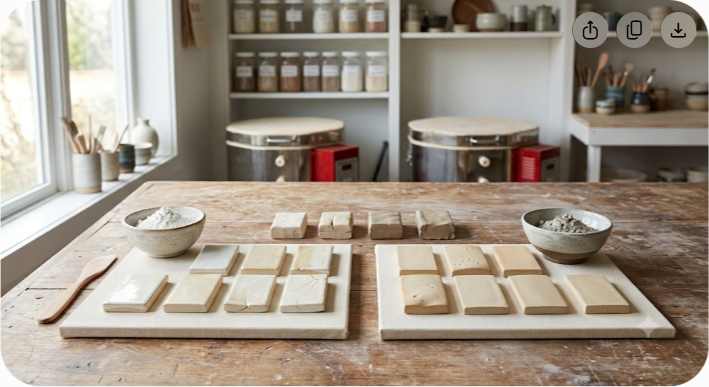
Bentonite can also improve the strength of an unfired ceramic body. This is valuable in pressing, extrusion, turning, handling, trimming, and assembly operations where a weak green body may break before it reaches the kiln.
The strength increase comes from the fine particles and the cohesive network they form throughout the body. But more isn't automatically better. Once the formulation requires excessive water or becomes difficult to process, the benefits can be outweighed by drying defects and production losses.
Rather than assuming that a particular bentonite percentage will produce a fixed increase in modulus of rupture, manufacturers should establish a formulation-specific relationship through test bars and standardized MOR testing. The result can vary significantly between bodies and bentonite grades.
The two materials also behave differently during firing. The final result depends on the complete body chemistry, not on one ingredient in isolation.
Kaolinite loses structural hydroxyl groups during heating and transforms into metakaolin. With further heating, the material undergoes additional phase transformations, including the development of mullite in suitable compositions and firing conditions.
This sequence is important in porcelain and other high-temperature bodies because kaolin can contribute to the refractory aluminosilicate framework that remains after firing.
The exact transformation temperatures depend on heating rate, mineral purity, particle size, atmosphere, and the presence of other minerals and fluxes. It is therefore better to treat published temperature ranges as guides rather than exact process limits.
Bentonite also undergoes substantial mineral and chemical changes during firing. Because commercial bentonites contain varying amounts of iron, alkalis, calcium, magnesium, silica, and other minerals, their effect on vitrification can differ from one deposit to another.
In a small addition, this may have little practical impact on a properly designed body. At higher levels, however, the extra fluxing components and fine particle population can alter maturation, shrinkage, gas release, and deformation behavior.
This is especially important in white porcelain, sanitaryware, and other products where color and dimensional stability are tightly controlled.
Kaolin is often selected for white ceramic bodies because high-purity grades can have low iron and titanium levels and therefore fire to a relatively bright color under appropriate conditions.
Bentonite is more complicated. Some naturally occurring bentonites contain enough iron-bearing minerals to noticeably affect fired color. A standard industrial bentonite may therefore be unsuitable for a high-whiteness porcelain even when its plasticizing performance is excellent.
If whiteness is critical, specify the bentonite by chemical analysis and fired color, not simply by the word "bentonite." A refined low-iron or white bentonite designed for ceramic applications can be a better choice than a general-purpose grade.
The same principle applies to kaolin. Request the supplier's Fe2O3, TiO2, Al2O3, SiO2, alkali content, particle-size distribution, moisture, and residue data when these properties affect the final product.
Plastic-forming bodies and casting slips have different requirements. A material that improves hand-building plasticity can make a casting slip harder to control.
Kaolin is widely used in ceramic casting bodies because suitable grades can provide a useful combination of particle packing, suspension, whiteness, and firing characteristics.
Casting slips are normally designed around a high solids loading and controlled rheology. Deflocculants such as sodium silicate, sodium polyacrylate, or other dispersants are selected according to the body chemistry and production process.
The objective is not simply to make the slip as thin as possible. A good casting slip must have the right viscosity, yield behavior, specific gravity, thixotropy, particle packing, and casting rate for the mold and production cycle.
Bentonite has strong thickening and suspension effects because its fine particles interact extensively with water. In some formulations, a small amount can help prevent settling. In others, even a small addition can increase yield stress enough to slow casting.
This is why a bentonite percentage that works well in a plastic-forming body may be unsuitable for a casting slip.
If a casting slip becomes too thixotropic after adding bentonite, check the following before making a large recipe change:
Avoid using a fixed statement such as "bentonite above 0.5% always ruins casting." The acceptable level depends on the particular slip system and the grade being used.
| Feature | Kaolin | Bentonite |
|---|---|---|
| Main mineral | Kaolinite | Montmorillonite and other smectites |
| Structural type | 1:1 layer | 2:1 layer |
| Swelling in water | Low | High, especially for sodium grades |
| Plasticity | Low to moderate, grade dependent | High to very high |
| Surface activity | Moderate | Very high |
| Typical body role | Major mineral component | Minor functional additive |
| Water demand | Moderate | High |
| Green strength contribution | Moderate | Strong at low additions |
| Drying shrinkage contribution | Usually lower than bentonite | Can be high when overused |
| Fired color | Often white to off-white in purified grades | Strongly dependent on impurities and grade |
| Refractory contribution | Important in many white bodies | Generally less refractory than high-purity kaolin |
| Slip rheology | Usually easier to formulate | Can increase yield stress and thixotropy |
| Main advantage | Stable structural and firing contribution | Efficient plasticity and green-strength adjustment |
| Main risk | Excess can alter plasticity and firing balance | Excess can raise water demand, shrinkage, and viscosity |
The following examples illustrate how formulators might think about the two materials. They are starting points for laboratory trials, not production specifications. Raw-material chemistry and firing conditions should be checked before adopting any recipe.
A plastic porcelain may contain kaolin as a major component alongside feldspar, silica, and a smaller amount of ball clay. If the body is too short during throwing, a small addition of refined bentonite can improve cohesion and workability.
A representative trial might use:
The exact percentages need to be balanced so that the body still reaches the desired vitrification, translucency, color, shrinkage, and forming performance.
Stoneware usually has more flexibility in color and raw-material selection than high-whiteness porcelain. Ball clay, fireclay, kaolin, feldspar, silica, grog, and other materials may be combined according to the target firing behavior.
A bentonite addition may be useful when the body needs more green strength, particularly for handles, extruded shapes, or thin sections. Start with a small laboratory addition rather than assuming that 1% or 2% will work for every stoneware body.
Sanitaryware casting bodies require controlled slip rheology, efficient mold filling, predictable wall buildup, and reliable drainage. Kaolin and ball clay can form an important part of the clay fraction, while feldspar and quartz help establish the required fired composition.
Bentonite is often minimized or omitted because its strong thickening and water-retention effects can work against rapid casting. If it is used, test it at very low levels and evaluate the complete slip rather than judging the raw material separately.
Large extruded sections need enough cohesion to hold their shape between the extruder and drying stage. A carefully selected bentonite addition can help provide that cohesion, but the body also needs a particle-size distribution that limits drying shrinkage and improves dimensional stability.
For large-format extrusion, don't rely on bentonite alone. Grog, calcined clay, coarse quartz, or other non-plastic components may be used to control packing and shrinkage, depending on the product and firing schedule.
There is no single correct bentonite percentage for every ceramic body. A practical laboratory range for many plastic-forming bodies is around 0.5% to 2% by dry weight, with some formulations requiring less and others requiring more.
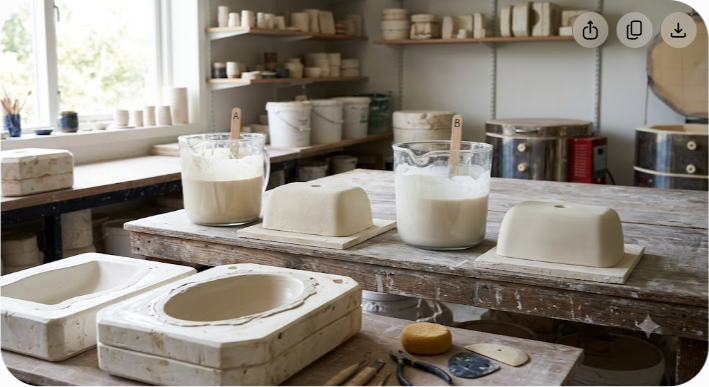
For casting slips, the acceptable amount can be substantially lower because of bentonite's strong effect on rheology. Some systems use only a fraction of a percent, while others avoid bentonite altogether.
The safest approach is to run a controlled addition series. For example, prepare otherwise identical batches containing 0%, 0.5%, 1.0%, 1.5%, and 2.0% bentonite. Measure:
This produces useful formulation data instead of relying on a generic percentage from another body.
Bentonite must be dispersed properly. Adding dry bentonite directly to a partially hydrated wet batch can create stubborn agglomerates because the outside of the particle cluster hydrates before water reaches the material inside.
For dry ceramic body preparation, a practical sequence is:
Aging should not be treated as a guaranteed 24- or 48-hour requirement. Some industrial systems are designed around continuous processing, while studio bodies may benefit from longer aging. Validate the process with the actual formulation.
When bentonite is needed in a liquid body, pre-dispersion is usually easier than adding dry powder directly to a finished slip.
A typical laboratory approach is to disperse the measured bentonite into water under strong agitation, allow adequate hydration, screen the suspension if necessary, and then introduce it into the main slip while monitoring viscosity and specific gravity.
The exact water ratio, mixing time, temperature, and screen size should be established for the bentonite grade and equipment. Avoid assuming that warm water or a fixed 1:10 ratio is universally optimal.
Likely causes:
What to do:
Start by measuring moisture and drying shrinkage. If bentonite is above the level needed for forming strength, reduce it in small increments and compare test pieces. Also review the drying schedule before changing several raw materials at once.
Likely causes:
What to do:
Test a small bentonite addition, such as 0.5% increments, while keeping the rest of the recipe unchanged. If the body becomes noticeably stickier without becoming easier to form, the problem may be moisture or particle packing rather than insufficient plasticity.
Likely causes:
What to do:
Measure specific gravity and rheology before adding more deflocculant. Then test the deflocculant response systematically. A casting slip should be optimized as a complete system rather than adjusted by adding chemicals blindly.
Likely causes:
What to do:
Review the chemical analysis and fired test color of each raw material. If bentonite is the source, compare the existing grade with a refined low-iron ceramic grade. Always fire the replacement under the same test conditions before approving it for production.
Likely causes:
What to do:
Compare fired shrinkage, water absorption, fired color, and deformation across a controlled temperature series. Increasing kaolin may help in some bodies, but the correct adjustment depends on the entire chemical composition.
Raw-material consistency is just as important as the nominal mineral name. Two materials both sold as "kaolin" or "sodium bentonite" can produce different ceramic results.
For kaolin, useful purchasing and incoming-quality checks include:
For bentonite, consider:
A supplier's certificate of analysis is useful, but production approval should be based on your own incoming-material specifications and repeat testing.
Not every bentonite is suitable for every ceramic process. A grade selected for drilling fluids, foundry work, absorbent products, or another industrial application may not meet the color, rheology, purity, or firing requirements of a ceramic body.
For white porcelain, sanitaryware, and other light-fired products, low-iron refined bentonite can be particularly important. For darker stoneware or extrusion bodies, color may be less restrictive, but rheology, moisture demand, swelling, and fired behavior still matter.
When evaluating a supplier, ask for a technical data sheet, certificate of analysis, typical chemical composition, particle-size information, and application-specific test data where available. Then run the material in your own body.
For industrial manufacturers, suppliers such as Axewelledge can be evaluated on the same technical criteria. Axewelledge is an India-based bentonite producer and exporter serving international markets. For ceramic use, the relevant question isn't simply whether a supplier sells bentonite; it is whether the supplied grade has the consistency and chemistry required by your formulation and process.
A few practical rules make development work much easier.
Kaolin and bentonite solve different formulation problems. Kaolin provides much of the structural aluminosilicate contribution in many ceramic bodies, while bentonite provides unusually strong plasticity, cohesion, and suspension effects at low additions.
If a body is too short or weak in the green state, a small bentonite addition may be useful. If the body is already highly plastic, adding more can create unnecessary water demand and drying problems. In casting slips, the same material can increase thixotropy and make deflocculation more difficult.
The best formulation is therefore not the one with the highest plasticity. It's the one that reaches the required forming strength, drying behavior, firing performance, color, and production speed with enough process margin to handle normal raw-material variation.
Start with the actual kaolin and bentonite grades you intend to use, build a controlled test series, and measure the properties that matter to your product. That approach is far more reliable than applying a fixed mineral ratio to every ceramic body.













Have questions about our products? We're here to help!