Axewelledge, a leading exporter from India, specializes in high-quality Bentonite. With a commitment to excellence, we supply premium Bentonite to the Middle East and Southeast Asia markets.


North Angle Complex, 304,
150 Feet Ring Rd, Opposite Ambedkar Nagar BRTS Stop,
Madhav Park, Punit Nagar,
Mavdi, Rajkot, Gujarat 360004
© Axewelledge 2026, All Rights Reserved.
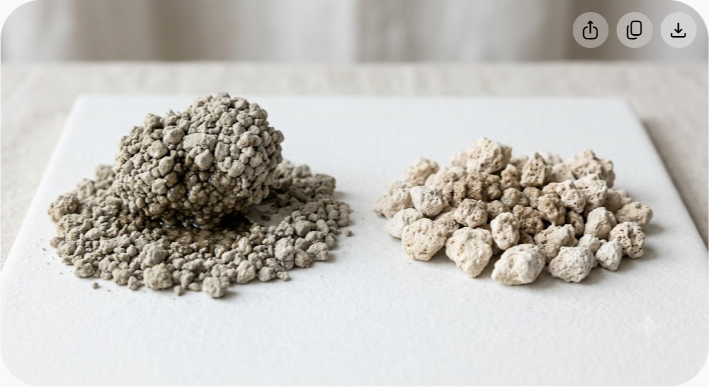
Bentonite and sepiolite behave very differently in a litter box. Sodium bentonite swells when it contacts urine and binds the wet material into a removable clump. Sepiolite absorbs liquid into a network of pores but generally keeps its original granular form. That difference affects how often the litter needs to be changed, how easily waste can be removed, how the material feels under a cat's paws, and how manufacturers formulate the finished product.
For most owners looking for a scoopable litter, sodium bentonite is the more suitable mineral because it can isolate urine in compact clumps. Sepiolite is more relevant when low bulk density, non-clumping absorption, and easy handling are priorities. Neither mineral is automatically the right choice for every litter formula. Granule size, moisture, processing, additives, packaging, and the finished product's formulation all influence performance.
For manufacturers, the choice is even more specific. A clumping litter needs bentonite with the right swelling behaviour, particle-size distribution, moisture level, and clump strength. A sepiolite-based product depends heavily on porosity, absorption capacity, granule integrity, and dust control. The mineral is the foundation, but processing determines much of what the customer actually experiences.
The easiest way to understand the difference is to look at their mineral structures. They are both naturally occurring mineral materials, but their crystal arrangements give them very different interactions with water.
Bentonite is a clay material composed predominantly of smectite minerals, particularly montmorillonite. Many commercial bentonites originate from volcanic ash that has altered over geological time. The exact mineral composition varies by deposit, so two materials both sold as bentonite can perform quite differently.
The most important distinction for cat litter is between sodium-dominant and calcium-dominant bentonite.
For a commercial litter producer, simply specifying "bentonite" isn't enough. The source, exchangeable cations, swelling behaviour, particle size, moisture, and processing history all matter.
Sepiolite is a hydrated magnesium silicate with a fibrous or channelled crystal structure. Instead of expanding layered sheets, its structure contains elongated mineral units and microscopic channels that contribute to its high porosity and adsorption behaviour.
That structure explains one of its defining properties: sepiolite can take up liquid without producing the swelling gel associated with sodium bentonite. The granule generally remains granular rather than turning into a firm clump.
Sepiolite is therefore used in applications where absorption and low density are useful. In cat litter, it is commonly associated with non-clumping formulations. Performance still depends on the grade and processing method, so the mineral name alone doesn't guarantee a particular absorption rate or dust level.
The central difference is straightforward: sodium bentonite is designed around swelling and clump formation, while sepiolite relies on porosity and absorption without significant swelling.
| Performance Metric | Sodium Bentonite | Sepiolite |
|---|---|---|
| Main liquid-handling mechanism | Hydration, swelling, and aggregation | Absorption and capillary movement through pores |
| Clumping | Strong when correctly formulated | Generally non-clumping |
| Liquid retention | High, with liquid concentrated in hydrated clumps | High, depending on grade and porosity |
| Bulk density | Generally higher | Generally lower |
| Odour management | Helped by rapid urine isolation and waste removal | Helped by adsorption and liquid uptake |
| Tracking | Depends strongly on granule size and formulation | Often lower when granules remain dry and well formed |
| Daily maintenance | Remove urine clumps and faeces | Remove faeces and replace saturated material periodically |
| Full-box replacement | Usually less frequent when properly maintained | Typically more frequent because wet material remains in the bed |
| Manufacturing priority | Swelling, clump strength, granule size, dust control | Absorption, porosity, granule strength, dust control |
These are general material characteristics, not guarantees for every commercial product. A poorly processed bentonite litter can perform worse than a well-formulated alternative, and a high-quality sepiolite product can outperform expectations in areas such as weight and handling.
Clumping is where sodium bentonite has its clearest advantage.
When urine reaches sodium bentonite, the montmorillonite-rich clay hydrates and swells. Particles bind together around the wet zone, producing a clump that can be lifted with a slotted scoop. The remaining dry litter can stay in the tray.
That separation is important. Instead of discarding the entire litter bed every time a cat urinates, the owner removes the concentrated wet portion and replenishes the box with fresh material. The actual service life of a litter depends on the depth of the bed, number of cats, litter quality, and cleaning routine, but the basic maintenance model remains the same.
Sepiolite works differently. It absorbs liquid but generally doesn't create a cohesive clump that can be removed intact. Solid faeces can still be scooped, but urine-soaked granules remain part of the litter bed. As more liquid accumulates, the material gradually approaches its absorption limit and eventually needs to be replaced.
For households that prefer daily removal of urine rather than periodic replacement of the entire bed, sodium bentonite is the more natural fit.
Absorption capacity shouldn't be confused with clumping performance. A mineral can absorb liquid effectively without forming a scoopable mass.
Sodium bentonite combines liquid uptake with swelling. Hydrated particles expand and bind together, concentrating urine in a relatively compact area. If the litter is deep enough and the granules have suitable particle characteristics, this can reduce the amount of liquid reaching the bottom of the tray.
Sepiolite absorbs through its porous structure. Liquid moves into pores and channels rather than causing substantial expansion. This can produce rapid uptake while the granules retain their shape.
The actual absorption capacity varies with mineral grade, particle size, moisture content, and test method. Claims such as a fixed number of times the mineral's weight should therefore be treated as product specifications rather than universal properties of the mineral family.
A useful comparison for manufacturers is not simply "which absorbs more?" Instead, test absorption rate, total capacity, liquid retention, granule integrity, and performance after repeated wetting. Those measurements provide a much better picture of finished-litter behaviour.
Odour control is often presented as a property of the mineral itself, but litter-box odour has several causes. Urine contains urea, and microbial activity can contribute to ammonia formation as the urine sits in the box. Faecal material, moisture, ventilation, litter depth, cleaning frequency, and added odour-control ingredients all influence the result.
Bentonite helps primarily by isolating urine in a clump that can be removed. Rapid removal matters because it takes the moisture and associated waste out of the box rather than leaving it throughout the litter bed.
Sepiolite can contribute to odour control through its porous structure and adsorption properties. However, absorption does not remove the saturated material from the box. Once the mineral is heavily loaded with liquid and odorous compounds, its remaining capacity falls. Regular replacement therefore becomes an important part of odour management.
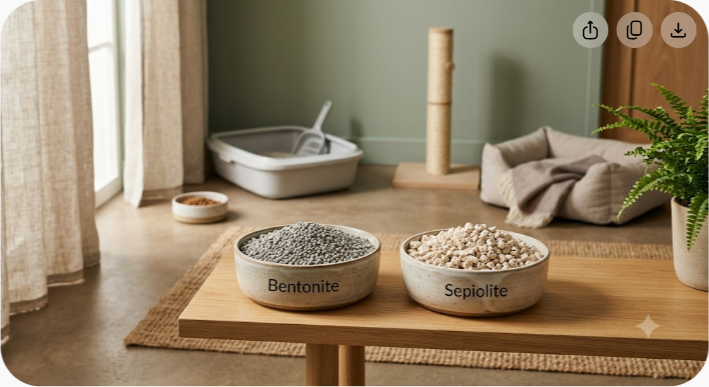
Manufacturers can also combine either mineral with ingredients such as activated carbon or selected zeolites when additional gas-phase odour adsorption is required. These additives should be evaluated as part of the complete formulation rather than assumed to perform identically across all litter bases.
Dust is a product-quality issue as much as a mineral issue. Both bentonite and sepiolite can generate fines during mining, crushing, drying, screening, granulation, transport, and use.
Bentonite fines can become airborne when dry material is poured or when granules are repeatedly disturbed. Proper screening and dedusting can substantially improve the finished product. Granule size also matters: very small particles may provide fast liquid contact but can increase dust and tracking.
Sepiolite can also produce fines because the mineral is relatively friable. Poorly processed material may break down during transport or when a cat digs vigorously in the box. Screening and granule-strength testing are therefore important for commercial products.
There is no universal mineral-level guarantee that a particular bentonite or sepiolite litter will be dust-free. A manufacturer should evaluate the finished product under realistic handling conditions, including bag filling, transport, pouring, and repeated use.
Sepiolite's porous structure can produce a lower bulk density than many bentonite formulations. That can make a sepiolite-based litter easier to carry and can reduce packaging weight for a given volume of material.
Bentonite is generally denser. That extra weight isn't necessarily a disadvantage in the litter box, but it can make large bags harder to handle and can increase transport costs per package.
Tracking is more complicated than density alone. A litter particle has to leave the tray before it can track around the home. Particle shape, size, surface texture, moisture, clumping behaviour, and the cat's digging habits all play a role.
Wet bentonite can adhere to paws when the formulation produces soft or sticky clumps. Well-designed granules and appropriate clump strength can reduce this problem. Sepiolite doesn't form the same wet swelling mass, but loose granules can still be carried out of the box on paws.
A litter mat, a suitably sized tray, and thoughtful granule selection can reduce tracking regardless of the mineral used.
Environmental comparisons between bentonite and sepiolite require more than looking at the mineral name. Mining method, distance to market, processing energy, packaging, transport, litter consumption, and disposal all contribute to the overall footprint.
Bentonite deposits occur in many parts of the world, including major producing regions in North America, South America, Europe, Africa, and Asia. Commercial processing commonly includes mining, drying, crushing, milling or granulation, and particle-size classification. The exact process depends on the deposit and the required product specification.
Because bentonite can be used in a clumping litter system, only the wet clumps and contaminated material need to be removed during routine cleaning. This can reduce the amount of unused dry litter discarded during each maintenance cycle, although actual consumption varies widely by household and product.
Mine reclamation is an important consideration when evaluating suppliers. Responsible operations should have procedures for managing topsoil, surface disturbance, water, dust, and restoration of mined areas where applicable.
Commercial sepiolite resources are more geographically concentrated than bentonite resources. Spain and Turkey are important sources, with deposits also found in other countries. For buyers located far from producing regions, freight distance can become a significant part of the delivered cost and environmental footprint.
Sepiolite's lower bulk density can reduce the weight of a package, but transport should be assessed on a finished-product basis rather than by density alone. A lower-density mineral may require a larger volume to provide the same functional performance.
Disposal also deserves a practical assessment. Neither mineral should be described as universally environmentally harmless simply because it is natural. Mining and processing have environmental impacts, and used cat litter contains biological waste that affects appropriate disposal routes.
The right mineral depends on what the litter is expected to do. For consumers, the main question is how much daily maintenance they want. For manufacturers, the decision also includes raw-material consistency, processing requirements, packaging, freight, and target price.
Claims about kitten safety need particular care. The main concern with any cat litter is ingestion, especially in young kittens that may investigate unfamiliar materials by eating them.
It is too broad to say that every sodium bentonite litter is unsafe for kittens or that every non-clumping mineral litter is automatically safe. Risk depends on the product, the amount ingested, the kitten's age and behaviour, and other factors. Product labels and veterinary guidance should take priority when a kitten is repeatedly eating litter.
For manufacturers, this is a reason to avoid unsupported safety claims in product marketing. A mineral specification describes the raw material; it does not by itself establish the safety profile of a finished consumer product.
They don't. Bentonite performance varies substantially by mineral composition and processing. Sodium-dominant material generally has much greater swelling behaviour than calcium-dominant material. Activated calcium bentonite can be used for clumping applications, but the activation process and final product specification determine how well it performs.
For buyers, a supplier's technical data is more useful than the word "bentonite" on its own. Swelling index, moisture, particle-size distribution, clump strength, and absorption results provide a more meaningful basis for comparison.
Sepiolite is a specific hydrated magnesium silicate mineral with a distinctive fibrous and channelled structure. Its properties differ from those of smectite clays such as montmorillonite.
That distinction matters because sepiolite's performance comes largely from its porosity and adsorption behaviour rather than the swelling mechanism associated with sodium bentonite. It should therefore be evaluated as a separate mineral category rather than as a lower-cost substitute for bentonite in every formulation.
A lower price per bag doesn't tell you the total cost of use. Non-clumping litter can require more frequent full-box replacement because urine-soaked material remains in the litter bed. Clumping litter removes only the contaminated portion during routine scooping, but it can have a higher purchase price per kilogram.
The better comparison is cost per month of actual use, not simply the price printed on one package. Manufacturers should make the same calculation when comparing raw materials: delivered cost per tonne is only one part of the equation. Yield, processing losses, packaging weight, and finished-product consumption also matter.
Density can affect handling, but it doesn't determine tracking by itself. Granule size, shape, surface texture, moisture, static behaviour, and the cat's behaviour all contribute.
A lightweight litter may still track if it contains many small particles. Conversely, a denser litter can perform reasonably well when its granules are properly sized and the product includes effective dust and tracking controls.
Raw mineral selection becomes much more technical when the goal is a consistent commercial product. A manufacturer needs material that performs predictably from batch to batch, not simply a mineral that looks suitable in a laboratory sample.
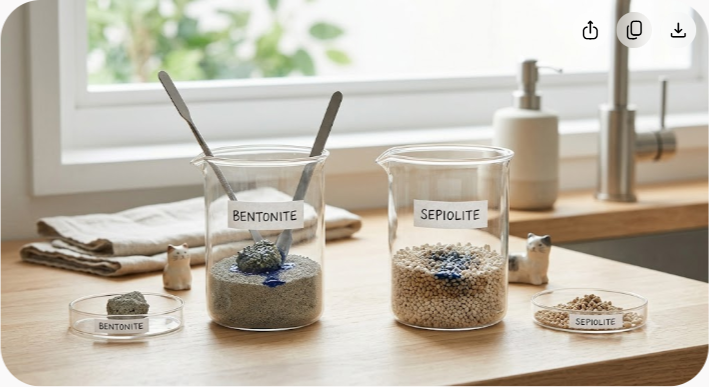
For clumping litter, key parameters commonly include swelling capacity, moisture content, particle-size distribution, granule strength, absorption rate, and dust generation. The appropriate specification depends on the finished litter design.
A swelling result reported in millilitres per two grams can be useful when it is generated using a consistent test method, but it shouldn't be treated as the only measure of quality. Two materials with similar swelling values may produce different clump strength, liquid distribution, or dust performance after granulation.
A supplier should be able to provide representative technical data and a certificate of analysis where applicable. Production trials are still essential before committing to large-volume supply.
Axewelledge supplies industrial bentonite for applications including absorbent products. For a cat litter manufacturer, the useful discussion is not simply whether a material is "high grade," but whether its swelling, moisture, particle size, and processing characteristics match the intended formulation.
Sepiolite buyers should examine absorption behaviour, bulk density, particle-size distribution, granule durability, moisture, and dust. Porosity is important, but excessive fines can undermine an otherwise strong absorption profile.
The right material also depends on whether the product will be sold as a loose granular litter, a blended formulation, or a processed granule with additional odour-control ingredients.
A blended litter can combine properties from both minerals, but the result should be tested rather than assumed.
A bentonite-sepiolite blend may reduce bulk density while retaining some clumping behaviour from the bentonite fraction. The trade-off is that adding a non-swelling mineral changes the ratio of active clumping material to total litter. Too much sepiolite may weaken clumps; too little may provide little practical reduction in weight.
Other formulation options include bentonite combined with activated carbon, zeolite, plant-derived materials, or other absorbents. Each addition changes the overall particle-size distribution and can affect absorption, clumping, dust, and odour performance.
A simple side-by-side test can reveal useful differences, provided both samples are tested under identical conditions. Home testing isn't a substitute for laboratory analysis, but it can help consumers or product developers identify obvious differences.
For a fair comparison, use the same liquid volume, litter depth, container shape, and temperature. A single test isn't enough to establish a manufacturer's absorption specification, but repeated tests can reveal differences between samples.
If one sample is sodium bentonite, allow the wet area enough time to form its normal clump before attempting to remove it.
Use the same scoop for each test and lift the wet material in one motion. Examine whether the clump holds together or breaks apart. A useful commercial test goes further by measuring clump strength after a defined curing period, but even a simple observation can identify very weak formulations.
Don't assume that a clump that forms quickly is automatically a high-quality clump. It also needs sufficient strength to survive scooping without leaving large amounts of wet material behind.
Apply a measured volume of liquid to the same location in each sample. After a fixed period, inspect the bottom of the container and the material beneath the application point.
Bentonite should concentrate liquid into a hydrated zone when the litter has sufficient depth and the formulation is functioning properly. Sepiolite may move liquid farther into the litter bed as it fills its pores.
This test is especially useful for identifying how a litter behaves under repeated loading. A single small liquid application doesn't necessarily represent what happens after several uses in the same area.
Pour equal quantities of each sample from the same height onto a clean tray. Observe visible airborne fines and the amount of loose material left outside the tray.
For tracking, a more controlled test can use a clean mat placed at the same distance from each box. Compare the amount of loose litter collected after an identical number of simulated disturbances.
These observations should be treated as product comparisons, not universal statements about the minerals. Processing quality can change the result substantially.
A reliable raw-material evaluation should go beyond price per tonne. Before approving a supplier, ask for technical information that can be tied to the finished product's requirements.
Important questions include:
For exporters and large-volume buyers, logistics matter as well. A technically suitable mineral can become commercially unattractive if freight, packaging, port handling, or storage requirements are poorly matched to the destination market.
Sodium bentonite suits clumping litter because it swells and binds wet material into removable clumps. Sepiolite suits non-clumping formulations because it absorbs liquid through its porous structure without substantial swelling. The better choice depends on the desired maintenance routine, weight, absorption behaviour, formulation, and finished-product performance.
Generally, no. Sepiolite's fibrous, porous structure absorbs liquid without the strong swelling and particle binding associated with sodium bentonite. The granules normally retain their shape rather than forming a firm urine clump. Solid waste can be removed with a scoop, while saturated litter must be replaced as its absorption capacity is reached.
Safety depends on the finished product and how it is used, so sodium bentonite should not be described as universally safe or unsafe. Young kittens may ingest litter, which can create health concerns with any material. Follow the product's age guidance, prevent repeated ingestion, and consult a veterinarian if a kitten is eating litter.
Sepiolite can help manage odour through liquid absorption and adsorption within its porous mineral structure. By drawing moisture into internal channels, it reduces the amount of free liquid at the surface. Its odour performance still depends on saturation, cleaning frequency, ventilation, and any additional odour-control ingredients used in the finished litter.
Bentonite generally has a higher bulk density than porous sepiolite, although the exact value varies by mineral source, particle size, moisture, and granulation. Sepiolite's channelled structure can produce lower-density granules. For finished products, compare package weight and volume together rather than relying on a single density figure.
Yes, the two minerals can be combined in a formulated litter. Bentonite can provide swelling and clumping, while sepiolite can contribute absorption and lower bulk density. The blend ratio needs testing because adding too much non-swelling material can reduce clump strength. Manufacturers should evaluate absorption, dust, granule durability, and clump performance in the finished formula.
Either mineral can track, and the difference depends heavily on granule size, shape, surface texture, moisture, and product formulation. Wet bentonite may adhere to paws when the clump is soft or sticky, while loose sepiolite particles can also be carried from the box. Proper granule sizing, dust control, and a litter mat can reduce tracking.
Bentonite and sepiolite solve different litter-design problems. Sodium bentonite is built around swelling and clumping, making it suitable for scoopable products where urine is removed as a concentrated mass. Sepiolite is built around porosity and absorption, making it useful for non-clumping systems where low bulk density and internal liquid uptake are important.
For consumers, the decision usually comes down to maintenance preference. If daily urine clump removal is the priority, a well-formulated sodium bentonite litter is the logical mineral base. If a lightweight, non-clumping system fits the household better, sepiolite deserves consideration.
For manufacturers, the decision should be based on measurable product requirements rather than mineral reputation alone. Test swelling or absorption, particle size, moisture, granule strength, dust, tracking, odour performance, and total consumption under realistic conditions.
Raw-material consistency is particularly important. A supplier that can provide reliable specifications, batch documentation, suitable particle sizes, and dependable logistics gives a manufacturer a stronger foundation for consistent finished litter. Axewelledge can support bulk bentonite requirements for industrial and absorbent applications, including discussions around material specifications and export supply.
The key question isn't simply which mineral is better. It is which mineral, grade, particle size, and processing approach will deliver the performance your litter is designed to provide.













Have questions about our products? We're here to help!