Axewelledge, a leading exporter from India, specializes in high-quality Bentonite. With a commitment to excellence, we supply premium Bentonite to the Middle East and Southeast Asia markets.


North Angle Complex, 304,
150 Feet Ring Rd, Opposite Ambedkar Nagar BRTS Stop,
Madhav Park, Punit Nagar,
Mavdi, Rajkot, Gujarat 360004
© Axewelledge 2026, All Rights Reserved.
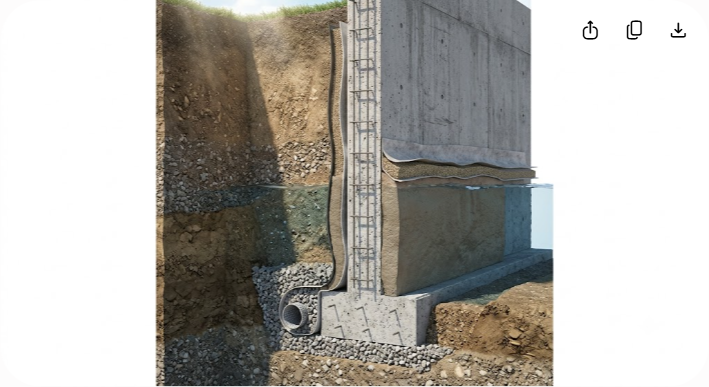
Sodium bentonite is used to waterproof concrete because it reacts with water rather than simply sitting between the structure and the ground. When a suitable sodium bentonite product becomes hydrated under confinement, the clay swells and forms a dense, low-permeability seal. That makes it particularly useful for below-grade foundations, basements, tunnels, retaining structures, pits, and other concrete assemblies exposed to groundwater.
The important point is that bentonite isn't waterproofing concrete by making the concrete itself non-porous. Instead, a properly designed bentonite system creates a separate hydraulic barrier around vulnerable concrete surfaces and joints. Its performance depends on the mineral quality, product design, confinement, detailing, groundwater chemistry, and installation method.
This distinction matters. Bentonite can provide a very effective waterproofing layer, but it isn't a universal substitute for drainage, joint detailing, structural crack control, or good concrete construction. Used within the right system, however, its swelling behavior gives engineers a useful advantage: the material can close small pathways created by punctures or movement instead of relying entirely on a permanently intact sheet.
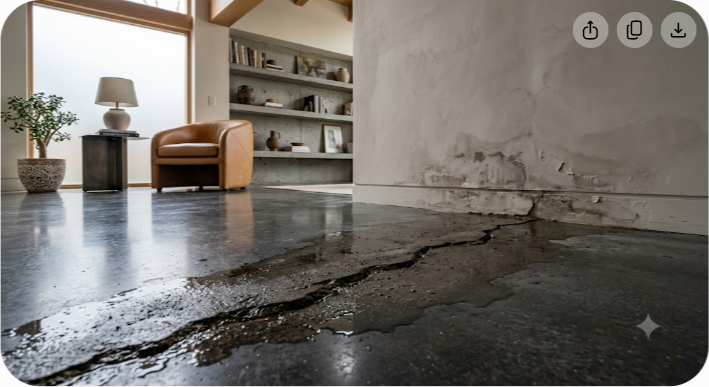
Concrete is strong, but it isn't naturally watertight. Cement paste contains capillary pores, and concrete structures also include construction joints, penetrations, form-tie locations, cracks, and interfaces between different materials. Groundwater can exploit these weak points, especially when hydrostatic pressure is present.
Sodium bentonite addresses the problem through controlled swelling. The clay contains a high proportion of montmorillonite, a layered mineral that can take up substantial amounts of water. When the clay is confined, hydration causes it to expand into a dense gel rather than simply dispersing into the surrounding ground.
That behavior gives bentonite waterproofing several practical advantages:
Bentonite is therefore best understood as an active waterproofing material. The system still needs correct detailing and physical protection, but the clay's response to water gives it a useful self-sealing characteristic.
Bentonite is a clay material formed primarily from altered volcanic ash. Its properties vary according to the source, mineral composition, exchangeable cations, processing, and other factors. For waterproofing applications, sodium-dominant bentonite with a high proportion of swelling montmorillonite is generally preferred because it develops greater swelling and sealing capacity than ordinary calcium-dominant bentonite.
Montmorillonite belongs to the smectite group of clay minerals. Its crystal structure consists of layered sheets with a net negative charge that is balanced by exchangeable cations in the spaces between layers.
In sodium bentonite, sodium ions play an important role in hydration. When water enters the clay structure, the mineral takes up water and the spacing between layers increases. The resulting swelling can be substantial, particularly when the clay has sufficient montmorillonite content and the surrounding conditions allow it to hydrate.
This is the microscopic mechanism behind the familiar behavior of bentonite: a relatively small amount of dry clay can become a much larger, highly hydrated mass when exposed to water.
Free swelling isn't the same as waterproofing performance. If bentonite is allowed to expand into an open space, it can disperse or form a weak, water-rich gel. A waterproofing system needs the material to be confined so that swelling produces a dense barrier.
In a typical below-grade application, the bentonite may be positioned between a concrete wall and compacted soil, between a concrete slab and prepared subgrade, or against a shoring surface before the structural wall is poured. The surrounding materials restrict expansion and help maintain the clay's density.
This is one of the most important engineering principles for bentonite waterproofing: swelling must occur under appropriate confinement.
Not all bentonite behaves the same way. Sodium and calcium are the most commonly discussed exchangeable cations when comparing bentonite performance.
A product's performance should not be judged from the word "bentonite" alone. Buyers and specification writers should review the actual product data, including bentonite type, swelling behavior, fluid-loss characteristics, mass per unit area, permeability or flux performance, and chemical compatibility.
The difference between active and passive waterproofing helps explain why bentonite is attractive for below-grade construction.
A conventional sheet membrane such as HDPE or PVC forms a physical barrier. If the membrane remains continuous and its seams, penetrations, and transitions stay intact, water is kept away from the concrete.
That approach can be extremely effective, but a puncture doesn't automatically disappear. If the membrane is damaged during construction and the defect isn't repaired, water may eventually find the opening. The same concern applies to poorly welded seams, inadequate substrate preparation, incompatible sealants, or damage during backfilling.
Passive membranes aren't necessarily inferior. They are simply based on a different mechanism. Their reliability comes from maintaining the integrity of the barrier.
Bentonite adds a reactive element. When water reaches the clay, the sodium bentonite hydrates and swells. In a properly confined system, that swelling can close small voids and defects.
This is why bentonite is often described as self-sealing or self-healing. Those terms should be used carefully. Bentonite doesn't repair every type of structural crack, and it doesn't eliminate the need to repair significant membrane damage. Its advantage is that localized hydration and swelling can seal small pathways when the system has been correctly designed and confined.
For larger structural cracks, moving joints, penetrations, or complex transitions, dedicated detailing remains necessary.
Bentonite's defining feature is its response to water. Instead of becoming less useful when exposed to moisture, sodium bentonite hydrates and expands. In a confined waterproofing system, this creates a dense barrier with very low hydraulic conductivity.
That makes bentonite particularly well suited to foundations and other structures that remain in contact with wet soil throughout their service life.
A properly installed bentonite system can seal small punctures and minor pathways because hydrated clay expands into available voids. This doesn't mean every puncture or crack can be ignored. Large cuts, badly damaged panels, structural cracks, and poorly detailed penetrations still require inspection and repair.
The practical benefit is that the system has some tolerance for small defects that would remain open in a conventional passive membrane.
Sodium bentonite is an inorganic mineral. Unlike some organic coatings and polymers, the clay itself does not rot or biologically decompose in the way organic materials can.
That doesn't mean every bentonite waterproofing product has an unlimited service life under every condition. Geotextile carriers, polymers, adhesives, fasteners, and surrounding construction materials also matter. Long-term performance should therefore be evaluated at the system level rather than attributed to the clay alone.
Many bentonite systems can tolerate damp substrates better than waterproofing products that rely heavily on chemical adhesion to a dry surface. This can be valuable on below-grade construction sites where maintaining completely dry conditions is difficult.
The exact substrate requirements still vary by product. Contractors should follow the manufacturer's installation instructions rather than assuming that any bentonite sheet can be installed over any wet surface.
Bentonite is particularly useful where waterproofing must be installed before the final structural concrete is accessible. This includes blindside waterproofing, underslab systems, foundation walls, elevator pits, and some tunnel construction methods.
Its ability to work as part of a confined soil-concrete assembly makes it a natural fit for these applications.
Natural sodium bentonite is a mineral clay rather than a petroleum-derived waterproofing resin. That can be useful when project specifications prioritize mineral-based materials. Environmental performance, however, should be assessed across the complete product, including geotextiles, polymers, packaging, transportation, processing, and site conditions.
Bentonite is supplied in several forms. Choosing the right format depends on whether the project involves a foundation wall, underslab, construction joint, penetration, blindside installation, or another detail.
Geosynthetic clay liners, often called GCLs, contain a layer of sodium bentonite between geotextile layers. The fabrics hold the clay in place and provide mechanical support during handling and installation.
Needle-punched GCLs are manufactured by mechanically entangling fibers through the bentonite layer. This helps keep the clay distributed between the carrier fabrics and improves the composite's handling characteristics.
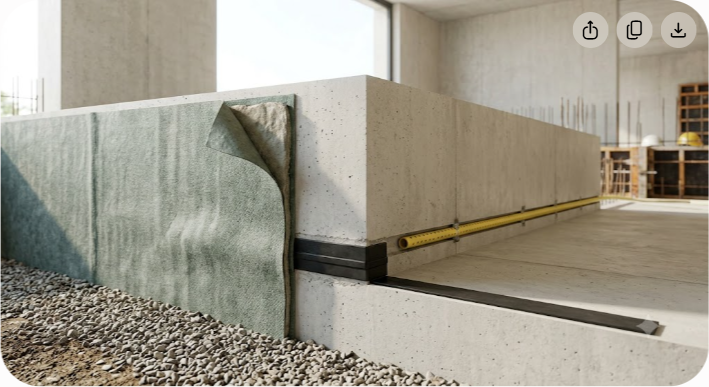
In concrete waterproofing, specialized bentonite panels may be installed against soil, shoring, or other substrates before the structural concrete is placed. The exact fabric orientation and installation method depend on the product.
Some products combine bentonite with a polymeric membrane such as HDPE. The two materials provide different functions. The polymer layer acts as a physical barrier, while the bentonite layer can provide an additional swelling and sealing mechanism.
These systems can be useful where the project requires a combination of chemical resistance, gas or vapor resistance, and active bentonite sealing. Compatibility with the site's groundwater and contaminants should be checked before specification.
Bentonite waterstops are used at selected concrete joints where water could otherwise travel through the interface between concrete pours. They typically contain swelling bentonite within a strip or composite profile.
When exposed to water, the bentonite expands and presses against the surrounding concrete. The waterstop must be positioned correctly and remain adequately confined by the concrete. It should not be treated as a replacement for proper joint design, reinforcement, joint preparation, or other specified water-control measures.
Granular bentonite can be used around selected penetrations, irregular areas, joints, terminations, and other locations where sheet products are difficult to fit.
Specialized bentonite detailing compounds are also available. These products are formulated for specific installation conditions and should be selected according to the waterproofing manufacturer's system rather than made from arbitrary mixtures on site.
No waterproofing material is best for every project. The right choice depends on hydrostatic pressure, groundwater chemistry, construction sequence, access, joint design, expected movement, repair access, and the required service environment.
| Performance Metric | Sodium Bentonite System | Rubberized Asphalt | HDPE/PVC Sheet | Crystalline Admixture |
|---|---|---|---|---|
| Primary mechanism | Water-activated swelling and sealing | Continuous membrane barrier | Continuous membrane barrier | Reduction of permeability within concrete |
| Response to small defects | Can self-seal when confined and properly hydrated | Depends on product formulation and defect size | Does not inherently self-seal | May seal some suitable micro-cracks under favorable conditions |
| Substrate moisture tolerance | Often high, depending on product | Product dependent; many require controlled substrate conditions | Product and system dependent | Concrete mix-based system |
| Main installation concern | Confinement and detailing | Surface preparation and application | Seams, penetrations, and damage protection | Correct concrete batching and placement |
| Chemical resistance | Depends strongly on groundwater chemistry and product | Product specific | Generally strong, depending on polymer | Depends on concrete and chemical exposure |
| Best suited applications | Below-grade walls, slabs, blindside systems, joints | Foundations, decks, walls, and selected horizontal systems | Foundations, tunnels, tanks, and other high-performance barriers | Integral concrete waterproofing and permeability reduction |
| Repair approach | Repair major damage and restore confinement | Locate and repair membrane defects | Locate and repair punctures or seam defects | Repair depends on concrete crack and exposure conditions |
Bentonite is especially attractive when the waterproofing system can be properly confined and the project has significant exposure to groundwater. It is also useful when construction conditions make conventional dry-substrate membrane installation difficult.
Blindside construction is a good example. When there isn't enough room to install a conventional membrane after the excavation is complete, a bentonite system can be placed against the shoring before the foundation wall is poured. The concrete then becomes part of the confinement system.
A different membrane may be preferable where the project requires exceptional resistance to a particular chemical contaminant, gas barrier performance, exposed waterproofing, or a specific movement capability. HDPE and other polymeric systems can be excellent choices when their material properties and detailing suit the application.
Crystalline admixtures can also be useful when the goal is to reduce water permeability within the concrete itself. They should not automatically be treated as a direct replacement for an external waterproofing membrane because the two approaches protect the structure in different ways.
Installation requirements vary between products, so the manufacturer's current instructions and project specifications should always control. The following sequence describes the main engineering principles rather than a universal installation specification.
Concrete and shoring surfaces should be stable and free from sharp projections, excessive voids, loose material, and debris that could damage the waterproofing layer.
Repair honeycombing, large holes, deep voids, and other irregularities with an approved repair material. Cut or treat protruding ties and reinforcement according to the project detail. Sharp changes in direction should be addressed with the manufacturer's recommended corner and fillet details.
The objective is straightforward: create a surface that allows the bentonite product to remain continuous and properly supported.
Place panels according to the manufacturer's specified orientation. Some products have a designated concrete-contact side, while others have different installation requirements.
Avoid wrinkles, folds, unsupported gaps, and areas where the material could shift before concrete placement or backfilling. The panels need to remain in their intended position throughout the construction sequence.
Panel overlaps are critical. Adjacent panels should overlap by the dimension specified for the product and exposure condition. Some systems also require additional dry bentonite or a compatible bentonite detailing compound within the overlap.
Do not assume that one overlap dimension works for every product. Follow the manufacturer's technical data and project specification.
Mechanical fastening methods vary according to whether the substrate is concrete, soil, timber lagging, shotcrete, or another shoring system.
Fasteners should hold the panels firmly without creating unnecessary damage. Fastener spacing and washer requirements should come from the product installation instructions. Excessive or incorrectly placed fasteners can create detailing problems, while insufficient fastening can allow panels to move before confinement is established.
Pipes, anchors, piles, columns, drains, joints, corners, and terminations require special attention. Cut panels neatly around penetrations and use the specified bentonite detailing material, collars, waterstops, or additional membrane layers required by the system.
Penetrations are among the most common weak points in any waterproofing assembly. They deserve individual inspection rather than being treated as ordinary sheet overlaps.
The bentonite must be confined after installation. For a wall system, that may come from compacted backfill or the structural concrete wall itself. For an underslab system, the concrete slab and prepared substrate provide the relevant confinement conditions.
If the product becomes prematurely hydrated while it is still unconfined, the clay can swell and become displaced. Follow the manufacturer's instructions for protecting the material from rain, standing water, and construction traffic before confinement is established.
A common misconception is that more swelling automatically means better waterproofing. It doesn't. Bentonite needs controlled confinement to develop the dense sealing structure required for hydraulic resistance.
Protect installed material from premature exposure to water when the system has not yet been confined.
Freshwater conditions and highly saline groundwater are not equivalent. Dissolved salts and multivalent ions such as calcium and magnesium can reduce the swelling behavior of sodium bentonite through changes in the clay's exchangeable-ion environment.
For projects exposed to saline groundwater, seawater, road salts, industrial contaminants, or landfill leachate, groundwater testing should be part of material selection. Some systems use polymer modification or other formulation changes to improve performance under challenging chemical conditions.
Bentonite can seal small defects under suitable conditions, but it isn't a substitute for structural crack repair. Large cracks, actively moving joints, poorly detailed penetrations, and major membrane damage require an engineered repair or additional waterproofing detail.
A specification that simply says "self-healing" without defining the expected crack size, water chemistry, confinement, and product test conditions can create unrealistic expectations.
A large waterproofing area can perform well while a single pipe penetration leaks. Corners, construction joints, penetrations, terminations, and transitions should therefore receive the same attention as the main membrane field.
Not every bentonite product is intended for structural waterproofing. Foundry, drilling, absorbent, animal-feed, drilling-fluid, or other industrial grades shouldn't be substituted for a tested waterproofing product simply because they contain sodium bentonite.
Review the product's technical data, test methods, bentonite content, swelling characteristics, permeability or flux data, and intended application before approving a material.
Blindside waterproofing is common on constrained construction sites where a foundation wall is built directly against a shoring system or property-line excavation.
The waterproofing material is installed on the side of the excavation before the structural concrete wall is poured. Once the concrete is placed, the wall provides confinement against the bentonite system.
This method can save working space and simplify construction where there is no practical access to the exterior face of the completed foundation. It also makes construction sequencing especially important because the waterproofing cannot be inspected or repaired from the exterior once the wall is poured.
Shoring irregularities need to be addressed before the panels are installed. Sharp soldier-pile edges, exposed anchors, rough shotcrete, gaps, and protrusions can damage the waterproofing or create voids that compromise confinement.
Foundation walls are among the most common applications. Bentonite panels can be installed against prepared soil or shoring before the concrete wall is constructed, providing a water-control layer on the exterior side of the structure.
Bentonite systems can be installed below concrete slabs to control groundwater rising through the subgrade. This is particularly relevant for basements, parking structures, elevator pits, utility buildings, and other below-grade spaces.
The subgrade must be prepared carefully. Sharp rocks, standing water, unstable soil, and construction debris can damage or displace the membrane before the slab provides confinement.
Elevator pits often sit below the surrounding groundwater level and are difficult to access for future repairs. Bentonite can be incorporated into the wall and slab waterproofing strategy, with special attention to joints, penetrations, sump areas, and transitions.
Tunnel projects can use bentonite-based systems where the construction method and surrounding materials provide suitable confinement. However, tunnel waterproofing is highly project specific. Groundwater pressure, segment joints, structural movement, drainage design, fire requirements, and construction sequence all affect material selection.
Waterproofing below plazas, landscaped areas, and occupied spaces is difficult to repair once the finished surface has been installed. Bentonite may be considered where the construction assembly provides adequate confinement and where its properties match the exposure conditions.
Waterproofing specifications should rely on measurable material properties rather than broad claims such as "premium bentonite" or "permanent waterproofing."
ASTM D5890 is commonly used to determine the swell index of bentonite. The test provides an indication of the clay's free-swelling behavior under a defined laboratory procedure. A higher swell index can be useful when evaluating bentonite quality, but it should not be treated as the only measure of field waterproofing performance.
ASTM D5891 is used for determining the fluid loss of bentonite clay. Fluid-loss performance provides information about the clay's ability to retain water under the specified test conditions.
As with swell index, the result needs to be interpreted alongside other material properties and the intended application.
ASTM D5887 is associated with determining the index flux through a geosynthetic clay liner. Index testing helps characterize the hydraulic behavior of a GCL under defined laboratory conditions.
Project specifications may also require additional testing for mass per unit area, tensile or peel properties, seam performance, bentonite content, permeability, chemical compatibility, or other characteristics.
The key point is that laboratory values don't automatically translate into identical field performance. Field confinement, groundwater chemistry, installation quality, concrete placement, and construction damage all influence the final result.
Hydrostatic pressure is the force created by water at depth. As a foundation moves deeper below the groundwater table, the pressure acting against the structure increases.
A waterproofing system must therefore do more than absorb water. It must control water movement under pressure.
Confined bentonite performs well in this environment because hydration increases the density of the clay barrier. The resulting low-permeability layer limits water flow through the waterproofing interface.
Still, hydrostatic pressure should be considered as part of a complete waterproofing design. Drainage, concrete crack control, waterstops, joint design, and pressure-relief provisions may all be relevant. A bentonite membrane should not be specified as though it operates independently from the rest of the below-grade system.
Bentonite can have a useful environmental profile because the active waterproofing component is a naturally occurring mineral. It doesn't depend on the clay itself remaining flexible like a rubber membrane.
However, environmental claims should be made carefully. Mining has land, energy, water, and transportation impacts, while many commercial bentonite products also contain synthetic geotextiles or polymer components. A credible lifecycle assessment should consider extraction, processing, transportation, installation, service life, maintenance, and end-of-life handling.
Long service life can also reduce the need for repeated waterproofing replacement. Avoiding intrusive below-grade leak repairs can reduce material consumption and disruption during a building's operating life.
When comparing products, don't choose on swelling capacity alone. A practical specification review should include:
A reputable sodium bentonite supplier should be able to explain the material's technical properties rather than simply quote a swelling ratio.
For contractors and engineers, the strongest case for bentonite isn't simply that the clay swells dramatically. Its real value comes from what controlled swelling does under confinement: it creates an active sealing layer that can respond to water and close small pathways that would otherwise become leakage points. When the material, product system, groundwater conditions, and installation method are matched correctly, sodium bentonite can provide a durable and practical waterproofing solution for demanding below-grade concrete construction.













Have questions about our products? We're here to help!