Axewelledge, a leading exporter from India, specializes in high-quality Bentonite. With a commitment to excellence, we supply premium Bentonite to the Middle East and Southeast Asia markets.


North Angle Complex, 304,
150 Feet Ring Rd, Opposite Ambedkar Nagar BRTS Stop,
Madhav Park, Punit Nagar,
Mavdi, Rajkot, Gujarat 360004
© Axewelledge 2026, All Rights Reserved.
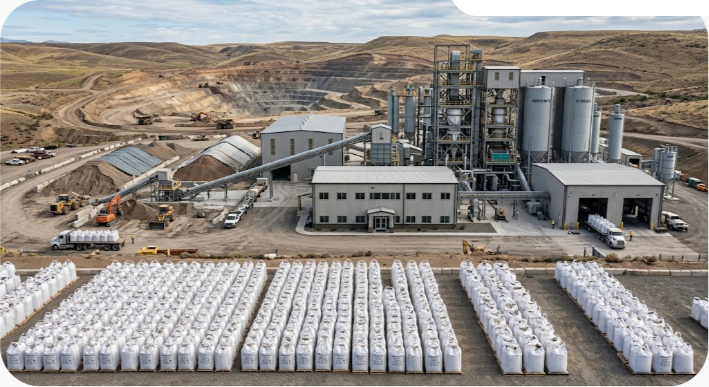
A bulk bentonite supplier should be judged on more than price per metric ton. The real question is whether the supplier can deliver the same functional material, within an agreed specification, shipment after shipment.
That matters because bentonite is a natural mineral, not a chemically uniform commodity. Montmorillonite content, exchangeable cations, moisture, particle size, grit, and associated minerals can vary between deposits and even between mining areas within the same deposit. Those differences show up in drilling-fluid rheology, sealing performance, foundry strength, slurry preparation, and processing costs.
The right supplier evaluation therefore starts with seven areas: mine and reserve control, mineralogical classification, independent testing, applicable standards, processing capability, logistics, and total landed cost. A supplier that performs well across all seven is far more likely to support a dependable long-term supply program than one that simply offers an attractive quotation.
This guide explains what to check, which questions to ask, what documents to request, and which warning signs deserve closer attention before you commit to a bulk bentonite contract.
The first supplier question is simple: where does the bentonite come from?
A company may describe itself as a bentonite manufacturer while sourcing raw clay from several independent mines. That model isn't automatically a problem. Brokers and processors can be useful, especially for smaller or less frequent purchases. The risk appears when you need large, repeatable volumes and the supplier has little control over the underlying mineral source.
If the raw material changes from one pit or seam to another, the processing plant may be able to adjust the product, but it can't always make different clays behave identically. For applications that depend on swelling, rheology, filtration, or bonding, that variation can become an operational issue.
When assessing a long-term bulk bentonite supplier, determine whether the company owns the mining rights, operates the mine, has long-term extraction agreements, or simply purchases raw clay on the open market. Ask for evidence rather than relying on a statement in a brochure.
A vertically integrated producer generally has more control over the material entering its processing plant. That can make it easier to maintain a defined grade and investigate quality deviations when they occur.
Look for evidence of:
Reserve claims deserve context. A headline figure such as 20 million or 60 million metric tons doesn't tell you how much material is economically recoverable, how much meets your grade, or how quickly it can be mined and processed.
For procurement purposes, ask three separate questions:
Those figures can be very different.
A supplier may have a substantial geological resource but limited annual processing capacity. Another may have enough mine capacity but inadequate drying, milling, storage, or port logistics. Your supply risk is determined by the entire chain, not the reserve figure alone.
For a serious long-term program, ask for a mine overview, production capacity, current mining areas, raw-material specifications, and evidence of continuity between mining and processing. If an on-site audit is practical, inspect how material is excavated, segregated, stockpiled, sampled, and transferred to the plant.
The goal isn't to demand confidential geological information. It's to establish whether the supplier actually controls enough suitable raw material to support your contracted volume and specification.
The word "bentonite" doesn't tell you enough about performance. Two bentonites can both be correctly labeled while behaving very differently in water.
Bentonite is primarily composed of smectite minerals, commonly dominated by montmorillonite, together with varying amounts of quartz, feldspar, calcite, gypsum, and other associated minerals. The type and proportion of exchangeable cations also influence hydration and swelling.
For procurement, you should define the material by measurable performance and composition rather than by the product name alone.
Natural sodium bentonite has sodium as a major exchangeable cation and is known for high water absorption, swelling, and gel formation. Depending on deposit characteristics and test method, high-quality sodium bentonite can swell many times its dry volume.
These properties make sodium-dominant bentonite particularly useful in applications such as:
However, the phrase "sodium bentonite" should not be treated as a universal quality grade. A low-purity sodium bentonite with substantial inactive minerals may perform worse than a well-processed material with a higher active clay fraction.
Calcium bentonite has calcium as a major exchangeable cation and generally swells less than sodium-dominant bentonite. It can still be valuable in absorbent, clarification, refining, and other applications where very high swelling or gel strength isn't the primary requirement.
A buyer should therefore avoid specifying only "bentonite" or "high-swelling clay." State the intended application and define the performance parameters that matter for that application.
Some calcium-dominant bentonites can be treated with sodium carbonate, commonly called soda ash, to exchange some calcium ions for sodium ions. This process can increase swelling and improve other performance characteristics.
That doesn't make every sodium-activated product equivalent to a naturally sodium-dominant deposit. The final behavior depends on the original clay, degree of activation, processing conditions, water chemistry, and application environment.
This distinction is especially important for buyers working with saline water or other challenging chemical conditions. Activation can change performance substantially, but the resulting product still needs to be tested under the conditions in which it will actually be used.
X-ray diffraction, or XRD, can help identify the mineral phases present in a bentonite sample. X-ray fluorescence, or XRF, provides elemental or oxide-composition information. Neither test should be treated as a standalone measure of field performance, but together they can help explain why two samples with similar names behave differently.
Don't rely on a blanket requirement such as "more than 75% montmorillonite" unless your application and test method support that specification. Montmorillonite percentage is useful, but it isn't a substitute for application-specific performance testing.
For a drilling-fluid grade, rheology, filtration, yield, and grit may matter more than a single mineralogical number. For a GCL, swelling, fluid loss, hydraulic conductivity, and compatibility with the intended barrier system may be more important. For foundry applications, active clay and green-sand performance deserve greater attention.
A technical data sheet tells you what a product is supposed to meet. A batch-specific Certificate of Analysis tells you what was measured for a particular production lot.
For bulk procurement, you need both.
Before approving a supplier, send representative samples from a current production batch to an independent laboratory when the application is technically or commercially significant. The supplier's internal results and the independent results don't need to match digit for digit, but they should be reasonably consistent within the agreed test method and tolerance.
The exact test panel should follow the application, but common parameters include:
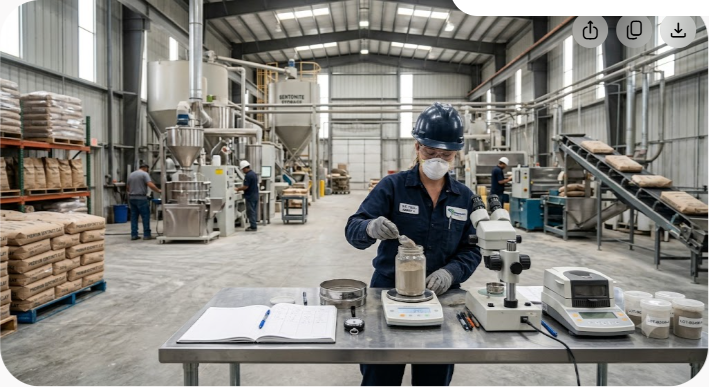
A CoA can be accurate and still fail to answer your procurement question if the test panel is incomplete. For example, a report showing moisture and chemical composition may say little about how a drilling-grade bentonite performs in the actual mud system.
Your purchase specification should identify the test method, acceptance range, sampling procedure, and frequency of testing. That gives both sides a common definition of acceptable material.
For a new supplier, use a staged qualification process:
That last step matters. Supplier qualification is not a one-time event. Natural mineral deposits change, mining areas move, and processing conditions can drift.
There isn't one universal bentonite specification that covers every industrial application. A drilling-fluid material, foundry binder, GCL bentonite, and pharmaceutical-grade clay have different requirements.
The right supplier should understand the standard that applies to your product and provide evidence that its testing and manufacturing controls support the claimed grade.
API Specification 13A is widely used for drilling-fluid materials and contains requirements for materials such as bentonite. Buyers should identify the applicable section and edition rather than simply writing "API bentonite" into a purchase order.
For drilling applications, relevant performance checks can include rheology, yield-related properties, filtration, moisture, and grit, depending on the specific product and specification. Ask the supplier for current documentation showing how the product is tested and controlled.
Don't accept an API logo or statement on a sales sheet as the entire qualification process. Confirm the actual product grade, test methods, certification status where applicable, and batch documentation.
ASTM methods are often used to measure specific properties rather than certify a supplier as a whole. For example, ASTM D5890 is used for determining the free swell index of clay mineral components for geosynthetic clay liners, while other ASTM methods address different geotechnical properties.
This distinction is important. Saying a material is "ASTM compliant" without naming the applicable test and acceptance criteria isn't a meaningful specification.
Foundry buyers should focus on the properties that influence molding-sand performance. Depending on the process, these can include active clay content, green compression strength, wet tensile strength, compactability, permeability, and thermal behavior.
A bentonite that performs well in drilling mud isn't automatically a suitable foundry grade. The supplier should be able to provide application-specific data and support a trial in the buyer's actual sand system.
For GCLs and related containment systems, swelling index, fluid loss, hydraulic conductivity, compatibility with the intended fluids, and other specified performance properties can be critical. Testing should follow the project specification and relevant standards rather than relying on a generic bentonite grade.
| Industry / Application | Commonly Referenced Standards or Methods | Key Quality Parameters |
|---|---|---|
| Oil and Gas Drilling | API Specification 13A and applicable test methods | Rheology, filtration, moisture, grit, yield-related performance |
| Civil Engineering | Project specifications, ASTM methods, and local standards | Swelling, viscosity, gel behavior, filtration, density |
| Foundry and Metal Casting | AFS methods and foundry-specific specifications | Active clay, green strength, compactability, thermal performance |
| Environmental Liners | ASTM methods and project-specific GCL requirements | Swell index, fluid loss, hydraulic conductivity, compatibility |
| Other Industrial Uses | Application-specific standards and internal specifications | Absorption, rheology, particle size, chemistry, purity, moisture |
The important point is simple: match the test to the application. A supplier that can discuss the relevant specification in practical terms is usually better prepared to support industrial procurement than one that simply lists certifications.
Mining good bentonite is only the beginning. The supplier must turn that raw material into a controlled commercial product.
Raw bentonite can contain substantial natural moisture and arrives from the mine as irregular lumps. Industrial processing typically involves selective stockpiling, crushing, drying, milling, classification, blending where required, and final quality inspection.
Every stage can affect the finished material.
The purpose of drying is to bring the product into a suitable moisture range without damaging its functional properties. Natural or solar drying can reduce initial moisture efficiently in suitable climates, but final moisture control generally requires a more controlled process when tight specifications are needed.
A supplier should be able to explain how drying temperature, residence time, feed rate, and final moisture are monitored. Excessive thermal treatment can alter clay behavior, while insufficient drying can leave the product difficult to mill, store, or convey.
Avoid simplistic claims that one fixed temperature automatically defines good or bad bentonite. The effect of heat depends on the clay's mineralogy, residence time, moisture state, and processing conditions.
The mill should produce a particle-size distribution suited to the customer's process. Raymond-type roller mills, vertical mills, pulverizers, and other systems can all be appropriate when correctly configured.
Ask about:
Finer powder isn't automatically better. A drilling-fluid grade may require rapid dispersion and hydration, while another industrial application may call for a different particle distribution to control handling or processing behavior.
The better question is whether the supplier can consistently produce the particle-size distribution your process requires.
For example, a specification might define the percentage passing a particular sieve rather than simply describing the product as "fine powder." That creates a measurable acceptance criterion and reduces disputes between buyer and supplier.
During a plant audit, ask where samples are taken and how often. A strong quality system doesn't wait until finished bags are ready for export before checking the material.
Useful checkpoints include raw-clay inspection, post-drying moisture, milling performance, final particle size, and finished-product testing. Retained samples from each batch or lot can also help investigate complaints later.
A technically excellent bentonite can still become an expensive purchase if the supplier can't ship it reliably.
Bentonite is a bulk mineral, so freight, packaging, storage, inland transportation, port handling, container availability, and vessel schedules can materially affect the final cost. Procurement teams should evaluate these factors before comparing supplier quotations.
Map the complete supply chain:
The supplier doesn't necessarily need to control every step. What matters is whether the company has reliable arrangements for each stage and can explain where delays or additional charges are likely to occur.
For exporters in India, proximity to major western ports can be commercially useful, particularly when the customer is located in the Middle East, Europe, Africa, Southeast Asia, or other international markets served through those gateways.
However, don't judge logistics on distance alone. A plant 50 kilometers from a port isn't necessarily a better option if road access is poor, port handling is congested, or the supplier cannot secure suitable vessel or container capacity.
Ask for historical lead times, typical booking windows, loading capacity, and contingency arrangements rather than relying on a general statement such as "fast export service."
Your unloading system should determine the packaging format. Common options include:
Check bag construction, liner quality, safe working load, discharge design, palletization, and loading method. Packaging failures can turn a quality shipment into a handling problem.
A serious supplier should have answers to basic contingency questions:
You don't need a supplier with zero disruptions. You need one that has a credible plan for managing them.
The lowest quotation isn't necessarily the lowest-cost supply.

For bentonite, a useful procurement comparison should account for product price, moisture, usable yield, freight, packaging, handling, rejects, and the quantity required to achieve the desired process result.
Suppose Supplier A quotes $90 per metric ton and Supplier B quotes $120 per metric ton. Supplier A appears to be 25% cheaper.
Now assume your application trial shows that Supplier A's material requires 1.5 tons to achieve the same functional result that 1 ton of Supplier B's material provides. The apparent price advantage changes immediately.
At the functional-equivalent level:
Supplier B is more expensive per ton but cheaper per unit of useful performance, before even considering additional handling, storage, or freight.
This is why yield and application performance should be part of the commercial comparison.
If two suppliers quote the same price per metric ton but one product contains substantially more free moisture, the buyer may receive less dry mineral for the same shipment weight.
For example, 100 metric tons at 10% moisture contains approximately 90 tons of dry solids. At 14% moisture, the same 100 tons contains approximately 86 tons of dry solids. The difference is material when shipping thousands of tons.
The exact commercial calculation should follow the contract's moisture basis. Some buyers purchase on an as-is basis, while others negotiate on a dry basis. Make sure everyone is using the same definition.
A practical landed-cost model can include:
| Cost Element | What to Compare |
|---|---|
| Product price | Price per metric ton and pricing basis |
| Moisture | As-is versus dry basis |
| Packaging | Bags, liners, pallets, loading |
| Inland freight | Mine or plant to port and destination delivery |
| Port charges | Handling, documentation, storage, and related fees |
| Ocean freight | Container or bulk freight to destination |
| Insurance | Cargo coverage where applicable |
| Duties and taxes | Destination-specific charges |
| Quality costs | Testing, inspection, rejection, and rework |
| Performance yield | Quantity required to achieve the required result |
This model gives procurement teams a much clearer basis for supplier comparison than FOB price alone.
A strong contract should define the product grade, test methods, acceptable ranges, sampling procedure, packaging, delivery terms, inspection rights, claim procedure, and consequences of non-conforming material.
Don't leave critical specifications in an email or informal technical discussion. If a property matters to your process, put it in the purchase specification or contract.
Use the following checklist when comparing potential suppliers.
Determine whether the supplier owns the mine, operates it under a valid agreement, or buys raw clay from third parties. Ask how many approved raw-material sources support the grade you're buying.
Separate geological reserves from material that is commercially available at the required grade. Compare annual production capacity with your expected purchase volume.
Specify whether you need natural sodium-dominant bentonite, calcium-dominant bentonite, sodium-activated material, or another application-specific grade. Define performance rather than relying on the product name.
Ask for recent CoAs, test methods, sample-retention procedures, and independent laboratory results where appropriate. Confirm that the test panel reflects your application.
Run laboratory and application trials using your own process conditions. Water chemistry, mixing equipment, dosage, and formulation can all affect bentonite performance.
Review drying, milling, classification, blending, storage, sampling, laboratory controls, and finished-product handling. Check whether the plant can maintain your required production rate.
Review lead times, port access, packaging, loading capacity, shipping arrangements, and contingency plans. Ask for realistic—not best-case—delivery timelines.
Calculate landed cost and cost per unit of useful performance. Include moisture, freight, handling, rejects, and application dosage.
Define numerical acceptance limits, test methods, sampling rules, delivery terms, and the process for handling non-conforming shipments.
Some warning signs are easy to spot. Others appear only when you ask a few technical questions.
If the supplier's evaluation sample performs well but commercial material varies significantly, investigate the sampling and production controls. One good sample doesn't establish consistency.
Statements such as "premium quality," "high swelling," or "high purity" are not useful unless the supplier supports them with defined test methods and numerical specifications.
A supplier doesn't need to disclose confidential geological data, but it should be able to explain where the material comes from, how it is mined, and how raw grades are controlled.
A report from a previous year or a different production lot may provide background information, but it shouldn't substitute for current batch or lot testing when quality is critical.
An unusually low quotation deserves investigation. The difference may come from lower-grade raw material, higher moisture, coarser particle size, different packaging, shorter commercial terms, or simply an incomplete landed-cost calculation.
A supplier that sells bentonite for drilling, foundry, civil engineering, and containment should be able to explain how the grades differ. If every application receives the same generic product description, ask more questions.
If your supplier promises a certain swelling value, moisture range, viscosity, or grit level but none of those values appears in the purchase specification, the promise may be difficult to enforce.
A structured supplier questionnaire can make the qualification process much faster. Start with these questions:
The quality of the answers is often as revealing as the answers themselves. A technically mature supplier should be able to explain its process without relying entirely on marketing language.
Once a supplier passes technical qualification, turn the evaluation into an ongoing quality system.
Create a specification that lists the exact grade, application, test methods, acceptance limits, packaging requirements, and moisture basis. If the product has multiple grades, keep the specifications separate.
Retain a properly identified sample from the qualification batch. It can serve as a reference when investigating future variations, although it shouldn't replace routine batch testing.
High-volume programs may require every lot to have a supplier CoA, with independent verification performed periodically or when a defined trigger occurs. The right frequency depends on the criticality of the application and the supplier's demonstrated consistency.
Don't limit supplier evaluation to laboratory results. Track delivery performance, rejected lots, moisture variation, application dosage, downtime, packaging damage, and customer or production complaints.
A supplier that consistently delivers within specification and communicates problems early may create more value than one that offers a slightly lower unit price but requires frequent corrective action.
Choosing a bulk bentonite supplier is ultimately a risk-management decision. The strongest supplier is not necessarily the one with the largest mine, the finest powder, or the lowest quoted price. It's the one that can connect controlled raw-material sourcing with consistent processing, appropriate testing, dependable logistics, and transparent commercial terms.
For most industrial buyers, the evaluation should come down to seven questions:
If the answer to all seven is yes, you have a much stronger basis for a long-term supply relationship.
For buyers evaluating an Indian bentonite exporter, Axewelledge can provide technical information, product samples, and application-specific specifications for industrial grades. Ask for current test data, production details, packaging options, and commercial terms so you can evaluate the material against your own requirements rather than relying on a generic product description.













Have questions about our products? We're here to help!