Axewelledge, a leading exporter from India, specializes in high-quality Bentonite. With a commitment to excellence, we supply premium Bentonite to the Middle East and Southeast Asia markets.


North Angle Complex, 304,
150 Feet Ring Rd, Opposite Ambedkar Nagar BRTS Stop,
Madhav Park, Punit Nagar,
Mavdi, Rajkot, Gujarat 360004
© Axewelledge 2026, All Rights Reserved.
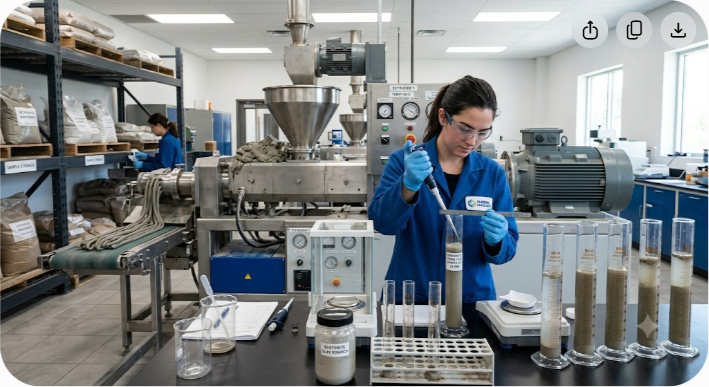
Converting raw calcium bentonite into high-performance sodium bentonite relies on a precise chemical conversion: replacing divalent calcium ions (Ca 2+ ) on the montmorillonite clay lattice with monovalent sodium ions (Na + ). Adding 3% to 5% sodium carbonate (soda ash) by dry weight is the standard target range, but dosing without evaluating your specific cation exchange capacity (CEC) can lead to incomplete swelling, brittle foundry molds, or rheological failure in drilling fluids.
Raw calcium bentonite possesses excellent natural absorption, but its swelling capacity in water is limited—typically 3 to 5 times its dry volume. Sodium bentonite, by contrast, swells up to 15 to 20 times its dry volume, forming cohesive, thixotropic gels required for foundry green sand, civil engineering cut-off walls, and drilling muds. Achieving those properties synthetically demands a strict approach to soda ash dosing, moisture management, and mechanical shear.
To optimize activation, you must understand the underlying mineralogy of bentonite clay. Bentonite consists predominantly of smectite group minerals, specifically montmorillonite. The crystal structure features an alumina octahedral sheet sandwiched between two silica tetrahedral sheets (2:1 layered silicate structure).
Due to isomorphic substitution—where trivalent aluminum ions (Al 3+ ) replace tetravalent silicon (Si 4+ ) in the tetrahedral layer, or divalent magnesium (Mg 2+ ) replaces Al 3+ in the octahedral layer—the clay platelets carry a net negative surface charge. In natural calcium bentonite, this charge is balanced primarily by divalent calcium ions (Ca 2+ ) residing in the interlayer spaces between platelets.
2+ to Na + Exchange
The activation reaction is an equilibrium-driven cation exchange process:
Ca-Bentonite+Na 2 ?
CO 3 ?
2(Na-Bentonite)+CaCO 3 ?
Divalent calcium ions hold adjacent montmorillonite platelets tightly together due to their high charge density and strong electrostatic attraction. This keeps interlayer spacing narrow, preventing water molecules from easily penetrating and swelling the crystal lattice.
When sodium carbonate (Na 2 ?
CO 3 ?
) is introduced under moist, high-shear conditions, the sodium ions replace the calcium ions on the clay exchange sites. Crucially, calcium carbonate (CaCO 3 ?
) precipitates out of solution as an insoluble salt, driving the thermodynamic reaction forward according to Le Chatelier's principle.
In the unactivated interlayer, divalent calcium binds platelets tightly together. During activation, dissolved sodium ions enter the gallery while insoluble calcium carbonate precipitates. The resulting sodium-occupied interlayer allows water hydration and significant lattice expansion.
Monovalent sodium ions have a lower charge density and a larger hydrated radius than calcium ions. Once Na + occupies the interlayer exchange sites, the electrostatic attractive force holding the clay platelets together drops significantly. When exposed to water, water molecules readily hydrate the sodium ions and diffuse into the interlayer gallery, pushing the individual platelets apart.
This process, known as crystalline and osmotic swelling, delaminates the clay into individual nanoplatelets. In suspension, these negatively charged face surfaces and weakly positive edge surfaces form a three-dimensional house-of-cards network, transforming a simple slurry into a highly thixotropic gel with high yield stress, high fluid-loss control, and superior thermal durability.
Dosing soda ash purely by rule of thumb—such as applying a flat 4% across all raw clay runs—wastes chemical additives and risks over-soda contamination. Precise dosing requires evaluating your clay's physical and chemical parameters.
Cation Exchange Capacity measures the total exchangeable cations a clay mineral can retain, expressed in milliequivalents per 100 grams of dry clay (meq/100g). High-grade montmorillonite typically exhibits a CEC between 70 meq/100g and 100 meq/100g.
To determine the exact stoichiometric amount of pure soda ash needed to replace all exchangeable calcium:
$$ ext{Soda Ash Dosage (g per 100g dry clay)} = rac{ ext{Exchangeable } Ca^{2+} (meq/100g) imes 105.99}{2000}
Where $105.99 ext{ g/mol}$ is the molar mass of $Na_2CO_3$, and dividing by $2000$ accounts for the valency of $Ca^{2+}$ ($2 ext{ eq/mol}$) and the conversion from milliequivalents.
If a laboratory analysis reveals a raw calcium bentonite batch with an exchangeable $Ca^{2+}$ content of $65 ext{ meq}/100g$:
ext{Theoretical Pure Soda Ash} = rac{65 imes 105.99}{2000} = 3.44 ext{ grams per 100g dry clay (3.44%)}
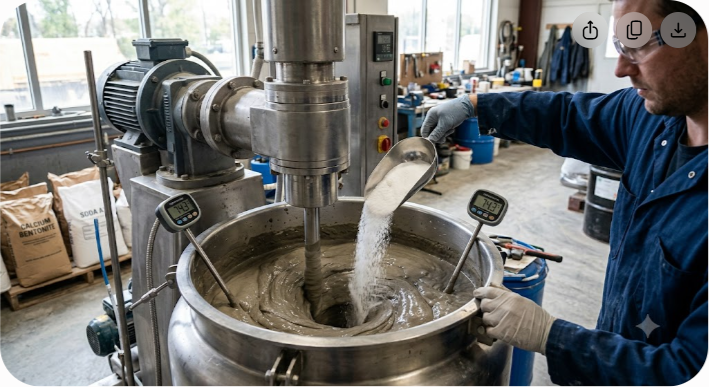
Commercial soda ash is rarely 100% pure anhydrate, and industrial mixing in extruders or pan mills rarely achieves 100% kinetic efficiency. Furthermore, non-exchangeable carbonate consumption by other soluble species in the raw clay must be offset. Industrial processors apply a Reaction Efficiency Factor ($E$), typically between $1.10$ and $1.25$ (10% to 25% excess above stoichiometric requirement).
ext{Actual Soda Ash Required (%)} = rac{ ext{Theoretical Dosage (%)}}{ ext{Purity Fraction}} imes E$$
Assuming 99.2% dense soda ash purity and a 1.15 efficiency factor:
For this specific batch, you should dose 4.0% soda ash based on absolute dry clay weight.
Applying the exact calculated chemical weight will fail if processing conditions do not support the ion exchange reaction. Four key industrial parameters govern activation performance:
Ion exchange cannot occur in completely dry solids because Na + and Ca 2+ ions require liquid moisture to dissolve, diffuse, and migrate between clay galleries.
2 ?
CO 3 ?
. Soda ash remains as unreacted granules trapped between clay aggregates, leading to patchy activation and poor swelling index values.
Soda ash activation is not a passive soaking process. Mechanical work must break down macro-aggregates, shear clay platelets apart, and force Na + ions into interlayer voids. High-torque twin-screw extruders, pan mills, or pug mills apply intense mechanical shear that strips away the hydration layers of raw clay, exposing fresh exchange sites to the dissolved sodium solution.
Ion exchange begins immediately upon contact with moisture, but full equilibrium requires time for ions to diffuse into dense montmorillonite clusters. Industrial best practice incorporates a maturation phase where moist, dosed clay is stockpiled in covered sheds for 24 to 72 hours prior to drying and fine grinding. Maturation allows the ion migration to reach completion, increasing the swelling index by 15% to 30% compared to un-aged clay processed immediately.
Thermal energy speeds up ion diffusion rates and increases Na 2 ?
CO 3 ?
solubility. Conducting activation at elevated temperatures (40 ? C to 60 ? C) accelerates exchange kinetics. However, temperatures must not exceed 90 ? C during activation mixing, as premature moisture evaporation halts the ion exchange process.
Balancing your soda ash addition avoids negative operational and performance side effects.
| Parameter | Under-Dosed (<3.0%) | Optimal Zone (3.5% - 4.5%) | Over-Dosed (>5.5%) |
|---|---|---|---|
| Chemical State | High Calcium Retention | Complete Ca2+ Exchange | Excess Free Na+ Ions |
| Swelling Performance | Low Swelling Index | Peak Viscosity & Gel Strength | Coagulation & Flocculation |
| Application Result | Poor Water Loss Control | Maximum Thermal Durability | Brittle Foundry Molds |
Under-dosing leaves a significant fraction of Ca 2+ ions attached to the clay framework.
Excess soda ash does not improve quality and can degrade bentonite performance.
+ ) and carbonate (CO 3 2? ?
) ions into the pore solution. High ionic strength compresses the electrical double layer surrounding montmorillonite platelets, preventing them from expanding. The clay paradoxically loses swelling capacity and flocculates.
Selecting the right process route depends on raw clay characteristics, plant infrastructure, and target end-use specifications.
The simplest process involves feeding dry soda ash powder directly into raw crushed clay before entering a roller mill or Raymond mill.
This process offers high chemical conversion efficiency and consistent quality for industrial-grade bentonite.
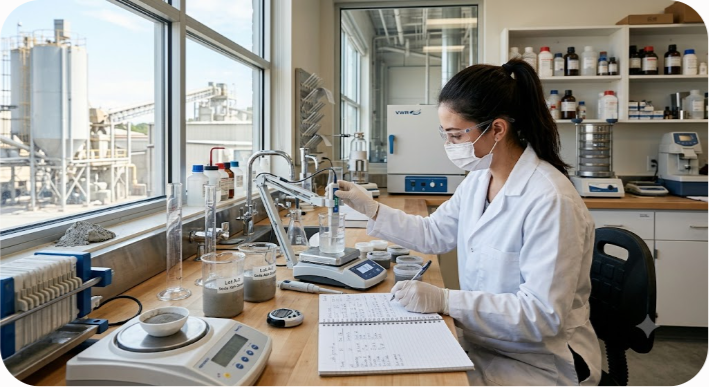
Used primarily for high-purity applications, such as pharmaceutical grade clay, specialized civil engineering slurries, or paper-making retention aids.
| Parameter | Dry Mix Activation | Semi-Wet Extrusion | Wet / Slurry Process |
|---|---|---|---|
| Typical Moisture Level | 12% - 18% | 28% - 35% | 88% - 92% (Slurry phase) |
| Shear Energy Applied | Low (Mill impact only) | Very High (Extruder / Pug mill) | High (Fluid shear & mixing) |
| Ion Exchange Efficiency | 50% - 65% | 85% - 95% | 95% - 100% |
| Soda Ash Excess Required | 20% - 35% over stoichiometry | 10% - 15% over stoichiometry | 0% - 5% over stoichiometry |
| Relative Capital Cost | Low | Medium - High | High |
| Energy Consumption | Low | Moderate | High (Thermal drying) |
| Best End-Use Application | Basic agricultural/civil grades | Foundry, Drilling Mud, Civil Eng. | Specialty, Chemical, API grades |
To confirm activation performance and fine-tune soda ash dosing, implement a standardized quality control workflow:
2+ content, and natural moisture.
2 ?
CO 3 ?
requirements with efficiency factors.
Measures the volumetric expansion of 2 grams of dried, ground bentonite dusted slowly into 100 mL of distilled water in a graduated cylinder over 24 hours.
Determines the total cation exchange capacity and active montmorillonite clay fraction in the sample. Methylene blue dye replaces exchangeable cations on the clay surface. A distinct blue halo on filter paper signals the endpoint, confirming the exact concentration of reactive smectite present.
For drilling and civil engineering applications, test rheological performance using a Fann Model 35 rotational viscometer at 600 rpm and 300 rpm:
2 Reading at 600 rpm ?
Properly activated bentonite demonstrates a balanced yield point to plastic viscosity ratio (YP/PV?1.0?1.5), providing strong solids suspension capabilities without requiring excessive pumping pressure.
Slurry pH testing provides a quick field indicator of activation completeness:
2+ or Mg 2+ levels is used during slurry makeup, or if residual gypsum (CaSO 4 ?
) is present in raw clay, calcium ions can replace sodium on exchange sites over time.
2 ?
CO 3 ?
across all clay aggregates.
Activating calcium bentonite with soda ash is a delicate equilibrium reaction that requires precise stoichiometric control. Relying on fixed rule-of-thumb chemical additions often leads to product quality variations, higher raw material costs, and reduced performance in foundry, drilling, and civil engineering uses.
By evaluating raw clay exchangeable cation levels, maintaining 28% to 35% processing moisture, applying high mechanical shear, and allowing a 24- to 48-hour maturation period, processing plants can consistently convert calcium bentonite into high-performing sodium bentonite.
For industrial operations seeking reliable raw material inputs, source clay quality remains the foundation of activation performance. High-grade raw calcium bentonite with natural smectite purity minimizes chemical consumption while maximizing final swelling index and rheological stability.
If you are scaling up industrial bentonite activation or sourcing high-purity raw or pre-activated bentonite minerals for foundry, drilling, or environmental applications, explore Axewelledge's Global Bentonite Solutions to access high-yield, chemically consistent minerals backed by technical support.













Have questions about our products? We're here to help!